China’s Intelligent Weaponry Gets Smarter

The Chinese-designed multicore processor of the Sunway TaihuLight, the world’s fastest supercomputer. The new supercomputer is thought to be part of a broader Chinese push to begin driving innovation. Credit Li Xiang/Xinhua, via Associated Press

Robert O. Work, the veteran defense official retained as deputy secretary by President Trump, calls them his “A.I. dudes.” The breezy moniker belies their serious task: The dudes have been a kitchen cabinet of sorts, and have advised Mr. Work as he has sought to reshape warfare by bringing artificial intelligence to the battlefield.

Last spring, he asked, “O.K., you guys are the smartest guys in A.I., right?”

No, the dudes told him, “the smartest guys are at Facebook and Google,” Mr. Work recalled in an interview.

Now, increasingly, they’re also in China. The United States no longer has a strategic monopoly on the technology, which is widely seen as the key factor in the next generation of warfare.

The Pentagon’s plan to bring A.I. to the military is taking shape as Chinese researchers assert themselves in the nascent technology field. And that shift is reflected in surprising commercial advances in artificial intelligence among Chinese companies.

Continue reading on the New York Times

China warns US after Mattis says Senkaku islands covered by treaty

BEIJING: China warned the United States Saturday (Feb 4) not to destabilise East Asia after Donald Trump’s new defence secretary said an island chain claimed by both Tokyo and Beijing was covered by a US-Japan military accord.

The Senkaku islands, known in China as the Diaoyus, sit in rich fishing grounds and are at the centre of a festering row between Tokyo and Beijing, which claims they have been part of Chinese territory for centuries. Tiếp tục đọc “China warns US after Mattis says Senkaku islands covered by treaty”

Chinese official says U.S. should stop using Dalai Lama to stir up trouble

Reuters Feb 4, 2017 Japan Times

The United States should stop using the Dalai Lama to create trouble for China, a senior Chinese official in charge of Tibet affairs told an influential state-run newspaper.

The U.S. is damaging ties with China, said Zhu Weiqun, head of the ethnic and religious affairs committee of the top advisory body to China’s parliament, according to the Global Times.

The Global Times, a tabloid known for writing strongly worded, hawkish and nationalist editorials, is published by the Communist Party’s flagship paper. Tiếp tục đọc “Chinese official says U.S. should stop using Dalai Lama to stir up trouble”

China accuses US of putting stability of Asia Pacific at risk

Beijing reacts to defence secretary James Mattis saying that the US would defend Japan in a conflict with China over disputed Senkaku islands

James Mattis reviews the guard of honour prior to a meeting with Japanese defence minister Tomomi Inada in Tokyo on Saturday.
James Mattis reviews the guard of honour prior to a meeting with Japanese defence minister Tomomi Inada in Tokyo on Saturday. Photograph: Franck Robichon/EPA

China has accused the US of putting the stability of the Asia-Pacific at risk after Donald Trump’s defence secretary said Washington would come to Japan’s defence in the event of a conflict with Beijing over the disputed Senkaku islands.

James Mattis, on a two-day visit to Japan, said the islands, which are controlled by Japan but also claimed by China, fell within the scope of the Japan-US security treaty, under which Washington is obliged to defend all areas under Japanese administrative control. Tiếp tục đọc “China accuses US of putting stability of Asia Pacific at risk”

Donald Trump is making China great again

The US president has dismayed the world; Xi Jinping has wooed it. This could be a huge win for Beijing

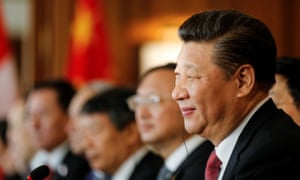
‘Xi Jinping reminded his audience of China’s contribution to global economic stability since the financial crisis, of an average of 30% of global growth each year.’
‘Xi Jinping reminded his audience of China’s contribution to global economic stability since the financial crisis, of an average of 30% of global growth each year.’ Photograph: POOL/Reuters

Two years ago, some European and US experts gathered to discuss China in an elegant English country house. The setting was seductive, but the mood was dark. Two years into Xi Jinping’s presidency, China’s politics were turning away from the liberalising trend of the previous three decades, towards a hard-edged nationalism that was discomfiting China’s immediate neighbours and their western allies.

China was getting more powerful but less friendly, squeezing foreign competition out of its internal markets, throwing its weight around the South China Sea, crushing internal dissent and enforcing loyalty to the regime. Tiếp tục đọc “Donald Trump is making China great again”

U.S. warns North Korea of ‘overwhelming’ response to use of nuclear weapons

jAPAN TIMES

AP Feb 3, 2017

In an explicit warning to North Korea, U.S. Defense Secretary Jim Mattis on Friday said any use of nuclear weapons by the North on the United States or its allies would be met with what he called an “effective and overwhelming” response.

U.S. defense secretaries have long offered assurances to South Korea and Japan that its nuclear “umbrella” will protect them, but Mattis’ statement was perhaps more pointed than most. He made the remarks during an appearance with his South Korean counterpart, Defense Minister Han Min-koo. Tiếp tục đọc “U.S. warns North Korea of ‘overwhelming’ response to use of nuclear weapons”

Brazen Killing of Myanmar Lawyer Came After He Sparred With Military

The funeral of U Ko Ni, a top adviser to the governing National League for Democracy, in Yangon, Myanmar, on Monday. Credit Ye Aung Thu/Agence France-Presse — Getty Images

YANGON, Myanmar — The soft-spoken rights lawyer had devised a plan to replace Myanmar’s Constitution with one that would strip the military of its extraordinary political powers.

The lawyer, U Ko Ni, a top adviser to the governing National League for Democracy, had recently been working on a new draft, a colleague said, and he hoped to promote his project at a conference this month.

But when he returned to the Yangon airport on Sunday from a trip to Indonesia, cradling his young grandson in his arms as he waited for a taxi, a man drew a pistol and shot him in the head.

The killing appears to have been a rare political assassination in Myanmar, fueling rumors, distrust and worry about the country’s future.

Continue reading on New York Times

“This bullet was not only for Ko Ni,” the colleague, U Thein Than Oo, a human rights lawyer in Mandalay, Myanmar, said by telephone. “It was for the N.L.D. and the people who want to amend and replace the 2008 Constitution and support the peace process.”

Rohingya Face ‘Campaign of Terror’ in Myanmar, U.N. Finds

A refugee camp in Cox’s Bazar, Bangladesh, near the Burmese border. Over 200 Rohingya villagers who fled Myanmar to Bangladesh gave harrowing testimony to United Nations investigators about the treatment they received. Credit Allison Joyce/Getty Images

GENEVA — Members of Myanmar’s Army and the police have slaughtered hundreds of men, women and children, gang-raped women and girls, and forced as many as 90,000 Rohingya Muslims from their homes, according to a United Nations report released on Friday.

The report, the world body’s first official account of a four-month government crackdown on ethnic Rohingya in Myanmar, said the actions of members of the army and the police “very likely” were crimes against humanity.

“The gravity and scale of these allegations begs the robust reaction of the international community,” said Zeid Ra’ad al-Hussein, the United Nations high commissioner for human rights, whose office released the 50-page report.

Continue reading on  New York  Times

Jim Mattis Says U.S. Is ‘Shoulder to Shoulder’ With Japan

The American defense secretary, Jim Mattis, left; Prime Minister Shinzo Abe of Japan, second right; and the Japanese defense minister, Tomomi Inada, right, in Tokyo on Friday. Credit Pool photo by Eugene Hoshiko

TOKYO — Defense Secretary Jim Mattis assured Japan’s prime minister on Friday that the United States would stand by its mutual defense treaty with the country, despite statements by President Trump during last year’s campaign that suggested he might pull back from American security commitments in Asia.

“I want there to be no misunderstanding during the transition in Washington that we stand firmly, 100 percent, shoulder to shoulder with you and the Japanese people,” Mr. Mattis said at the start of a meeting with Prime Minister Shinzo Abe.

Continue reading on New York Times

Travel Ban Drives Wedge Between Iraqi Soldiers and Americans

Iraqi soldiers in Mosul. “This decision by Trump blows up our liberation efforts of cooperation and coordination with American forces,” one officer said. Credit Ivor Prickett for The New York Times

BAGHDAD — Capt. Ahmed Adnan al-Musawe had survived another day battling Islamic State fighters in Mosul last weekend when he heard startling news: The new American president had temporarily barred Iraqis from entering the United States and wanted tougher vetting.

Captain Musawe, who commands an infantry unit of the Iraqi Army’s elite counterterrorism force, considers himself already fully vetted: He has been trained by American officers in Iraq and in Jordan. And backed by American advisers, he has fought the Islamic State in three Iraqi cities, including three months of brutal street combat in Mosul.

“If America doesn’t want Iraqis because we are all terrorists, then America should send its sons back to Iraq to fight the terrorists themselves,” Captain Musawe told a New York Times reporter who was with him this week at his barricaded position inside Mosul.

President Trump’s Jan. 27 executive order has driven a wedge between many Iraqi soldiers and their American allies. Officers and enlisted men interviewed on the front lines in Mosul said they interpreted the order as an affront — not only to them but also to fellow soldiers who have died in the battle for Mosul.

Continue reading on New York Times

North Korean Leader’s Top Enforcer Is Now the One Getting Purged

The leader of North Korea, Kim Jong-un, at an undisclosed location in January. The decision by Mr. Kim to purge his top enforcer highlights the turmoil that has engulfed the upper reaches of his regime. Credit Korean Central News Agency, via Agence France-Presse — Getty Images

SEOUL, South Korea — The chief of North Korea’s powerful secret police, long considered the right-hand man for the top leader, Kim Jong-un, has been dismissed on charges of corruption and abuse of power, the South Korean government said on Friday.

The firing of the chief, Gen. Kim Won-hong, as minister of state security highlights the turmoil that has engulfed the upper reaches of Mr. Kim’s government. The general is the latest in a series of high-ranking party and military officials Mr. Kim has fired, demoted or executed as he tried to consolidate his totalitarian power through what South Korean officials and North Korean defectors have called a “reign of terror.”

Continue reading on New York Times

North Korea No. 2 threat to Beijing after U.S., Chinese military strategists say

Japan Times

Kyodo Jan 31, 2017

North Korea is seen as the No. 2 threat to China after the United States, according to a recent document written by strategists with the Chinese People’s Liberation Army and seen by Kyodo News.

It shows that despite the two neighboring countries’ traditionally friendly diplomatic ties, North Korea is seen, from a military perspective, as a threat in view of its nuclear arms and missile programs.

The document, issued in May 2016, is a wartime exercise guideline for designed to prepare in the event of threats from hypothetical enemies.

In their analysis of the situation facing China, the strategists cite “five potential threats,” the foremost of them being the United States and its “rebalance” to Asia. Tiếp tục đọc “North Korea No. 2 threat to Beijing after U.S., Chinese military strategists say”

Trump Tells South Korea That Alliance With U.S. Is ‘Ironclad’

Hwang Kyo-ahn, the acting leader of South Korea, spoke by phone with President Trump from Seoul on Monday. The call followed North Korea’s warning that it could test an intercontinental ballistic missile “anytime.” Credit Yonhap/European Pressphoto Agency

SEOUL, South Korea — President Trump assured South Korea’s acting president on Monday of the United States’ “ironclad” commitment to defend the country, agreeing with Seoul to strengthen joint defense capabilities against North Korea.

Mr. Trump’s assurances came amid anxiety in South Korea over the future of the alliance with the United States. During his campaign, Mr. Trump cast some doubt on the United States’ defense and trade commitments, saying that South Korea was not paying enough to help keep 28,500 American troops in the country.

But speaking by phone to Hwang Kyo-ahn, the acting president of South Korea, Mr. Trump said that the coming visit to South Korea by Defense Secretary Jim Mattis reflected the close friendship of the two countries and the importance of their alliance. Mr. Mattis is scheduled to visit South Korea on Thursday on his first official trip abroad, which also includes a stop in Japan.

“President Trump reiterated our ironclad commitment to defend the R.O.K., including through the provision of extended deterrence, using the full range of military capabilities,” the White House said in a statement after Mr. Trump’s phone conversation with Mr. Hwang, using the initials for South Korea’s official name, the Republic of Korea.

Continue reading on New York Times

Billionaire Is Reported Seized From Hong Kong Hotel and Taken Into China

Xiao Jianhua at a park in Beijing in an undated photograph. He has been missing since Friday. Credit The New York Times

HONG KONG — A Chinese-born billionaire who has forged financial ties with some of the country’s most powerful families was taken by the Chinese police from his apartment at the Four Seasons Hotel in Hong Kong late last week and spirited across the border, a person close to the businessman said on Tuesday.

The billionaire, Xiao Jianhua, who has been missing since Friday, is in police custody in China, where he apparently is safe, said the person, who spoke on condition of anonymity for fear of arrest. Mr. Xiao is a Canadian citizen with an Antiguan diplomatic passport, though he was born in China.

His removal from Hong Kong appears to contravene the “one country, two systems” rule that allows the former British colony to run its own affairs and bars the Chinese police from operating here.

Continue reading on New York Times

Rohingya Refugees in Bangladesh to Be Relocated to Remote Island

The Kutupalong refugee camp in Cox’s Bazar, Bangladesh, this month. The United Nations has called the Rohingya, a Muslim ethnic group denied citizenship in Myanmar, the most persecuted minority in the world. Credit Allison Joyce/Getty Images

DHAKA, Bangladesh — Bangladesh’s government is moving forward with a plan to relocate Rohingya refugees staying in camps near the country’s largest tourist resort towns to a remote island that is underwater for much of the year.

A cabinet order on Thursday directed officials to have the refugees transferred to Thengar Char, an island in the Bay of Bengal that is lashed by high tides year round and submerged during the monsoon season. The suggestion that they be moved to the largely uninhabitable marshland several hours by boat from the mainland drew criticism from around the world.

Continue reading on New York Times