I'm from Hanoi, Viet Nam.
I'm an author of Dot Chuoi Non (dotchuoinon.com/author/hangbelu/), a blog on Positive thinking, founded by Dr. Tran Dinh Hoanh, an attorney in Washington DC.
I'm a co-founder of Conversations on Vietnam Development - cvdvn.net, a virtual think tank. I am a co-founder of two companies in Viet Nam working on children education services. I advise companies on STEAM education, English language education for children and students in Vietnam.
I'm studying the Buddha's teaching and the teaching of Jesus. I practice mindful living including meditation.
I hold a PhD on Sustainable Energy Systems from University of Lisbon and Aalto University.
I graduated from Hanoi University of Technology on Environmental Engineering. I obtained a Master degree of the same major from Stanford University and Nanyang Technological University.
My English-language blog at: hangbelu.wordpress/.
I play table tennis as a hobby.
A leaked junta memo shows three Chinese firms appealing to Nay Pyi Taw to arrange liquified natural gas imports from Russia amid economic turmoil in Myanmar.
By FRONTIER
A leaked document from the junta’s Ministry of Electric Power reveals that three Chinese energy companies appealed to the junta for help importing liquified natural gas from the Russian government, as the regime’s economic policies wreak havoc on the energy sector.
The document, in the form of a memo, indicates a meeting took place on July 25 in Nay Pyi Taw with representatives from MoEP, Hong Kong-listed VPower and Chinese state-owned firms CNTIC and Genertec. (VPower is also part-owned by CITIC, another Chinese state-owned investment firm).
Iran’s President cancels interview after Amanpour refuses head scarf demand 03:23
(CNN) Iranian President Ebrahim Raisi withdrew from a long-planned interview with CNN’s chief international anchor Christiane Amanpour at the United Nations General Assembly in New York on Wednesday, after she declined a last-minute demand to wear a head scarf.
Some 40 minutes after the interview was scheduled due to start and with Raisi running late, an aide told Amanpour the president had suggested that she wear a head scarf. Amanpour said that she “politely declined.”
Amanpour, who grew up in the Iranian capital Tehran and is a fluent Farsi speaker, said that she wears a head scarf while reporting in Iran to comply with the local laws and customs, “otherwise you couldn’t operate as a journalist.” But she said that she would not cover her head to conduct an interview with an Iranian official outside a country where it is not required.
“Here in New York, or anywhere else outside of Iran, I have never been asked by any Iranian president — and I have interviewed every single one of them since 1995 — either inside or outside of Iran, never been asked to wear a head scarf,” she said on CNN’s “New Day” program Thursday.
Temple Prof Seeks Reinstatement of Damage Claims Against FBI
A Temple University physicist who was charged with sharing scientific technology with China only for the case to collapse before trial and be dismissed by the Justice Department is asking a federal appeals court to reinstate his claims for damages against the FBI agent who investigated him.
FILE – An American flag flies outside the Department of Justice in Washington, March 22, 2019. A Temple University physicist who was charged with sharing scientific technology with China only for the case to collapse before trial and be dismissed by the Justice Department is asking a federal appeals court to reinstate his lawsuit against the FBI agent who investigated him. Lawyers for Xiaoxing Xi and his wife say in a brief filed Monday with a Philadelphia-based appeals court that a judge erred last year when he dismissed their claims for damages. (AP Photo/Andrew Harnik, File) THE ASSOCIATED PRESS
By ERIC TUCKER, Associated Press
WASHINGTON (AP) — A Temple University physics professor who was charged with sharing scientific technology with China only for the case to collapse before trial and be dismissed by the Justice Department asked a federal appeals court on Monday to reinstate his clams for damages against the U.S. government.
New data on forest fires confirms what we’ve long feared: Forest fires are becoming more widespread, burning nearly twice as much tree cover today as they did 20 years ago.
Using data from a new study by researchers at the University of Maryland, we calculated that forest fires now result in 3 million more hectares of tree cover loss per year compared to 2001 — an area roughly the size of Belgium — and accounted for more than a quarter of all tree cover loss over the past 20 years.
Floods, droughts, tropical storms, and heat waves are severely testing the resilience of a region with a lot of vulnerable people.
Two people on a makeshift raft during flooding in Pakistan. People make their way along a waterlogged street in a residential area after a heavy monsoon rainfall in Hyderabad, Pakistan, on Aug. 24. AKRAM SHAHID/AFP VIA GETTY IMAGES
AUGUST 24, 2022, 5:07 PM
High temperatures, frequent droughts, torrential rains, and other extreme weather events this summer have throttled Asia, forced industries to shut down, slowed global business, disrupted food supplies, and upended the lives of ordinary people living in some of the world’s most populous countries and densely packed cities.
For months, countries across the Asia-Pacific have been experiencing a mix of heavier rains and higher temperatures, creating unpredictable weather patterns. When the rains aren’t falling a lot—as in Pakistan, where eight monsoon cycles have left thousands of people homeless—they aren’t falling at all, causing energy shortages as droughts have seriously restricted access to hydroelectric power. Record-breaking temperatures in China, for example, have sparked intense wildfires in the country’s center and dried up rivers that cities bank on to power industries and homes.
As Vietnam’s tourism industry expands, the Australian Human Rights Commission and the Vietnam Chamber of Commerce and Industry have partnered to produce guidance for companies operating in the tourism industry in Vietnam. The guidance aims to strengthen business capability and equip future business leaders to promote responsible business conduct and respect for human rights in Vietnam.
Tourism plays an important role in Vietnam’s economy by creating jobs, infrastructure, and market opportunities. It can also assist in fostering greater mutual understanding across cultures, regions and nations. However, the tourism sector can also create significant challenges for the promotion, protection and realisation of human rights. A range of human rights risks exist for workers, local communities and tourists interacting with the tourism industry. This guidance seeks to support business to navigate these challenges in a responsible and sustainable manner by assisting them to understand the key human rights challenges in the tourism industry and how to respond appropriately.
Teams of inspectors arrived this morning at the Central offices of PwC and KPMG to start reviewing the audit records of US-listed, China-based companies
The PCAOB has high standards and will perform a ‘very detailed’ inspection, which will take ‘as long as needed’, former SFC chairman says
The Hong Kong island skyline, showing the Central business district, pictured on June 6, 2022. Photo: EPA-EFE
Teams of US audit inspectors arrived at the Central offices of accounting firms PwC and KPMG this morning to begin a historic review of the audit records of US-listed, China-based companies, two sources told the South China Morning Post.
The inspectors from the Public Company Accounting Oversight Board (PCAOB) arrived in Central on Monday morning to work at the Hong Kong offices of PwC in the Prince’s Building and Edinburgh Tower as well as KPMG’s office in the Prince’s Building, the sources said.
Both accounting firms have reserved rooms for the inspectors to perform their review. The two firms have also already prepared the paper and electronic audit materials of the selected clients named by the PCAOB.
International efforts, such as the Paris Agreement, aim to reduce greenhouse gas emissions. But experts say countries aren’t doing enough to limit dangerous global warming.
Summary
Countries have debated how to combat climate change since the early 1990s. These negotiations have produced several important accords, including the Kyoto Protocol and the Paris Agreement.
Governments generally agree on the science behind climate change but have diverged on who is most responsible and how to set emissions-reduction goals.
Experts say the Paris Agreement is not enough to prevent the global average temperature from rising 1.5°C. When that happens, the world will suffer devastating consequences, such as heat waves and floods.
Over the last several decades, governments have collectively pledged to slow global warming. But despite intensified diplomacy, the world could soon face devastating consequences of climate change.
Through the Kyoto Protocol and the Paris Agreement, countries agreed to reduce greenhouse gas emissions, but the amount of carbon dioxide in the atmosphere keeps rising, heating the Earth at an alarming rate. Scientists warn that if this warming continues unabated, it could bring environmental catastrophe to much of the world, including staggering sea-level rise, record-breaking droughts and floods, and widespread species loss.
Dozens of countries made new commitments during a UN climate conference known as COP26 in November 2021. Still, experts, activists, and citizens remain concerned that these pledges are not ambitious enough.
What are the most important international agreements on climate change?
Indian Roots of the Term Speak of a History of Non-Violent Resistance
The first tree huggers were 294 men and 69 women belonging to the Bishnois branch of Hinduism, who, in 1730, died while trying to protect the trees in their village from being turned into the raw material for building a palace. They literally clung to the trees, while being slaughtered by the foresters. But their action led to a royal decree prohibiting the cutting of trees in any Bishnoi village.
Photo courtesy Waging NonviolenceThe Chipko movement (which means “to cling”) started in the 1970s when a group of peasant women in Northern India threw their arms around trees designated to be cut down.
Show the slightest bit of concern for the environment and you get labeled a tree hugger. That’s what poor Newt Gingrich has been dealing with recently, as the other presidential candidates attack his conservative credentials for having once appeared in an ad with Nancy Pelosi in support of renewable energy. Never mind that he has since called the ad the “biggest mistake” of his political career and talked about making Sarah Palin energy secretary. Gingrich will be haunted by the tree hugger label the rest of his life. He might as well grow his hair out, stop showering and start walking around barefoot.
But is that what a tree hugger really is? Just some dazed hippie who goes around giving hugs to trees as way to connect with nature. You might be shocked to learn the real origin of the term.
The first tree huggers were 294 men and 69 women belonging to the Bishnois branch of Hinduism, who, in 1730, died while trying to protect the trees in their village from being turned into the raw material for building a palace. They literally clung to the trees, while being slaughtered by the foresters. But their action led to a royal decree prohibiting the cutting of trees in any Bishnoi village. And now those villages are virtual wooded oases amidst an otherwise desert landscape. Not only that, the Bishnois inspired the Chipko movement (chipko means “to cling” in Hindi) that started in the 1970s, when a group of peasant women in the Himalayan hills of northern India threw their arms around trees designated to be cut down. Within a few years, this tactic, also known as tree satyagraha, had spread across India, ultimately forcing reforms in forestry and a moratorium on tree felling in Himalayan regions.
The writer is executive director of International Energy Agency
As the global energy crisis continues to hurt households, businesses and entire economies worldwide, it’s important to separate fact from fiction. There are three narratives in particular that I hear about the current situation that I think are wrong — in some cases dangerously so.
The first is that Moscow is winning the energy battle. Russia is undoubtedly a huge energy supplier and the increases in oil and gas prices triggered by its invasion of Ukraine have resulted in an uptick in its energy income for now. But its short-term revenue gain is more than offset by the loss of both trust and markets that it faces for many years to come. Moscow is doing itself long-term harm by alienating the EU, its biggest customer by far and a strategic partner. Russia’s place in the international energy system is changing fundamentally, and not to its advantage.
Hai ngày sau công bố điểm chuẩn, Hoàng Thu Giang (một nữ sinh tại Thái Bình) vẫn chưa thể vượt qua cú sốc “đầu đời” rằng mình đã trượt đại học dù em được 25 điểm và đăng ký 8 nguyện vọng.
Thí sinh dự thi tốt nghiệp THPT năm 2021. Ảnh: Huyên Nguyễn
Điểm cao vẫn trượt đại học
Nhận kết quả điểm thi tốt nghiệp THPT, Hoàng Thu Giang khá vui mừng khi em được 25 điểm tổ hợp A00 (Toán, Lí, Hoá). Với mức điểm này, Giang tự tin đăng ký vào ngành Công nghệ thông tin và ngành Kinh tế. Em sắp xếp nguyện vọng ưu tiên hai nhóm ngành này có mức điểm tương đương điểm của mình năm trước, sau đó thêm nguyện vọng vào một số ngành “chống trượt” với mức điểm chuẩn năm ngoái thấp hơn điểm của Giang vài điểm.
“Sau khi nghiên cứu điểm chuẩn của năm 2020, em khá tự tin khi đăng ký nguyện vọng năm nay ở tổ hợp A00 vào các ngành Kinh tế, Công nghệ thông tin. Thế nhưng sau khi xem điểm chuẩn năm 2020, em mới tá hỏa vì cả 8 nguyện vọng của em đều trượt hết. Ngay cả ngành “chống trượt” cũng tăng gần 3 điểm so với năm ngoái”, Giang chia sẻ.
Giang kể thêm: “Em không thể tin nổi vào mắt mình khi chỉ thiếu 0,25 điểm để đỗ nguyện vọng số 8, còn nguyện vọng số 7 vào Quản trị Kinh doanh của Học viện Chính sách và Phát triển cũng tăng 3 điểm nên em cũng thiếu 0,5 điểm”, Giang nói.
It used to be that nothing was certain but death and taxes. Now scientists have taken a step that casts some doubt on the former claim. In a study published Wednesday in Nature, Yale University researchers described a technology for restoring significant organ activity in pigs that had died of a cardiac arrest an hour before. The main goal for the work, they say, will be to improve the harvesting of organs for transplant, but the technique could also potentially be used to revive, for example, drowning victims.
Using a “device similar to a heart-lung machine” and a fluid containing the animals’ blood and a variety of drugs, including anticoagulants, the Yale team was able to observe several signs of restored function in the dead pigs, including heart contraction and some liver and kidney activity. Their hearts were contracting (though not fully beating), their organs were showing signs of metabolism, and genes responsible for cellular repair were active. “These cells are functioning after they should not be,” Nenad Sestan, a Yale University professor and one of the authors of the new study toldThe Wall Street Journal.
APORNRATH PHOONPHONGPHIPHAT, Nikkei staff writerAugust 24, 2022 16:12 JSTUpdated on August 24, 2022 20:08 JST
BANGKOK — Thailand’s Constitutional Court on Wednesday suspended Prime Minister Prayuth Chan-ocha from duty until it rules on a petition filed by opposition parties that the one-time army chief has served beyond the constitutionally mandated eight years.
Prayuth first awarded himself the prime minister post in 2014, after staging a military coup.
“The court has determined by a 5-4 vote to suspend Gen. Prayuth from the duties of Prime Minister from Aug. 24 onward until the court reaches a [final] verdict,” the court said in a statement.
While Prayuth remains suspended from duty, Deputy Prime Minister Prawit Wongsuwan will serve as a caretaker prime minister, said Wissanu Krea-Ngam, another deputy prime minister and the government’s legal expert. Prawit is the most senior deputy.
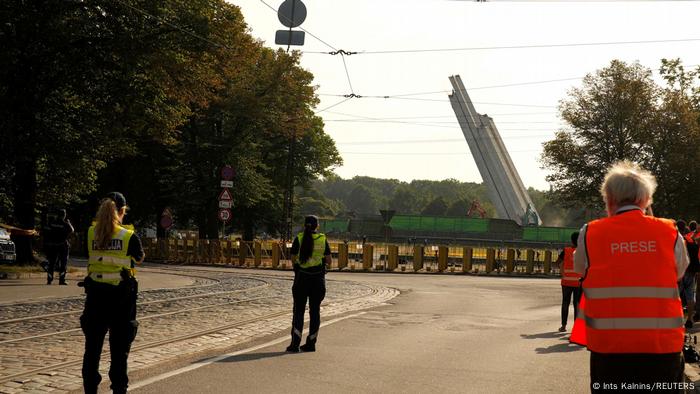
In view of the Russian invasion of Ukraine, Latvia issued a decree that all objects glorifying totalitarian regimes must be destroyed by November 15. This included the Soviet victory monument erected in 1985.
A controversial Soviet-era monument in the Latvian capital was brought down, despite protests from the Baltic state’s ethnic Russian minority to keep it.
Police officers and the press watch as the 80-meter high obelisk is torn down in Latvia’s capital Riga
A concrete obelisk topped with Soviet stars, which was the centerpiece of a monument commemorating the Red Army’s victory over Nazi Germany, was demolished in Latvia’s capital, Riga, on Thursday.
Two diggers with pneumatic hammers brought the 79-meter (261-foot) obelisk down to the applause of numerous onlookers. A number of large-scale bronze statues had already been removed from the monument in the preceding days.
In view of the Russian invasion of Ukraine, Latvia issued a decree that all objects glorifying totalitarian regimes must be destroyed by November 15. This included the Soviet victory monument erected in 1985.






 Pigs. Credit: or titanium22. CC BY-SA 2.0