I'm from Hanoi, Viet Nam.
I'm an author of Dot Chuoi Non (dotchuoinon.com/author/hangbelu/), a blog on Positive thinking, founded by Dr. Tran Dinh Hoanh, an attorney in Washington DC.
I'm a co-founder of Conversations on Vietnam Development - cvdvn.net, a virtual think tank. I am a co-founder of two companies in Viet Nam working on children education services. I advise companies on STEAM education, English language education for children and students in Vietnam.
I'm studying the Buddha's teaching and the teaching of Jesus. I practice mindful living including meditation.
I hold a PhD on Sustainable Energy Systems from University of Lisbon and Aalto University.
I graduated from Hanoi University of Technology on Environmental Engineering. I obtained a Master degree of the same major from Stanford University and Nanyang Technological University.
My English-language blog at: hangbelu.wordpress/.
I play table tennis as a hobby.
(Dân trí) – “TPHCM rất muốn hạn chế xe máy. Nếu có phương tiện công cộng nhanh, đúng giờ, kịp thời thì người dân tự động bỏ xe máy, không cần phải cấm, không cần phải hành chính, vận động”, Tổng Bí thư nói.
Tại buổi thăm, chúc Tết Đảng bộ, chính quyền, nhân dân TPHCM nhân dịp Xuân Bính Ngọ 2026 diễn ra ngày 9/2, Tổng Bí thư Tô Lâm đã phát biểu chỉ đạo gợi mở những vấn đề thành phố cần tập trung thời gian tới. Người đứng đầu Đảng đã chia sẻ về những kỳ vọng đối với đô thị đầu tàu của cả nước và những điểm nghẽn siêu đô thị cần tháo gỡ để bước vào kỷ nguyên mới.
Tổng Bí thư Tô Lâm đề nghị TPHCM tập trung tháo gỡ những điểm nghẽn lớn về thể chế, hạ tầng, nguồn nhân lực. Trong đó, địa phương cần đổi mới mô hình tăng trưởng theo chiều sâu, phát huy hiệu quả các cơ chế, chính sách đặc thù để từng bước hình thành các trung tâm tài chính, logistics, đổi mới sáng tạo tầm khu vực và quốc tế.
A new deal looks set to provide wideranging new minimum conditions to delivery riders and drivers who work for Uber Eats and DoorDash. (ABC News: Abubakr Sajid)
In short:
The Transport Workers Union has reached an agreement with Uber Eats and DoorDash for minimum safety net pay rates and other conditions for delivery drivers and riders.
The union says it is a “significant step” towards improving fairness in the gig economy.
What’s next?
The deal requires approval from the Fair Work Commission.
A historic deal could transform Australia’s gig economy, with the country’s two largest on-demand delivery platforms agreeing to minimum pay rates and providing wide-ranging improvements and protections for riders and drivers.
The agreement struck between the Transport Workers Union (TWU) and Uber Eats and DoorDash followed years of campaigning by workers and the union.
Minimum safety net pay rates would put a floor beneath what have been wildly variable earnings for delivery workers, who have often taken home far less than Australia’s minimum wage under current pay arrangements, which see them paid per delivery, not for time worked.
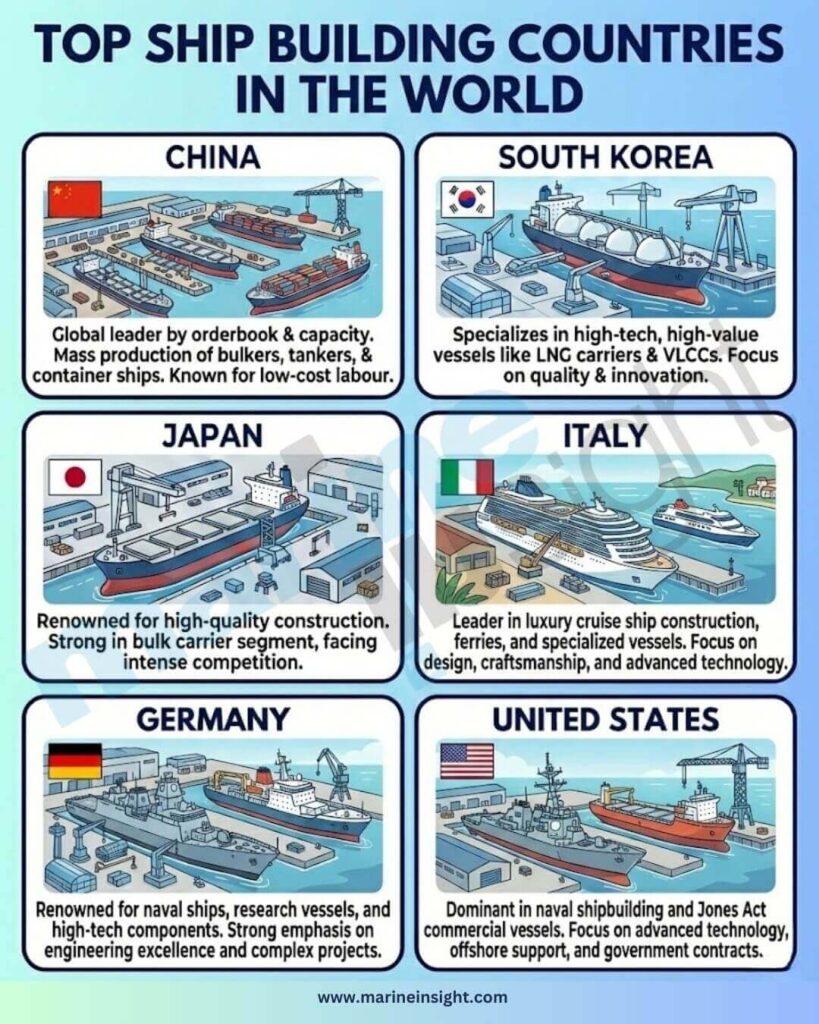
The shipbuilding industry is growing at a tremendous rate, with its market size expected to increase from USD 155.58 billion in 2025 to 203.76 billion in 2033, owing to greater container and dry bulk trade and the opening of new markets, per Straits Research. Around 85% of shipbuilding activities are concentrated in China, Japan, and South Korea, which are the top shipbuilding countries in the world.
Shipbuilding, which involves the construction of large seagoing vessels, manufacturing marine equipment, and refurbishing old vessels is a lucrative industry, propelled by the rising sea trade between countries, as the world population increases amidst rising consumer demands worldwide.
Apart from commercial vessels, naval vessels are also witnessing an increased demand with several navies like the Chinese and American, building new ships to showcase naval prowess.
In this article, we will mention the top 10 shipbuilding countries in the world, the majority of which are in Asia, Europe and the Americas, leading through their technological breakthroughs, and strategic investments in port infrastructure and ship equipment.
Thailand is confronting a convergence of economic and political pressures that threaten to lock in prolonged stagnation caused by weak growth, demographic decline and low productivity. Decades of political instability, repeated intervention by unelected ‘tutelary’ powers and the blocking of reformist forces have undermined policy continuity, discouraged investment and diverted spending away from long-term growth drivers like education and public investment. Renewed border tensions with Cambodia and looming elections now compound these structural weaknesses, leaving Thailand trapped in a cycle of political uncertainty and economic underperformance that erodes its regional standing.
With growth barely above 2 per cent, a looming demographic crisis and an immigration regime unsuited to offsetting future workforce challenges, Thailand is in urgent need of pro-growth, pro-productivity reforms and public investment despite its strained public finances. These challenges are par for the course in any rich post-industrial country — but for a middle-income country in today’s international environment, they’re all the more daunting.
– Trong kỳ trước, Tạp chí Năng lượng Việt Nam đã có bài viết đề xuất việc rà soát toàn diện các yêu cầu của IAEA về phát triển nguồn nhân lực trong mối quan hệ chặt chẽ, mang tính tương hỗ với 18 vấn đề hạ tầng then chốt của chương trình điện hạt nhân quốc gia. Tiếp nối định hướng này, bài viết dưới đây tập trung phân tích vai trò và trách nhiệm của Chính phủ ở Giai đoạn 1 của chương trình điện hạt nhân, với trọng tâm là khởi động hạ tầng an toàn. Cách tiếp cận này phù hợp với khuyến nghị của IAEA. Theo đó, an toàn hạt nhân không phải là một lĩnh vực độc lập, mà là kết quả tổng hợp của chính sách, khuôn khổ pháp lý – thể chế, năng lực con người, trong đó vai trò định hướng và bảo đảm của Chính phủ ở Giai đoạn 1 có ý nghĩa quyết định.
chatthamhouse.org Research paper Published 20 April 2020 ISBN: 978 1 78413 391 7
Royal Navy Vanguard Class submarine HMS Vigilant returning to HMNB Clyde after extended deployment. The four Vanguard-class submarines form the UK’s strategic nuclear deterrent force. Photo: Ministry of Defence.21st century. Researchers at Chatham House have worked with eight experts to produce this collection of essays examining four contested themes in contemporary policymaking on deterrence.
President Donald Trump speaks to the media before boarding Marine One on January 9, 2026. The day before, the President told New York Times reporters, “If it expires, it expires,” referring to New START—the last remaining bilateral nuclear arms control treaty between Washington and Moscow, which expires on February 5. (Photo: White House/Molly Riley)
For decades, nuclear weapons have been treated as the ultimate arbiter of international politics. They were supposed to deter great-power war, impose caution on leaders, and anchor what strategists liked to call strategic stability. Today, that framework is eroding in plain sight. Yet the reaction from policymakers and much of the expert community remains oddly muted.
Put simply, nuclear weapons are no longer functioning as a decisive factor in global security.
For almost four years, Russia—the world’s largest nuclear power—has been subjected to missile strikes carried out with systems supplied by several other nuclear-armed states. The United Kingdom now openly speaks of developing new tactical ballistic missiles for Kyiv and of placing “leading-edge weapons” directly into the hands of Ukrainians. Russia itself employs nuclear-capable intermediate-range ballistic Oreshnik missiles as if they were any other conventional weapon system for punishing Ukrainian infrastructure. Meanwhile, US President Donald Trump casually commented on New START—the last remaining bilateral nuclear arms control treaty between Washington and Moscow, which expires on February 5—“If it expires, it expires.” And former Russian President Dmitry Medvedev, currently serving as a Deputy Chief of the Russian Security Council, stated, “No START-4 is better than a treaty that only masks mutual distrust and provokes an arms race in other countries,” referring to what may come next after New START expires.
IAEA.org 12 December 2025 Ninh Thuan Province, Viet Nam
Viet Nam has taken important actions towards adding nuclear power to its energy mix, including in developing the necessary infrastructure for a safe and sustainable nuclear power programme, according to an International Atomic Energy Agency (IAEA) review mission.
An IAEA team of experts yesterday concluded an 11-day mission to Viet Nam to review its infrastructure development for the Ninh Thuan Nuclear Power Project, which had been stopped in 2016. In 2024, the Central Committee of the Communist Party of Viet Nam decided to restart the project and the National Assembly of Viet Nam authorized the Government to allocate the necessary resources for its implementation.
The establishment of nuclear power is an objective of the Revised National Power Development Plan for the period 2021-2030, which considers nuclear power as key for diversifying the national energy mix and strengthening energy security amidst Viet Nam’s steadily rising energy demand and economic growth in recent years. The plan envisages the commissioning of two nuclear power plants, Ninh Thuan 1 and Ninh Thuan 2, during the 2030–2035 period, with a total capacity of 4,000–6,400 MW.
BloombergNEF’s Energy Transition Investment Trends reviews annual investment figures in the global energy transition, including spending to deploy clean technologies, investment in the clean energy supply chain, equity investment in climate-tech companies, and debt issuance for energy transition purposes.
All four of these indicators moved upward in a year marked by trade disruptions and geopolitical tension, showcasing the energy transition’s resilience.
Walmart, the biggest single buyer of goods in the world, has lowered its emissions intensity and sent emissions-reducing ripples throughout its global supply chain. Joe Raedle/Getty Images
The Trump administration has given corporations plenty of convenient excuses to retreat from their climate commitments, with its moves to withdraw from the Paris Agreement, roll back emissions regulations, and scale back clean-energy incentives.
China has officially unveiled its latest large autonomous drone, the Wing Loong X, at the Dubai Airshow 2025. Ostensibly the same as its predecessor, Wing Loong drone siblings, this new drone is reportedly the first unmanned aerial vehicle (UAV) in the world capable of fully independent anti-submarine warfare (ASW).
If true, this is a big deal, as anti-submarine missions are widely considered the most difficult of all maritime military aviation operations. The new drone is huge, with a reported wingspan of well over 65.6 feet, or 20 meters (that’s roughly the same size as a small business jet).
Summary: Researchers using China’s “artificial sun” fusion reactor have broken through a long-standing density barrier in fusion plasma. The experiment confirmed that plasma can remain stable even at extreme densities if its interaction with the reactor walls is carefully controlled. This finding removes a major obstacle that has slowed progress toward fusion ignition. The advance could help future fusion reactors produce more power
China’s “artificial sun” fusion reactor has crossed a critical plasma density threshold that scientists once thought was unreachable. The result brings fusion ignition closer than ever. Credit: Shutterstock
Scientists working with China’s fully superconducting Experimental Advanced Superconducting Tokamak (EAST) have successfully reached a long-theorized “density-free regime” in fusion plasma experiments. In this state, the plasma remains stable even when its density rises far beyond traditional limits. The results, published in Science Advances on January 1, shed new light on how one of fusion energy’s most stubborn physical barriers might finally be overcome on the road to ignition.
Visions of planting walls of trees to block the expansion of the desert have long been promoted but never realized. The green wall myth persists today even though it is premised on outdated understandings of desertification. We review the history of the idea of green walls and focus on two sets of contemporary initiatives to assess their outcomes: peri-Saharan programs (Algeria’s Green Dam and Great Green Wall in sub-Saharan Africa) and China’s Three Norths Shelterbelt Program. This review reveals a mixed record of technical success with low rates of the establishment of monocultures of fast-growing trees vulnerable to disease. While there is evidence for reduced wind erosion in some areas, afforestation is also associated with reduced soil moisture and lowering of water tables. Social impacts include increased water scarcity for people and livestock in some cases, and resource enclosures that particularly work against pastoralist livelihoods.
Green walls refer to continuous bands of planted trees stretching across single or multiple countries in dryland regions. As socioecological projects, green walls invoke powerfully attractive images of maintaining life over the assumed sterility of the desert through human ingenuity and effort. A wall of planted trees is envisioned to hold back an expansionary desert from degrading the productivity of the lands behind the wall. Despite the persistent discursive power of this image, its scientific foundation rests on now discredited understandings of desertification.1Desertification, scientifically understood as land degradation due to human mismanagement, is less a regional phenomenon across a broad front than a highly localized phenomenon in areas of greater and more persistent human pressures. The power of the green wall vision is illustrated by its persistent use in promotions of a diverse array of dryland afforestation initiatives with different afforestation patterns (e.g., shelterbelts, scattered woodlots and larger afforested blocks, and agroforestry) and goals (ecological rehabilitation, carbon sequestration, and improved climate resilience). In short, green wall rhetoric mobilizes support and empowers certain actors rather than describing actual dryland afforestation practices.2This article focuses on the vision, practices, and effects of these programs.
This review was written during a period of global enthusiasm for trees and mobilization for mass afforestation, with the World Economic Forum’s Trillion Trees initiative the most prominent example (https://www.1t.org/) but also a wide range of other afforestation efforts across the globe (3). While the arborocentrism of this moment has a long history (see below), concerns about climate change and an interest in increasing the sequestration of industrial carbon has led to a rapid rise of tree planting initiatives. The world’s drylands could be seen as “empty” and thus important “untapped” landscapes to store carbon. Through a consideration of the empirical record of green wall programs, this article outlines reasons to be cautious. Trees are often not suited for the arid zones where they are planted and, even if they are established, may have negative ecological and social impacts (4). By ignoring the need for ecological and social monitoring of afforestation impacts, green wall enthusiasm has often worked to hide the mixed record of these initiatives.
China dominates global rare earth mining, but undeveloped reserves elsewhere could reshape future supply chains.
Greenland holds an estimated 1.5 million metric tons of rare earth reserves despite having no commercial production.
U.S. President Donald Trump has once again put Greenland at the center of global attention.
His renewed threat to assert U.S. control over the Arctic territory has drawn sharp reactions from European leaders and Denmark, which governs Greenland as an autonomous territory.
While the island’s strategic location is often cited, another underlying motivation is increasingly tied to its vast mineral potential. In particular, Greenland’s rare earth reserves have become a focal point in a world racing to secure critical resources.
This visualization compares rare earth mine production and reserves across countries, placing Greenland’s untapped resources in a global context.
China remains the backbone of the global rare earth market. In 2024, it produced roughly 270,000 metric tons, accounting for well over half of global output.
China also controls the largest reserves, estimated at 44 million metric tons. This combination of scale and integration gives Beijing significant leverage over industries ranging from electric vehicles to defense systems.
Country
Reserves (Metric Tons)
Rare Earth Production 2024 (Metric Tons)
🇨🇳 China
44.0M
270,000
🇧🇷 Brazil
21.0M
20
🇮🇳 India
6.9M
2,900
🇦🇺 Australia
5.7M
13,000
🇷🇺 Russia
3.8M
2,500
🇻🇳 Vietnam
3.5M
300
🇺🇸 United States
1.9M
45,000
🇬🇱 Greenland
1.5M
0
🇹🇿 Tanzania
890K
0
🇿🇦 South Africa
860K
0
🇨🇦 Canada
830K
0
🇹🇭 Thailand
4.5K
13,000
🇲🇲 Myanmar
0
31,000
🇲🇬 Madagascar
0
2,000
🇲🇾 Malaysia
0
130
🇳🇬 Nigeria
0
13,000
🌍 Other
0
1,100
🌐 World total (rounded)
>90,000,000
390,000
Large Reserves, Limited Production Elsewhere
Outside China, many countries with sizable reserves play only a minor role in production.
Brazil holds an estimated 21 million metric tons of rare earth reserves yet produces almost nothing today. India, Russia, and Vietnam show similar patterns.
Why Greenland Matters
Greenland’s estimated 1.5 million metric tons of rare earth reserves exceed those of countries like Canada and South Africa. Yet the island has never had commercial rare earth production.
Environmental protections, infrastructure constraints, and local political opposition have slowed development. Still, as supply chain security becomes a priority for major economies, Greenland’s position is becoming harder to ignore.
Trump’s interest in Greenland is driven by more than symbolism. Rare earths are essential for advanced manufacturing, clean energy technologies, and military hardware. With China firmly entrenched as the dominant supplier, policymakers in Washington are increasingly focused on alternative sources.
•Errors in airport demand forecasts stem from economic uncertainty and optimism.
•Forecasting can be improved by focusing on both macroscopic and microscopic levels.
•Models can predict the probability of passenger contraction.
•Reference class forecasts improve accuracy by incorporating past forecast errors of peers.
Abstract
Errors in forecasting airport passenger demand arise from uncertain economic climates and planners’ optimism, leading airport planners to make misinformed infrastructure investments. We use publicly available data to develop and test methodologies that enable airport planners to (1) predict the probability of a severe contraction in passenger volumes and (2) improve forecast accuracy by systematically incorporating past forecast errors of airport peers thus “grounding” optimistic forecasts. By incorporating past forecast errors from like airports into airport forecasting models, we build a methodology that is grounded in established demand forecasting practices and is able to significantly improve the accuracy of aviation demand forecasting models.


 President Donald Trump speaks to the media before boarding Marine One on January 9, 2026. The day before, the President told New York Times reporters, “If it expires, it expires,” referring to New START—the last remaining bilateral nuclear arms control treaty between Washington and Moscow, which expires on February 5. (Photo: White House/Molly Riley)