I'm from Hanoi, Viet Nam.
I'm an author of Dot Chuoi Non (dotchuoinon.com/author/hangbelu/), a blog on Positive thinking, founded by Dr. Tran Dinh Hoanh, an attorney in Washington DC.
I'm a co-founder of Conversations on Vietnam Development - cvdvn.net, a virtual think tank. I am a co-founder of two companies in Viet Nam working on children education services. I advise companies on STEAM education, English language education for children and students in Vietnam.
I'm studying the Buddha's teaching and the teaching of Jesus. I practice mindful living including meditation.
I hold a PhD on Sustainable Energy Systems from University of Lisbon and Aalto University.
I graduated from Hanoi University of Technology on Environmental Engineering. I obtained a Master degree of the same major from Stanford University and Nanyang Technological University.
My English-language blog at: hangbelu.wordpress/.
I play table tennis as a hobby.
Specifically, we focus on the flow of public adaptation funds from the governments of developed countries to developing countries, since the implementation of the Paris Agreement.
In this article, we identify three major gaps in adaptation finance and explain why these gaps have emerged even as nations commit to scaling up these funds.
Financial shortfall
Adaptation costs for developing countries are estimatedat between $215bn and $387bn annually this decade, according to the latest Adaptation Finance Gap Update report.
Spending from the public funds of developed nations, while not the only source of adaptation finance, remains a crucial source, especially for low-income countries.
As it stands, people in the least developed countries(LDCs) and small-island states are often more exposedto climate hazards and more likelyto be killed by climate-related disasters. This is despite the fact that these nations bear very little responsibilityfor causing climate change.
“In the UK we’ve seen suspension of students and staff from their universities. We’ve seen cancelling of events … of student activities like protests and sit-ins. We’ve seen a few cases of students that were arrested. We’ve seen students whose visas are threatened to be revoked.“
Across parts of academia, concerns are mounting that the Israel-Gaza war is having a chilling effect on academic freedom. In the second of two episodes of The Conversation Weekly exploring how the war is affecting life at universities, we speak to an Israeli legal scholar, now based in the UK, about the pressures that academics and students are facing to rein in their views about the war.https://embed.acast.com/60087127b9687759d637bade/65804f3a3c61a300185b8044
In the two months since the October 7 Hamas attack on Israel and subsequent Israeli war on Gaza, Neve Gordon is worried that there’s been a major clampdown on academic freedom in the US, Europe and Israel.
After teaching for 17 years in southern Israel, Gordon moved to the UK in 2016 and he’s now a professor of human rights and humanitarian law at Queen Mary University of London. His research looks at the laws of war with a special focus on Israel-Palestine, and on definitions of antisemitism.
He’s also the vice-president at the British Society for Middle Eastern Studies and chair of its committee on academic freedom. In this role, he’s been following the impact of the conflict on free speech at universities, and recently hosted an international webinar on the issue.
In the UK we’ve seen suspension of students and staff from their universities. We’ve seen cancelling of events … of student activities like protests and sit-ins. We’ve seen a few cases of students that were arrested. We’ve seen students whose visas are threatened to be revoked.
In Israel, Gordon told us he was aware of 113 cases in Israel of students and staff who have been suspended or dismissed, and at least ten students who have been arrested for their criticism of Israel’s attack on Gaza. “We have several students sitting behind bars for Facebook or tweets that basically express empathy for the suffering of the Palestinians,” he says.
All this, Gordon says, is having a chilling effect across academia.
I’m getting phone calls from friends in different universities in different countries saying that they want to cancel their Israel-Palestine course for next semester because they’re afraid that things that they will say in class can be interpreted by students as antisemitic.
Listen to the full interview with Neve Gordon on The Conversation Weekly podcast, where you can also listen to the first of our two episodes on the way the Israel-Gaza war is affecting life at universities, focusing on what’s been happening at one American public university.
Trapped under the rubble of a 5-storey building in Gaza, a 13-year-old called Alma pleaded for rescuers to help free her relatives first. What happened to her family members is not known.
Thousands of people have protested in Tel Aviv after Israeli forces killed three Israeli captives in Gaza who were shirtless, waving a white flag and calling for help in Hebrew. Demonstrators are demanding the gov’t reach a deal for the safe return of remaining captives
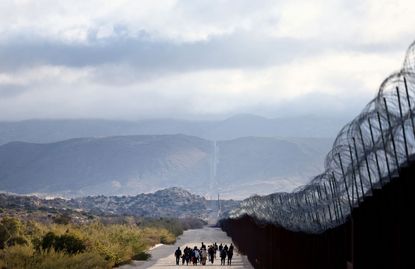
Asylum-seeking migrants walk toward a makeshift camp to await processing by the U.S. Border Patrol after crossing into the United States past a gap in the border barrier Dec. 1, 2023 in Jacumba Hot Springs, CaliforniaPUBLISHED 5 DAYS AGO
Immigration policy has been a hot-button issue for generations, in the United States and around the world. But waves of people fled their homes by land or by sea in 2023, triggering migrant crisis after migrant crisis in multiple regions. Battles over migration policy stoked domestic political feuds and diplomatic clashes.
International Organization for Migration officials told delegates at the United Nations’ COP28 climate conference that more than half of forced “internal displacements,” which totaled 32.6 million people last year, were driven by climate-related events, according to Forbes. Wars, like Russia’s invasion of Ukraine and the conflict between Israel and Hamas, drove more people to seek a better life in a new country, and increased tensions once they got there.
Here are some of the migration routes where the crisis was intense in 2023:
The U.S.-Mexico border
A “growing wave of migration” exploded at the U.S.-Mexico border in 2023, The Wall Street Journal reported recently. It hit especially hard in the small border city of Eagle Pass, Texas, where Mayor Rolando Salinas Jr. declared a state of emergency as the number of migrants entering from Mexico hit 3,000 per day. “We are on pace for this to be the worst of the border crisis yet, and we’ve seen some doozies,” said Rep. Tony Gonzalez (R-Texas), whose district includes Eagle Pass. The migrants included people fleeing turmoil in Venezuela, drug cartel violence in Ecuador and other once-safe countries, gang violence in Haiti, and a broad economic downturn across Latin America blamed on the Covid-19 pandemic.
But the impact wasn’t just felt at the U.S.-Mexico border. New York City Mayor Eric Adams declared a state of emergency as thousands of migrants — more than 146,000 between spring 2022 and November 2023 — arrived from the southern border. Many were sent north by Texas’ Republican governor, Greg Abbott, to cities run by Democrats in a campaign to pressure President Joe Biden to crack down at the border. Adams warned the city was facing a humanitarian crisis that would cost $12 billion over three years, The New York Times reported. City officials said in November their homeless shelters had no room for any more asylum-seekers.
The EU and UK
European nations have faced a huge influx of migrants in recent years. The EU is on track to receive more than one million asylum seekers in 2023, the most since a wave of people in 2015 and 2016, most of them fleeing Syria’s civil war. In Germany — already home to three million refugees, the most since waves of ethnic Germans returned from Eastern Europe after World War II — Chancellor Olaf Scholz is under pressure from overwhelmed states to do something about a more than 70 percent rise in asylum applications in 2023. “I don’t want to use big words,” Scholz told reporters in November, according to Politico, “but I think this is a historic moment.”
Italy and the United Kingdom joined forces in October to lead a European effort to fight “illegal migration.” Italy’s right-wing prime minister, Giorgia Meloni, came to power last year after vowing “to clamp down on unauthorized arrivals from North Africa with harsher immigration laws, restrictions on sea rescue charities, and plans to build migrant reception camps in Albania,” Reuters reported. U.K. Prime Minister Rishi Sunak’s conservative government wants to pay Rwanda to process asylum applications for people arriving illegally in the U.K., which Sunak said would help “break the cycle of tragedy” of people-smuggling using small boats, the BBC reported. The UK also is taking steps to curb legal migration, including a higher minimum salary.
South to South
Migrant waves to Western countries get most of the headlines, but most migration occurs between countries in the same region. “That has put a significant burden on states that border conflict zones, like Uganda, which sits alongside both South Sudan and the Democratic Republic of Congo,” according to the World Politics Review. Fighting between Sudan’s army and paramilitaries has internally displaced three million people, and sent 926,841 people seeking refuge in Egypt, Libya, Chad, the Central African Republic, South Sudan, Ethiopia, and other neighboring countries, according to the United Nations International Organization for Migration.
These crises threaten to only get worse as rising global temperatures fuel mass climate migrations, according to Fortune. Global carbon emissions are rising, and climate scientists say the greenhouse gasses already accumulated in our atmosphere all but guarantee that Earth’s average temperature rise will exceed the tipping point of two degrees Celsius, which it did briefly in November 2023. This, according to Fortune, could make countries like Bolivia or Yemen “vacant states,” as their people leave seeking “fertile” ground, with their leaders unable to give them reason to stay. As Fortune put it: “Solar panels for an Eritrean village won’t keep its boys from fleeing the country’s hopeless economy and austere politics.”
UNCTAD released on 14 December its Handbook of Statistics 2023 – the global reference for trade and development trends published each year.
It provides official statistics on how the global economy has evolved across regions, countries and sectors. An online version allows people to interact with the data, charts and graphs.
By using “nowcasts”, the handbook provides data-driven real-time estimates of current developments. These can assist governments in anticipating shifts in trade and the economy before final official statistics are available.
“Timely and quality data are critical now more than ever in an era of multiple global crises,” says Anu Peltola, head of UNCTAD Statistics. “These statistics will help countries take evidence-based decisions to tackle today’s challenges rather than yesterday’s.”
Below are some of the key trends for 2022 and 2023 highlighted in the report.
International trade dynamics
Trade in goods falls: Following a strong recovery from COVID-19 in 2021, goods exports increased by 11.4% in 2022, reaching $29 trillion. But statistics show a 4.6% decrease in merchandise trade in the first half of 2023, and UNCTAD nowcasts a continued year-on-year decline for the third and fourth quarters.
Trade in services continues to rise: Trade in services rebounded by 14.8% in 2022, surpassing pre-pandemic levels. Services trade grew more in developing countries, which in 2022 reached their highest global market share to date at 30%. Globally, UNCTAD nowcasts around 7% growth for trade in services in 2023.
Critics say the deal is still severely lacking when it comes to addressing the climate concerns of developing nations
Asia faces multiple obstacles to its clean energy transition, with countries such as China, India and Indonesia failing to provide clear timelines for ending coal usage
The United Nations Climate Change Conference in Dubai ended on Wednesday with a message signalling the eventual end to the fossil fuel era, but its lack of a clear timeline could leave parts of developing Asia increasingly vulnerable to climate shocks, experts said.
The conference, also known as Cop28, adopted within minutes of its presentation the proposed text for a final climate deal that acknowledges for the first time the need for “transitioning away from fossil fuels” and “accelerating action in this critical decade” to achieve net-zero carbon emissions by 2050.
The text also includes agreements to triple the deployment of renewable energy and double the rate of efficiency gains by the end of the decade.
Nikki Haley is trying to break the highest glass ceiling in politics, but you won’t hear her say so – at least not directly.
She does, however, offer fleeting glimpses at the historic nature of her Republican presidential campaign.
“There are no saints in DC right now, but that’s why I think you need a badass woman in charge at the White House,” the former South Carolina governor and United Nations ambassador said with a smile in the closing moments of a stop here Wednesday night, answering a voter’s question about criminal charges facing some politicians in Washington.
With the first votes of the Republican presidential primary barely a month away, Haley is drawing larger crowds – and louder applause – from voters like Thalia Floras, who has been eagerly searching for an alternative to former President Donald Trump.
“It would be great to have a female president, but that is not what this is about,” said Floras, a Nashua resident who has surveyed several candidates during their visits to New Hampshire. “I think we’re past the point of talking about that. It’s about the strongest candidate, and she, right now in the Republican Party, is the strongest candidate.”
Of course, not all of Haley’s supporters are women. And not all Republican women are supporting Haley, considering most polls show that Trump still receives a strong majority of support across all demographic groups.
But the makeup of Haley’s crowds is often distinct from those of her rivals, with audiences that include mothers bringing their daughters to see the candidate and older women hoping to see presidential history made in their lifetimes.
Tăng cường tiếp cận thông tin và giáo dục cho trẻ em ở lứa tuổi từ 13 đến 18 tuổi về sức khỏe sinh sản, nhận thức về hôn nhân phù hợp với đặc điểm văn hóa các dân tộc khác nhau trong nhà trường và trong cộng đồng.
Trong rất nhiều hủ tục, tập tục lạc hậu, có một vấn nạn đã tồn tại lâu nay đó chính là nạn tảo hôn và hôn nhân cận huyết thống. Luật pháp về hôn nhân và gia đình đã quy định tuổi kết hôn ở phụ nữ là từ đủ 18 và nam giới là từ đủ 20, nhưng theo thống kê gần đây nhất thì 11% phụ nữ tuổi từ 20 đến 49 đã kết hôn hoặc đã sống chung như vợ chồng trước tuổi 18 và vùng trung du miền núi phía Bắc là các tỉnh có tỷ lệ tảo hôn cao hơn so với các vùng khác trong cả nước.
Vấn nạn tảo hôn vẫn đang là một thực trạng nhức nhối ở một số địa phương hiện nay. Điều này không những vi phạm pháp luật mà còn để lại những hệ luỵ nghiêm trọng, lâu dài về mặt xã hội.
Theo kết quả khảo sát, tình trạng tảo hôn ở người dân tộc thiểu số là 21,9%. Tất cả 53 dân tộc thiểu số đều có tình trạng tảo hôn, trong đó, 5 dân tộc tỉ lệ tảo hôn cao nhất gồm: dân tộc Mông (51,5%), Cờ Lao (47,8%), Mảng (47,2%), Xinh Mun (44,8%), Mạ (39,2%).
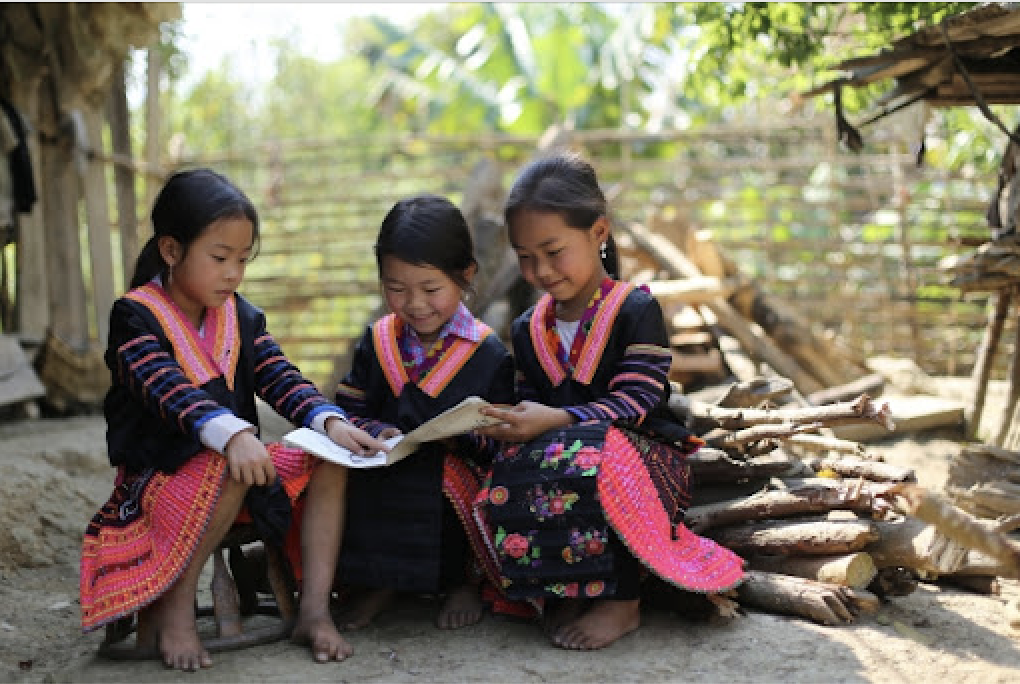
Ảnh minh hoạ
Kết hôn cận huyết thống không chỉ ảnh hưởng nghiêm trọng đến sức khỏe của bà mẹ và trẻ em, mà còn kéo lùi nền kinh tế của cả nước. Trẻ em sinh ra từ các cặp vợ chồng tảo hôn và hôn nhân cận huyết thống có tỉ lệ mắc các bệnh di truyền, dị tật bẩm sinh, suy dinh dưỡng, suy giảm sức khỏe và tử vong sơ sinh cao hơn trẻ em bình thường khác.
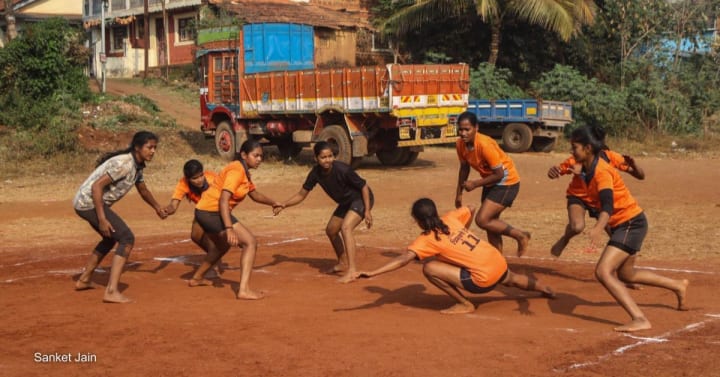
Girls from more than 50 villages train under Terase, where they learn multiple sports, the most common being kabaddi. Photo by: Sanket Jain
When Pandurang Terase, a sugarcane and rice farmer from India’s Maharashtra state, failed to turn his passion for kabaddi into a career, he ventured on a mission to train rural girls in sports for free. He never envisioned his work would someday save thousands from early and child marriage.
Every minute, 23 girls are married globally before they turn 18, according to the United Nations Population Fund. That’s over 12 million young women every year. So widespread is the problem that nearly 650 million women alive today became brides before turning 18 years old. India is home to 223 million child brides, the world’s highest. India accounts for one in three of the world’s child brides, UNICEF data shows.
“The world needed to find a new way. By following our North Star, we have found that path,” said COP28 President, Dr. Sultan Al Jaber during his closing speech, “We have worked very hard to secure a better future for our people and our planet. We should be proud of our historic achievement.”
COP28 has concluded with a final consensus that lays out an ambitious response to the Global Stocktake and puts forward a plan to close the gaps to 2030. It calls on Parties to transition away from fossil fuels to reach net zero, encourages them to submit economy-wide Nationally Determined Contributions (NDCs), includes a new specific target to triple renewables and double energy efficiency by 2030, and builds momentum behind a new architecture for climate finance.
The COP28 Presidency took bold and decisive steps to deliver beyond the negotiated text through its ‘Action Agenda,’ which spans the four pillars of the Paris Agreement: fast tracking a just and orderly energy transition; fixing climate finance to make it more available, affordable, and accessible; focusing on people, nature, lives and livelihoods; and fostering full inclusivity in climate action.
COP28 has mobilized over $85 billion in funding for climate action, secured a historic agreement on Loss and Damage, advanced the Global Goal on Adaptation (GGA) and overseen breakthrough agreements on the energy transition.
This has been the most inclusive COP to-date, ensuring all voices could participate in the process.

 CVD
CVD 