Gaza crisis: Babies being born ‘into hell’ amid desperate aid shortages

Conversations on Vietnam Development

Mosquito-borne disease once largely limited to Dhaka spreads countrywide as higher rainfall and heat lead to fivefold rise in cases in a year, with children the hardest hit

Corridors in Dhaka Medical College hospital crowded with dengue patients amid a shortage of beds. Bangladesh’s worst outbreak of dengue on record comes after unusually heavy rain, torrid temperatures and high humidity led to an explosion in the mosquito population
All photographs by Fabeha Monir for WHO
In a small, dimly lit control room at the Directorate General of Health Services (DGHS) in Dhaka, data on Bangladesh’s dengue outbreak flashes across multiple computer screens. Government analysts here have been busy collecting and monitoring the impact of the disease across the country since cases were first reported last April.
In 2023, the total reported cases of dengue numbered 321,179, with 1,705 deaths recorded, a massive jump from the year before, when 62,000 people were known to have had the virus, and 281 died. It was the highest number of annual deaths caused by the mosquito-transmitted disease ever recorded in Bangladesh.
We can’t afford to admit her to hospital so I’ve been doing whatever I can to protect her at home
Masuma Begum
The deaths last year included at least 113 children. According to Save the Children, the majority of these deaths were of children under the age of 10, with 38 deaths among those under five.
“Children make up around 30% of all dengue cases in Bangladesh and are particularly vulnerable to the virus because of underdeveloped immune systems,” says Dr Shamim Jahan, Bangladesh director of Save the Children. “Those under five are particularly at risk from developing severe symptoms, such as dehydration and shock.”
Over the past few months, the surge in cases has pushed Bangladesh’s health system to the limit, with hospital corridors overflowing with patients as wards run out of beds.
New research shows that by reducing populations and thinning out weak and sick animals, wolves have a role in creating resilient elk herds.

Wolves and black-billed magpies scavenge at a dump where carcasses are stored in Yellowstone National Park.
PUBLISHED JULY 10, 2020
LARAMIE, WYOMINGTwenty-five years after gray wolves returned to Yellowstone National Park, the predators that some feared would wipe out elk have instead proved to be more of a stabilizing force. New research shows that by reducing populations and thinning out weak and sick animals, wolves are helping create more resilient elk herds.

Released today, the annual Piracy and Armed Robbery Report of the ICC International Maritime Bureau (IMB) raises concern over the first successful Somali based hijacking since 2017.
The IMB annual report recorded 120 incidents of maritime piracy and armed robbery against ships in 2023 compared to 115 in 2022. It reveals that 105 vessels were boarded, nine attempted attacks, four vessels hijacked and two fired upon.
Where the number of 2023 reported incidents has slightly increased compared to 2022, the IMB urges caution for crew safety as the number of crew taken hostage and kidnapped increased from 41 to 73 and from two to 14 in 2022 and 2023 respectively. A further 10 crew were threatened, four injured and one assaulted in 2023.
On 14 December 2023, the report recorded the first successful hijacking of a vessel off the coast of Somalia since 2017.
Tiếp tục đọc “New International Maritime Bureau report reveals concerning rise in maritime piracy incidents in 2023”A process has begun to allow the Vietnam Shipbuilding Industry Corporation (SBIC) to declare bankruptcy, according to Deputy Minister of Transport Nguyen Xuan Sang.

A fishing trawler built by the Ha Long Shipbuilding Company, a subsidiary of SBIC, in 2018. (Photo: SBIC)
Hanoi (VNS/VNA) – A process has begun to allow the Vietnam Shipbuilding Industry Corporation (SBIC) to declare bankruptcy, according to Deputy Minister of Transport Nguyen Xuan Sang.
The Ministry of Transport (MoT) said the bankruptcy was, at this point, an inevitable conclusion and the ministry is now aiming for an overhaul of the corporation’s core businesses while trying to retain as many experienced managers and workers as possible.
Tiếp tục đọc “Vietnam’s State Shipbuilding corporation to declare bankruptcy: industry ministry”insideclimatenews.org By Katie Surma January 1, 2024

Ireland—a nation synonymous with its abundant, verdant landscapes—is considering a nationwide referendum on the rights of nature and the human right to a healthy environment.
If that happens, Ireland would become the first European country to constitutionally recognize that ecosystems, similar to humans and corporations, possess legal rights. More than two-thirds of the 27 European Union countries already recognize a universal human right to a healthy environment.
In December, a legislative committee proposed that the Irish government take a series of administrative measures to draft proposed constitutional amendments recognizing that nature has inherent rights to exist, perpetuate and be restored, and that humans have a right to a clean environment and stable climate.
To take legal effect, the proposed amendments must be approved by both houses of parliament, the Dáil Éireann (the lower house) and the Seanad (the upper house), and win a majority of the popular vote.
Tiếp tục đọc “Ireland Could Become the Next Nation to Recognize the Rights of Nature and a Human Right to a Clean Environment”>> Vietnam’s ticking time-bomb of elderly poverty

Elderly poverty in Vietnam is a significant issue considering that Vietnam currently has one of the highest rates of aging populations in the world. Right now, Vietnam is still a young country, despite the fact that its elderly population has increased from 4.9% in 1975 to 7.9% as of 2020. There is reason to have some concern over the aging population. Even just between 2009 and 2019, the elderly population older than the age of 60 increased by 2%. The World Bank has calculated that Vietnam could be the country that is aging fastest globally.
time.com

BY NICHOLAS DIRKS JANUARY 11, 2024 2:02 PM EST
Dirks is currently the president of the New York Academy of Sciences and author of the new book CITY OF INTELLECT: The Uses and Abuses of the University
The end of Claudine Gay’s brief and turbulent presidency at Harvard has hardly put an end to controversies about elite university leadership and governance. Bill Ackman, the “activist” donor and Harvard graduate, is calling for further resignations from the Harvard Corporation, while baiting MIT’s President, Sally Kornbluth, with the Shakespearean query: “et tu?” Meanwhile, Mark Rowan, the board member who engineered the takedown of the University of Pennsylvania’s erstwhile president, Elizabeth McGill—the first of the Washington three to step down—has now been pressing his advantage in calling for major reforms of an academic nature at Penn. Philanthropy and academic freedom are colliding in ways that have the potential to undermine the true purpose and mission of our universities.
As much as these, and some other, donors have appeared to embody popular discontent with those at the pinnacle of higher education, it is easy to forget that not long ago the scandals around these universities had to do with donors who used their gifts as leverage to secure admission for their children, making visible the problematic relationship between some individual philanthropy and private interests. We all called for firewalls then but seem now to have forgotten those critiques of the relationship between private interests and higher education.
Though the 100 incidents in 2023 increased by 19 per cent over 2022, these were small-time robberies, with theft of items such as nominal value wires, brass ship products, engine spares and scraps, Regional Cooperation Agreement on Combating Piracy and Armed Robbery, says executive director
PTI Singapore Published 09.01.24, 06:06 PM

Representational picture.File picture
No report of piracy incidents occurred on the Asian high seas but 99 actual incidents and one attempted armed robbery against ships occurred in Southeast Asian waters in 2023, a Singapore based maritime organisation reported said on Tuesday.
Though the 100 incidents in 2023 increased by 19 per cent over 2022, these were small-time robberies, with theft of items such as nominal value wires, brass ship products, engine spares and scraps, Regional Cooperation Agreement on Combating Piracy and Armed Robbery (ReCAAP) executive director Krishnaswamy Natarajan said at the annual press conference.
Such incidents were five in India in 2023, the same as those in 2022, while Bangladesh and Malaysia reported one incident each, compared to five and two incidents in 2022, respectively.
Reviewing the year, Natarajan pointed out that the increase in incidents occurred in Indonesia, the Philippines, the Straits of Malacca and Singapore (SOMS), Thailand and Vietnam.
Of concern was the occurrence of incidents in SOMS with 63 incidents compared to 55 incidents in 2022, said the former Director General of Indian Coast Guard.
In the Sulu-Celebes Seas, there was no report of the abduction of crew for ransom by the Abu Sayyaf Group (ASG), which was achieved through the concerted efforts of the Philippine and Malaysian authorities, he highlighted.
As part of the Centre’s continuous efforts to ensure that the evolving needs of the shipping industry are met, the ReCAAP Information Sharing Centre (ISC) launched various initiatives in 2023, to keep the shipping community abreast of the latest piracy and ARAS situation in Asia and to facilitate ship masters in the timely reporting of incidents to the nearest coastal State.
The initiatives include the launch of the ReCAAP Data Visualisation Map and Panel (Re-VAMP) — an interactive dashboard to enable the viewing and analytics of past and current incidents of piracy and ARAS in Asia.
The initiative also includes the production of a poster containing the guidelines and updated contact details of law enforcement agencies of the littoral States of the SOMS; and engagement of the shipping industry through various events including conferences, forums and shipping dialogue sessions, he elaborated.
Except for the headline, this story has not been edited by The Telegraph Online staff and has been published from a syndicated feed.
December 29, 2023
Sitting on my tiny rooftop garden, how much I cherish the early morning tea with the sweet sounds of a bird family, who has graciously made my roof their home since the day I settled here.
How thankful I am for this precious gift of sound, offered by my birdy friends despite the city noise that they have to compete with. How unbearable it would be, imagine one day, I find no birdy singing on my roof nor in any other corner of this Earth.
In the quiet corners of our world, where nature once thrived and rang its melody, Rachel Carson’s “Silent Spring” warned us about a future where the symphony of Nature would be no bird chirping, no insect buzzing, not even leaf rustling, but replaced by creepy hush, only. And that scary destructive silence was caused by the pesticide and herbicide.
These days, we find ourselves in a different strike of silence, one that haunts the holiday season in Gaza, Palestine – a Silent Christmas, where the laughters of children and the voices of joyous carols are muted by the horrors of war and genocide.
This is not a Christmas story from a distant land; this haunting silence deeply matters to our conscience. For this silence echoes the death of humanity. For this silence is the death of the voice in our heart.
Tiếp tục đọc “From Silent Spring to Silent Christmas: Humanity in the face of atrocity”
thestar.com Sunday, 07 Jan 202410:34 AM MYT
“We detained 48 foreign women – 32 Indonesians, 13 Thais and three Vietnamese – along with a man from Afghanistan.” he said.

KUALA LUMPUR: The Immigration Department detained 48 foreign women in raids on three suspected prostitution dens in the city.
Immigration deputy director-general (Operation) Jafri Embok Taha said the raids on Friday (Jan 5) night also busted the activities of a syndicate.
“We detained 48 foreign women – 32 Indonesians, 13 Thais and three Vietnamese – along with a man from Afghanistan.” he said.
Jafri added in a statement on Sunday (Jan 7) that three local men were detained, saying that two were caretakers of the premises while a third was a transporter.
He said that eight of the Thai women detained had valid social visit passes while the remaining female foreigners did not have any travel documents or passes.
“We seized various items, including condoms, eight Thai passports, RM300 cash, towels, CCTV equipment and a car,” he added.
Jafri said the syndicate would promote the services of the women by uploading their photos on Telegram and WhatsApp and added that the women would be sent to a specific hotel or location based on the preference of the customers.


© UNOCHA/Ayub Ahmed In 2023, the UN responded to crises across the world including floods in Somalia.
The UN is tasked with tackling many urgent issues of global importance, from humanitarian crises to peacekeeping operations and the climate crisis. This all comes at a cost, but not as much as you might think. With the 2024 budget recently approved, we crunch the numbers.
Just before Christmas, the 193 Member States that make up the UN General Assembly signed off a $3.59 billion budget to cover the expenses of the UN Secretariat in 2024. That’s a lot of money but, as UN Deputy Spokesperson Farhan Haq explained to UN News, there’s plenty of bang for each buck spent.
Farhan Haq: When you add up the regular UN Secretariat and peacekeeping budgets, the annual average cost of the UN for each person on the planet is about $1.25; that’s about the cost of a bag of chips in New York.
Aside from the U.N. Secretariat, the United Nations also comprises a vast range of agencies, funds, programmes and peacekeeping missions to deal with all kinds of issues, which are funded separately, and which are not included in the $3.59 billion budget.
At the high end you have agencies such as the World Food Programme, the refugee agency (UNHCR) and the children’s fund (UNICEF), which have budgets in the billions of dollars. Smaller agencies deal with, for example, maritime affairs, world tourism or civil aviation, and have budgets set accordingly. Member States join and pay dues for these agencies on a voluntary basis.

United Nations.
Tiếp tục đọc “The price of peace and development: Paying for the UN”
fulcrumm.sg PUBLISHED 4 JAN 2024 LE HONG HIEP
Punishment awaits the senior officials who allowed Vietnam’s renewable energy quest to go off the rails, despite its apparent initial success. This policy crisis has the potential to affect other economic sectors if no clear end is in sight.
In late 2023, the Inspection Commission of the Central Committee of the Communist Party of Vietnam (CPV) found that Tran Tuan Anh, head of CPV’s Central Economic Commission, and Trinh Dinh Dung, former deputy prime minister, were among the senior government officials responsible for “shortcomings in the advisory and policy-making processes for the development of solar and wind power projects, as well as in the implementation of the amended Power Development Plan VII” (PDP7). The Commission therefore recommended disciplinary actions be taken against Anh, Dung and some other senior officials involved.
Anh served as the minister of industry and trade while Dung was deputy prime minister overseeing economic affairs, including the energy sector, from 2016 to 2021. During their tenure, Vietnam experienced a remarkable surge in renewable energy, with numerous solar and wind power projects completed in just three years. According to Vietnam Electricity (EVN), the state-owned utility company, this led to a significant increase in Vietnam’s renewable energy output, rising from a mere 997 GWh in 2018 to an impressive 37,865 GWh in 2022. Vietnam therefore emerged as Southeast Asia’s renewable energy leader, accounting for 69 per cent of the region’s solar and wind power generation by 2022.
Such successes, however, did not come without problems. Last April, an inspection by the Government Inspectorate revealed numerous violations in the licensing and certification of renewable energy projects. For example, the amended PDP7 outlined a goal of installing 850MW of solar power by 2020, increasing to 4,000MW by 2025. Similarly, the plan projected 800MW of wind power by 2020, with a target of 2,000MW by 2025. However, as of May 2023, the total installed capacity of wind, solar, and rooftop solar projects in Vietnam had already reached a staggering 21,839MW, greatly surpassing targets set in PDP7.
This sudden surge in renewable energy has caused a strain on the national power grid, particularly in the central region where most renewable energy projects are located. Moreover, during the same period, there was a lack of new traditional power plants constructed, which are necessary to provide a stable baseload for renewable energy sources that are more weather-dependent and thus less reliable. This has created significant safety concerns for the national power system. Consequently, EVN had to curtail the amount of power it purchased from renewable sources, resulting in substantial financial losses for project owners.
A main driver behind Vietnam’s rapid growth in renewable energy has been the implementation of high feed-in tariffs (FITs) for certified projects that began commercial operation before specific deadlines. For instance, solar farms that became operational by 30 June 2019 were eligible for a FIT of 9.35 US cents/kWh, while onshore and offshore wind farms that began commercial operation by 1 November 2021 received FITs of 8.5 US cents/kWh and 9.8 US cents/kWh, respectively. Meanwhile, the FIT for rooftop solar projects operated before 31 December 2020 is 8.38 US cents/kWh. These FITs are locked in for 20 years.
This sudden surge in renewable energy has caused a strain on the national power grid, particularly in the central region where most renewable energy projects are located.
These attractive FITs sparked fierce competition among local investors to build solar and wind projects but most of them had no track record in the energy sector. They mainly leveraged connections, often involving under-the-table payments, to secure project licenses, then relied heavily on bank financing or corporate bonds to fund project development. Due to the pandemic and cut-throat competition for equipment and contractors, 62 wind projects failed to start operation before the FIT deadlines. Unable to sell their output to EVN, these projects faced severe financial difficulties. Even projects that qualified for the FITs faced mounting issues. Aside from the curtailment imposed by EVN, the Government Inspectorate found violations in the certification of many projects, putting them at risk of disqualification from the FITs. Foreign investors acquiring projects from local investors may face potential losses if similar violations are found.
The situation also negatively impacts the state and the broader economy. Most FIT rates are higher than average electricity retail prices, meaning that the state and end-users are essentially subsidising renewable energy projects. These high FITs have contributed to EVN’s mounting accumulative losses over the past two years, reaching VND55 trillion (US$2.3 billion) by September 2023. The government therefore has had no choice but to allow EVN to raise electricity retail prices, putting upward pressure on inflation and undermining Vietnam’s competitiveness.
In light of these grave consequences, the government has been trying to contain the damage. For example, EVN stopped buying power from rooftop solar projects completed after 31 December 2020, leaving thousands of investors in limbo. Authorities have also conducted thorough inspections into most renewable energy projects. Projects found to have committed serious violations, such as lacking construction permits or failing to secure proper land usage purpose conversion and commercial operation certification, may have their power purchase agreements with EVN terminated.
Last month, EVN even proposed lowering the FITs for 38 projects but quickly withdrew the proposal after just one day. This sudden reversal may reflect the government’s struggle in finding a satisfactory solution. Being lenient will perpetuate losses for the state budget but a heavy-handed approach could cause extensive financial losses for investors, potentially affecting the banking system, given investors’ heavy reliance on bank financing. This could also negatively impact investors’ confidence in Vietnam’s investment climate and raise doubts about the country’s commitment to energy transition.
At present, there seems to be no straightforward solution. It is not clear yet how Vietnam will effectively address and learn from this situation for future policy decisions. However, it is inevitable that those responsible for this predicament will soon face serious consequences for what could potentially become one of the most significant policy mishaps in Vietnam’s recent history.
2024/2
Le Hong Hiep is a Senior Fellow and Coordinator of the Vietnam Studies Programme at ISEAS – Yusof Ishak Institute.
VnExpress – Thứ hai, 25/7/2022, 06:00 (GMT+7)
II. Hệ thống xử lý nước nhiều rủi ro
Dòng nước ngọt của TP HCM khởi nguồn từ Lâm Đồng – thượng nguồn sông Đồng Nai; và Bình Phước – nơi bắt đầu của sông Sài Gòn
Thượng nguồn hai con sông được chặn dòng, tạo thành hồ Dầu Tiếng và hồ Trị An, làm nhiệm vụ điều tiết nước. Trong đó, Dầu Tiếng là hồ thuỷ lợi được xây dựng từ thập niên 80.
Hồ Dầu Tiếng và hồ Trị An là hai nguồn nước ngọt chính của hơn 10 triệu dân TP HCM, có tổng lượng nước bằng khoảng 5 triệu bể bơi Olympic (830 m3).
Lưu vực sông Sài Gòn – Đồng Nai chảy qua 10 tỉnh, thành trước khi đến TP HCM và nằm hoàn toàn trong Vùng kinh tế trọng điểm phía Nam – nơi có hơn 140 khu công nghiệp, khu chế xuất và 20 triệu dân.
Thông qua hai trạm bơm Hoà Phú và Hoá An, nước thô được lấy từ sông chuyển qua các nhà máy xử lý, cung cấp nước tới 94% dân số thành phố. 6% còn lại là nguồn nước ngầm.
Nước thô sau khi xử lý tại hai cụm nhà máy, được phân phối về 2,14 triệu hộ gia đình thông qua mạng lưới đường ống hơn 8.200 km, dài nhất Việt Nam.

“Có váng dầu ngoài bờ sông”. Thông báo ngắn gọn lúc 6h ngày 20/3/2022 khiến ông Đinh Xuân Hòa tỉnh ngủ, lao đến Trạm bơm Hoá An, cách trung tâm thành phố gần 30 km.
“Đó là chủ nhật căng thẳng nhất trong 33 năm sự nghiệp làm trưởng trạm bơm của tôi”, ông Hòa nói về lần đầu tiên ứng phó sự cố tràn dầu.
5 nhân viên sống gần trạm được huy động. Giám đốc Nhà máy nước Thủ Đức từ trung tâm thành phố lập tức đến hiện trường.
Tiếp tục đọc “Đường đi của dòng nước đến hơn 10 triệu dân Sài Gòn”baophapluat.vn Thứ Ba 29/08/2023 06:39 (GMT+7)
![]() |
| Một con kênh nhỏ nước đen bốc mùi khó chịu trong khu dân cư ở TP Thủ Đức, TP HCM. (Ảnh: Ngọc Mai) |
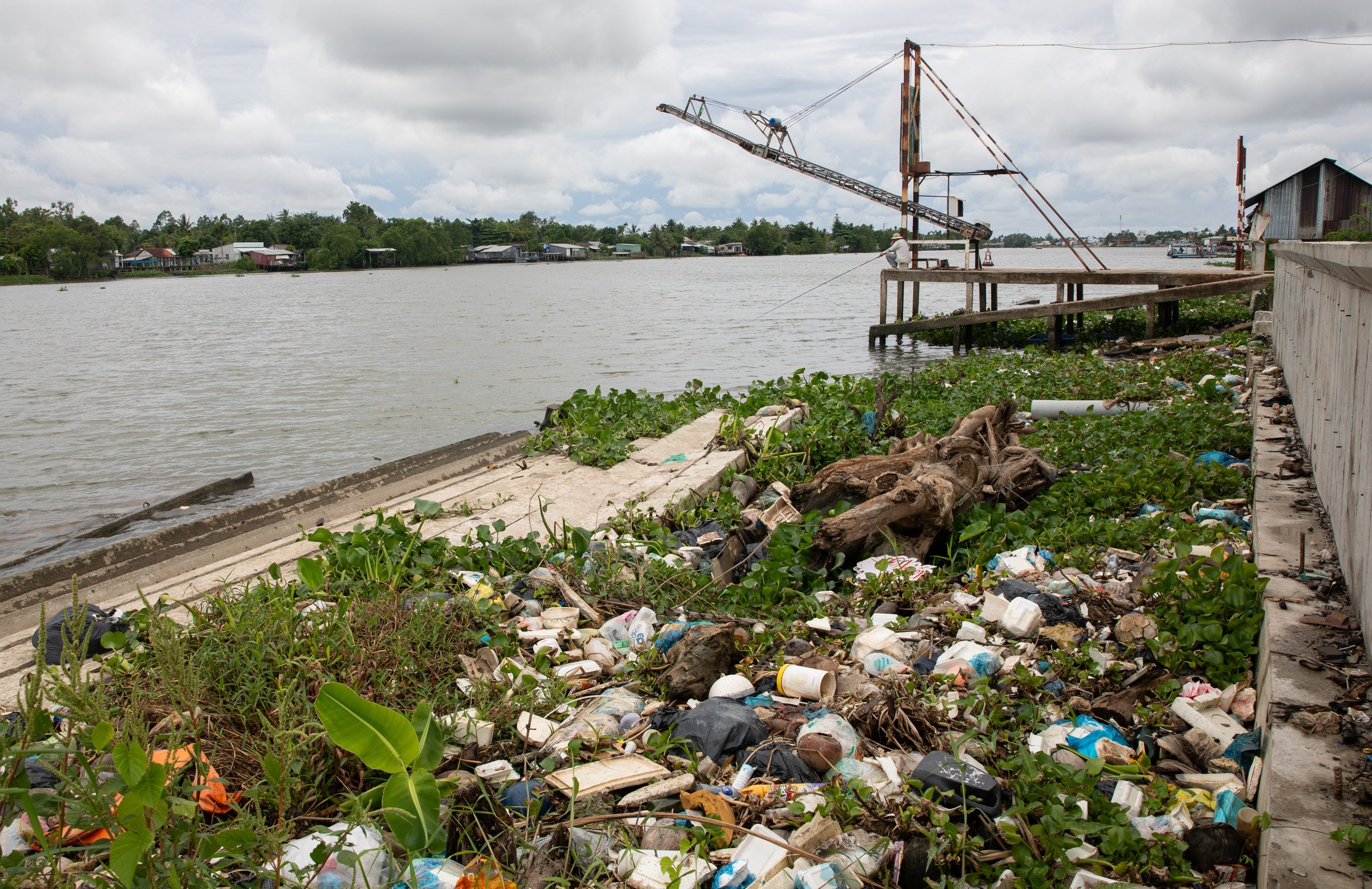
(PLVN) – Nhiều kênh rạch tại TP HCM đang trong tình trạng ô nhiễm, tái ô nhiễm. Cư dân ở những khu vực này không những phải chịu hoàn cảnh sống “nghẹt thở” mà còn đối mặt với nguy cơ dịch bệnh.
Khổ vì kênh nước đen
Nhiều người dân khu vực rạch Văn Thánh, Bình Thạnh, TP HCM lâu nay đã phải sống cạnh một dòng kênh đen nghịt, bốc mùi khó chịu. Nguyên nhân do tình trạng bồi lấp dòng và lấn chiếm dòng rạch kéo dài, con rạch không có khả năng thoát nước, gây ùn ứ và rác thải.
Tiếp tục đọc “Báo động thực trạng ô nhiễm và tái ô nhiễm kênh rạch ở TP HCM”