USAID Provides Critical Benefits to US National Security

Councilonstrategicrisks.org February 4, 2025

Center for Climate and Security, CSR Blog


The Trump Administration’s effort to try to shut down USAID and pause all foreign aid directly harms US national security, including by interrupting critical investments into resilience, adaptation, conflict prevention, and peacebuilding. In 2021, 79 senior national security leaders, including 8 retired 4-star generals and admirals, a former Director of National Intelligence, and a former Director of the Central Intelligence Agency, signed the Challenge Accepted report, which argued that USAID investments in resilience and adaptation were critical to preventing instability and conflict and maintaining the US competitive edge with China. 

In the Indo-Pacific, USAID investments in disaster response and resilience pay dividends in strengthening relationships with allies and partners critical to that competition with China. Take Papua New Guinea as an example, where the US signed a new security pact in 2022, gaining exclusive access to develop and operate out of PNG bases. As Admiral Sam Locklear, former head of US INDOPACOM, and Erin Sikorsky, Director of CCS, wrote, “To sustain and maintain this presence, the United States will need access to reliable energy sources, clean, fresh water, and an economically vibrant, healthy local population.” Those functions are all supported by USAID efforts, such as the $3.5 million in disaster response funds the agency allocated to PNG in 2024. 

Meanwhile, in the Sahel region of Africa, USAID investments in climate adaptation and resilience help prevent extremist and terrorist group recruitment in communities affected by climate hazards.  For example, the Resilience in the Sahel Enhanced (RISE) program funded by USAID aims to break cycles of crisis in the region that enable groups like Boko Haram and ISIS-W to thrive. AS US AFRICOM Commander Michael Langley noted in testimony to Congress, international aid and development programs “attack the roots of terrorism and tyranny more than bullets and air strikes ever will.”

Further, as we outlined in this article last week, USAID programs focused on agriculture resilience have helped curb irregular migration from Honduras to the United States by helping local farmers weather risk and stay in the country. Upstream investments before crises hit cost significantly less than waiting until such challenges become full-blown crises. 

The bottom line is that addressing critical, bipartisan national security priorities requires a robust 3D approach to US foreign policy—defense, diplomacy, and development. Anything less is short-sighted and puts the country at risk. CCS Advisory Board member and former commander of US Central Command General Anthony Zinni (USMC, Ret.) has endorsed CCS recommendations to expand USAID work on climate and food security. He said as Co-Chair of the US Global Leadership Coalition’s National Security Advisory Council, “a freeze on all U.S. foreign assistance – at a time when our rivals are playing to win – takes the U.S. off the playing field and diminishes U.S. strength around the world.”

Online fraud leaves nobody safe – The vast and sophisticated global enterprise that is Scam Inc

economist.com

EDGAR MET Rita on LinkedIn. He worked for a Canadian software company, she was from Singapore and was with a large consultancy. They were just friends, but they chatted online all the time. One day Rita offered to teach him how to trade crypto. With her help, he made good money. So he raised his stake. However, after Edgar tried to cash out, it became clear that the crypto-trading site was a fake and that he had lost $78,000. Rita, it turned out, was a trafficked Filipina held prisoner in a compound in Myanmar.

In their different ways, Edgar and Rita were both victims of “pig-butchering”, the most lucrative scam in a global industry that steals over $500bn a year from victims all around the world. In “Scam Inc”, our eight-part podcastThe Economist investigates the crime, the criminals and the untold suffering they cause. “Scam Inc” is about the most significant change in transnational organised crime in decades.

Pig-butchering, or sha zhu pan, is Chinese criminal slang. First the scammers build a sty, with fake social-media profiles. Then they pick the pig, by identifying a target; raise the pig, by spending weeks or months building trust; cut the pig, by tempting them to invest; and butcher the pig by squeezing “every last drop of juice” from them, their family and friends.

The industry is growing fast. In Singapore scams have become the most common felony. The UN says that in 2023 the industry employed just under 250,000 people in Cambodia and Myanmar; another estimate puts the number of workers worldwide at 1.5m. In “Scam Inc” we report how a man in Minnesota lost $9.2m and how a bank in rural Kansas collapsed when its chief executive embezzled $47m to invest in crypto, under the tutelage of a fake online woman, called Bella. A part-time pastor, he also stole from his church.

Online scamming compares in size and scope to the illegal drug industry. Except that in many ways it is worse. One reason is that everyone becomes a potential target simply by going about their lives. Among the victims we identify are a neuroscience PhD and even relatives of FBI investigators whose job is to shut scams down. Operating manuals give people like Rita step-by-step instructions on how to manipulate their targets by preying on their emotions. It is a mistake to think romance is the only hook. Scammers target all human frailties: fear, loneliness, greed, grief and boredom.

The Countries with the Most Stateless People

Visual Capitalist: By Arciom Antanovič  Featured Creator Article/Editing: Ryan Bellefontaine

Demographics

Mapped: The Countries with the Most Stateless People

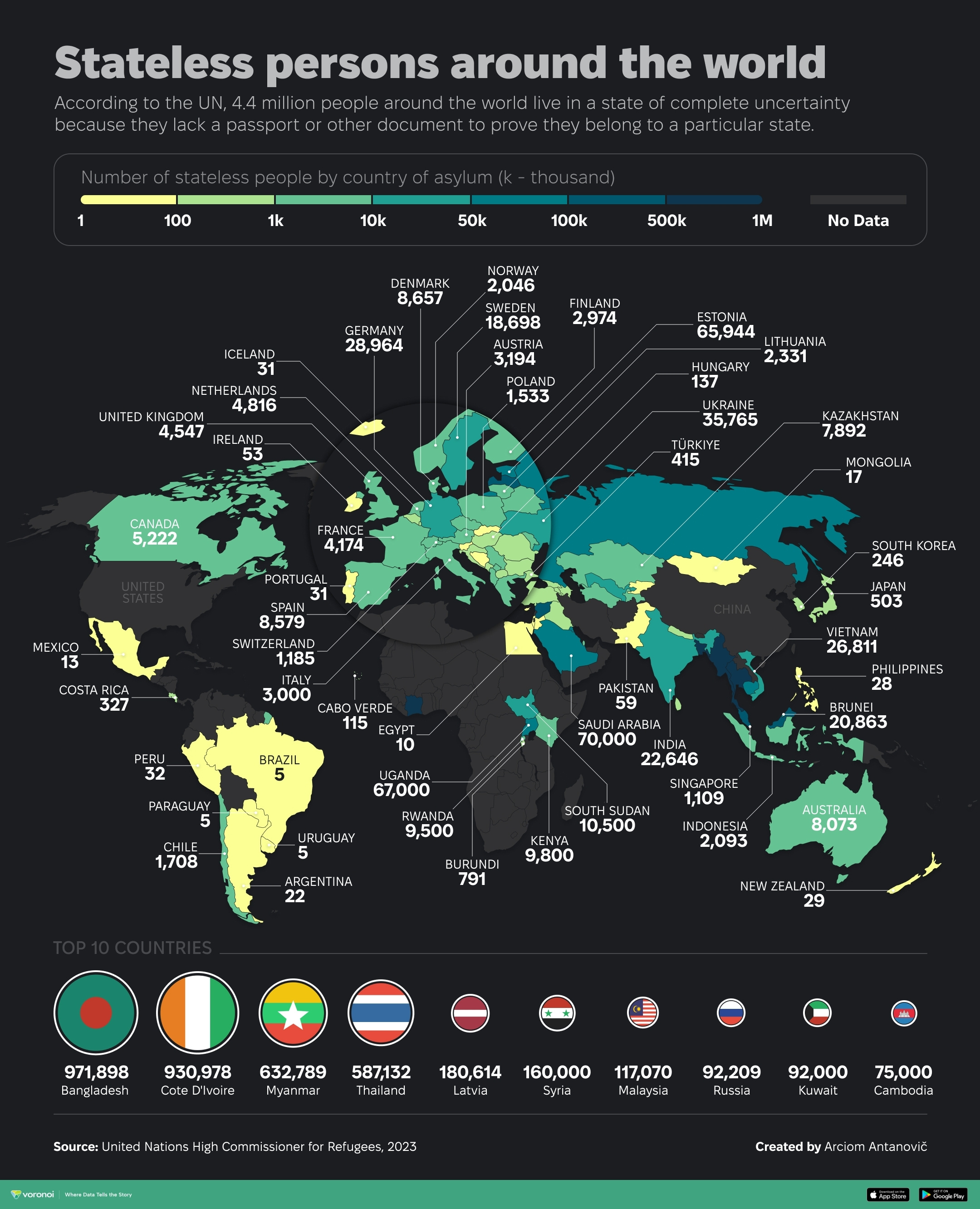
A map of the countries with the most stateless persons in 2023, using data from the United Nations High Commissioner for Refugees.

Mapped: The Countries with the Most Stateless People

This was originally posted on our Voronoi app. Download the app for free on iOS or Android and discover incredible data-driven charts from a variety of trusted sources.

The United Nations High Commissioner for Refugees (UNHCR) officially recognizes over 4.4 million people worldwide as stateless or of undetermined nationality. However, the actual number is likely much higher due to data collection challenges.

Stateless persons—those not recognized as citizens of any country—are deprived of fundamental rights such as education, healthcare, and employment, leaving them highly vulnerable to exploitation and discrimination. But which countries have the most?

This map, created by Arciom Antanovič, uses data from the United Nations High Commissioner for Refugees to show the countries with the most stateless persons in 2023.

Bangladesh Tops the List

Certain countries are home to a disproportionate share of the world’s stateless people, often due to historical, social, and legal complexities.

Bangladesh comes in first with 971,898, followed by Côte d’Ivoire with 930,978, while Myanmar comes in third with 632,789.Search:

Country of AsylumStateless Persons
🇦🇱 Albania2,018
🇦🇷 Argentina22
🇦🇲 Armenia520
🇦🇺 Australia8,073
🇦🇹 Austria3,194
🇦🇿 Azerbaijan513
🇧🇩 Bangladesh971,898
🇧🇾 Belarus5,567
🇧🇪 Belgium936
🇧🇦 Bosnia and Herzegovina21

‹12345…10›

The raw number drops significantly after the fourth-placed Thailand with 587,132, as the fifth-placed Latvia only has 180,614.

The Causes of Statelessness

One of the primary drivers of statelessness is that in some countries, nationality can only be inherited through the father. When fathers are absent, the children may be left without a recognized nationality. This issue is particularly harmful for single mothers and families separated by conflict or migration.

Another significant cause of statelessness is racial and ethnic discrimination. Some governments use citizenship laws to exclude specific minority groups. In Myanmar, the Rohingya are a well-known example of such discrimination.

Geopolitical changes, such as shifting borders and citizenship revocation, also contribute to the issue. Governments sometimes strip individuals of their nationality as a punitive measure.

Addicted: how the world got hooked on illicit drugs – and why we need to view this as a global threat like climate change

theconversation.com

It has taken decades for some to accept the devastating effects of climate change on our planet. Despite scientific evidence that was available years ago, many people were reluctant to make the connection between increasing use of fossil fuels, rising global temperatures and devastating weather events.

A key reason for this reluctance is the dislocation of cause and effect, both in time and geography. And here there are clear parallels with another deadly human activity that is causing increasing levels of suffering across the planet: the production, trafficking and consumption of illicit drugs. Here are some troubling “highlights” from the UN’s latest World Drugs Report:

Cocaine production is reaching record highs, with production climbing in Latin America coupled with drug use and markets expanding in Europe, Africa and Asia.

Synthetic drugs are also inflicting great harm on people and communities, caused by an increase in methamphetamine trafficking in south-west Asia, the near and Middle East and south-eastern Europe, and fentanyl overdoses in North America.

Meanwhile, the opium ban imposed by the de facto authorities in Afghanistan is having a significant impact on farmers’ livelihoods and incomes, necessitating a sustainable humanitarian response.

The report notes how organised criminal groups are “exploiting instability and gaps in the rule of law” to expand their trafficking operations, “while damaging fragile ecosystems and perpetuating other forms of organised crime such as human trafficking”.

Tiếp tục đọc “Addicted: how the world got hooked on illicit drugs – and why we need to view this as a global threat like climate change”

The Value of the Truth

Ruth Thalía’s truth would cost her everything. On national television in Peru, the nineteen-year-old revealed her darkest secrets for a prize, only to be found dead just two months later. A game show called ‘The Value of the Truth’ launched in South America in 2012. In it, contestants must reveal the most shocking and intimate details about their own lives in front of their loved ones in exchange for a prize jackpot.

UNCTAD16: Countries to meet in Viet Nam to propel development in a multipolar world

UNCTAD

17 January 2025

UN Trade and Development’s 16th quadrennial conference is set for October with a focus on driving economic transformation for a more sustainable future.

Default image copyright and description© UNCTAD Photo | The Trade and Development Board meets for its 33rd special session in Geneva on 17 January.

The 16th session of the United Nations Conference on Trade and Development (UNCTAD16) will take place Viet Nam in October 2025 under the theme “Shaping the future: Driving economic transformation for equitable, inclusive and sustainable development”.

Tiếp tục đọc “UNCTAD16: Countries to meet in Viet Nam to propel development in a multipolar world”

Sex Inequalities in Medical Research: A Systematic Scoping Review of the Literature

National Library of Medicine

Lea Merone 1,*Komla Tsey 1Darren Russell 1,2Cate Nagle 1

Abstract

Background: Historically, medical studies have excluded female participants and research data have been collected from males and generalized to females. The gender gap in medical research, alongside overarching misogyny, results in real-life disadvantages for female patients. This systematic scoping review of the literature aims to determine the extent of research into the medical research sex and gender gap and to assess the extent of misogyny, if any, in modern medical research.

Methods: Initial literature searches were conducted using PubMed, Science Direct, PsychINFO and Google Scholar. Articles published between January 01, 2009, and December 31, 2019, were included. An article was deemed to display misogyny if it discussed the female aesthetic in terms of health, but did not measure health or could not be utilized to improve clinical practice.

Results: Of the 17 included articles, 12 examined the gender gap in medical research and 5 demonstrated misogyny, assessing female attractiveness for alleged medical reasons. Females remain broadly under-represented in the medical literature, sex and gender are poorly reported and inadequately analyzed in research, and misogynistic perceptions continue to permeate the narrative.

Conclusion: The gender gap and misogynistic studies remain present in the contemporary medical literature. Reasons and implications for practice are discussed.

Tiếp tục đọc “Sex Inequalities in Medical Research: A Systematic Scoping Review of the Literature”

Only 0.5% of neuroscience studies look at women’s health

inspirethemind.org 

Neuroscience has Underserved Women. That’s Changing

A symmetrical pattern of brains are shown against a light-blue background.
Photo by DS stories on Pexels.

Neuroscientists are making strides in mapping and understanding the human brain, but like many other scientific fields, neuroscientific research has suffered from gender bias: men have been studied far more than women.

Since it came on the scene, magnetic resonance imaging (MRI), where a magnetic camera looks through the skull and captures pictures of a living brain, mountains of neuroimaging studies have been made by scientists eagerly delving into the most complex organ we have. It’s led to amazing discoveries and insights, and revolutionised our understanding of how we function.

But the neuroscientific investigation into brain health in relation to conditions only affecting women, girls, and people who have or have had menstrual periods, has been comparably pitifully small.

My name’s Livia. I’m a freelance science writer and journalism student, and I found myself diving into this as I wondered why hormonal birth control, several decades after its invention, still causes negative effects on many users’ moods and well-being. Shouldn’t somebody have looked into how our brains get affected when we go on the pill — and created something better?

It turns out that this large neuroscience knowledge gap leaves billions of people in the dark about the organ that creates their lived experiences, affects drug development, and is bad for science, generally.

It’s time for neuroscience to catch up.

Tiếp tục đọc “Only 0.5% of neuroscience studies look at women’s health”

The deadly truth about a world built for men – from stab vests to car crashes

theguardian.com

Crash-test dummies based on the ‘average’ male are just one example of design that forgets about women – and puts lives at risk

Caroline Criado PerezSat 23 Feb 2019 08.59 GMTShare822

When broadcaster Sandi Toksvig was studying anthropology at university, one of her female professors held up a photograph of an antler bone with 28 markings on it. “This,” said the professor, “is alleged to be man’s first attempt at a calendar.” Toksvig and her fellow students looked at the bone in admiration. “Tell me,” the professor continued, “what man needs to know when 28 days have passed? I suspect that this is woman’s first attempt at a calendar.”

Women have always tracked their periods. We’ve had to. Since 2015, I’ve been reliant on a period tracker app, which reassures me that there’s a reason I’m welling up just thinking about Andy Murray’s “casual feminism”. And then there’s the issue of the period itself: when you will be bleeding for up to seven days every month, it’s useful to know more or less when those seven days are going to take place. Every woman knows this, and Toksvig’s experience is a neat example of the difference a female perspective can make, even to issues that seem entirely unrelated to gender.

For most of human history, though, that perspective has not been recorded. Going back to the theory of Man the Hunter, the lives of men have been taken to represent those of humans overall. When it comes to the other half of humanity, there is often nothing but silence. And these silences are everywhere. Films, news, literature, science, city planning, economics, the stories we tell ourselves about our past, present and future, are all marked – disfigured – by a female-shaped “absent presence”. This is the gender data gap.

These silences, these gaps, have consequences. They impact on women’s lives, every day. The impact can be relatively minor – struggling to reach a top shelf set at a male height norm, for example. Irritating, certainly. But not life-threatening. Not like crashing in a car whose safety tests don’t account for women’s measurements. Not like dying from a stab wound because your police body armour doesn’t fit you properly. For these women, the consequences of living in a world built around male data can be deadly.

The gender data gap is both a cause and a consequence of the type of unthinking that conceives of humanity as almost exclusively male. In the 1956 musical My Fair Lady, phoneticist Henry Higgins is baffled when, after enduring months of his hectoring put-downs, his protege-cum-victim Eliza Doolittle finally bites back. “Why can’t a woman be more like a man?” he grumbles.

Tiếp tục đọc “The deadly truth about a world built for men – from stab vests to car crashes”

Gaza Doctor Corrects CNN Anchor: ‘This Is Not a Humanitarian Crisis… This Is Genocide’

commondreams.org

“History books will be written on this and countries will have to reckon—media agencies will have to reckon—with their major role in the genocide,” said Dr. Tanya Haj-Hassan.

Brett Wilkins

Dr. Tanya Haj-Hassan appears on CNN

Dr. Tanya Haj-Hassan (left) pushes back on CNN anchor Kate Bolduan’s (center) description of the Gaza genocide as a “humanitarian crisis” during an October 7, 2024 interview. 

(Photo: CNN screen grab)

Oct 11, 2024

Human rights advocates on Friday highlighted a rare instance in which a U.S. corporate media outlet allowed a pro-Palestinian voice to set the record straight about Israel’s crimes against humanity in Gaza.

Earlier this week, CNN “News Central” aired a panel segment on the anniversary of the October 7, 2023 Hamas-led attack on Israel and Israel’s retaliatory war. Anchor Kate Bolduan noted that around 1,200 people were killed during the Hamas attack—although she did not say that at least some of them were slain by Israeli forces in “friendly fire” incidents and under the Hannibal Directive—and that 250 others were kidnapped.

Tiếp tục đọc “Gaza Doctor Corrects CNN Anchor: ‘This Is Not a Humanitarian Crisis… This Is Genocide’”

Atomic Bomb Survivors Win Nobel Peace Prize, Say Gaza Today Is Like Japan 80 Years Ago

Nobel Peace Prize Winner Toshiyuki Mimaki: “I thought the prize would go to those working hard in Gaza. In Gaza, bleeding children are being held by their parents. It’s like Japan 80 years ago.” 36,000 tons of explosives were dropped on Hiroshima/Nagasaki 82,000 tons have been dropped on Gaza

A Japanese group of atomic bomb survivors, Nihon Hidankyo, has won the Nobel Peace Prize as fears grow of a new nuclear arms race. The head of the group has compared Gaza today to Japan 80 years ago when the U.S. bombed Hiroshima and Nagasaki. We feature a Democracy Now! interview with Setsuko Thurlow, a survivor of the U.S. atomic bombing of Hiroshima and an anti-nuclear activist, and get response from Joseph Gerson, president of the Campaign for Peace, Disarmament and Common Security, a U.S. nuclear disarmament activist who has spent decades working closely with the group.

‘Hopeless and broken’: why the world’s top climate scientists are in despair

We asked 380 top climate scientists what they felt about the future…

theguardian.com

 Hopeless and broken – Ruth Cerezo-Mota Mexico

 We live in an age of fools – Anonymous South Africa

I worry about the future my children are inheriting – Lorraine Whitmarsh UK

They are terrified, but determined to keep fighting.Here’s what they said

Exclusive: Survey of hundreds of experts reveals harrowing picture of future, but they warn climate fight must not be abandoned

Damian Carrington Environment editorWed 8 May 2024 10.00 BSTShare

“Sometimes it is almost impossible not to feel hopeless and broken,” says the climate scientist Ruth Cerezo-Mota. “After all the flooding, fires, and droughts of the last three years worldwide, all related to climate change, and after the fury of Hurricane Otis in Mexico, my country, I really thought governments were ready to listen to the science, to act in the people’s best interest.”

Instead, Cerezo-Mota expects the world to heat by a catastrophic 3C this century, soaring past the internationally agreed 1.5C target and delivering enormous suffering to billions of people. This is her optimistic view, she says.

Tiếp tục đọc “‘Hopeless and broken’: why the world’s top climate scientists are in despair”

The world is reducing its reliance on fossil fuels – except for in three key sectors

theguardian.com

Dramatic changes in energy industry and EVs reducing fossil fuel use, but shipping, aviation and industry a long way from net zero

@olliemilmanFri 9 Feb 2024 12.00 GMT

Humanity has made some uneven progress in reducing our addiction to fossil fuels – but there remain three areas of our lives in which we are notably not on track to kick the habit over the next 30 years, according to a new analysis.

Record levels of investment in clean energy (solar has been called the cheapest source of electricity in history by the International Energy Agency) and a decline in coal-powered generation means less and less of the world’s power will come from fossil fuels between now and 2050, the analysis from Rhodium shows.

Similarly, the blossoming electric vehicle market is going to drive down emissions from cars and trucks, with global oil consumption for on-road vehicles set to drop by 50% over the next three decades, the forecast finds.

But even with these dramatic changes reshaping two of the world’s hungriest consumers of fossil fuels, emissions are still a long way from hitting net zero by 2050, as scientists say they must if dangerous global heating – spurring worsening heatwaves, floods, droughts and more – is to be avoided.https://interactive.guim.co.uk/uploader/embed/2024/02/archive-zip/giv-13425ZCBwhBxEyLin/

A major reason for this is the stubborn, ongoing carbon pollution from three areas: aviation, shipping and industry.

.https://interactive.guim.co.uk/uploader/embed/2024/02/archive-zip/giv-13425v3zDOTaHHQGz/

There is currently no widespread alternative to jet fuel or ship diesel, meaning steady or even rising fossil fuel use as developing countries’ economies grow. A range of industrial processes – such as cement-making and the production of plastic – will collectively fail to meaningfully cut carbon-intensive fuels by 2050, too.

“We’ve made a lot of progress in the last few years – wind and solar are really poster children of success and electric vehicles are at a turning point now,” said Hannah Pitt, associate director at Rhodium, which made the projections based on anticipated policies until 2050.

“That makes up a good chunk of emissions but there is much less progress in other sectors. With aviation and shipping, there’s just not as much innovation and no clear cost-effective alternatives to fossil fuels.

“And then we have industrial processes that make up a huge fraction of emissions and each require their own tools and innovations to bring that down, and emissions are staying stubbornly high.”

All told, global fossil fuel use will likely flatten or decline by mid-century before starting to grow again due to rising energy demand in various parts of the world, according to the report’s projections. Gas will lead the way, rising significantly in use even as oil and coal decline.https://interactive.guim.co.uk/uploader/embed/2024/02/archive-zip/giv-13425v3zDOTaHHQGz/

Pitt said we are still a long way from breaking our dependence on fossil fuels in everything from switching on a light at home, to driving a car, to getting an Amazon package delivered, to flying to a holiday destination.

“The success with renewables and EVs shows it can be done, but it really will take a lot of different policies and innovations. There’s no one solution,” said Pitt.

“This is a good reminder that climate change touches every piece of our economies, and it needs solutions to each of those areas. There is a lot of work to do.”

International business in Russia risks slipping from compliance to complicity

businesshumanrights.org

Moscow City Towers on the bank of Moskva River

On 21 September, 2022, an IT specialist with the Austrian Raiffeisen Bank, Timur Izmailov, was leading a normal life in Moscow. Three weeks later Izmailov found himself serving as a soldier in Russia’s 27th motorized rifle brigade near the Ukrainian city of Svatove, when he was eventually killed by mortar fire. How does a 33-year-old techie make his way from his cubicle to the frontline of an unprovoked war in a neighbouring democratic state?

Timur’s journey began on 24 February, 2022, when President Vladimir Putin ordered the all-out military invasion of Ukraine in continuation of a war started in 2014. The response was immediate. The Ukrainian people and their leadership — with the support of the democratic allies — have defended themselves against armed aggression despite gross human rights violations.

Western sanctions imposed on Russia created an extremely hostile commercial environment for companies such as Raiffeisen to continue their operations in the aggressor state. Many international firms pulled out, announcing plans to leave or suspend activity in Russia. But many more international companies continue to operate and pay taxes, thus contributing to the occupation of Ukraine and undermining the financial support provided to Ukraine by their own governments.

On 21 September 2022, President Vladimir Putin issued the mobilization decree that obliged companies to immediately assist in conscripting soldiers and help equip the Russian army. The results of this piece of legislation were immediately felt by many, including Timur Izmailov. Raiffeisen’s attempts to shield their staff from the draft failed.

How do bank employees in other countries feel knowing this is happening to their colleagues in Russia? How does a client of Raiffeisen based in Vienna feel, knowing the employees of his bank might soon become soldiers sent to the battlefield to kill innocent civilians in Ukraine?

An additional stopover on the companies’ journey from compliance to complicity happened last July, when Putin signed a new law allowing the government to impose special economic measures to support “counter-terrorism and other operations outside of Russia”. Once introduced, such measures would require companies to provide goods and services in support of these operations and impose significant penalties for failing to do so. In accordance with the law of 7 October 2022, the Russian subsidiary of Raiffeisen Bank International is now obliged to provide loan payment holidays to the troops fighting in Ukraine. Moreover, the bank is required to write off the entire debt in case of a soldier’s death. This legal requirement concerns other financial institutions that still operate in Russia, namely Intesa Sanpaolo, OTP Bank, ING Bank, Credit Agricole, Citibank, Credit Europe Bank and UniCredit.

This loan relief scheme has already triggered criticism from Ukraine’s central bank, as well as from investors concerned about reputational impact. The requirement for banks to grant payment holidays to soldiers “illustrates the dangers of operating in jurisdictions where companies can…be forced into actions that go directly against their corporate values,” said Eric Christian Pederson of Nordea Asset Management. “We feel that it is right for companies to withdraw from Russia, given its unprovoked attack on Ukraine,” he added.

Tiếp tục đọc “International business in Russia risks slipping from compliance to complicity”