Firmer ties between EU and ASEAN on clean technology

An EU-organised trade mission brought Europe’s leading cleantech companies to meet Southeast Asian firms, creating new growth opportunities and strengthening trade ties between both regions.

European clean technology firms and their Southeast Asian counterparts spent a week exploring new collaborations and growth opportunities during a trade mission to Singapore and Vietnam – a move that is expected to strengthen trade ties between both regions.

Organised by the EU delegation to Singapore, the EU Business Avenues trade mission brought 41 small and medium enterprises (SMEs) from Europe’s energy efficiency, pollution, waste and water technology sectors to explore opportunities in Southeast Asia. Tiếp tục đọc “Firmer ties between EU and ASEAN on clean technology”

Rising fossil fuel energy costs spell trouble for global food security

Date: July 1, 2015

Source:Oregon State UniversitySummary:In an analysis of food preservation and transportation trends, scientists warn that new sustainable technologies will be needed for humanity just to stay even in the arms race against the microorganisms that can rapidly spoil the outputs of the modern food system.

FULL STORY

Sciencedaily – Ongoing efforts to feed a growing global population are threatened by rising fossil-fuel energy costs and breakdowns in transportation infrastructure. Without new ways to preserve, store, and transport food products, the likelihood of shortages looms in the future.

In an analysis of food preservation and transportation trends published in this week’s issue of the journal BioScience, scientists warn that new sustainable technologies will be needed for humanity just to stay even in the arms race against the microorganisms that can rapidly spoil the outputs of the modern food system. Tiếp tục đọc “Rising fossil fuel energy costs spell trouble for global food security”

Geneticists reveal what makes great rice

Gene responsible for long grains and pleasing texture can now be bred into existing varieties without sacrificing yield.

Article tools – Rights & Permissions

Xiangdong Fu

Nature – Breeders in China have discovered the secret for creating rice varieties that could improve breakfast, lunch and dinner for millions of people in Asia. Two teams of molecular geneticists, working independently, have identified a gene that controls both shape and texture and can be selected for without sacrificing the yield of the crop. Tiếp tục đọc “Geneticists reveal what makes great rice”

“The Future of Low-Carbon Road Transport: What Role for Second-Generation Biofuels?”

Rapporteur’s Report, Energy Technology Innovation Policy research group, Belfer Center for Science and International Affairs, Harvard Kennedy School

June 2015 Authors: Joern Huenteler, Former Postdoctoral Research Fellow, Energy Technology Innovation Policy research group, Henry Lee, Director, Environment and Natural Resources Program

OVERVIEW

Belfercenter – The promise, prospects, and public policy trade-offs related to second-generation biofuels in road transport were addressed in an executive session convened at The Henry Ford Museum in Dearborn, Michigan, on April 7 and 8, 2015. The workshop brought together twenty-eight of the world’s leading experts from the fields of policy, science, and business for an intensive two-day session (see the Appendix for a list of the participants). The discussions were off-the-record, with each participant present in his or her own capacity, rather than representing his or her organization. This report is a summary of the main points and issues raised over the two days. It has been reviewed by all the participants. The summary is intended to reflect the breadth of the discussion, rather than to suggest any form of overall consensus among the participants. Tiếp tục đọc ““The Future of Low-Carbon Road Transport: What Role for Second-Generation Biofuels?””

Thirsty Yet? Central Asia’s Coming Water Crisis

Thediplomat – “Water is life. Water is health. Water is dignity. Water is a human right,” UN Secretary General Ban Ki-moon said last week at a conference in Tajikistan aimed at assessing the results of the UN’s decade-long “Water for Life” initiative, launched in 2005.

Reportedly 2,000 participants attended the event, hearing more than 70 reports in the Tajik capital, Dushanbe. But, Eurasianet notes, “despite numerous statements of concern, the meeting produced no substantive measures.” Meaningless conferences apparently don’t just happen in Washington, DC. After an entire decade of concerted focus on the issue, Central Asia remains one of the most irresponsible regions when it comes to water.

Tiếp tục đọc “Thirsty Yet? Central Asia’s Coming Water Crisis”

Solving Asia’s water crisis

[Magazine exclusive] Too much, too little, too dirty – when it comes to water, Asia faces complex problems that require governments, multilateral organisations and the corporate sector to work together to solve.

The emerging renewable financing landscape

Green bonds – and a newer, flashier financing vehicle called the yieldco – are generating considerable buzz in the renewable energy sector. In Asia, it’s early days but experts say it’s a matter of time before these financing options become widely available for infrastructure owners and investors.

With more companies, funds and endowments planning to divest from fossil fuels, the role of renewables as a key energy source has never been more important.According to the United Nations Environment Programme (UNEP), in 2014, more than US$270 billion was invested in green energy projects and infrastructure, mainly in solar and wind energy. In June, the US$900 billion Norwegian Government Pension fund, one of the largest in the world, announced that it would begin selling its coal assets which are worth about US$8 billion. Tiếp tục đọc “The emerging renewable financing landscape”

The Impact of Lower Gas and Oil Prices on Global Gas and LNG Markets

OIES – The aftermath of warmer than normal 2013/2014 winters in Europe and Asia, evidence of slowing Asian LNG demand growth through 2014 and the collapse of the oil price in late 2014 has resulted in a painful ‘new normal’ for key players in the global gas system, specifically LNG project investors and Russia/Gazprom. Although this paper has used a similar approach to previous work by the author relating to global LNG interactions, the context in mid 2015 has changed markedly and while the gas industry has in the past experienced and weathered periods of low prices, this time ‘it really does feel different’. At one level we can rationalise the slowdown in Asian LNG demand and stagnant European gas demand as having a direct causal impact on European hub and LNG spot prices. The oil price fall has in parallel brought oil – indexed gas and LNG contract price levels down to levels unimaginable just two years ago. With project economics challenged and cashflows crimped, investors in new gas supply projects, especially LNG, will inevitably hold back, cut costs and await a more positive market outlook.At a more fundamental level however, what we may be about to witness is a significant disruption to regional gas equilibria as a wave of new (Australian) LNG supply meets a slowing Asian market and a significant regional component (US/North America) re-connects with the global system in the form of 77 bcma (and counting) of new LNG export projects. Europe will be a passive recipient of excess supply at a time when its gas demand growth is at best tepid, but its import requirement may be rising due to declining domestic production.
This paper has addressed the following questions:

Tiếp tục đọc “The Impact of Lower Gas and Oil Prices on Global Gas and LNG Markets”

Tiếp sức cho doanh nghiệp vừa và nhỏ

Tiếp sức cho doanh nghiệp vừa và nhỏ

Doanhnhansaigon – Đánh giá lại hiệu quả của các chương trình hỗ trợ phát triển doanh nghiệp nhỏ và vừa tại TP. Hồ Chí Minh là một trong những nội dung quan trọng được đề cập trong buổi hội thảo với chủ đề Hỗ trợ doanh nghiệp phát triển sản xuất kinh doanh hàng Việt và kết nối cung cầu, được tổ chức mới đây trong khuôn khổ Hội chợ – Triển lãm tôn vinh hàng Việt năm 2015 tại Trung tâm Triển lãm và Hội chợ Tân Bình (TP.HCM).

Từ chính sách…

Tính đến thời điểm hiện nay, khoảng 97% trong tổng số trên 800.000 doanh nghiệp trên cả nước là doanh nghiệp nhỏ và vừa (DNNVV), riêng TP. Hồ Chí Minh có gần 152.000 doanh nghiệp. Tiếp tục đọc “Tiếp sức cho doanh nghiệp vừa và nhỏ”

Asia takes the lead on sustainable energy but many still have none

Eco-business – Although Asia has done well on ensuring electricity access for people and using renewable energy, there is room for further improvement on energy efficiency and access to clean, smoke-free cooking. CSR Asia chairman Richard Welford outlines how the private sector can help.

Asian countries are making a vital contribution to achieving global sustainable energy goals, according to a new World Bank report. However, while the region performs strongly on ensuring electricity access for people and using more modern renewable energy, there is room for further improvement on energy efficiency and access to clean, smoke-free cooking, particularly for poor people. In total 1.1 billion people still have no access to adequate energy. Tiếp tục đọc “Asia takes the lead on sustainable energy but many still have none”

Why we need to rethink ‘maladaptation’

By Lindsey Jones 29 June 2015


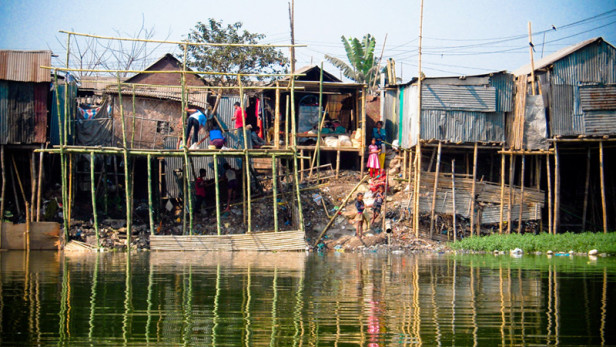
Urban poor communities built stilt houses in Dhaka, Bangladesh, to cope with flooding brought about by climate change. There is concern that actions taken to respond to climate change may end up increasing people’s vulnerability now or in the future. Photo by: Development Planning Unit / University College London / CC BY

Devex – “Maladaptation” is a hot topic in the climate change community. With increasing global attention and finance being poured into adaptation, people are understandably concerned that actions taken to respond to climate change may end up increasing people’s vulnerability now or in the future.

But what does maladaptation actually look like? One example comes from Ho Chi Minh City, Vietnam, where city planners drew up and started to implement many infrastructure projects to help mitigate the risk of flooding. The design of these infrastructural investments was based on the best information and predictions of future climate and development trends available at the time. Tiếp tục đọc “Why we need to rethink ‘maladaptation’”

Political science’s problem with research ethics

Ethicist Trisha Phillips discusses the fall-out from the Michael LaCour scandal.

Article tools – Rights & Permissions

Courtesy of Trisha Phillips

Research ethicist Trisha Phillips studies the factors that lead people into research misconduct.

Nature – Researchers are still debating what academia can learn from last month’s political science scandal: a now-retracted paper in Science reported that gay canvassers could sway voter opinions on same-sex marriage (Science http://doi.org/4zt; 2015).

Michael LaCour, a graduate student in political science at the University of California, Los Angeles, has admitted misrepresenting some aspects of the work, and there is now little evidence left that he ever conducted the survey he detailed in the paper. An investigation is ongoing at LaCour’s institution, while Princeton University in New Jersey, where he was due to start a new job in the coming academic year, rescinded its employment offer. Tiếp tục đọc “Political science’s problem with research ethics”

Vắng bóng DN tư nhân trong chính sách nông nghiệp của ASEAN

Một vấn đề lớn được đặt ra trước thời điểm Cộng đồng Kinh tế ASEAN hình thành: Làm thế nào để tăng cường sự hợp tác trong ASEAN như tăng cường sự phát triển bền vững, tăng khả năng cạnh tranh trong sản xuất nông nghiệp?

Vắng bóng DN tư nhân trong chính sách nông nghiệp của ASEAN

Doanhnhansaigon – Thách thức lớn đặt ra cho Việt Nam và các nước ASEAN là đáp ứng nhu cầu ngày càng tăng của thế giới về các mặt hàng sản xuất theo hướng bền vững như gạo, cà phê, chè và các mặt hàng nông sản quan trọng khác. Tiếp tục đọc “Vắng bóng DN tư nhân trong chính sách nông nghiệp của ASEAN”

Germany Gives Dirtiest Coal Plants Six Years for Phase Out

July 2, 2015 — 9:24 AM BST Updated on July 2, 2015 — 3:03 PM BST
A Coal-Fired Power Plant
A coal-fired power plant in Janschwalde, Germany. The government’s coal plans would mean immediate closures of lignite mines and power stations, RWE AG Chief Executive Officer Peter Terium told shareholders on April 23. Photographer: Krisztian Bocsi/Bloomberg

Bloomberg – Germany’s main political parties worked out a compromise plan to cut power-industry pollution by handing a six-year lifeline to some of the dirtiest coal-fired plants. Tiếp tục đọc “Germany Gives Dirtiest Coal Plants Six Years for Phase Out”

Thai Solar Energy Plans 300 MW Solar PV Capacity In Japan

July 2nd, 2015 by

Cleantechnica– Global interest in Japan’s renewable energy sector, specifically the solar power market, continues to strengthen with a major developer from Thailand looking to boost its footprint in the land of the rising sun.

Thai Solar Energy has announced that it will set up 300 MW worth of solar power capacity in Japan over the next 3 years. The company will start with the implementation of a 25 MW solar power plant, then expand the installed capacity to 100 MW by the end of 2016, which will eventually be increased to 300 MW.

Thai Solar Energy claims to be “the first company in Southeast Asia to have effectively applied solar energy commercially.” The company is moving into Japan as the government policies support development of renewable energy projects and a large number of solar power projects are already under construction. Tiếp tục đọc “Thai Solar Energy Plans 300 MW Solar PV Capacity In Japan”