Trust Empirical View – Levels of Trust across Countries

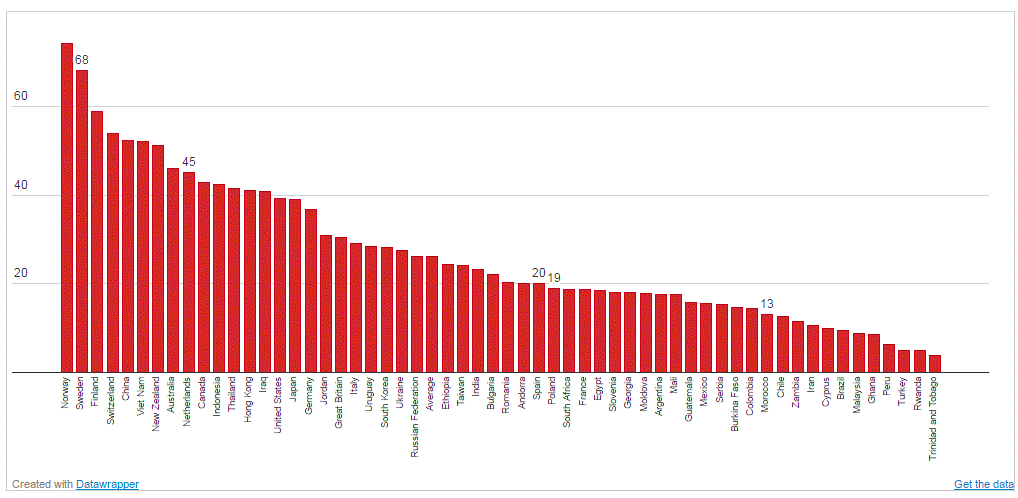
ourworldindata – Levels of Trust by Country: ‘Generally speaking, would you say that most people can be trusted or that you need to be very careful in dealing with people?’ Possible Answers ‘Most people can be trusted’ or ‘Can’t be too careful’ – Max Roser1

Trust 1

Correlates, Determinants & Consequences

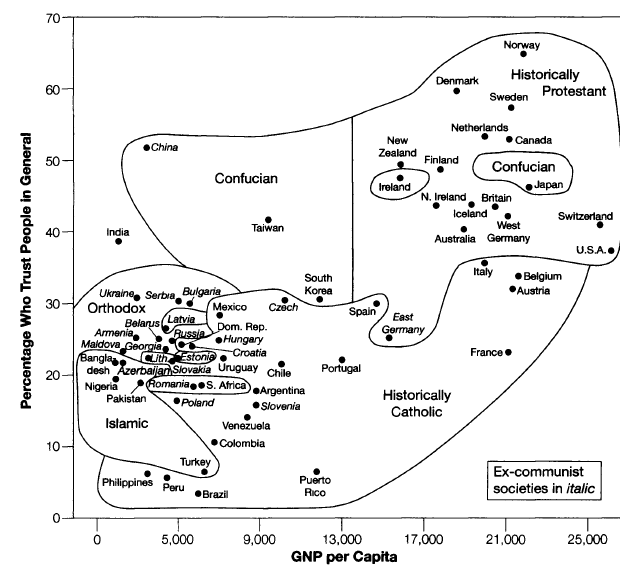
Percentage of people who trust people in general vs GNP per capita – Beinhocker (2006)2

The Relationship Between Trust and Economic Performance – Beinhocker (2006)

Percentage of people expressing high level of trust in others (2008) vs. income inequality by Gini index (mid-2000s) – Max Roser3

From Omen to Opportunity: How Cheap Oil Is Accelerating Sustainable Energy Investment

An increasingly unprofitable global oil market is driving fuel prices to historic lows and hemorrhaging investment in conventional energy sources. Breaking with tradition, cheap oil no longer foretells disaster for renewable energy companies. On the contrary, disillusioned fossil fuel investors are seeking high-growth opportunities—just in time to ride the renewables wave in the wake of the 2015 Paris climate talks.

worldwatch – Crashing out in February at $27 per barrel, crude oil prices have reached their lowest point in over 13 years, since the 2003 U.S.-led invasion of Iraq. Despite a modest recovery in March driven by expectations for reduced production, investors remain skeptical of underlying oil market fundamentals and are reducing their exposure. These selloffs have dragged down the stock prices of large conventional energy companies listed in the Standard & Poor’s 500 Index by 13 percent and have cost investors more than $703 billion since the record-high oil prices of June 2014.

Responding to these selloffs, oil companies have tightened their belts, decommissioning two-thirds of their rigs and sharply cutting investment in oil field exploration and development, while an estimated 250,000 oil workers have lost their jobs. A Wood Mackenzie report identified 68 major oil and natural gas projects—representing a combined value of $380 billion and output of 2.9 million barrels of oil equivalent (boe) per day—that have been put on hold since late 2014. Besides reducing operating costs, oil companies hope that these measures will have a stabilizing effect on the market by reducing productive capacity in the medium to long term. Tiếp tục đọc “From Omen to Opportunity: How Cheap Oil Is Accelerating Sustainable Energy Investment”

ASEAN PLAN OF ACTION FOR ENERGY COOPERATION (APAEC) 2016-2025

FULL REPORT

EXECUTIVE SUMMARY

Energy is key to the realisation of the ASEAN Economic Community (AEC) which calls for a well-connected ASEAN to drive an integrated, competitive and resilient region. Energy is key to the realisation of the ASEAN Economic Community (AEC) which calls for a well-connected ASEAN to drive an integrated, competitive and resilient region.

ASEAN is now one of the most dynamic and fastest growing economic regions in the world, and through the implementation of the AEC by end of December 2015, this growth is expected to continue. The region is projected to grow by at least 4% per year on average over the next five years, but could be as high as 6% – provided ASEAN moves towards greater integration, where member states continuously implement domestic structural reforms to raise their productivity and competitiveness under the framework of the AEC.

1 To fuel this growth, the demand in primary energy
2 is expected to grow by an average of 4.7% per year from 2013 to reach 1,685 Mtoe in 2035, according to the ASEAN Centre for Energy’s (ACE) 4 th ASEAN Energy Outlook (AEO4).

Addressing this growing demand for energy, which is driven by both economic and demographic growth, has been a challenge for ASEAN ahead of the AEC. Against this backdrop, the 32 nd ASEAN Ministers on Energy Meeting (AMEM) held on 23 rd September 2014 in Vientiane, Lao PDR, endorsed the theme of the new ASEAN Plan of Action for Energy Cooperation (APAEC) 2016-2025 as “Enhancing Energy Connectivity and Market Integration in ASEAN to Achieve Energy Security, Accessibility, Affordability and Sustainability for All” .

The theme also reflects the central elements of connectivity and energy security captured in the Nay Pyi Taw Declaration on the ASEAN Community’s Post 2015 Vision adopted by the ASEAN Leaders at the 25 th ASEAN Summit in Nay Pyi Taw, Myanmar, on 12 th November 2014 The key initiatives under this APAEC include embarking on multilateral electricity trading to accelerate the realisation of the ASEAN Power Grid (APG), enhancing gas connectivity by expanding the focus of the Trans-ASEAN Gas Pipeline (TAGP) to include Liquefied Natural Gas (LNG) regasification terminals as well as promoting clean coal technologies. It also includes strategies to achieve higher aspirational targets to improve energy efficiency and increase the uptake of renewable energy (RE) sources, in addition to building capabilities on nuclear energy.

Plans to broaden and deepen collaboration with ASEAN’s Dialogue Partners (DPs), International Organisations (IOs), academic institutions and the business sector will be stepped up to benefit from their expertise and enhance capacity building in the region. The APAEC 2016-2025 will be implemented in two phases. Phase I will cover the period 2016-2020 for the implementation of short to medium-term measures to enhance energy security cooperation and to take further steps towards connectivity and integration. In 2018, there will be a stocktake of the progress of Phase I, which will guide ASEAN in charting the pathways and directives for Phase II (2021-2025).



Nearly 1 in 3 companies in Vietnam bribe tax officials: survey

HANOI – Tuesday, August 11, 2015 16:29

Taxpayers wait at a tax office in Vietnam. Photo credit: VietNamNet Taxpayers wait at a tax office in Vietnam. Photo credit: VietNamNet

thanhniennews – Nearly a third of companies in Vietnam say they have to pay “unofficial fees” to tax officials, even as recent tax procedure reforms have improved the country’s business environment, a new report found.

The Vietnam Chamber of Commerce and Industry (VCCI), which represents thousands of businesses in the country, on Tuesday released the report based on its survey of more than 2,500 companies last year.

The General Tax Department said it has saved businesses more than 420 hours at tax offices by abolishing hundreds of procedures. And yet half of the businesses questioned said they still faced trouble in certain procedures, especially tax registration and tax declaration.

“Tax officials usually demanded different unnecessary papers and dragged cases out for a long time,” VCCI said in the report.

It said that 32 percent of companies in Vietnam had to pay “unofficial fees” and 40 percent believed that a business would be treated badly without that under-the-table money.

The survey was the first conducted by VCCI on tax procedures. It has given an idea of how prevalent corruption in the country can be.

The Hidden Consequences of the Oil Crash

Crude prices are at their lowest levels since 2003. Fifteen experts tell us what that means for the United States and the rest of the world.

By POLITICO Magazine January 21, 2016

Politico -For months, American drivers have been greeted at gas stations with a pleasant surprise: Gas prices have fallen by half, dropping an average of more than $2 a gallon since their most recent peak in 2011. President Barack Obama took a moment to bask in the credit last week in his State of the Union speech: “Gas under two bucks a gallon ain’t bad,” he said.Or maybe it is. Behind that drop is an even bigger collapse in the price of oil, from more than $100 a barrel in 2014 to under $27 this week. On Tuesday, the Dow fell 250 points amid fears about what will happen if the price of oil continues its slump, which will have effects far beyond consumers, beyond even the global market.

Oil prices drive not just economics, but geopolitics. Alliances rise and fall over petroleum. Expensive oil props up governments in Russia and Iran, provides stability in Middle Eastern countries and also offers a revenue stream to extremist groups in Nigeria and Iraq. Domestically, high-priced oil spurs innovation in alternative energy; it has also driven America’s shale boom. For all these reasons and more, the collapsing value of oil will have profound consequences around the world, with the potential to destabilize regimes, remake regions and alter the global economy in lasting and unforeseen ways. Tiếp tục đọc “The Hidden Consequences of the Oil Crash”

Consumer goods giants under fire for poor palm oil record

Italian confectionery maker Ferrero is leading the consumer goods industry on sustainable palm oil procurement while household names Colgate-Palmolive, Johnson&Johnson, and PepsiCo are the biggest laggards, according to a new scorecard by Greenpeace International.

The scorecard ranked the 14 global companies which have made no-deforestation promises in recent years on their performance in three key areas: responsible sourcing of palm oil; transparency about their supply chain; and their support for wider industry reform. 

The 14 corporations were: Colgate-Palmolive, Danone, Ferrero, General Mills, Ikea, Johnson & Johnson, Kellogg, Mars, Mondelez, Nestle, Orkla, PepsiCo, P&G and Unilever. Tiếp tục đọc “Consumer goods giants under fire for poor palm oil record”

The Effects of Fukushima Linger after Five Years, but Not from Radiation

While hundreds died in the evacuation, none perished as a result of exposure to radiation.

technologyreview : The Fukushima Daiichi nuclear accident, which began on March 11, 2011, uprooted thousands of Japanese people, set the worldwide nuclear power industry back a decade, and caused a run on potassium iodide (said to help ward off thyroid cancer). What it didn’t do was kill anyone from radioactive fallout.

A Greenpeace report released this week, Nuclear Scars: The Lasting Legacies of Chernobyl and Fukushima,” takes a harsher view, saying that “the health consequences of the Chernobyl and Fukushima catastrophes are extensive.” But most of the report dwells on Chernobyl, and it notes that the primary effects of Fukushima were “mental health disorders, such as depression, anxiety and Post Traumatic Stress Disorder.” Put another way: fear and panic resulting from the accident (and from the loss of homes and livelihoods) were more dangerous than the radiation.
Tiếp tục đọc “The Effects of Fukushima Linger after Five Years, but Not from Radiation”

Can we ‘vaccinate’ plants to boost their immunity?

March 11, 2016 11.12am GMT
Our modern crops need some help in the immunity department.

theconversation – When you pick up the perfect apple in the supermarket it’s easy to forget that plants get sick just like we do. A more realistic view might come from a walk outside during summer: try to find a leaf without a speck, spot or blemish. Tough, huh? Those are the signs of a microscopic battle waged every day in and on plants.

Plants get sick too. Carsten Niehaus

Just like us, plants are covered in microbes. And just like us, plants have evolved an immune system to protect against the dangerous ones. But our current agricultural system works against plants’ natural immune defenses, by limiting the tools plants have to fight back and restricting evolution of new tools. Tiếp tục đọc “Can we ‘vaccinate’ plants to boost their immunity?”

Reforming Electricity Reforms? Empirical Evidence from Asian Economies

Executive Summary

Anupama Sen* Rabindra Nepal** Tooraj Jamasb*** & Tooraj Jamasb

February 2016

After more than two decades of attempts at electricity sector reform, there is a strong case for assessing empirical evidence on its outcomes, particularly for developing countries. Electricity reform programmes , implemented through the ‘standard’ or ‘textbook’ model, have their foundations in standard microeconomic theory and are based on the rationale that restructuring towards greater competition can lead to higher efficiency, maximise economic welfare, and transfer surplus to consumers. In practice, this has not always been the case, even in the OECD economies which pioneered the standard model.

This paper investigates the outcomes of the standard model for developing countries, by applying instrumental variable regression techniques on an original and previously untested panel dataset covering 17 non – OECD developing Asian economies spanning 23 years. While there is some cross – country literature on the effects of electricity reforms in developed and developing economies, there has been no systematic attempt thus far to examine their technical, economic and welfare impacts whilst accounting for cross – country institutional differences, for non – OECD Asian developing economies.

This paper fills a gap in the literature in the following ways: First, to our knowledge, this paper is the first to empirically assess the impact of electricity reforms on non – OECD Asian countries as a whole. Second, it applies econometric techniques to a new panel data set on 17 non – OECD developing Asian economies, from 1990 – 2013, which allows for cross – country comparisons whilst controlling for differing institutional and political contexts. Third, it draws the link between electricity reform and sector (technical) performance, economic impacts, and welfare indicators, assuming a cumulative impact of reform. In contrast with the theoretical literature, our results show a tension between wider economic impacts and welfare impacts for consumers: namely, the variables that are associated with a positive effect on economic growth appear to be associated with a negative impact on welfare indicators. Tiếp tục đọc “Reforming Electricity Reforms? Empirical Evidence from Asian Economies”

Định giá đúng cho giá năng lượng: Từ nguyên tắc đến thực tiễn

English: Getting Energy Prices Right : From Principle to Practice

Chương I: Tóm tắt cho các nhà hoạch định chính sách

Dữ liệu công bố tại đây

Các loại thuế năng lượng có thể mang lại lợi ích đáng kể về môi trường và doanh thu và là một thành phần quan trọng của hệ thống tài chính quốc gia. Mặc dù nguyên tắc cũng được thành lập về việccác khoản thuế này cần phản ánh vấn đề nóng lên toàn cầu, ô nhiễm không khí, tắc nghẽn gia thông, và những tác động xấu đến môi trường khác của việc sử dụng năng lượng, rất ít các nghiên cứu và báo cáo trước trước đây cung cấp các hướng dẫn để các nước có thể đưa nguyên tắc này vào thực tế.

Cuốn sách này xây dựng một phương pháp thực tế, và các công cụ liên quan, để cho thấy những thiệt hại chủ yếu về môi trường từ nguồn năng lượng có thể được định lượng ở các quốc gia khác nhau và phương pháp được sử dụng để thiết kế các chính sách hiệu quả về thuế năng lượng.

Kết quả, được minh họa cho hơn 150 quốc gia, báo cáo đề cập đến sự đinh giá năng lượng chênh lệch một cách phổ biến về giá năng lượng giữa các nước phát triển và đang phát triển cũng như là sự chênh lệch trong trong các chính sách cải cách. Ở cấp độ toàn cầu, thực thi giá năng lượng hiệu quả sẽ làm giảm lượng khí thải cácbon ước tính đến 23% và giảm số lượng người tử vong do ô nhiễm không khí gây bởi nguyên liệu hóa thạch tới 63%, trong khi nâng cao doanh thu (rất cần thiết để củng cố tài chính và giảm các loại thuế) trung bình 2,6 % GDP. Tiếp tục đọc “Định giá đúng cho giá năng lượng: Từ nguyên tắc đến thực tiễn”

Women and Girls Imperative to Science & Technology Agenda

Lakshmi Puri is UN Assistant-Secretary-General and Deputy Executive Director UN Women

Lakshmi Puri

ipsnews _ UNITED NATIONS, Feb 8 2016 (IPS) – Can you imagine an entire day without access to your mobile phone, laptop, or even to the internet? In our rapidly changing world, could you function without having technology at your fingertips?

Unfathomable for most of us, but across the world—especially for many in developing countries–using and accessing technology is not readily available, and certainly not a privileged choice. This is particularly true for women and girls.

In low- to middle-income countries, a woman is 21 per cent less likely to own a mobile phone than a man, and the divide is similar for Internet access. The possibilities of scientific and technological progress is almost limitless, yet women and girls are sorely missing in these fields, particularly as a creators and decision-makers in spheres that are transforming our everyday world. Tiếp tục đọc “Women and Girls Imperative to Science & Technology Agenda”

Women’s work: mothers, children and the global childcare crisis

This report and summary explores the current childcare policy failures across a range of case-study countries, including Viet Nam, Gaza, Mexico, India and Ethiopia, and highlights examples of progress in countries which are successfully responding to these challenges.

Research reports and studies

March 2016
Emma Samman, Elizabeth Presler-Marshall and Nicola Jones with Tanvi Bhatkal, Claire Melamed, Maria Stavropoulou and John Wallace
Rubina takes her children to the mobile creche in Delhi. Photo: Atul Loke/ODI

ODI – The world is facing a hidden crisis in childcare. That crisis is leaving millions of children without the support they need, with damaging consequences for their future. It is also having severe impacts on three generations of women – on mothers, grandmothers and daughters.There is an urgent need to solve the global care crisis to improve the lives of both women and children and to grow economies.

There are 671 million children under five in the world today. Given labour force participation rates that exceed 60% globally, a large number of these children need some sort of non-parental care during the day. Early childhood care and education programming is not managing to match this need. At most, half of three- to five-year-old children in developing countries participate in some form of early childhood education, typically for a few hours daily. We know very little about what is happening to the rest, but all the evidence points to a crisis of care. That crisis is heavily concentrated among the poorest children with the most restricted access to early childhood support.

This report and summary explores the current childcare policy failures across a range of case-study countries, including Viet Nam, Gaza, Mexico, India and Ethiopia, and highlights examples of progress in countries which are successfully responding to these challenges. Based on these findings the authors make six key policy recommendations to extend and improve care-related labour market policies; promote more integrated approaches to social protection; and to invest in better data.
Tiếp tục đọc “Women’s work: mothers, children and the global childcare crisis”

Lessons from Fukushima

7 March 2016
Author: Editors, East Asia ForumAs we approach the 5th anniversary of the 11 March 2011 earthquake, tsunami and nuclear meltdown which devastated Japan’s Tohoku region, how has the Japanese state absorbed the lessons of that triple disaster?

eastasiaforum_ The scale of the disaster was massive: a 9.0 magnitude earthquake, the most powerful to hit Japan in recorded history, which triggered a 40-metre-high tsunami that took out the Fukushima Daiichi nuclear power plant. Over 20,000 perished, an evacuation zone carved out around Fukushima Daiichi will remain uninhabitable for tens of thousands of years, and 100,000 people from the evacuation zone and surrounding areas are still living as nuclear refugees. Tiếp tục đọc “Lessons from Fukushima”

Hanoi’s persistent air pollution reaches hazardous level

Related:

Unclean air: Study finds pollution at dangerous level in HCMC’s new urban areas

Vietnam’s air quality among the worst in the world: study

Hanoi most polluted city in Southeast Asia: expert

Smog begins to blanket Saigon as air pollution soars

Urban dilemma: Fast-growing Ho Chi Minh City misses most environmental targets

HANOI – Saturday, March 05, 2016 13:11

Bike riders ride past a dusty road in Hanoi. Photo: Le Hieu/Zing
thanhniennews – Air pollution in Hanoi is worsening and has reached dangerous levels this week, according to official data.

Many locals are worried that the capital city is becoming another Beijing while environment officials said the situation is bad, but not that bad.

The Real-time Air Quality Index on aqicn.org on recent days ranked the pollution in Hanoi as “unhealthy” and “very unhealthy,” which means outdoor exertion should be limited for everyone.

Aqicn.org uses data collected from Vietnam Center for Environment Monitoring from the environment ministry, the United Nations International School of Hanoi and the US Embassy in Hanoi.

The index in Hanoi on Tuesday morning reached the “hazardous” 388, a level in which everyone may experience more serious health effects and everyone should avoid all outdoor exertion, according to the site.

The peak index has prompted several local media outlets to compare Hanoi with Beijing, whose air pollution usually scores above 300.
Tiếp tục đọc “Hanoi’s persistent air pollution reaches hazardous level”

Self-nominated Candidates Seek Seats in Vietnam’s Parliament

vietnam-national-assembly-may20-2015.jpg

Vietnamese deputies stand up and sing the national anthem at the opening of the summer session of the National Assembly in Hanoi, May 20, 2015.

AFP

RFA _ More self-nominated candidates, including those not associated with the Vietnamese Communist Party, are expected to run for seats in the upcoming parliamentary elections than in past elections, despite control of the candidate selection process by the ruling Communist Party.

Some non-party candidates said they have nominated themselves because they want to exercise their rights and test the truthfulness of a remark by party General Secretary Nguyen Phu Trong at the end of the 12th Party Congress in late January that Vietnam’s elections are democratic.

So far, more than 20 non-party candidates have nominated themselves for seats in the National Parliament, a number that is expected to increase between now and the application deadline on March 13, according to Vietnamese social media sites. Tiếp tục đọc “Self-nominated Candidates Seek Seats in Vietnam’s Parliament”