Disease: Poverty and pathogens

  • Michael Eisenstein
  • Nature 531, S61–S63  (17 March 2016) doi:10.1038/531S61a
  • Published online
  • 16 March 2016

The growth of slums in the developing world’s rapidly expanding cities is creating new opportunities for infectious disease to flourish and spread.

Women’s Empowerment and the Environment: What Does Science Say?

“Sisters are doin’ it for themselves, standin’ on their own two feet and ringin’ on their own bells,” sang Aretha Franklin and the Eurythmics’ Annie Lennox in a 1985 hit song.

14029946657_bdde4f059b_k

Worldwatch – On International Women’s Day 2016 today (March 8), is it fair to ask whether sisters also are doing it for the earth? Or, put differently, could the empowerment of women and girls contribute to environmental sustainability—to a world that meets human and nature’s needs in perpetuity?

That’s the question we’re asking in the Family Planning and Environmental Sustainability Assessment (FPESA) as part of our search for a scientific basis for the proposition that wider use of family planning is good for sustainability. Not that any such justification should be needed for women and girls’ well-being. Equal rights and opportunities are their own reward, and are worth striving for no matter what. And there’s no way that saving the environment should be seen as women’s work or a special obligation for females. It’s human work, and it obligates us all.

Yet a practical question arises: Might people of both sexes who care about sustainability be more likely to advocate for gender equality and an end to sexual violence if research demonstrated that a world of secure and powerful women would be better off environmentally? Tiếp tục đọc “Women’s Empowerment and the Environment: What Does Science Say?”

The curious case of Thai-Chinese relations: Best friends forever?

lowyinterpreter – Thailand has a long tradition of balancing its relations with major powers and, since the 2014 coup, it has been shifting towards China. However, with the two countries now involved in a  complicated collaboration on high speed rail, the Thai public has started to question whether China is truly its best ally. Indeed, once one looks beyond perceptions and emotions and examines the detail of the Thailand-China relations, the best friend status is puzzling.

Sweet relationship

Thailand and China drew closer back in the late 1970s when Bangkok needed Beijing’s military and strategic support to cope with an expansionist Vietnam. The friendship strengthened when China withdrew its support of the communist movement in Thailand, removing red threats from within and outside of the country. Cordial relations strengthened further in the last decade. Then, when other friends — like the US, UK, Australia and Japan —  condemned the 2014 coup, China stated that Thailand should resolve its domestic conflicts peacefully. This reaction was welcomed by many Thais who supported the overthrow of the Shinawatra government, even by unconstitutional means.
Tiếp tục đọc “The curious case of Thai-Chinese relations: Best friends forever?”

The United States dominates global investment banking: does it matter for Europe?

Europe’s banks are in retreat from playing a global investment banking role, and this trend is likely to continue in the future. What will be the consequences and what should be the policy response?

By: and Date: March 7, 2016

BRUEGEL

Highlights

For the full references and the annex, please see the PDF version of this publication.

  • In the aftermath of the global financial crisis, the market share of US investment banks is increasing, while that of their European counterparts is declining. We present evidence that US investment banks are on the verge of taking over pole position in European investment banking. Meanwhile, since 2015, Chinese investment banks have overtaken American and European investment banks in the Asia-Pacific market.
  • Credit rating agencies and investment banks are the gatekeepers of the capital markets. The European supervisory institutions can effectively supervise the European operations of these US-managed players. On the political side, we suggest that the European Commission should continue to view its, albeit declining, banking industry as a strategic sector. The Commission, the European Central Bank and the Bank of England should jointly develop a strategic agenda for the EU-US Regulatory Dialogue.
  • Finally, corporates rely on investment banks to issue new securities. We recommend that the big European corporates should cherish the (few) remaining European investment banks, by giving them at least one place in otherwise US- dominated banking syndicates. That could help to avoid complete dependence on US investment banks.

Tiếp tục đọc “The United States dominates global investment banking: does it matter for Europe?”

BÌNH LUẬN VỀ QUY HOẠCH ĐIỆN 7 HIỆU CHỈNH – LIÊN MINH NĂNG LƯỢNG BỀN VỮNG VIỆT NAM

“Cần tạo nhiều đột phá trong chính sách để đảm bảo tính khả thi và sự đồng bộ giữa định hướng và phương án tăng mạnh năng lượng tái tạo và giảm nhiệt điện than”  

Ngày 18 tháng 3 vừa  qua, Quy hoạch phát triển điện  lực quốc gia giai đoạn 2011 – 2020,  có xét đến năm 2030  HIỆU CHỈNH (QHĐ VII  HC) đã được Thủ  Tướng Chính Phủ phê duyệt.  Những nội dung cơ bản của QHĐ VII HC đã  được chia sẻ và thảo luận tại hội thảo “Phát triển  Năng lượng  – Tăng trưởng  Xanh – Biến  đổi khí  hậu: Nỗ lực  và Khoảng trống”  do Liên  minh Năng lượng  Bền vững Việt  Nam – VSEA – (1)  tổ chức sáng  ngày 24/3/201.

QHĐ VII  HC định hướng  chính sách  phát triển nguồn  điện trong  giai đoạn  tới tập  trung vào  “giảm công  suất và số  lượng các  nhà máy nhiệt điện  than  (NMNĐ than)”,  “giảm bớt  nhu cầu  nhiên liệu  hóa thạch”,  “sử dụng  các công nghệ tiên  tiến trong  nhà máy  nhiệt điện  (tăng hiệu  suất, giảm  tiêu hao nhiên  liệu, giảm  phát thải”, “tăng mạnh tỷ  trọng năng lượng tái tạo (NLTT)  trong cơ cấu nguồn điện”.

Luôn quan  tâm và thúc  đẩy sự  phát triển  năng lượng  bền vững ở  Việt Nam,  VSEA cho  rằng định  hướng điều chỉnh này  của Chính phủ  rất phù  hợp với nguyện  vọng của người dân cũng  như xu  thế  chung của thế giới hướng đến phát triển năng lượng sạch và bền vững.

Tuy nhiên, nhìn vào cơ cấu nguồn điện  trong QHĐ VII HC, nhiệt điện than vẫn dự kiến chiếm tới hơn 50% tổng sản  lượng điện sản xuất trong mười và  mười lăm năm tới. Khối lượng than  nhập khẩu để phát điện dự  kiến vào năm 2030 lên tới hơn 85  triệu tấn, cao gần gấp đôi so  với lượng than cung  ứng nội địa.  Kịch bản  này đặt ra  câu hỏi lớn  với an  ninh năng lượng  của Việt Nam. Liệu an ninh năng lượng  quốc gia có được đảm bảo khi theo  phương án hơn một nửa hệ thống điện phụ  thuộc vào  nhiệt điện than  trong đó  2/3 nguồn nhiên  liệu phụ  thuộc vào bên  ngoài? Tiếp tục đọc “BÌNH LUẬN VỀ QUY HOẠCH ĐIỆN 7 HIỆU CHỈNH – LIÊN MINH NĂNG LƯỢNG BỀN VỮNG VIỆT NAM”

Vietnam: Problems in enforcing environmental law and ensuring environmental rights for legal aid beneficiaries

Rights of legal aid beneficiaries and environmental rights: Article 34 of Decree No. 7/CP dated 12/1/2007 on guidelines for implementing 2006 Law on legal aid stipulates: poor people, policy supported groups and other marginalized groups are entitled to legal aid services in eight fields, including environmental law

Dr Truong Thi Quoc Khanh - permenant Deputy of the National Assembly’s Commission on Science, Technology, and Environment - presented at the workshop

Dr Truong Thi Quoc Khanh – permenant Deputy of the National Assembly’s Commission on Science, Technology, and Environment – presented at the workshop

IUCN – Legal aid beneficiaries are entitled to, represention by counsel in order to lodge a complaint, to conduct negotiations or during legal proceedings. All of these activities shall be provided at no cost, and be followed-up, monitored by the state legal aid center, lawyers, or legal counselors.

The aim of providing legal aid services for the poor and marginalized groups is to protect their rights and interests, and to improve their legal knowledge. It also aims to avoid needless loss of business. Thus, legal aid plays an important role in raising people’s awareness on environment, and poverty eradication. Environment is closely linked with poverty, thus poverty can induce vulnerable communities (who are heavily dependant on local natural resources) to increase use of natural resources, causing overexplointation and the exhaustion of these resources. Poverty will lead to the lack of investment on environment. In additions, the growth at no costs strategy and population boom in Viet Nam will suplement to this, causing the serious environmental problems. Tiếp tục đọc “Vietnam: Problems in enforcing environmental law and ensuring environmental rights for legal aid beneficiaries”

CORRUPTION IN THE HEALTH SECTOR IN VIETNAM

Transparency International

SUMMARY

In Vietnam, corruption in the health sector is considered a serious problem by both the government and citizens at large. The country’s health system is particularly susceptible to corruption due to uncertainty, asymmetry of information between health officials and patients, and conflicts of interest between health officials and private companies.

Corruption manifests itself in many forms: it can involve political influence in defining health and drug policy; bribery to influence procurement processes for construction of health facilities or purchase of equipment/supplies and pharmaceuticals; fraudulent billing for services provided; and over-provision of services; selling and buying positions; absenteeism; and informal payments, among others. It has serious consequences in terms of access, quality, equity and effectiveness of health care services.

The government has designed a series of reforms directly aimed at improving the country’s health governance framework. While assessments of the impact of these reforms are still lacking, the government, experts and civil society organisations have acknowledged that more needs to be done in order to reduce corruption and improve health delivery in the country, including improvements in internal and external controls, simplification of administrative rules, establishment of conflicts of interest law, and engagement of citizens.

Author(s): Maira Martini, Transparency International, tihelpdesk@transparency.org
Reviewed by: Marie Chêne, Transparency International; Dr. Finn Heinrich, Transparency International
Publication date: 4 February 2013
Number: 1325

Download full Corruption_in_the_Health_Sector_in_Vietnam

Tiếp tục đọc “CORRUPTION IN THE HEALTH SECTOR IN VIETNAM”

Facing Mekong Drought, China to Release Water From Yunnan Dam

In response to a request from Vietnam, China is discharging water from a dam in Yunnan.

Nonproliferation and Nuclear Energy: The Case of Vietnam

Is Vietnam diverting its civilian know-how to create an indigenous nuclear weapons program? Not yet, says the CSS’ Oliver Thränert, but increased tensions or overt conflict with China could lead Hanoi to develop its own nuclear deterrent.

By Oliver Thränert for Center for Security Studies (CSS)

ISN – For many years, the international nuclear non-proliferation regime has been in deep crisis. This became apparent most recently when the ninth Review Conference of the Parties to the Treaty on the Non-Proliferation of Nuclear Weapons (NPT) in May 2015 ended without a common final document. At the same time, a number of threshold countries are planning to begin using nuclear energy for peaceful purposes. In a time of increasing international tensions, some of them might build on know-how acquired through their civilian programs to safeguard their national security needs through a nuclear weapons program in the near future. Vietnam is an interesting case in point. Irrespective of certain delays in the development of its peaceful nuclear program, the country has progressed quite far. At the same time, it is engaged in an increasingly precarious conflict with its main neighbor, nuclear-armed China. Currently, there are no signs of a Vietnamese nuclear weapons program. In the framework of the nuclear non-proliferation regime, the country is a model of transparency and cooperation. But it is uncertain whether this will always remain the case. On the contrary, Hanoi might change its policy if the conflict with China should come to a head while the NPT continues to be weakened.

Vietnam’s strategic situation

Vietnam might complete its first nuclear reactor within a few years, ahead of ambitious neighbors such as Indonesia or Malaysia. The country’s main motivations are its growing energy requirements and the desire to diversify its energy sources. Considerations of prestige may also be a factor. As a threshold nation, Vietnam aims to achieve the same level as Asia’s developed nations. With a view to China, Hanoi probably also wishes to demonstrate the high level of global confidence that the country enjoys in sensitive matters of security policy. Tiếp tục đọc “Nonproliferation and Nuclear Energy: The Case of Vietnam”

Deadly blast in Hanoi allegedly caused by man opening bomb with blow torch, police said

By Ha An – Minh Chien, Thanh Nien News

HANOI – Sunday, March 20, 2016 16:26

The large crater caused by the blast in Hanoi on March 19. Photo: Minh Chien

The large crater caused by the blast in Hanoi on March 19. Photo: Minh Chien

thanhniennews: The Ministry of Public Security has found traces of explosives and bomb debris at the site of a blast in Hanoi on Saturday that killed four people, injured 10 others and damaged more than 120 houses.

The explosion at about 3.10 p.m. at a scrap metal trading business seriously tore through 36 houses and damaged 95 others, and left a large crater in Van Phu residential area, Ha Dong District, the police said. Many vehicles along the street were damaged too.

Although the police was yet to officially pinpoint the cause of the blast, they speculated that it was ignited when the shop owner tried to cut open a bomb using a blow torch.

One of the perished victims was Pham Van Cuong, 42, who had rent the house for his scrap metal shop since 2013 and reportedly often used a blow torch to cut large scrap metal pieces, police said.

Tiếp tục đọc “Deadly blast in Hanoi allegedly caused by man opening bomb with blow torch, police said”

New Energy, New Geopolitics: Balancing Stability and Leverage

An assessment of how shale gas and tight oil in the United States is impacting energy, geopolitical and national security dynamics around the world.

CSIS – In early 2013, the CSIS Energy and National Security Program and the Harold Brown Chair in Defense Policy Studies assembled a broad multi-functional team to explore how shale gas and tight oil in the United States is impacting energy, geopolitical and national security dynamics around the world, with the intention of providing policymakers with a structured way to consider the potential risks and rewards of the new shale gas and tight oil resources.

The result was the report, “New Energy, New Geopolitics: Balancing Stability and Leverage” which concludes:

  • Shale gas and tight oil have had important impacts on the global energy sector. It has changed energy trade flows, altered the investment outlook for energy projects, reordered the climate change debate, and has helped change the energy posture of the United States, to name a few.
  • To date, the broader geopolitical impacts have remained limited. The uncertain trajectory of U.S. production, and even more uncertain, the potential for global production, make anticipating future impacts difficult.
  • So far, perception leads reality when it comes to geopolitical and national security impacts. Many countries are acting on early interpretations of the shale gas and tight oil trend.
  • A U.S. strategy for how to incorporate shale gas and tight oil developments into its current energy and national security strategies is still evolving. Going forward, U.S. policymakers face a choice between two strategic paths for managing shale gas and tight oil resources: “energy stability” or “energy leverage.”
  • This report concludes that “energy stability” is the most prudent and robust approach against a range of potential energy futures and recommends that the United States pursue policies that hew more closely to an “energy-stability” approach.

In addition to the summary for policymakers and report, CSIS will publish three contributing reports- one on energy, one on geopolitics and national security, and one of scenarios, strategies and pathways. These contributing reports will offer greater detail to the analysis provided in “New Energy, New Geopolitics: Balancing Stability and Leverage.” Tiếp tục đọc “New Energy, New Geopolitics: Balancing Stability and Leverage”

Japan: How Energy Security Shapes Foreign Policy

thediplomat_Five years after the nuclear meltdown at Fukushima, public debates over nuclear power are still having an impact on Japan’s energy mix — and that, in turn, helps shape Japanese foreign policy. The Diplomat speaks with Jane Nakano, a senior fellow in the Energy and National Security Program at the Center for Strategic and International Studies, about the connection between Japan’s energy security concerns and its foreign policy decision making.

The Diplomat: What effect do you think the indictment and impeding trial of the three former TEPCO executives will have on the public debate in Japan over the future of nuclear energy? What other energy options does Japan have?

Nakano: The current public apprehension over, or opposition to, nuclear power generation in Japan seems to stem from their loss of trust in nuclear safety and governance. It is unclear as to what extent the indictment of TEPCO officials five years later may serve to restore the public confidence in nuclear safety and governance.

Diversification will remain to be the key in enhancing Japan’s sense of energy security.  As fossil fuels will remain important in Japan, as in most of the industrialized economies around the world, Japan is focused on using natural gas—which is the cleanest type of fossil fuels—and advancing clean coal technologies while promoting the greater use of wind and solar.

How dependent is Japan on oil imports from the Middle East, and how does this shape Japan’s foreign policy approach to the region? Tiếp tục đọc “Japan: How Energy Security Shapes Foreign Policy”

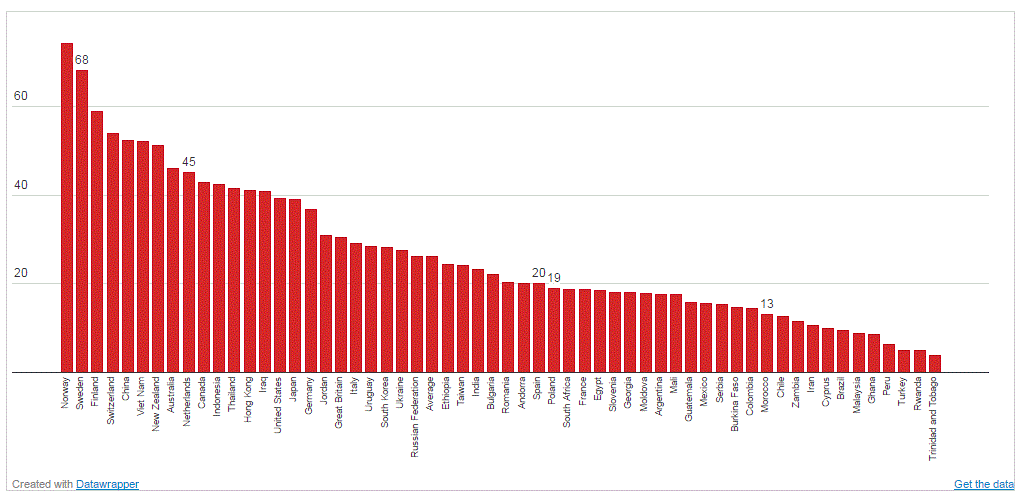
Trust Empirical View – Levels of Trust across Countries

ourworldindata – Levels of Trust by Country: ‘Generally speaking, would you say that most people can be trusted or that you need to be very careful in dealing with people?’ Possible Answers ‘Most people can be trusted’ or ‘Can’t be too careful’ – Max Roser1

Trust 1

Correlates, Determinants & Consequences

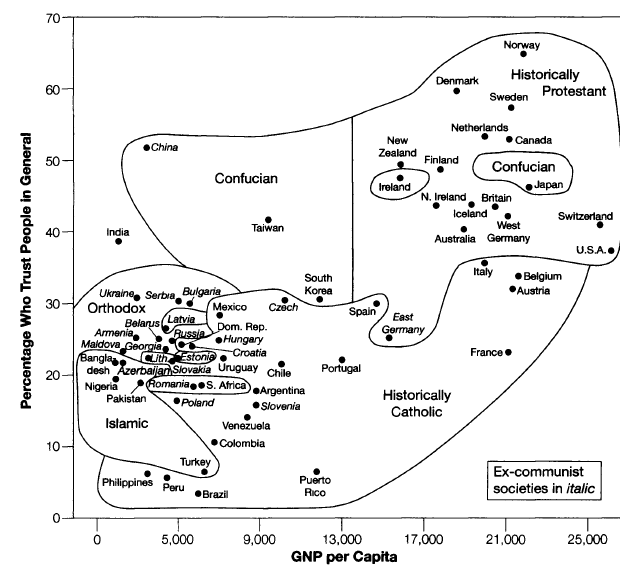
Percentage of people who trust people in general vs GNP per capita – Beinhocker (2006)2

The Relationship Between Trust and Economic Performance – Beinhocker (2006)

Percentage of people expressing high level of trust in others (2008) vs. income inequality by Gini index (mid-2000s) – Max Roser3

From Omen to Opportunity: How Cheap Oil Is Accelerating Sustainable Energy Investment

An increasingly unprofitable global oil market is driving fuel prices to historic lows and hemorrhaging investment in conventional energy sources. Breaking with tradition, cheap oil no longer foretells disaster for renewable energy companies. On the contrary, disillusioned fossil fuel investors are seeking high-growth opportunities—just in time to ride the renewables wave in the wake of the 2015 Paris climate talks.

worldwatch – Crashing out in February at $27 per barrel, crude oil prices have reached their lowest point in over 13 years, since the 2003 U.S.-led invasion of Iraq. Despite a modest recovery in March driven by expectations for reduced production, investors remain skeptical of underlying oil market fundamentals and are reducing their exposure. These selloffs have dragged down the stock prices of large conventional energy companies listed in the Standard & Poor’s 500 Index by 13 percent and have cost investors more than $703 billion since the record-high oil prices of June 2014.

Responding to these selloffs, oil companies have tightened their belts, decommissioning two-thirds of their rigs and sharply cutting investment in oil field exploration and development, while an estimated 250,000 oil workers have lost their jobs. A Wood Mackenzie report identified 68 major oil and natural gas projects—representing a combined value of $380 billion and output of 2.9 million barrels of oil equivalent (boe) per day—that have been put on hold since late 2014. Besides reducing operating costs, oil companies hope that these measures will have a stabilizing effect on the market by reducing productive capacity in the medium to long term. Tiếp tục đọc “From Omen to Opportunity: How Cheap Oil Is Accelerating Sustainable Energy Investment”

ASEAN PLAN OF ACTION FOR ENERGY COOPERATION (APAEC) 2016-2025

FULL REPORT

EXECUTIVE SUMMARY

Energy is key to the realisation of the ASEAN Economic Community (AEC) which calls for a well-connected ASEAN to drive an integrated, competitive and resilient region. Energy is key to the realisation of the ASEAN Economic Community (AEC) which calls for a well-connected ASEAN to drive an integrated, competitive and resilient region.

ASEAN is now one of the most dynamic and fastest growing economic regions in the world, and through the implementation of the AEC by end of December 2015, this growth is expected to continue. The region is projected to grow by at least 4% per year on average over the next five years, but could be as high as 6% – provided ASEAN moves towards greater integration, where member states continuously implement domestic structural reforms to raise their productivity and competitiveness under the framework of the AEC.

1 To fuel this growth, the demand in primary energy
2 is expected to grow by an average of 4.7% per year from 2013 to reach 1,685 Mtoe in 2035, according to the ASEAN Centre for Energy’s (ACE) 4 th ASEAN Energy Outlook (AEO4).

Addressing this growing demand for energy, which is driven by both economic and demographic growth, has been a challenge for ASEAN ahead of the AEC. Against this backdrop, the 32 nd ASEAN Ministers on Energy Meeting (AMEM) held on 23 rd September 2014 in Vientiane, Lao PDR, endorsed the theme of the new ASEAN Plan of Action for Energy Cooperation (APAEC) 2016-2025 as “Enhancing Energy Connectivity and Market Integration in ASEAN to Achieve Energy Security, Accessibility, Affordability and Sustainability for All” .

The theme also reflects the central elements of connectivity and energy security captured in the Nay Pyi Taw Declaration on the ASEAN Community’s Post 2015 Vision adopted by the ASEAN Leaders at the 25 th ASEAN Summit in Nay Pyi Taw, Myanmar, on 12 th November 2014 The key initiatives under this APAEC include embarking on multilateral electricity trading to accelerate the realisation of the ASEAN Power Grid (APG), enhancing gas connectivity by expanding the focus of the Trans-ASEAN Gas Pipeline (TAGP) to include Liquefied Natural Gas (LNG) regasification terminals as well as promoting clean coal technologies. It also includes strategies to achieve higher aspirational targets to improve energy efficiency and increase the uptake of renewable energy (RE) sources, in addition to building capabilities on nuclear energy.

Plans to broaden and deepen collaboration with ASEAN’s Dialogue Partners (DPs), International Organisations (IOs), academic institutions and the business sector will be stepped up to benefit from their expertise and enhance capacity building in the region. The APAEC 2016-2025 will be implemented in two phases. Phase I will cover the period 2016-2020 for the implementation of short to medium-term measures to enhance energy security cooperation and to take further steps towards connectivity and integration. In 2018, there will be a stocktake of the progress of Phase I, which will guide ASEAN in charting the pathways and directives for Phase II (2021-2025).