Gained In Translation: Why You Should Translate – Những thứ học được từ dịch thuật

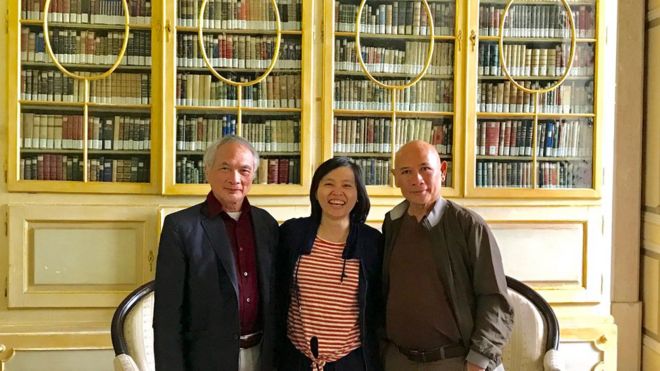
Having reluctantly stumbled upon poetry translation at the age of 14, Minh Quan takes us on his journey through the world of translation explaining how it helped him to broaden his notion of Vietnamese culture, offering a bridge between him and the past, and how it can help others do the same as well. Minh Quan Do, a student at United Nations International School of Hanoi (UNIS), is an aspiring poet and translator of poetry. He has been working for a series of years on projects involving translation of poetry and crafting original works. His current project, “Gained In Translation,” seeks to explore the effect of translation on language and meaning through a process called back-translation. In addition to his work with poetry, he also is working with a franchise startup, Pablo Vietnam, and another food and beverage startup with the aim of promoting a healthier lifestyle. In his spare time, he is a co-founder of the Vietnam Youth Leaders (VYL), a networking group with the aim of connecting engaged youth in Vietnam. He is additionally a member of the student-led charity SANSE which seeks to promote the local education systems in mountainous regions. This talk was given at a TEDx event using the TED conference format but independently organized by a local community.

Vietnam Electricity (EVN) Achieves its First and Positive Credit Rating from Fitch Ratings

Worldbank

Hanoi, June 7, 2018: Vietnam’s electricity company Vietnam Electricity, or EVN, is one step closer to issuing US dollar bonds and strengthening its financing capacity, following an endorsement by Fitch Ratings of its credit profile.

Now assigned an Issuer Default Rating (IDR) of ‘BB’ with a ‘Stable Outlook’ for long-term foreign currency, EVN’s ratings align with Vietnam’s sovereign rating. EVN’s sustainable financing strategy is supported by technical assistance from the World Bank.

“This positive rating enables EVN to issue international bonds, diversify our financing sources, and reassure domestic and foreign institutional investors. We are now on a stronger footing to deliver more reliable electricity to Vietnam,” said Dinh Quang Tri, Vice President of EVN. 
Tiếp tục đọc “Vietnam Electricity (EVN) Achieves its First and Positive Credit Rating from Fitch Ratings”

The Sharing Economy Isn’t About Sharing at All

HBR

JANUARY 28, 2015

The sharing economy has been widely hailed as a major growth sector, by sources ranging from Fortune magazine to President Obama. It has disrupted mature industries, such as hotels and automotives, by providing consumers with convenient and cost efficient access to resources without the financial, emotional, or social burdens of ownership. But the sharing economy isn’t really a “sharing” economy at all; it’s an access economy.

Sharing is a form of social exchange that takes place among people known to each other, without any profit. Sharing is an established practice, and dominates particular aspects of our life, such as within the family. By sharing and collectively consuming the household space of the home, family members establish a communal identity. When “sharing” is market-mediated — when a company is an intermediary between consumers who don’t know each other — it is no longer sharing at all. Rather, consumers are paying to access someone else’s goods or services for a particular period of time. It is an economic exchange, and consumers are after utilitarian, rather than social, value. Tiếp tục đọc “The Sharing Economy Isn’t About Sharing at All”

Shrimp Paste and Fish Sauce: A Brief Primer on Vietnam’s Dipping History

It is a well-known fact among Vietnamese that their home country has a rich portfolio of fermented food, from mắm chua (pickled shrimp) to mắm tôm (shrimp paste). Here is a comprehensive look into not only these funky condiments’ history, taste and production, but also the emerging food science behind them. 

For thousands of years, Vietnamese cuisine has taken great pride in its arsenal of preserved foodstuffs. Indeed, the category constitutes some of the most essential elements of Vietnamese flavors — think nước tương (soy sauce), nước mắm (fish sauce) or mắm tôm (shrimp paste) — these are condiments that few dishes go without.

Nước Mắm (Fish Sauce)

Fish sauce is fiercely coveted by diners across Southeast Asia and even in smaller pockets across the continent as a whole. For example, in Japan it is known as shottsuru and widely used in nabemono, the nation’s version of a hotpot. Indeed, any self-confessed addict of Vietnamese cuisine must have a soft spot for the sauce. An iconic example was Anthony Bourdain imparting the flavors of Hanoian bún chả to former US President Barack Obama. It is incredibly versatile, useful to garnish any dish in its concentrated form and makes an exquisite broth on its own if diluted. Tiếp tục đọc “Shrimp Paste and Fish Sauce: A Brief Primer on Vietnam’s Dipping History”

Climate Change Is Melting ‘The Roof Of The World’

Huffingtonpost

Two “unprecedented” avalanches in once-stable western Tibet highlights the extent of global warming, researchers warn.
The Tibetan plateau is home to <a href="https://www.theguardian.com/commentisfree/2015/nov/11/tibet-climate-change-paris-talk

GETTY IMAGES
The Tibetan plateau is home to more than 46,000 glaciers. Sometimes referred to as the “Third Pole,” the area has the third largest concentration of ice after the polar regions.

The glaciers of western Tibet have been stable for thousands of years. But climate change is now threatening that status quo.

Two enormous ice avalanches ripped through the area in the summer, forever transforming the landscape. Global warming likely triggered the icefalls, new research suggests.

Once unheard of, such disasters could become more frequent in the region, scientists warn.

On July 17, more than 60 million cubic meters (or 24,000 Olympic swimming pools) of ice and rock broke off without warning from a glacier in Tibet’s Aru Mountains and hurtled down into a valley below. Within minutes, the avalanche had buried an area of almost four square miles in debris up to 100 feet deep. Nine herders were killed, along with hundreds of sheep and yaks.

Tiếp tục đọc “Climate Change Is Melting ‘The Roof Of The World’”

Carrying Way Too Much Stuff

man on motorcycle transporting ducks

In most western nations, goods are transported on trains, ships, and trucks.

But in areas where those vehicles are less available, people who need to move a lot of stuff from place to place get much more creative.

These photos reveal how people from all over the world use bikes, carts, boats, and animals in amazing ways to get themselves and their stuff where Tiếp tục đọc “Carrying Way Too Much Stuff”

Humans Are Driving Other Mammals to Become More Nocturnal

Scientific American

The shift could change which prey animals hunt or make it harder to find food

Humans Are Driving Other Mammals to Become More Nocturnal
European beaver (Castor fiber) in the middle of a  French city, Orléans. Credit: Laurent Geslin

Humans dominate the animal world. Whether hunting or competing for limited space and resources, we are the planet’s superpredator. Other animals seem to understand this, avoiding people if they can help it. But as the human population expands, it is getting harder for other creatures to find somewhere to hide during the day. Now new findings indicate mammals around the world have come up with another strategy: They are becoming nocturnal. Exactly what this bizarre shift means for the future of individual species—and entire ecosystems—is unknown. Tiếp tục đọc “Humans Are Driving Other Mammals to Become More Nocturnal”

STEAM not STEM: Why scientists need arts training

From biotech to climate change, advances in technology raise significant moral questions. To engage responsibly, our next generation of scientists need training in the arts and ethics. 

In 1959, the British physicist and novelist C.P. Snow delivered a famously controversial lecture at Cambridge University. He described a post-war schism between two groups — scientists and the literary world.

Snow identified this as a newly emergent divide, across which each party was more than happy to sneer at the other: Scientists proudly unable to quote a phrase of Shakespeare, and literary types untroubled by the second law of thermodynamics. Tiếp tục đọc “STEAM not STEM: Why scientists need arts training”

Tracking the battles for environmental justice: here are the world’s top 10

theconversation

Environmental justice activism is to this age what the workers’ movement was for the industrial age – one of the most influential social movements of its time. Yet, despite its consistent progress since the 1970s, environmental justice protests seem to get lost in the morass of information on broader environmental issues.

In contrast, labour conflicts, including strikes and lock-outs, carry such gravity that the International Labour Organization tracks these on a systematic basis. As more communities are refusing to allow the destruction and contamination of their land, water, soil and air, these, in turn, deserve to be counted. Tiếp tục đọc “Tracking the battles for environmental justice: here are the world’s top 10”

Why Developing Countries Should Not Neglect Liberal Education

AACU

By: David E. Bloom and Henry Rosovsky

Worth and genius would thus have been sought out from every condition of life, and completely prepared by education for defeating the competition of wealth and birth for public trusts….
(Thomas Jefferson, addressing the benefits to society of a liberal education, in an 1813 letter to John Adams)

Introduction

Western civilization is home to a long tradition of liberal education, defined as an emphasis on the whole development of an individual apart from (narrower) occupational training. The beginnings of this philosophy can perhaps be traced back as far as ancient Greece and more clearly to the trivium (grammar, rhetoric, and logic) and quadrivium (arithmetic, geometry, astronomy, and music) of medieval times. That tradition has continued, and today liberal education is an important segment of higher education in all developed countries. Its role in nurturing leaders and informed citizens is recognized in both the public and private sectors. Global statistics are difficult to obtain, but our impression is that interest in liberal education is growing in many parts of the West. Tiếp tục đọc “Why Developing Countries Should Not Neglect Liberal Education”

Sự thật về hiện trạng đất đai tại Việt Nam

Đọc bài quan trọng “Phân tích pháp lý về đất đai trong vu Đồng Tâm
Bộ Quốc Phòng và Công An có vi phạm Luật Hình Sự
trong vụ Đồng Tâm ngày 9/1/2020?

Chuỗi bài Đồng Tâm >>>

English: The truth about the lie of the land

Đó chính là Mark Twain, với câu nói độc nhất vô nhị: “Hãy mua đất, vì chúng không tạo ra thêm đất nữa.”

Land management, urban land management, Vietnam economy, Vietnamnet bridge, English news about Vietnam, Vietnam news, news about Vietnam, English news, Vietnamnet news, latest news on Vietnam, Vietnam

Tổng quan khu đô thị Nam Sài Gòn, TP HCM. Hình minh họa. – Ảnh của VNA / VNS

Đó là lời khuyên có lý khi đất đai biến thành một loại hàng hóa được mua và bán trong một “thị trường tự do”, nhưng đây lại là một thứ bí hiểm cho người dân Việt Nam, bởi vì để sở hữu được một mảnh đất hoặc một ngôi nhà tại thành thị nhiều người chỉ có thể nằm mơ mà thôi.

Mặc dù về mặt lý thuyết, theo điều lệ quốc gia, tất cả các đặc trưng địa lý của đất nước – đất đai, nguồn nước, khoáng sản dưới lòng đất cũng như tài nguyên dưới biển đều thuộc về “người dân”, nhưng Nhà nước đại diện cho người quản lý tất cả những tài sản đó – có nghĩa là Nhà nước có thẩm quyền cao nhất. Tiếp tục đọc “Sự thật về hiện trạng đất đai tại Việt Nam”

RENEWABLES 2018 GLOBAL STATUS REPORT: A comprehensive annual overview

This document presents the overarching trends and development from 2018 so that policy makers and others can more easily understand the significance of the latest renewable energy development. It outlines what is happening to drive the energy transition and details why it is not happening fast enough or as fast as possible. It draws on the meticulously documented data found in REN21’s Renewables 2018 Global Status Report. See the endnotes and methodological notes in the full report for further details at http://www.ren21.net/gsr-2018/

The Facial Recognition Technology Genie Is Out of the Bottle

IOTI.COM

The potential for misuse of facial recognition technology is real, but its power may be too great for many to ignore.

Brian Buntz | May 30, 2018

The ACLU is worried about a Kafka-esque near future where police and other government agencies harness the power of facial recognition technologyto identify undocumented migrants, minority activists or individuals joining public protests. As such, the organization is demanding that online retail giant Amazon stop selling “dangerous” face recognition technology to law enforcement, which could potentially help police identify individuals from footage gathered from a variety of sources, including surveillance cameras in public and retail establishments, as well as from police body cameras.