I'm from Hanoi, Viet Nam.
I'm an author of Dot Chuoi Non (dotchuoinon.com/author/hangbelu/), a blog on Positive thinking, founded by Dr. Tran Dinh Hoanh, an attorney in Washington DC.
I'm a co-founder of Conversations on Vietnam Development - cvdvn.net, a virtual think tank. I am a co-founder of two companies in Viet Nam working on children education services. I advise companies on STEAM education, English language education for children and students in Vietnam.
I'm studying the Buddha's teaching and the teaching of Jesus. I practice mindful living including meditation.
I hold a PhD on Sustainable Energy Systems from University of Lisbon and Aalto University.
I graduated from Hanoi University of Technology on Environmental Engineering. I obtained a Master degree of the same major from Stanford University and Nanyang Technological University.
My English-language blog at: hangbelu.wordpress/.
I play table tennis as a hobby.
Summary: Honey bees exposed to glyphosate, the active ingredient in Roundup, lose some of the beneficial bacteria in their guts and are more susceptible to infection and death from harmful bacteria. Scientists believe this is evidence that glyphosate might be contributing to the decline of honey bees and native bees around the world.
FULL STORY
Glyphosate might be contributing to the decline of bees around the world.
VietNamNet Bridge – Lac Hong Vien, the largest cemetery in Vietnam and Southeast Asia, is located on nine hills, with nine natural streams. It looks like a giant swimming turtle.
Today the Government of Canada’s Department of Environment and Climate Change, the French Development Agency (AFD), Germany’s Federal Ministry for the Environment, Nature Conservation and Nuclear Safety (BMU), the United Kingdom’s Department for Business, Energy and Industrial Strategy (BEIS), and global philanthropies announced the beginning of a new collaboration at the One Planet Summit in New York to accelerate the energy transition in partnership with countries in South East Asia.
South East Asian countries can ensure continued economic growth and prosperity, keep pace with the related growth in energy demand, and meet their Nationally Determined Contributions (NDCs) toward the Paris Agreement. The fall in the cost of renewable energy, the untapped renewable energy potential in South East Asia, and the lessons learned from increasing renewable energy penetration globally presents an opportunity for South East Asian countries to accelerate the energy transition and meet their Paris commitments. Tiếp tục đọc “Governments and Philanthropies Announce South East Asia Energy Transition Partnership”→
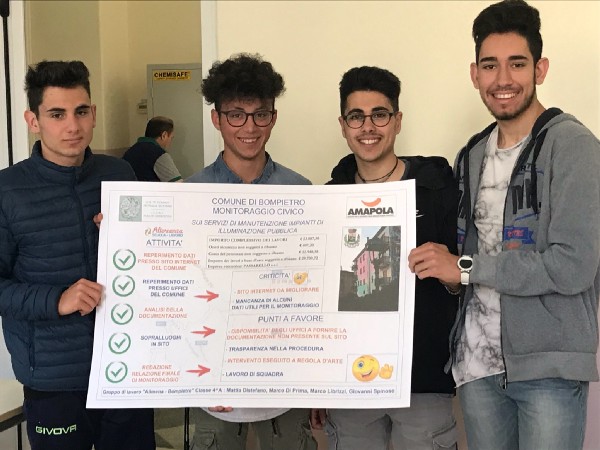
What happens when you take a group of young people and give them a taste of citizen power?
The answer: Lots!
“So, you want us to become snitches?!”
That was one of the first reactions we got, in response to our idea.
Our plan was this: run a training lab to make a group of young people aware of their power as citizens.
The aim? To get them to understand the role they can play in making public procurement more transparent. A big ask? Perhaps. But our experience has shown that it can be done, and with positive results that could help shape the future.
The Power of Youth
Engaged citizens!
In the fight against corruption, young people represent the future.
Our setting was Madonie, in the province of Palermo, Sicily. The area has an ageing, shrinking population. That means it’s even more important to convince students of the importance of exercising their power as citizens.
With a group of 13 students, it’s true to say that we didn’t really know what to expect. But with a bit of creative thinking they all got on board and really surprised us.
A Hard Topic for Students?
Ok, ok, so public procurement is clearly not what teenagers spend most of their time thinking about!
Canadian lawmakers vote unanimously to revoke symbolic honour from Myanmar leader over her handling of Rohingya crisis.
Myanmar military’s campaign has driven more then 700,000 Rohingya into neighbouring Bangladesh since last August [Altaf Qadri/The Associated Press]
Canada’s parliament has unanimously voted to strip Myanmar’s leader Aung San Suu Kyi of her honorary citizenship over her handling of the Rohingya crisis.
The Chinese city of Huainan is rich in coal—very rich. By one 2008 estimate, it has nearly a fifth of all of China’s coal reserves.
Now the city has become home to the world’s largest floating solar farm. Appropriately, it has been built atop a former coal mine, which had become a lake after being flooded with groundwater. The China Daily reports that the farm started generating electricity earlier this week.
The 40-megawatt power plant consists of 120,000 solar panels covering an area of more than 160 American football fields. The $45-million investment could help power 15,000 homes. Here’s a drone tour of the solar farm, set to electronic music:
Ủy ban Thường vụ Quốc hội biểu quyết thông qua nghị quyết tăng thuế bảo vệ môi trường với các mặt hàng xăng dầu. Thuế môi trường với xăng dự kiến tăng lên 4.000 đồng/lít từ 2019.
Dr. Le Van Be, director of the Institute of Vaccines and Medical Biologicals (IVAC) in Nha Trang, Vietnam, is driven by a childhood encounter with rabies to improve the health outcomes of the people of Vietnam. Photo: PATH/Hai Trinh.
Dr. Le Van Be, director of the Institute of Vaccines and Medical Biologicals, believes in the power of vaccines. And he is committed to seeing locally made influenza vaccine become a reality. Tiếp tục đọc “Vietnam’s vaccine champion”→
Lực lượng lao động gồm 50 triệu người của Việt Nam
đang là nền tảng làm nên thành công kinh tế cho đất
nước. Quá trình chuyển đổi sang lĩnh vực dịch vụ, chế
tạo/chế biến, cùng với năng suất lao động ấn tượng và
mức lương tăng dẫn tới tỉ lệ nghèo giảm mạnh và tốc
độ tăng trưởng kinh tế ấn tượng trong vòng mấy thập
kỷ qua. Tỉ lệ có việc làm cao, trong khi tỉ lệ thất nghiệp
thấp theo tiêu chuẩn thế giới.
Thách thức về việc làm là làm sao tạo được những việc làm có chất lượng hơn và bao phủ hơn. Những nhà máy khang trang của nước ngoài trả lương công nhân cao hơn mức lương tối thiểu, kèm theo các chế độ phúc lợi xã hội, nhiều nhất cũng chỉ tạo được 2,1
triệu việc làm. Doanh nghiệp trong nước có đăng ký
kinh doanh cung cấp không quá 6 triệu việc làm nữa.
Trong khi đó, 38 triệu việc làm ở Việt Nam nằm ở
các hộ nông nghiệp, hộ kinh doanh cá thể hay việc
làm thuê không hợp đồng. Những loại hình việc làm
truyền thống này thường có đặc trưng năng suất thấp,
lợi nhuận thấp, thu nhập ít ỏi và không có nhiều chế
độ bảo vệ người lao động. Dù đây là con đường để
thoát nghèo nhưng sẽ không phải là phương cách để
đạt đến vị thế tầng lớp trung lưu mà người dân Việt
Nam mong muốn. Người dân tộc thiểu số, phụ nữ và
lao động phổ thông phân bổ rải rác trong nhóm những
việc làm này. Tiếp tục đọc “Tương lai việc làm Việt Nam: Khai thác xu hướng lớn cho sự phát triển thịnh vượng hơn”→
Visitors to Camn Thanh in round bottom boats operated by locals as part of their community-based tourism. Credit: HanoiTV.vn
By Tran Thuy Binh
Can Thanh, Vietnam, September 17, 2018
Despite knowing the damage she was causing, Nguyen Thi Vang still walks through the coral reef in the Tam Hai sea to collect seaweed for her daily meals. “When I walk, I heard its broken sound and I feel painful,” said Nguyen. “Yet I need seaweed.”
When seaweed dies it floats on the water. But due to high demand locals pick the seaweed while it is still alive, walking over and often breaking parts of the coral reef. While the harvest season traditionally starts in May, Nguyen and other locals collect earlier. “People from other communes come and if we do not harvest they will collect it all,” said Nguyen. Tiếp tục đọc “Community-based tourism and new livelihoods in Vietnam”→
A young girl helps her family from the Khmer community collect snails during low-tide in Southern Soc Trang Province. These mangroves were destroyed completely by bombing during the Vietnam War but over the last 25 years were able to grow back naturally, finally being protected and expanded by Government initiatives. Now, over 20 families come to the beach daily to collect snails and other fish that returned with the healthy mangrove eco-system.
By Luke Duggleby
Mekong Delta, September 17, 2018
Vietnam’s Mekong Delta is one of the world’s most at-risk areas from the effects of climate change, posing challenges both for its environment and population in years to come. Tiếp tục đọc “A Damaged Delta – Mekong Delta”→
After denials, government ordered to pay compensation to family of lung cancer victim
Reuters in Tokyo
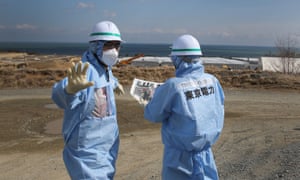
Contamination experts work at the site of the Fukushima disaster. Photograph: Christopher Furlong/Getty Images
Japan has acknowledged for the first time that a worker at the Fukushima nuclear power plant, destroyed by an earthquake and tsunami more than seven years ago, died from radiation exposure.
UNESCO and FOSSASIA invite developers, designers, students, bloggers and all open source contributors to join the hackathon “Getting the Message Across: Climate Change and Sustainable Development” on 13 and 14 October 2018 in Ho Chi Minh City in Vietnam.
The objective of the hackathon is to develop innovative apps that help journalists to monitor and report on climate change and sustainable development issues in Asia and the Pacific. The participants will be introduced to UNESCO’s Guidebook for Journalists Reporting on Climate Change and Sustainable Development in Asia and the Pacific which includes information and knowledge on climate science, related international and regional treaties and policy frameworks including the 2030 Agenda for Sustainable development, and tips for journalists for finding and telling stories.
The apps developed should meet one of the following objectives: Tiếp tục đọc “UNESCO Hackathon on Climate Change and Sustainable Development, Hochiminh, Vietnam”→