Policing Beyond Borders: China’s Law-Enforcement Expansion in the Mekong Region

NBR.org September 17, 2025

The People’s Republic of China (PRC) faces a mounting challenge from transnational organized crime along its southern periphery. Myanmar has become the world’s most criminalized state, particularly after the 2021 military coup, providing a safe haven for illicit economies ranging from drug, human, and arms trafficking to illegal mining, cybercrime, and financial crimes.1 Other Mekong countries have also emerged as criminal hotspots, with Cambodia hosting around 100,000 trafficked victims in scam centers, according to a UN estimate.2 Sustained by corruption, weak governance, and entrenched Chinese criminal networks, these activities have disproportionately targeted Chinese nationals and thus have been framed as a matter of national security by the party-state.

In response, the PRC Ministry of Public Security (MPS) and other security agencies have intensified law-enforcement efforts in the Mekong region, designated as a “pilot zone” (实验区) for the Global Security Initiative (全球安全倡议). Chinese authorities have increased pressure on their neighbors and multiplied joint operations, resulting in the arrest and deportation of over 55,000 individuals from scam centers in northern Myanmar between August 2023 and April 2025.3 At the same time, Beijing has sought to pursue subregional security mechanisms under its leadership. These include coordinated Mekong river patrols with Laos, Myanmar, and Thailand, which were launched in 2011, and the Lancang-Mekong Law Enforcement and Security Cooperation Center (LM-LECC), a spin-off intergovernmental body established in Yunnan in 2017 within the broader Lancang-Mekong Cooperation framework.

Tiếp tục đọc “Policing Beyond Borders: China’s Law-Enforcement Expansion in the Mekong Region”

Lancang-Mekong countries see positive outcomes from joint anti-crime operation

Langcan-Mekong Coorperation January 29, 2026

Six Lancang-Mekong Cooperation (LMC) countries have achieved fruitful results in combating telecommunication fraud, online gambling, and drugs and human trafficking in 2025.

During the”Safe Lancang-Mekong 2025″ joint operation launched in late February last year, law-enforcement agencies from China, Cambodia, Laos, Myanmar, Thailand and Vietnam cracked down on 8,012 telecommunication fraud and online gambling cases and arrested 14,047 criminal suspects, according to the Lancang-Mekong Integrated Law Enforcement and Security Cooperation Center (LMLECC).

Additionally, 122,503 drug-related cases were busted, leading to the arrest of 139,956 suspects and the seizure of over 82 tonnes of various drugs along with 169.73 tonnes of precursor chemicals.

Law enforcement officers also cracked down on 1,017 human trafficking cases, capturing 718 suspects and rescuing 1,469 victims.

Officials from the LMC countries met Monday and Tuesday in Kunming, capital of southwest China’s Yunnan Province, to exchange experiences and discuss further law enforcement and security cooperation.

All parties agreed to continue joint operations to combat telecommunication fraud, the most serious transnational crime in the Lancang-Mekong region.

Established in 2017 in Kunming, the LMLECC serves as a comprehensive intergovernmental international organization for law enforcement and security cooperation in the Lancang-Mekong River basin.

The crime of killing baby girls – Female infanticide in India and China

gendercide.org

Female infanticide does not only occur in India and China, but in this case study we will focus on those two countries, two of the most populous countries in the world.

Note: China does not longer have a one-child policy. It was replaced with a two-child policy in 2015, and a three-child policy in 2021. This is expected to greatly decrease the prevalence of female infanticide and sex-selective abortions in China.

Introduction

In this article, female infanticide is the sex-selective killings of newborn female children due to a preference for male children. It typically results from, and is a reflection of, the low status of females in the surrounding culture, where males – and therefore also boys – are seen as more valuable than women and girls.

Tiếp tục đọc “The crime of killing baby girls – Female infanticide in India and China”

China has been preparing for a global energy crisis for years. It is paying off now

theguardian.com Fri 20 Mar 2026

As other Asian economies race to conserve energy, China has huge reserves of oil and gas as well as alternative energy sources like wind and solar

Xi Jinping has been preparing for a crisis like this for years. China must secure its energy supply “in its own hands”, its president was reported to have said during a visit to one of its vast oilfields in 2021.

The US-Israel war on Iran plunged the Middle East into a deep conflict, with the strait of Hormuz – one of the most important waterways in global trade – all but closed and key energy facilities across the region under attack.

Oil exports from the Middle East have tumbled 61% over recent weeks, according to maritime tracking consultancy Kpler – roiling countries across Asia, which relied on the region for 59% of its crude imports in 2025, and have been left racing to conserve energy.

Tiếp tục đọc “China has been preparing for a global energy crisis for years. It is paying off now”

Viet Nam to receive nearly 72 million USD from Green Climate Fund based on the country’s verified results in reducing deforestation

en.nhandan.vn Thursday, April 2, 2026 at 15:44

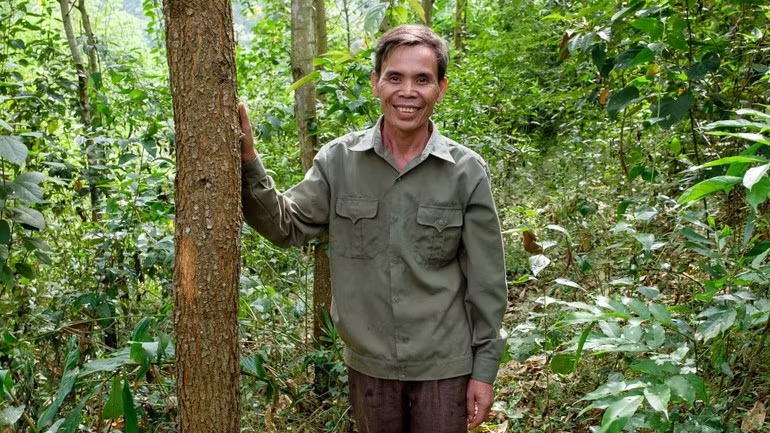
Baku Takahashi, a JICA expert, provides guidance on tree planting in Muong Phang Commune, Dien Bien Province. (Photo: JICA)

The Green Climate Fund has approved a funding proposal submitted by the Japan International Cooperation Agency (JICA) and the Government of Viet Nam for a results-based payment project on reducing emissions from deforestation and forest degradation (REDD+), recognising Viet Nam’s emission reduction achievements in 2014.

The proposal, titled “Viet Nam’s REDD+ Results-Based Payment for the Results Period of 2014,” was approved at the 44th meeting of the GCF Board held on March 26, 2026 in Republic of Korea.

Accordingly, Viet Nam will receive 71.96 million USD through a results-based payment mechanism, corresponding to independently verified greenhouse gas emission reductions. These results were achieved through efforts to curb deforestation and forest degradation, while increasing forest carbon stocks through tree planting and natural forest restoration. The funding from the project will be reinvested in strengthening forest-related policies, institutions and enforcement measures.

A local resident beside acacia trees planted in Phieng Ban Commune, Son La Province.

Through project activities, Viet Nam will gradually address the main causes of deforestation and forest degradation, promote sustainable forest management, and improve livelihoods for forest-dependent communities.

The project is expected to be implemented over six years, led by the Ministry of Agriculture and Environment of Viet Nam in coordination with provincial People’s Committees in the project areas. Target locations include provinces in the Northwest and Northeast regions, namely Dien Bien, Lai Chau, Lao Cai, Son La, Phu Tho and Tuyen Quang provinces.

The approval of this project further affirmed the long-standing and effective cooperation between JICA and Viet Nam in the field of REDD+, including support for development of policy, forest monitoring systems, the measurement, and calculation of emission reductions and elimination.

The Depth of MAGA’s Moral Collapse – How we got to “I love Hitler.”

By George Packer October 17, 2025

A static-patterned icon with three dots, on fire, in front of a black background with grey diagonal lines emanating
Illustration by Akshita Chandra / The Atlantic

When leaders of Young Republican groups around the country exchange texts that say “I love Hitler”; that joke about gas chambers and rape, approve of slavery, sneer about “watermelon people” and monkeys in zoos, and throw around words like faggot and retarded, they aren’t just exposing their own anti-Semitism, racism, homophobia, and misogyny. To see only the varieties of bigotry with which we’re painfully familiar is to miss the depth of MAGA’s moral collapse. Professing love for Hitler is more than anti-Semitic—it’s antihuman. It’s a proud refusal to be bound by the most basic standard of goodness, a deliberate expression of contempt for everything decent. The texts degrade all of us.

And they’re hardly surprising. Cruelty and humiliation have become the Trump administration’s common currency. With permission from President Donald Trump’s coarse rhetoric and vows of hatred, Elon Musk’s Nazi salute, Tucker Carlson’s flirtation with Holocaust denial, and Stephen Miller’s rage-filled threats, the young loyalists who wrote the texts were speaking the language of the people they admire most. Nor was it surprising when, the day after Politico revealed the texts’ existence, the image of an American flag altered into the shape of a swastika appeared on the cubicle wall behind a staffer in the Capitol Hill office of a MAGA congressman. In that culture, the rehabilitation of the man who stands for the worst in humanity was inevitable.

Read full text on the Atlantic This article was featured in the One Story to Read Today newsletter. 

Landmark case: Facebook-Meta has lost a legal battle over its failure to prevent children being sold on its platforms.

‘It started with a tipoff’: how a Guardian investigation exposed child sex trafficking on Facebook and Instagram

theguardian.com Mon 6 Apr 2026 

It started with a tipoff. I was reporting on the trafficking and exploitation of migrant workers in the Gulf when a source I had known for more than a decade reached out. They told me that child sexual abuse trafficking in the US was surging. As the Covid pandemic pushed predators online, some were using Facebook and Instagram to buy and sell children.

It was 2021 and I was about to begin an investigation with Mei-Ling McNamara, a human rights journalist, that would lead to the tech company Meta losing a multimillion-pound court case in March this year. The company had not yet rebranded and was known as Facebook, and there had not been any reporting on how children were being trafficked on its platforms. Experts from anti-trafficking nonprofit organisations and an American law enforcement official talked me through the crimes they were seeing.

Tiếp tục đọc “Landmark case: Facebook-Meta has lost a legal battle over its failure to prevent children being sold on its platforms.”

Understanding Inequality in China

China’s inequality has steadily risen over the years, surpassing even some major Western economies, driven by market forces and urban policies

Global Policy – 23 May 2025 

Economic inequality is a global phenomenon. And while the data suggests that inequality between countries has fallen, inequality within countries has risen. China, for instance, a country with very low levels of inequality just a few decades ago, now features inequality levels that are comparable to those in the US. 

Tiếp tục đọc “Understanding Inequality in China”

Nguồn gốc Vân Nam, Trung Quốc của trống đồng Đông Sơn, Việt Nam ?

Một dòng học thuyết dựa trên bằng chứng khảo cổ cho rằng trống đồng Đông Sơn, Việt Nam có nguồn gốc từ Vân Nam, nằm ở Tây Nam Trung Quốc được mang xuống Bắc Việt Nam, phát triển rực rỡ tại Đông Sơn. Trống đồng sau đó được lan rộng ra toàn khu vực Đông Nam Á. Trống đồng là sản phẩm của quá trình hợp chủng giao thoa văn hoá, Đông Sơn, Việt Nam là điểm phát triển rực rỡ nhất, nhưng không phải là nơi khởi điểm của trống đồng.

nghiencuulichsu.com

Kienthuc-Van-Gia-Ba-01_KELS

Trống đồng Vạn Gia Bá, Vân Nam, trung Quốc

Trương Thái Du

Theo Ben Kiernan trong quyển Viet Nam: A history from earliest times to present (2017), kỷ nguyên đồ đồng tại vùng đất là nước Việt Nam ngày nay diễn ra muộn hơn Lưỡng Hà, Trung Hoa (3000 – 2800 BC) hay Ai Cập và Âu Châu (2200 – 2000 BC) rất nhiều. Nó cùng thời với mảnh đất Thái Lan, chỉ vào khoảng 1500 – 1400 BC.

Tiếp tục đọc “Nguồn gốc Vân Nam, Trung Quốc của trống đồng Đông Sơn, Việt Nam ?”

All Railroads Lead to China: China’s Borderlands Strategy of Integration in Laos

Laos shift from landlocked to land-linked by lowering transport costs, boosting trade, attracting investment and tourism

Stepping onto the Laos-China Railway (LCR) in Luang Prabang, the picturesque former royal capital in Northern Laos, brings a rush of aesthetic familiarity to anyone who has ridden the high-speed rail in China. From the train station massage chairs to the voice over the loudspeaker and the advertisements on seatbacks, the experience is decidedly Chinese. The result is both comforting and disorienting: riders feel they are not quite in China, but not quite all the way out of it either. China’s borderlands strategy of integration through connectivity results in borders that are blurred and shifted. The LCR is a physical manifestation of this new kind of borderland.

Opened in December 2021, the LCR is celebrated by China and Laos as a major accomplishment. President Xi Jinping called the LCR a “landmark project of high-quality Belt and Road cooperation.”1 The railway connects the Yunnan provincial capital of Kunming to Laos’s national capital of Vientiane, covering one thousand kilometers in less than ten hours—a trip that previously took days.2 It is a marvel of modern engineering, traversing the mountain jungle terrain of southern Yunnan and northern Laos with a long series of tunnels and bridges. It is the first leg constructed of China’s vision for a pan-Asia railway system connecting Kunming to Singapore via three trunks: Myanmar in the west, Laos and Thailand in the center, and Vietnam and Cambodia in the east.


The Laos-China Railway in Luang Prabang, Laos. By author, September 2025.

Tiếp tục đọc “All Railroads Lead to China: China’s Borderlands Strategy of Integration in Laos”

Laos Orders Reduced School Week to Offset Fuel Cost Pressures

kpl.gov.la 20/03/2026 07:54

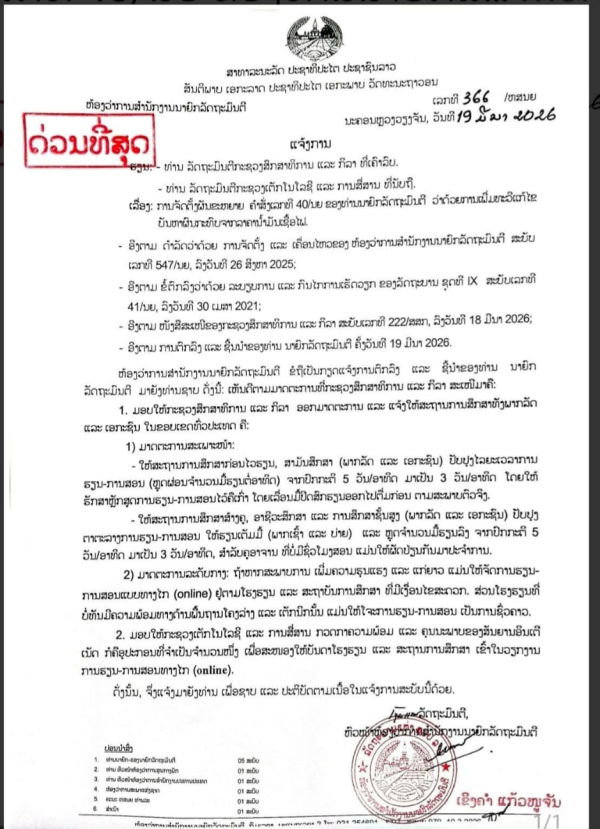
On March 19, 2026, the Prime Minister’s Office of the Lao PDR issued Notice No. 366/PMO mandating nationwide adjustments to school operations, as part of emergency measures to ease the financial strain on families amid continued fuel price volatility.

The directive, addressed to the Ministry of Education and Sports, introduces immediate changes to learning schedules while preserving academic standards and signaling further contingency steps if economic conditions worsen.

Under the order, all general education institutions—public and private—are required to scale back in-person instruction from five days to three days per week. Schools must continue delivering the full curriculum, with the academic calendar extended to compensate for reduced classroom time.

For teacher training institutes, vocational schools, and higher education institutions, schedules will be restructured into full-day sessions, combining morning and afternoon classes, while similarly reducing attendance to three days per week. Teaching personnel without assigned classes are instructed to report for duty on a rotating basis.

Officials said the policy is aimed at lowering transportation-related expenses for households while ensuring continuity in education delivery.

The government also outlined escalation measures should fuel-related pressures persist. Institutions with adequate digital infrastructure will transition to remote learning, while those lacking technical readiness may be required to temporarily suspend operations.

To support potential online learning, the Ministry of Technology and Communications has been tasked with verifying internet reliability nationwide and assessing the availability of essential equipment.

Authorities stressed that parents, teachers, and students must prepare for immediate implementation, highlighting the government’s broader effort to balance economic relief with uninterrupted access to education during a period of heightened cost pressures.

How High-Speed Rail is Reshaping Chinese Regional Air Travel

cirium.com August 20, 2025

China’s high-speed rail network is reshaping regional air travel, challenging short-haul aviation and redefining how passengers move across the country. Yuanfei Zhao (Scott) explores the co-evolution of rail and air, and examines the implications for airline strategy, fleet demand and the future of China’s regional aviation market.

China’s transportation landscape has undergone a quiet but profound transformation, one that is redefining how people move across the country and recalibrating the roles of air and rail in the national mobility ecosystem. At the heart of this shift is the rapid rise of high-speed rail (HSR), which has not only captured market share from short-haul aviation but has fundamentally altered traveller behaviour, airline network strategies, and urban connectivity.

Tiếp tục đọc “How High-Speed Rail is Reshaping Chinese Regional Air Travel”

Debut the bullet train that rivals airplane flying times – year 2019 Japan

nbcnews.com May 19, 2019, 12:00 AM GMT+7

Passengers will be able to travel 680 miles, between Tokyo and Sapporo, in less than four hours.

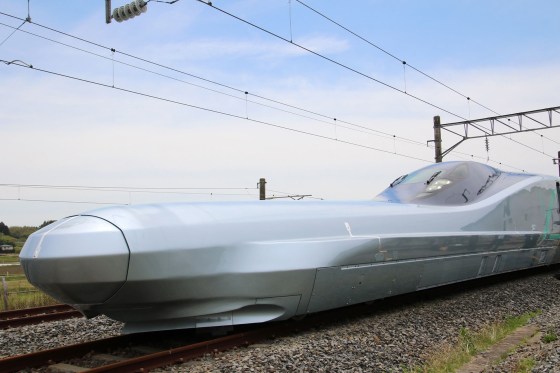
Image: A prototype of Japan's next-generation Shinkansen bullet train, set to be the fastest train on wheels when it enters service, reached speeds of 320 kilometres (198 miles) per hour on a test run on May 16

Japan’s next-generation bullet train reached speeds of 198 miles per hour on a test run on May 16.Jiji Press / AFP – Getty Images

The picture of a “bullet train” speeding past Mount Fuji is an iconic image of modern Japan.

Tiếp tục đọc “Debut the bullet train that rivals airplane flying times – year 2019 Japan”

In 2000, China’s president, Jiang Zemin, sat down for a rare interview with American television broadcast

CBSnews.com On the eve of his visit to the United States, China’s president, Jiang Zemin, sat down for a rare interview with Mike Wallace.

In a wide-ranging and surprisingly frank interview, Jiang talked about many topics, including relations between the United States and China, Tiananmen Square and American morals.

Britainnica.com

Jiang Zemin (born August 17, 1926, YangzhouJiangsu province, China—died November 30, 2022, Shanghai, China) was a Chinese official who was general secretary of the Chinese Communist Party (CCP; 1989–2002) and president of China (1993–2003).

Jiang joined the CCP in 1946 and graduated from Shanghai Jiao Tong University the following year with a degree in electrical engineering. He worked in several factories as an engineer before receiving further technical training in the Soviet Union about 1955. He subsequently headed technological research institutes in various parts of China. In 1980 Jiang became vice minister of the state commission on imports and exports. Two years later he became vice minister of the electronics industry and from 1983 to 1985 was its minister. He had meanwhile become a member of the Central Committee of the CCP in 1982. Named mayor of Shanghai in 1985, he joined the Political Bureau in 1987.

Tiếp tục đọc “In 2000, China’s president, Jiang Zemin, sat down for a rare interview with American television broadcast”