
Over the past 20 years, Paris has undergone a major physical transformation, trading automotive arteries for bike lanes, adding green spaces and eliminating 50,000 parking spaces.
Part of the payoff has been invisible — in the air itself.
Airparif, an independent group that tracks air quality for France’s capital region, said this week that levels of fine particulate matter (PM 2.5) have decreased 55 percent since 2005, while nitrogen dioxide levels have fallen 50 percent. It attributed this to “regulations and public policies,” including steps to limit traffic and ban the most polluting vehicles.
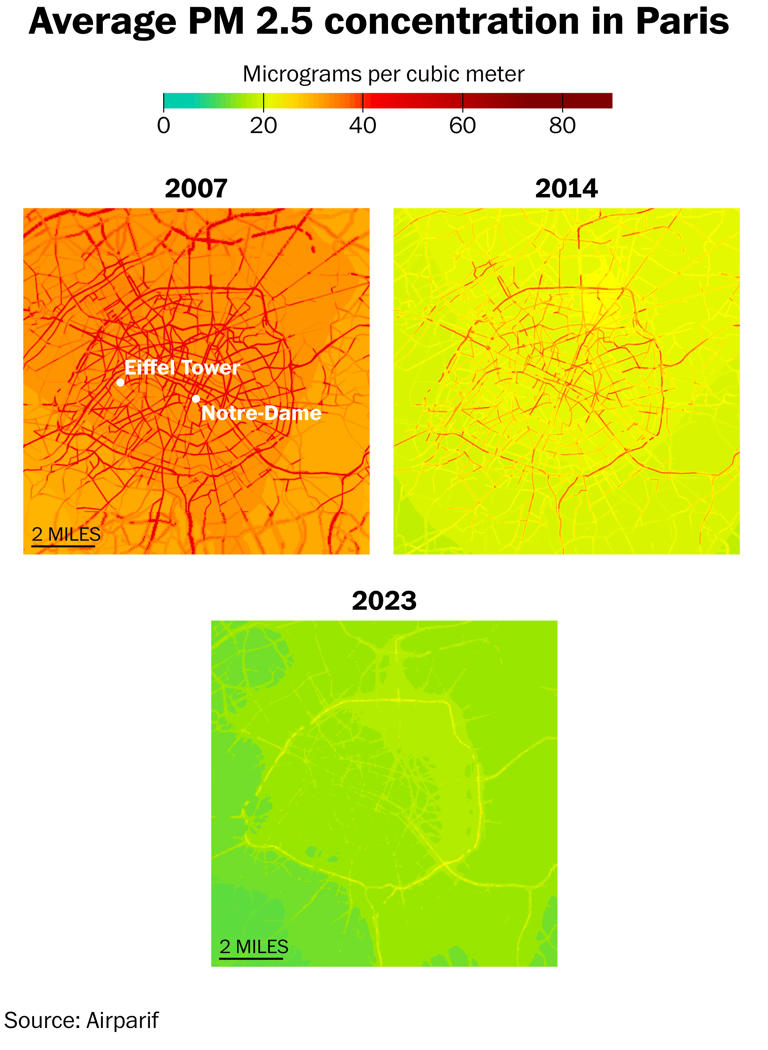
Paris said au revoir to cars. Air pollution maps reveal a dramatic change.
Air pollution heat maps show the levels of 20 years ago as a pulsing red — almost every neighborhood above the European Union’s limit for nitrogen dioxide, which results from the combustion of fossil fuels. By 2023, the red zone had shrunk to only a web of fine lines across and around the city, representing the busiest roads and highways.

 CVD
CVD 