“Cool” years are now hotter than the “warm” years of the past: tracking global temperatures through El Niño and La Niña

oneworldata.org

The world is warming despite natural fluctuations from the El Niño cycle.

In 2024, the world was around 1.5°C warmer than it was in pre-industrial times.1 You can see this in the chart below, which shows average warming relative to average temperatures from 1861 to 1890.2

Temperatures, as defined by “climate”, are based on temperatures over longer periods of time — typically 20-to-30-year averages — rather than single-year data points. But even when based on longer-term averages, the world has still warmed by around 1.3°C.3

But you’ll also notice, in the chart, that temperatures haven’t increased linearly. There are spikes and dips along the long-run trend.

Many of these short-term fluctuations are caused by “ENSO” — the El Niño-Southern Oscillation — a natural climate cycle caused by changes in wind patterns and sea surface temperatures in the Pacific Ocean.

While it’s caused by patterns in the Pacific Ocean and most strongly affects countries in the tropics, it also impacts global temperatures and climate.

There are two key phases of this cycle: the La Niña phase, which tends to cause cooler global temperatures, and the El Niño phase, which brings hotter conditions. The world cycles between El Niño and La Niña phases every two to seven years.4 There are also “neutral” periods between these phases where the world is not in either extreme.

The zig-zag trend of global temperatures becomes understandable when you are taking the phases of the ENSO cycles into account. In the chart below, we see the data on global temperatures5, but the line is now colored by the ENSO phase at that time.6

The El Niño (warm phase) is shown in orange and red, and the La Niña (cold phase) is shown in blue.

You can see that temperatures often reach a short-term peak during warm El Niño years before falling back slightly as the world moves into La Niña years, shown in blue.
Full article https://ourworldindata.org/global-temperatures-el-nino-la-nina?utm_source=OWID+Newsletter&utm_campaign=df01bb5c85-biweekly-digest-2025-03-07&utm_medium=email&utm_term=0_-0c7f305164-537125314

Myanmar’s military rule is crippling hope for young people like never before

theconversation.com Published: March 12, 2025 5.03pm GMT

Myanmar has struggled with civil war, military rule and widespread poverty for much of the past seven decades. But the country’s youth have never faced threats to their survival and future as severe as today.

The military coup of February 2021 shattered the hopes of many young people in Myanmar who had envisioned a better and more stable future under their democratically elected leader, Aung San Suu Kyi.

As brutal crackdowns on peaceful protests unfolded, thousands of young people fled to the jungles to take up arms. Hundreds of thousands more joined the civil disobedience movement, abandoning their studies to protest military rule through demonstrations and strikes.

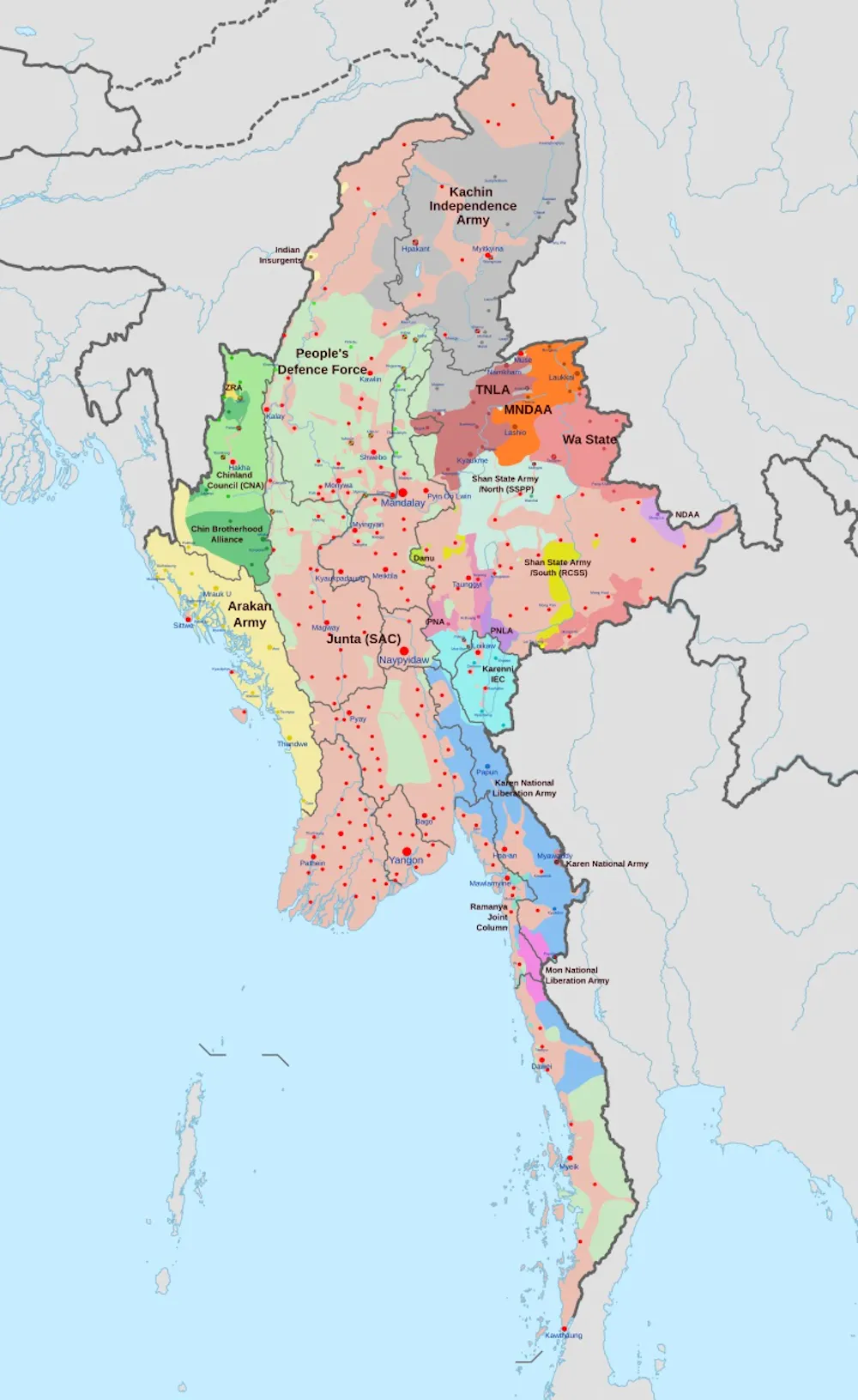
A map of Myanmar showing the military situation there as of February 4.
The military situation in Myanmar as of February 4 2025. Wikimedia Commons

Myanmar’s armed opposition has made significant gains over the past year, seizing vast territories from the military – though the latter still controls major cities like Naypyidaw, Yangon, and Mandalay.

Amid the surging violence, young people in Myanmar are finding themselves even more deprived of opportunities and increasingly forced into submission.

In February 2024, Myanmar’s junta declared mandatory military service for men aged 18 to 35 and women aged 18 to 27. Those who do not comply face up to five years in prison.

Tiếp tục đọc “Myanmar’s military rule is crippling hope for young people like never before”

Why has the Philippines arrested ex-President Duterte on ICC warrant?

Aljazeera.com

Families of victims, human rights groups call for ‘expeditious surrender and transfer of custody’ of Duterte to the ICC.

Relatives of victims of former Philippine president Rodrigo Duterte's war on drugs cry during a mass for victims at a church in Manila on March 11, 2025. Former Philippines president Rodrigo Duterte was arrested on March 11 in Manila by police acting on an International Criminal Court warrant tied to his deadly war on drugs. (Photo by TED ALJIBE / AFP)
Relatives of victims of former Philippine President Rodrigo Duterte’s deadly war on drugs cry during a mass for victims at a church in Manila following his arrest on Tuesday [Ted Aljibe/AFP]

By Ted Regencia Published On 11 Mar 202511 Mar 2025

Manila, Philippines – Almost three years after leaving the presidency, former President Rodrigo Duterte has been arrested by Philippine authorities in Manila, upon the request of the International Criminal Court (ICC) at The Hague, which is investigating allegations of “crimes against humanity” committed during his six years in power.

Duterte was immediately taken into police custody on Tuesday at the Manila international airport following his arrival from Hong Kong, in a move hailed by human rights groups as “a critical step for accountability in the Philippines”.

His trip to Hong Kong over the weekend had whipped up speculation that he would evade arrest.

Tiếp tục đọc “Why has the Philippines arrested ex-President Duterte on ICC warrant?”

Mekong Dam Monitor Weekly Update

February 24 – March 2, 2025 Stimson Mekong Monitor

Spotlight

Significant releases from China’s large dams push river to higher-than-normal levels.

Sustained large releases from China’s Xiaowan and Nuozhadu Dams are causing the river to run at levels 1-2 meters higher than normal along the Thai-Lao border. The two graphs illustrate  the sudden spike in river level occurring during the last days of February, corresponding to about 900 million cubic meters of water releases from China’s dams. Under normal dry season conditions, the river level does not spike in a manner seen on the graphs. At this time of year, the river level should gradually decrease over the next six weeks. Sudden spikes in river level, particularly those which run for sustained periods at higher levels, can be devastating for the river’s ecological processes and for the communities who depend on the river.

What Happened Last Week?

    • Where’s the Water: Last week, dams throughout the basin released a significant cumulative total of 1.6 billion cubic meters of water. Significant releases came from Xiaowan (PRC, 749 million cubic meters), Nuozhadu (PRC, 164 million cubic meters), and Thuen Hinboun Expansion (LAO, 199 million cubic meters). Dry season water releases generate hydropower but also artificially raise the level of the river. Where is the water?
    • River Levels: River levels throughout the basin are now about one meter higher than normal. See how this looks.
    • Wetness and Weather: While the headwaters of the Mekong in China are excessively wet (blue), most of the lower Mekong region is experiencing intensifying drought (red). Dry season irrigation activities in the Mekong Delta are creating slightly above average wetness anomalies in Vietnam’s delta. Temperatures in the Mekong basin were about average overall, with slightly above-average temperatures in the northern portion of the basin and slightly below average temperatures in the lower basin. See the maps.

Tiếp tục đọc “Mekong Dam Monitor Weekly Update”

Impact of Trump 2.0 on Southeast Asia’s Energy Geopolitics

Fulcrum.sg Published 3 Mar 2025 Mirza Sadaqat Huda

Trump’s rent-seeking foreign policy pertaining to energy and critical minerals will force Southeast Asian countries to do what they least desire: making a choice between China and the US.

The Trump administration’s insular and rent-seeking foreign policy will significantly alter the geopolitics of energy transition in Southeast Asia. This will manifest in two ways. First, the potential cessation of US involvement in the region’s energy sector will heighten fears of China’s dominance in energy infrastructure projects — including the ASEAN Power Grid (APG). Second, Trump’s intentions of using critical minerals as a bargaining chip for providing military assistance, if applied to the ASEAN region, will impact the regional vision for sustainable mineral development.

The shutting down of the United States Agency for International Development (USAID), an important player in the energy sector, will intensify existing fears of China’s dominance in electricity transmission and generation. As shown in Table 1, China provided approximately US$534 million in aid to the region’s energy sector in 2022, accounting for more than a quarter of the total share. Comparatively, the US provided only US$23.7 million, or 1 per cent of total energy-related aid to Southeast Asia. In addition, the China Southern Power Grid Company and State Grid Corporation of China own and operate significant portions of the national grids in Laos and the Philippines, respectively.

China Leads in Energy Aid

Table 1 Energy-related aid to Southeast Asia 2022 (excerpt) (USD, in %)

Donor Amount Contribution
China 534 million 26
ADB 368 million 18
Germany 274 million 13
Canada 231 million 11
South Korea 211 million 10
Japan 167 million 8
World Bank 90.0 million 4
EU Institutions 42.3 million 2
France 42.2 million 2
AIIB 34.8 million 2
United States 23.7 million 1

The table is modified from Lowy Institute’s (2024) Southeast Asia Aid Map.

Tiếp tục đọc “Impact of Trump 2.0 on Southeast Asia’s Energy Geopolitics”

Fruits of spoil: Laos’ forests disappearing as fruit farms flourish (2 parts)

Fruits of spoil: Laos’ forests disappearing as fruit farms flourish

Mekong eyes – 16 December 2024 at 9:27 (Updated on 16 December 2024 at 15:40)

The country’s improved railway connectivity facilitates fruit exports to China but has also sparked a boom in foreign-owned banana and durian farms, leading to forest clearance

A Chinese-owned banana plantation on land that was once forested, located in Attapeu province, southern Laos, in August 2024.

The report was produced with support from the Pulitzer Center’s Rainforest Investigations Network (RIN) and Internews’ Earth Journalism Network as part of the “Ground Truths” collaborative reporting project on soils. 

ATTAPEU, LAOS — The new high-speed railway has enabled faster fruit exports from Laos to China, attracting more investment in large-scale plantations. However, this growth has come at the cost of deforestation.

Bananas and the “king of tropical fruit” – durians – are very popular in China, but they typically ripen within a few days of harvesting.

However, that problem was resolved with the launch of the Laos-China Railway in 2021, which has enabled landlocked Laos to deliver its fruit quickly to China’s 1.4 billion consumers.

Tiếp tục đọc “Fruits of spoil: Laos’ forests disappearing as fruit farms flourish (2 parts)”