
Good morning. Today, my colleague Peter Baker reflects on President Trump’s first week back in office. We’re also covering South Korea, the Covid lab leak theory and a parenting poem. —David Leonhardt
 |
| President Trump in the Oval Office. Doug Mills/The New York Times |
Testing the limits
| By Peter BakerI’m the chief White House correspondent. | |
On his first full day back in the White House, President Trump vowed to do what no president had ever done before. “We’re going to do things that people will be shocked at,” he declared. Of all the thousands of words that Trump uttered during his fact-challenged, talkathon-style opening days as the nation’s 47th president, those may have been the truest.
Not so much because of the ideological swings that come with a party change in the White House, but because of the norm-shattering, democracy-testing assertions of personal power that defy the courts, the Congress and the ethical lines that constrained past presidents.
Trump freed even the most violent of the rioters who assaulted the Capitol in his name four years ago. Out of pique over questions of loyalty, he stripped former advisers facing credible death threats of their security details. Disregarding a law passed with bipartisan support and upheld by the Supreme Court, he allowed the Chinese-owned app TikTok to operate despite national security concerns.
Not satisfied just to eliminate diversity initiatives, he ordered government workers to snitch on anyone suspected of not going along. He fired at least a dozen inspectors general who monitored departments for corruption and abuse, ignoring the law that requires him to give Congress 30 days’ notice and provide specific reasons.
Right out of the gate, Trump challenged the expectations of what a president can and should do, demonstrating a belief that the rules his predecessors largely followed were meant to be bent, bypassed or broken.
Presidential maximalism
It is broadly within a president’s power, say, to reverse the government’s approach to diversity programs, to pull out of an international climate agreement or to fire holdover political appointees. But as so often happens with Trump, he takes even those decisions one step further.
Trump has never cared for the argument that he should do something because that is the way it has previously been done. Now he is determined to crash through obstacles and any supposed “deep state” that gets in his way. Ideas that establishment advisers talked him out of the last time around, he is pursuing this time with a new cast of more like-minded aides.
Possibly the most staggering action last week was Trump’s decision to pardon or commute the sentences of violent rioters who beat police officers at the Capitol, despite assurances by his vice president, designated attorney general and House speaker that he wouldn’t.
At the same time, Trump simply ignored the TikTok law. Instead, he declared he would not enforce it for 75 days to broker a deal in which China and the U.S. government would go into business together running the social media app.
He also decided to rewrite the 14th Amendment to declare that it does not guarantee automatic citizenship to children born in the United States. It took just three days for a federal judge to step in and temporarily block the move.
And unlike any president in modern times, Trump has tried to redraw the map of the world. He unilaterally declared that the Gulf of Mexico was now the Gulf of America. He sought to pressure Canada into becoming the 51st state. And he held out the possible use of force to take over Greenland and seize the Panama Canal.
His antecedents
Trump is hardly the first president to push the limits of presidential power, of course. Richard Nixon comes to mind, among others. Indeed, Trump’s allies see a more immediate precedent: President Biden, who spoke in favor of traditional standards even as he stretched his authority.
 |
| Joe Biden Pete Marovich for The New York Times |
Biden issued pre-emptive pardons to members of his own family and other targets of Trump’s wrath, a first-of-its-kind move he described as a means to prevent political prosecutions. Trump has in fact made such threats, but even some Democrats objected to the pardons, describing them as self-serving and a terrible precedent.
Biden also declared in his final days as president that the Equal Rights Amendment had met the requirements of ratification and was therefore now the 28th Amendment of the Constitution. In doing so, he disregarded time limits established by Congress that were exceeded. Some analysts asked how it was different for Biden to impose his interpretation of the Constitution in this way than for Trump to offer his own interpretation of the 14th Amendment.
But Trump has proved more effective at squelching opposition than Biden was. He dominates his own party as no president has in generations and pushed on its members cabinet nominees who would not have passed muster in the past. He has forced technology billionaires, Wall Street tycoons, corporate executives and media owners who previously opposed him to show newfound deference and, in many cases, flood his political accounts with donations.
Trump’s flex
That leaves Trump as the single most important player in any decision he cares to involve himself in, whether it be who is the speaker of the House or what the fact-checking policies should be at Meta’s Facebook.
Trump’s allies reject the notion that he has authoritarian aspirations. After all, he is still subject to the 22nd Amendment, which bars him from running in four years. Still, one House Republican was eager to get rid of even that guardrail. Representative Andy Ogles of Tennessee, whose campaign finances, as it happens, are under investigation by the F.B.I., introduced a constitutional amendment last week to allow Trump to run again.
It has no realistic chance of passing, but it did not hurt the congressman’s position with the president, who oversees the F.B.I.
| THE LATEST NEWS |
Trump Administration
 |
| Trump in Las Vegas. Kenny Holston/The New York Times |
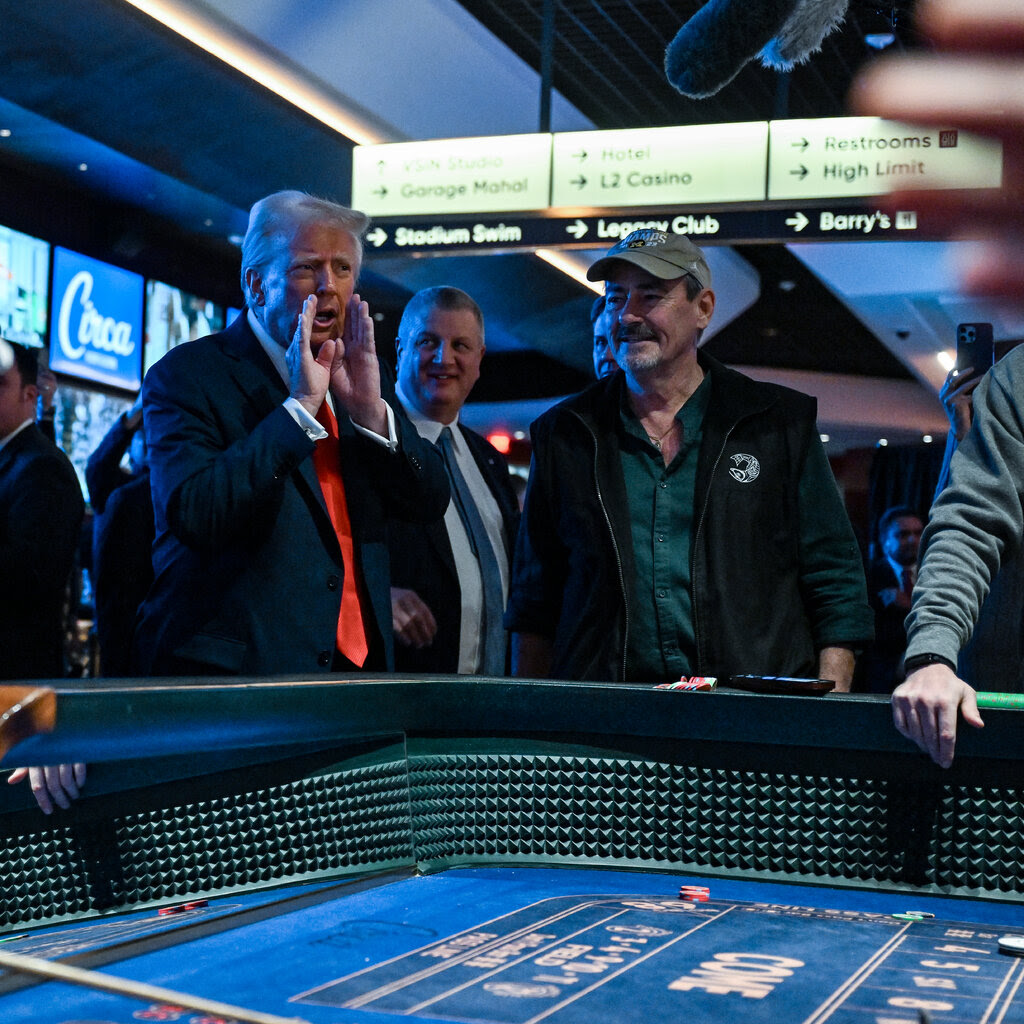
| Trump, capping his first week in office, used a speech about ending taxes on tips as a victory lap. “I’m here to say thank you,” he told a crowd in a Las Vegas casino.Through executive orders, Trump has already shifted the direction of the country. Read how.Trump is trying to overhaul the federal bureaucracy. Workers are unsure how to implement his policies and worried about what they might mean for their careers.Defense Secretary Pete Hegseth believes diversity has weakened the U.S. military. The Pentagon, however, views it as an asset.Some Democrats fear that voters may become numb if they push back at Trump’s every move and want to be more selective in their response to the administration, The Washington Post reports.“We were so close to bringing them to safety”: An executive order blocked a path to the U.S. for thousands of Afghans who supported the American mission in their country.Trump’s threat of mass deportations has caused uncertainty in India, which is the largest source of undocumented migrants outside Latin America. |
Middle East
 |
| Displaced Palestinians in northern Gaza. Jehad Alshrafi/Associated Press |
| Israeli troops prevented Palestinians from returning to their homes in northern Gaza today after Israel accused Hamas of violating the terms of the cease-fire agreement.Trump said that he told Jordan’s leader that he wants Jordan and Egypt to receive more Palestinians from Gaza. “Something has to happen,” Trump said. “It’s literally a demolition site right now.”In Lebanon, Israeli forces killed at least two people as the deadline for Hezbollah and Israel to withdraw from the south expired and thousands of displaced Lebanese tried to return to their homes, Lebanese officials said.Read what we know about the four Israeli hostages freed in the second hostage-for-prisoner swap of the Gaza cease-fire. |
More International News
 |
| President Yoon Suk Yeol Pool photo by Jeon Heon-Kyun |
| The authorities in South Korea indicted President Yoon Suk Yeol on charges of leading an insurrection when he briefly imposed martial law last month.Gang violence has closed schools in Haiti and left hundreds of thousands of children without formal education.Protesters in three Australian cities vandalized monuments on Australia Day, a holiday that commemorates the arrival of British ships and that some see as a symbol of oppression.In a rare display of public dissent in China, top doctors raised concerns about domestically produced drugs. They said the government was sacrificing quality to cut costs. |
California Fires
| Los Angeles is expecting rain that will help fire crews, but it also faces a small risk of flash floods and mudslides.After the fires, rents spiked past a legal limit in nearly 30 cities across Los Angeles County, The Washington Post found.Even before the fires, film and television production in Los Angeles was hitting a near-record low. |
Other Big Stories
| The C.I.A. said it now favors the theory that Covid emerged from a leak at a Wuhan research lab. It began the new assessment under Biden.Some drivers are spending less time in traffic after the introduction of congestion pricing in New York. But the results are mixed. |
| THE SUNDAY DEBATE |
Is Trump’s mass deportation plan too extreme?
Yes. The government doesn’t have the resources to expel the millions of unauthorized migrants living on U.S. soil. “Whatever is gained through mass deportation — and we are unconvinced anything will be — is it worth the costs?” The San Antonio Express-News’s editorial board writes.
No. Deportation has long been a feature of U.S. immigration policy, under Democrats and Republicans. The Obama administration deported more than three million people. “The anti-Trump vitriol on illegal immigration is so strong, one would think he is the first president to take such a stand,” The Boston Herald’s editorial staff writes.
| FROM OPINION |
Syrians will continue to document atrocities and provide humanitarian aid. The fall of Bashar al-Assad’s regime means they can work in the open and get far more done, Alia Malek writes.
Artificial intelligence can replace decisions based on hunches and faulty logic with decisions based on data and rationalism, Reid Hoffman, a Microsoft board member, writes.
Antisemitism isn’t just a problem for Jews. It also threatens democracy and the rule of law, Deborah Lipstadt, a former Biden administration ambassador, writes.
Here are columns by Ross Douthat on “King Trump” and Maureen Dowd on tech tycoons.
Receive free access to handpicked articles via text message.
Now you can get Times journalism sent right to your phone. Each article will be accessible for 30 days.

 CVD
CVD 