
Greenhouse gas emissions can be offset by carbon sinks such as forests, but expanding these areas can put Indigenous communities, reliant on the forests, at risk.
By Rebecca L. Root // 11 October 2023
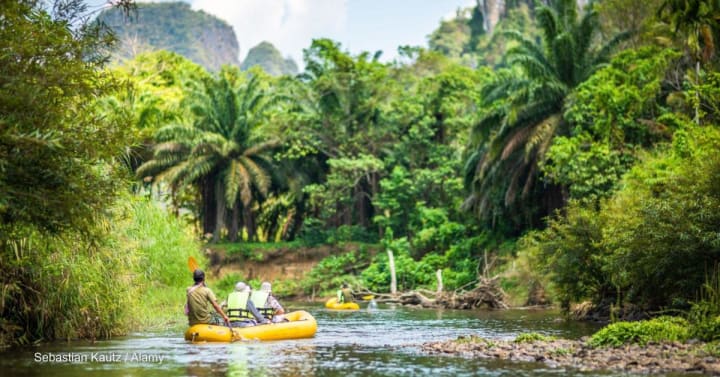
From Khao Sok National Park in the southwest to Phu Chi Fa Forest Park in the north, forests cover around 30% of Thailand’s total area. Approximately 23 million people live near or in these lush green landscapes, depending on them for sustenance and livelihoods. But that’s now at risk, due to both climate change-related threats and the policies implemented to protect the forests.
Warangkana Rattanarat, Thailand country director for The Center for People and Forests, warned that the arrival of El Niño earlier this year has caused long droughts and less rain, damaging crops and other forest resources. This has affected the availability of food, as well as the income local people can derive from forest resources, she added.
The country has also experienced floods and the highest temperatures on record this year, impacting forests and the communities within them. In the GermanWatch Global Climate Risk Index 2021, Thailand ranked at number nine globally for long-term climate risks.
Additionally, there are land and tenure rights issues for Indigenous forest communities to contend with, and national climate commitments that have the potential to negatively impact such communities, said experts.
At the 2015 United Nations Climate Change Conference, or COP 21, Thailand pledged to achieve carbon neutrality by 2050 and net zero by 2065. It has also committed to increasing the total forested area in the country to 55% by 2037.
However, a recent report by the Asia-focused human rights, social justice, and peace NGO Manushya Foundation states that the carbon neutrality goal will likely be met at the expense of forest communities, as the government uses forests to help counter emissions, rather than reducing them through other means.
Forests, alongside the ocean and soil, are the world’s biggest carbon sinks — which absorb carbon dioxide from the atmosphere. By formally protecting more forest areas or planting new forests, Thailand can offset the emissions it continues to generate through the burning of gas, oil, and coal.
But designating forest areas as “protected areas” restricts existing residents’ access to the land they may have lived on and cultivated for centuries, potentially pushing them into poverty.
“If this land is coming under the ownership of the government, it means that it is illegal for the villagers to live in this area,” said Malee Sitthikriengkrai, a professor at the Center for Ethnic Studies and Development at Chiang Mai University.
The Manushya report notes: “Instead of choosing to phase out fossil fuels, the government continues to fight against the most marginalized forest-dwelling communities and Indigenous peoples, leaving the big polluters to keep making money.”
In addition, according to the report, extracting high levels of carbon emissions through forest sinks doesn’t help to achieve net zero as it doesn’t limit the amount of emissions being produced.
As part of the Paris Agreement, the country committed to reducing emissions by 30-40% by 2030 and plans to implement energy efficiency measures and decarbonize the energy sector to help achieve that. But in 2021, Thailand generated 6.31 tonnes of greenhouse gas emissions per capita — a decrease of just over a tonne since 2011. The 2023 Climate Change Performance Index notes that Thailand has “only slightly” reduced its emissions, making it “a low performer” — dropping 11 places in its global ranking to 42 out of 63 countries.
“The Thai government is trying to persuade the international community that it is a climate champion with its commitment to reforestation, electric vehicles production, or renewable energy plans,” Emilie Palamy Pradichit, founder and executive director of the Manushya Foundation, said in a statement. “Dig deeper and you find out that most of its policies actually violate human rights and do very little to tackle climate change.”
Manushya claims forest communities’ rights have long been threatened by such policies.
One example is the 2014 forest reclamation policy — part of Thailand’s push to expand and rehabilitate forest cover — which permitted the penalization of people encroaching on areas designated as national parks.
Despite the policy, Sab Wai villagers continued to live on land that was designated as part of the Sai Thong National Park in central Thailand. In 2016, 14 community members were arrested, with some receiving prison sentences. Manushya Foundation and Sai Thong Rak Pah Network submitted a complaint for urgent action to the U.N. Special Procedures of the Human Rights Council in 2022. Some villagers continue to live on the land, regardless of the daily risk of eviction and arrest.
“We have farmed the land for more than 40 years, long before the forest became a national park,” Suwit Rattanachaisi, a then-63-year-old farmer from the village told Reuters in 2021. “The government says we destroy the forest, but why would we destroy the land that feeds us?”
An hour’s drive south, in the Kaeng Krachan National Park, members of the Indigenous Bangkloi village face a similar situation. According to a statement that same year from UN Human Rights, which warned against the granting of heritage status for the park, the Indigenous Karen have been forcibly evicted, arrested, and had their homes burned down. It called for recognition of the community as guardians of nature.
There are, however, certain laws in place that offer protections to such communities, said Rattanarat.
A National Parks Act, introduced in 2019 in response to widespread protests across Thailand by environmentalists, forest communities, and land rights activists, allows certain people living in the vicinity of 100 selected parks to be able to access them, though this is at the discretion of authorities. The Community Forest Act, introduced that same year, aimed to give Thai villagers more say in managing the forests’ natural resources. It permitted certain forest communities — excluding those living within national parks — to manage their resources if they registered with the government. But not all were aware of the process and how to navigate it.
“If you declare to the government that you produce a certain type of crop and you face a very bad year — like a drought or flood that destroys your crops — … you have a chance to obtain compensation,” Rattanarat said. However, this is only applicable to those with the correct land rights documentation, which many Indigenous communities lack.
She called for better raising of awareness across forest communities of these rights, and said remote sensing technology could help the government better verify land use and land boundaries.
Manuyusha’s report calls for Thailand to shift to an “intersectional feminist, just, inclusive, and green transition,” ensuring that communities are consulted when it comes to the planning and implementation of climate mitigation measures. Research conducted in northern Thailand showed that community participation in decision-making, forest fire management, and in forming effective forest regulations “positively impacted ecosystem services.”
It also called for more efforts to be made at the national level to tackle the biggest emitters of carbon emissions and phasing out fossil fuels, rather than simply expanding protected forest areas to meet global commitments.
“It is clear that to achieve the Paris Agreement targets, the transition to a low-carbon society is of greatest importance,” it states. “However, the new system has to be built on strong foundations, respecting human rights and the environment in its most imminent surroundings.”

 CVD
CVD 