Freedom of expression under threat in Southeast Asia

Chathamhouse.org

Governments across Southeast Asia have little incentive to protect freedom of expression domestically but steps taken by both domestic and international actors could mean the difference between freedom and its opposite.

All of the countries of Southeast Asia currently sit in the bottom half of the World Press Freedom Index, with four – Brunei, Laos, Singapore and Vietnam – ranked below 150 in the 180-country list, and Myanmar expected to join them following its February 2020 coup.

In these countries, critical coverage is not formally banned but there is no presumption of the right to publish. In Cambodia, Indonesia, Malaysia, Philippines and Thailand, for example, a theoretical commitment to freedom of expression is marred by restrictive legislation, intimidation and even the killing of journalists.

The media in Southeast Asia faces two problems – vaguely worded laws open to abuse and politically-motivated prosecutions – and, in the absence of robust independent courts willing to challenge these governments, politicians have been able to pursue personal vendettas against publications and individuals with few limitations.

.

Without independent courts, even those countries with rules-based legal systems, will fail to defend dissenting voices against politicians in power.


Tiếp tục đọc “Freedom of expression under threat in Southeast Asia”

Understanding Causes for Wrongful Convictions in Vietnam: a View from the Top and the Bottom of the Iceberg

Abstract

Wrongful convictions have severe consequences and effects on the values, dignity, and self-esteem of the innocent and their beloved ones. While Vietnam is implementing the rule of law to ensure the protection of citizens’ fundamental rights, recent and serious wrongful conviction cases suggest a need to enhance the effectiveness and credibility of criminal justice reform. Using several cases for examples from Vietnam, this study examines two levels of factors that contribute to wrongful convictions: (i) the acknowledged causes (the top of the iceberg) and (ii) the hidden roots (beneath the surface). In addition, we compare the case of Vietnam to the findings from other Asian nations, notably those of East Asia. We conclude that the causes for wrongful convictions are embedded in the criminal justice process and culture, and eradication of wrongful convictions requires careful planning and innovative reforms that address the root causes of the problems. Relevant policy and practical recommendations are offered to deal with the factors leading to wrongful convictions in Vietnam.

Introduction

In recent years, Vietnam’s criminal justice system has been more effective in addressing human rights and responding to transnational crimes and maintaining national security. New legislation in Vietnam’s criminal justice system sets the goals of safeguarding justice and human rights first and foremost, a component of which requires reduction of wrongful convictions. Wrongful convictions have weakened public trust in the criminal justice system, violated human rights, and affected the integrity of the rule of law. Yet, at the domestic level, wrongful convictions are still persistent.

Vietnamese legal scholars have started examining wrongful convictions, particularly after the Communist Party of Vietnam (CPV) called for judicial reforms in the 2000s (Dao, 2020; Thai, 2020). These scholars have paid little attention, however, to the fundamental reasons that lead to wrongful convictions. While the CPV encouraged the combination of inquisitorial and adversarial models in criminal proceedings, the legal ideology to identify and recognize hidden factors of wrongful convictions has not been seriously considered in the process. In other words, the hidden factors contributing to wrongful convictions are still not reviewed and assessed alongside the surface elements of wrongful convictions in Vietnam.

Tiếp tục đọc “Understanding Causes for Wrongful Convictions in Vietnam: a View from the Top and the Bottom of the Iceberg”

3 ngôi đền thờ vua Hùng ở Sài Gòn

vnexpress.net

Ngoài đền thờ Vua Hùng ở Thảo Cầm Viên là di tích được xếp hạng để bảo tồn, thành phố còn có đền tưởng niệm lớn nhất Nam Bộ.

Đền thờ vua Hùng trong Thảo Cầm Viên

Đền thờ vua Hùng nằm cạnh quầy vé Thảo Cầm Viên (quận 1, TP HCM), do người Pháp xây dựng năm 1926. Công năng ban đầu của công trình là đền tưởng niệm những người Việt tử trận vì đi lính cho Pháp trong Thế chiến thứ nhất.

Sau năm 1954, khi người Pháp rút khỏi Việt Nam, công trình được đổi tên thành đền Quốc Tổ Hùng Vương. Trong đó, ngoài việc thờ vua Hùng, còn thờ một số nhân vật lịch sử khác như Trần Hưng Ðạo, Tả quân Lê Văn Duyệt. Sau năm 1975, đền được đổi thành đền thờ Hùng Vương và giao cho Bảo tàng lịch sử Việt Nam – TP HCM trực tiếp quản lý.

Ngôi đền có bình đồ hình vuông, mang phong cách kiến trúc thời nhà Nguyễn với bộ mái chồng diêm, tạo thành ba tầng mái cong. Về tổng thể, công trình phảng phất tòa Minh lâu của lăng Minh Mạng ở Huế.

Mỗi tuần, đền mở cửa miễn phí cho khách đến thăm từ thứ 3 đến ngày chủ nhật. Ngày giỗ tổ Hùng Vương mùng 10 tháng 3 âm lịch hàng năm, ở đây đều tổ chức lễ dâng hương.

Năm 2015, UBND TP HCM xếp hạng di tích lịch sử - văn hóa cấp thành phố cho công trình này. Ảnh: Quỳnh Trần
Năm 2015, UBND TP HCM xếp hạng di tích lịch sử – văn hóa cấp thành phố cho công trình này. Ảnh: Quỳnh Trần

Đền tưởng niệm các vua Hùng

Tiếp tục đọc “3 ngôi đền thờ vua Hùng ở Sài Gòn”

Remarks by US National Security Advisor Jake Sullivan on Renewing American Economic Leadership at the Brookings Institution

APRIL 27, 2023 whitehouse.gov

AS DELIVERED

I want to start by thanking all of you for indulging a National Security Advisor to discuss economics.

As most of you know, Secretary Yellen gave an important speech just down the street last week on our economic policy with respect to China.  Today I’d like to zoom out to our broader international economic policy, particularly as it relates to President Biden’s core commitment—indeed, to his daily direction to us—to more deeply integrate domestic policy and foreign policy.

After the Second World War, the United States led a fragmented world to build a new international economic order.  It lifted hundreds of millions of people out of poverty.  It sustained thrilling technological revolutions.  And it helped the United States and many other nations around the world achieve new levels of prosperity.

But the last few decades revealed cracks in those foundations.  A shifting global economy left many working Americans and their communities behind.
A financial crisis shook the middle class.  A pandemic exposed the fragility of our supply chains.  A changing climate threatened lives and livelihoods.  Russia’s invasion of Ukraine underscored the risks of overdependence.

So this moment demands that we forge a new consensus. 

That’s why the United States, under President Biden, is pursuing a modern industrial and innovation strategy—both at home and with partners around the world.  One that invests in the sources of our own economic and technological strength, that promotes diversified and resilient global supply chains, that sets high standards for everything from labor and the environment to trusted technology and good governance, and that deploys capital to deliver on public goods like climate and health. 

Now, the idea that a “new Washington consensus,” as some people have referred to it, is somehow America alone, or America and the West to the exclusion of others, is just flat wrong.

This strategy will build a fairer, more durable global economic order, for the benefit of ourselves and for people everywhere.

So today, what I want to do is lay out what we are endeavoring to do.  And I’ll start by defining the challenges as we see them—the challenges that we face.  To take them on, we’ve had to revisit some old assumptions.  Then I’ll walk through, step by step, how our approach is tailored to meeting those challenges.

When President Biden came into office more than two years ago, the country faced, from our perspective, four fundamental challenges.

First, America’s industrial base had been hollowed out.

The vision of public investment that had energized the American project in the postwar years—and indeed for much of our history—had faded.  It had given way to a set of ideas that championed tax cutting and deregulation, privatization over public action, and trade liberalization as an end in itself. 

There was one assumption at the heart of all of this policy: that markets always allocate capital productively and efficiently—no matter what our competitors did, no matter how big our shared challenges grew, and no matter how many guardrails we took down.

Now, no one—certainly not me—is discounting the power of markets. But in the name of oversimplified market efficiency, entire supply chains of strategic goods—along with the industries and jobs that made them—moved overseas.  And the postulate that deep trade liberalization would help America export goods, not jobs and capacity, was a promise made but not kept.  

Another embedded assumption was that the type of growth did not matter.  All growth was good growth.  So, various reforms combined and came together to privilege some sectors of the economy, like finance, while other essential sectors, like semiconductors and infrastructure, atrophied.  Our industrial capacity—which is crucial to any country’s ability to continue to innovate—took a real hit.  

The shocks of a global financial crisis and a global pandemic laid bare the limits of these prevailing assumptions.

The second challenge we faced was adapting to a new environment defined by geopolitical and security competition, with important economic impacts.

Much of the international economic policy of the last few decades had relied upon the premise that economic integration would make nations more responsible and open, and that the global order would be more peaceful and cooperative—that bringing countries into the rules-based order would incentivize them to adhere to its rules.

It didn’t turn out that way.  In some cases it did, and in lot of cases it did not.

By the time President Biden came into office, we had to contend with the reality that a large non-market economy had been integrated into the international economic order in a way that posed considerable challenges. 

The People’s Republic of China continued to subsidize at a massive scale both traditional industrial sectors, like steel, as well as key industries of the future, like clean energy, digital infrastructure, and advanced biotechnologies.  America didn’t just lose manufacturing—we eroded our competitiveness in critical technologies that would define the future.

Economic integration didn’t stop China from expanding its military ambitions in the region, or stop Russia from invading its democratic neighbors.  Neither country had become more responsible or cooperative.

Tiếp tục đọc “Remarks by US National Security Advisor Jake Sullivan on Renewing American Economic Leadership at the Brookings Institution”

Nhức nhối đất nông lâm trường ở Tây Nguyên – 2 bài

Nhức nhối đất nông lâm trường ở Tây Nguyên: [Bài 1] Dưới bóng ma ‘phát canh thu tô’ kiểu mới

NN – Thứ Ba 16/08/2022 , 10:41

Những hợp đồng khoán sản xuất thực chất vẫn theo kiểu phát canh thu tô ở tỉnh Đăk Lăk hệt như ‘bóng ma’ ám ảnh người nông dân nhận khoán suốt bao năm qua.

LTS: Doanh nghiệp ôm diện tích lớn đất đai màu mỡ nhưng hoạt động không hiệu quả, trong khi người dân liên kết nhận khoán phải chịu vô số các khoản thu. Mâu thuẫn, bất ổn đang ngày càng nhức nhối trên hàng vạn ha đất nông lâm trường ở Tây Nguyên.

Nông dân nhận khoán gánh hàng loạt các khoản thu ở Đăk Lăk. Ảnh: Minh Quý.
Tiếp tục đọc “Nhức nhối đất nông lâm trường ở Tây Nguyên – 2 bài”

Myanmar is a failing state, led by a junta fuelled by Russian arms, says UN rights envoy

theguardian.com

Civilians are being killed by Russian weapons just like in Ukraine, says special rapporteur Tom Andrews in call for global action

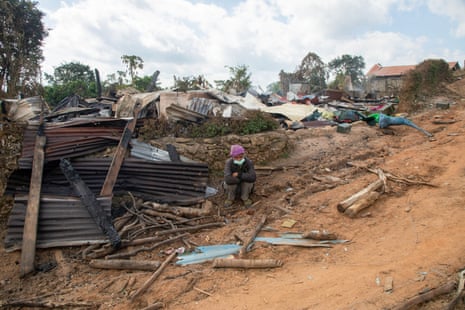
A man sits in front of a house destroyed by the Myanmar junta’s air strike.

A man sits in front of a house destroyed by a Myanmar junta air strike. The UN special rapporteur for human rights there has called for an arms embargo. Photograph: SOPA Images/LightRocket/Getty Images

Rebecca Ratcliffe South-east Asia correspondentWed 15 Mar 2023 19.00 GMT

Myanmar is a “failing state” and the crisis is getting exponentially worse, a UN special rapporteur for the country has warned, urging countries to adopt the same unified resolve that followed the invasion of Ukraine.

“The same types of weapons that are killing Ukrainians are killing people in Myanmar,” Tom Andrews, special rapporteur on the situation of human rights in Myanmar, told the Guardian in an interview, citing the supply of Russian weapons to the junta since the coup two years ago. The junta relies heavily on aircraft from China and Russia, and has increasingly resorted to airstrikes to attempt to quell determined resistance forces.

The international response to Myanmar has been inadequate and some countries are continuing to enable the junta’s atrocities, Andrews said, calling for an arms embargo.

A man sits in front of a house that was burned by a military air strike

https://66ae38e287ca1c63cdfd74afa802d2e4.safeframe.googlesyndication.com/safeframe/1-0-40/html/container.html

Tiếp tục đọc “Myanmar is a failing state, led by a junta fuelled by Russian arms, says UN rights envoy”