G7 phản đối Trung Quốc cải tạo ồ ạt các đảo trên Biển Đông

(LĐO) V.N – 7:49 PM, 08/06/2015

Lãnh đạo các nước công nghiệp G7 đã bày tỏ sự phản đối mạnh mẽ với việc Trung Quốc cải tạo ồ ạt các đảo nhằm thay đổi hiện trạng ở Biển Đông – Kyodo ngày 8.6 dẫn lời một quan chức Nhật cho biết.

Theo Phó chánh văn phòng Nội các Nhật Hiroshige Seko, tại hội nghị, Thủ tướng Nhật Shinzo Abe đã nhắc tới những hành động của Bắc Kinh ở Biển Đông và Biển Hoa Đông. Ông nói rằng các nhà lãnh đạo G7 “không được để yên cho các nỗ lực đơn phương nhằm thay đổi hiện trạng”. Tiếp tục đọc “G7 phản đối Trung Quốc cải tạo ồ ạt các đảo trên Biển Đông”

ASEAN must take a collective stance on the South China Sea

4 June 2015

Author: Vignesh Ram, Manipal University

 
EAF – The South China Sea dispute has become the new normal in ASEAN meetings. The dispute, with its overlapping claims on various land features in the South China Sea, has started to figure as the most important territorial disputes in Asia, one that risks becoming a major power confrontation in the region. With this in mind, ASEAN must take a collective stand on the South China Sea.

Beijing deployed the Haiyang Shiyou oil rig 981 in May 2015 close to the Paracel Islands, triggering a furious reaction in Hanoi and the most serious uptick in tensions in the waters in years. (Photo: AAP) Tiếp tục đọc “ASEAN must take a collective stance on the South China Sea”

China hacks US government

Washington (CNN) Four million current and former federal employees may have had their personal information hacked, the Office of Personnel Management said on Thursday.

The agency, which is conducts background checks, warned it was urging potential victims to monitor their financial statements and obtain new credit reports.

U.S. officials believe this could be the biggest breach ever of the government’s computer networks.

The breach is beyond the Office of Personnel Management and Department of Interior, with nearly every federal government agency hit by the hackers, government officials said. Tiếp tục đọc “China hacks US government”

Carter on the South China Sea: Committed and (Mostly) Clear

Defense Secretary Ashton Carter’s remarks at the Shangri-La Dialogue on May 30 amounted to a robust, but measured, defense of the United States’ rebalance to the Asia Pacific and its commitment to remain a Pacific power.

The speech covered a broad spectrum of U.S. commitments to the region—economic, political, and security—before concluding with an enthusiastic articulation of the United States’ interests in the South China Sea and commitment to pursue them. Tiếp tục đọc “Carter on the South China Sea: Committed and (Mostly) Clear”

The Philippines to the United States: We Want You Back

FP Report

Amid the escalating tensions in the South China Sea, the Philippines is growing increasingly desperate for more U.S. military support.

gettyimages-474697868_6-1

By Siddhartha Mahanta
June 1, 2015
sid.mahanta@sidhubaba

MANILA — At the Shangri-La Dialogue in Singapore on May 30, U.S. Defense Secretary Ashton Carter stressed that the United States will continue to rebuff Chinese efforts to assert sovereignty in the South China Sea, largely by boosting military support to regional allies. Carter announced a proposal called the Southeast Asia Maritime Security Initiative, which would authorize up to $425 million for maritime capacity-building efforts in Southeast Asia. Tiếp tục đọc “The Philippines to the United States: We Want You Back”

In defense of facts in the South China Sea

AMTI – Secretary of Defense Ash Carter’s address at this weekend’s Shangri-La Dialogue was generally well received by conference attendees and Asia-security watchers. A few critics have argued that Carter was “just talk.” What none have noted, however, is the fact that the Secretary’s remarks were the latest installation in a series of moves by the administration to articulate a fact-based approach to the South China Sea. This approach is a nuanced one and does not necessarily constitute a “strategy” for countering China’s recent moves. It is, however, a wise way to engage two key audiences to whom Carter was speaking at Shangri-La: other states in the region and China itself. Let me explain.

Tiếp tục đọc “In defense of facts in the South China Sea”

Shangri La Dialogue 2015


AMTI

Explore key maritime security developments from the 2015 Dialogue.

Ashton Carter, Secretary of Defense, United States

Secretary of Defense Ash Carter’s Saturday morning address was well-received by the Shangri-La audience. Carter’s speech included a strong stand against China’s building efforts in the South China Sea, and reaffirmed the United States’ intention to “fly, sail, and operate wherever international law allows.” This was, however, embedded in a broader message was that all countries in Asia should have the opportunity to rise peacefully. Carter called for a freeze on land reclamation by all South China Sea claimants, and has reportedly since taken up the issue with Vietnam on a visit to Hanoi.

Tiếp tục đọc “Shangri La Dialogue 2015”

Messages from China’s National Defense White Paper


June 2, 2015
CSIS

“China’s Military Strategy,” released on May 26, 2015, is the 9th Chinese defense white paper since 1998. For the first time, the white paper elaborates comprehensively on the missions and strategic tasks of China’s armed forces in the new political environment and emphasizes the essence of the strategic concept of active defense. There are four critical security domains highlighted in this White Paper: challenges for outer space security; security of strategic SLOCs and overseas interests; maintenance of a minimum nuclear capacity sufficient to meet national security demand; an increased capacity for cyber security.

Tiếp tục đọc “Messages from China’s National Defense White Paper”

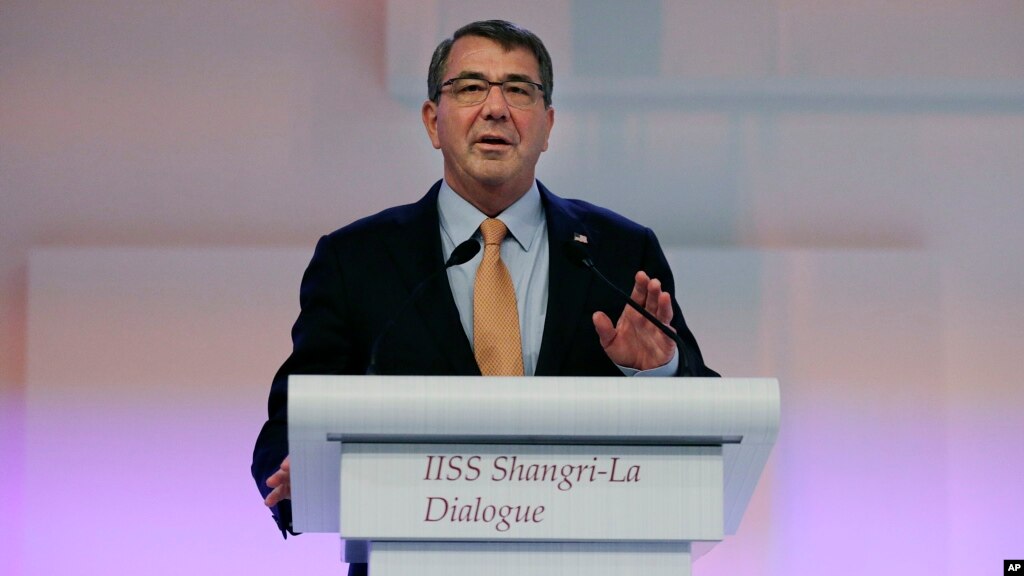
US Defense Secretary Gives Keynote Address at Shangri-La Dialogue


U.S. Secretary of Defense Ashton Carter delivers his speech about

U.S. Secretary of Defense Ashton Carter delivers his speech about “The United States and Challenges to Asia-Pacific Security” during the 14th International Institute for Strategic Studies Shangri-la Dialogue (IISS) Asia Security Summit, May 30, 2015, in Shangri-la

U.S. Secretary of Defense Ashton Carter delivered the keynote address at the Shangri-La Dialogue in Singapore Saturday.

Here is the text, as delivered: Tiếp tục đọc “US Defense Secretary Gives Keynote Address at Shangri-La Dialogue”

Carter Defends the South China Sea at Shangri-La

On Saturday morning at the Shangri-La defense dialogue in Singapore, U.S. Secretary of Defense Ashton Carter delivered a long-anticipated speech on security issues in Asia.  As tensions have mounted over China’s island building in the South China Sea, Carter has been one of the administration’s strongest voices, calling the militarization of the islands a challenge to international norms and reaffirming the United States’ intention to uphold freedom of navigation and overflight, and to defend international law.  Carter’s Shangri-La speech did not disappoint; he broadened the aperture focusing on wider strategic goals for the region, he called for a regional architecture that gives all countries and people in the Asia-Pacific the right to rise, and spoke at length on the South China Sea disputes. Here are some of the prominent themes from the Secretary’s remarks. Tiếp tục đọc “Carter Defends the South China Sea at Shangri-La”

U.S. naval vessel on patrol meets Chinese military vessels in South China Sea

 CSIS
Southeast Asia from Scott Circle – May 28, 2015

The littoral combat ship USS Fort Worth on May 13 completed a weeklong patrol of the South China Sea, including near the disputed Spratly Islands, during which the U.S. Navy said it encountered several Chinese warships and was trailed at least once by a Chinese frigate. The Fort Worth, which is on a rotational deployment to Singapore, used agreed-upon codes for unplanned encounters with the Chinese vessels.

Pentagon debates freedom of navigation operations near reclaimed features

CSIS
Southeast Asia from Scott Circle – May 28, 2015

The Pentagon is considering “freedom of navigation” operations near some of China’s reclaimed features in the South China Sea, according to unnamed officials cited in a May 12 Wall Street Journal article. Assistant Secretary of Defense David Shear said during a Senate Foreign Relations Committee hearing the next day that he could not discuss potential operations. The proposed operations would likely involve a Navy ship transiting within 12 nautical miles of reclaimed features that were originally submerged, such as Mischief Reef and Subi Reef, to assert that as artificial islands they are not entitled to a territorial sea.