Shipping data: UNCTAD releases new seaborne trade statistics

UNCTAD.org 23 April 2025

Maritime transport moves over 80% of goods traded worldwide. Country-level seaborne trade data is vital for shaping better transport, trade and investment policies.

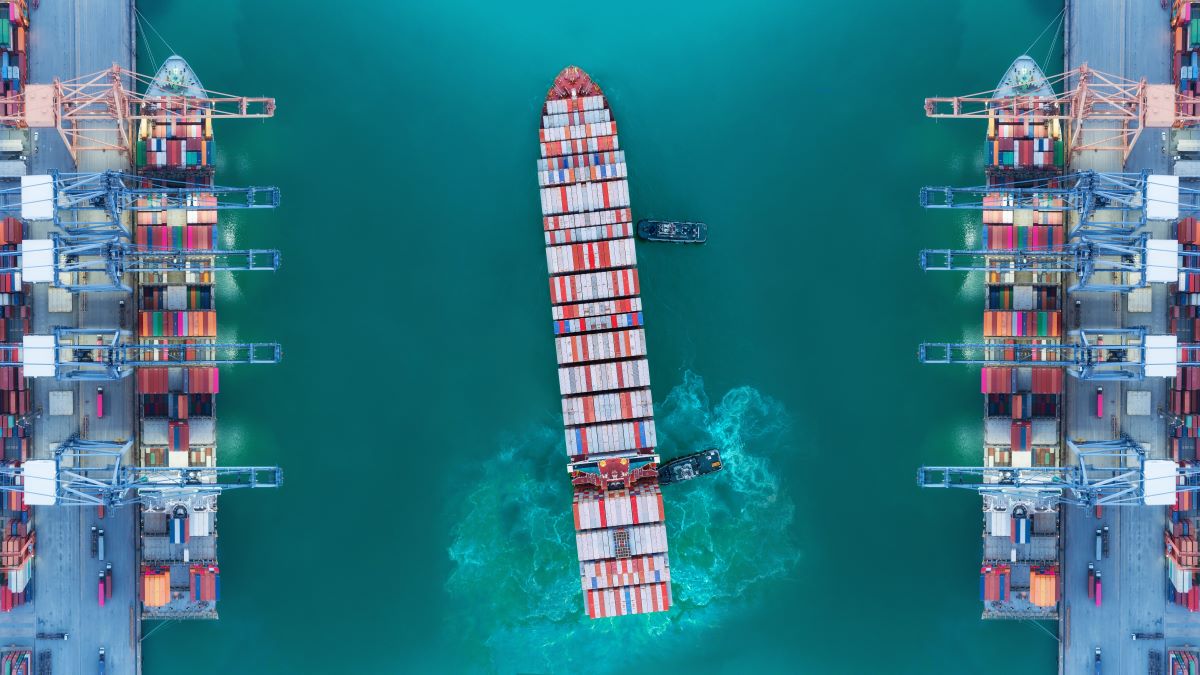
An aerial view of a container vessel leaving port
Default image copyright and description© Shutterstock/Studio conept

UN Trade and Development (UNCTAD) released on 15 April new seaborne trade dataFor the first time, the dataset includes country-level statistics.

Maritime transport is the backbone of global trade, moving over 80% of goods traded worldwide by volume. It connects global value chains, carrying raw materials and semi-processed goods to production hubs and delivering finished products to consumers. These flows are vital for industrialization, economic growth and job creation.

Seaborne trade has evolved over the decades, shaped by containerization, the rise of developing economies and shifting production and consumption patterns. Today, digitalization, geopolitics and the push for sustainability and climate resilience are redefining the sector.

A clearer picture of who ships what – and how much

Reliable, up-to-date country-level data is key to understanding trade flows and guiding better transport and trade policies and investment decisions.

Built from official trade data reported by governments to UN Comtradethe new dataset offers a more accurate and comparable view of global maritime cargo movements, helping countries to:

  • Monitor trade performance and competitiveness.
  • Assess integration into global supply chains and trade networks.
  • Inform port and transport infrastructure investment decisions.
  • Track progress on Sustainable Development Goal 9.1.2 to develop quality, reliable, sustainable and resilient infrastructure – for which maritime freight and port cargo volumes are indicators.

Data highlights developing countries’ rising share of maritime trade

Historically, developing countries served mainly as loading hubs – major exporters of raw materials but marginal importers of manufactured goods. But this has evolved since the 1970s, driven by structural changes such as the oil crises, trade liberalization, increased private sector participation in port operations, the rise of container shipping and reforms to liner shipping alliances.

The shift accelerated in the early 2000s as developing countries increased trade among themselves – including in raw materials, oil and manufactured goods. Their share of global maritime freight rose from 38% in 2000 to 54% in 2023. The surge was led by Asia, with China driving much of the growth.

Read full article here https://unctad.org/news/shipping-data-unctad-releases-new-seaborne-trade-statistics

UNCTAD16: Countries to meet in Viet Nam to propel development in a multipolar world

UNCTAD

17 January 2025

UN Trade and Development’s 16th quadrennial conference is set for October with a focus on driving economic transformation for a more sustainable future.

Default image copyright and description© UNCTAD Photo | The Trade and Development Board meets for its 33rd special session in Geneva on 17 January.

The 16th session of the United Nations Conference on Trade and Development (UNCTAD16) will take place Viet Nam in October 2025 under the theme “Shaping the future: Driving economic transformation for equitable, inclusive and sustainable development”.

Tiếp tục đọc “UNCTAD16: Countries to meet in Viet Nam to propel development in a multipolar world”

How the Russia-Ukraine Conflict is Affecting Businesses in Vietnam

vietnam-briefing.com

As the Russia-Ukraine conflict unfolds and completes a month, Vietnam Briefing looks at the impact of the conflict on Vietnam as well as businesses in the country. While it’s still early to determine long-term effects, we examine the short-term effects that will play a key role in how the economy moves forward.

The Russia-Ukraine conflict which began on February 24, sent shockwaves to global markets and led to an unprecedented response from countries around the world in the form of economic sanctions and other restrictive measures. In doing so, western countries and allies are sending a clear signal that they want to cut off Russia from the global financial system and isolate Putin politically.

While analysts state the impact of the Russia-Ukraine conflict is likely to have limited direct consequences on Vietnam, the fallout of the conflict is likely to have significant consequences on trade and businesses in Vietnam. From disrupting trade and global supply chains to causing tensions geopolitically, we discuss the impact that is likely to be felt by businesses operating in Vietnam.

Tiếp tục đọc “How the Russia-Ukraine Conflict is Affecting Businesses in Vietnam”

Advancing human rights through trade

chathamhouse.org

Why stronger human rights monitoring is needed and how to make it work

Political shifts, the impact of the COVID-19 pandemic, and the struggle for a shared vision of how to ‘build back better’, have reignited the debate about trade and human rights. 

Although many trade agreements take human rights impacts into consideration, the monitoring systems that have emerged so far are not comprehensive. Without robust human rights monitoring, trading partners have little chance of ensuring that their counterparts are meeting their commitments.

While there are considerable structural, political and resource-related challenges to conducting more systematic and effective human rights monitoring, recent experiences in this field can help policymakers design more effective monitoring mechanisms for the future.

Tiếp tục đọc “Advancing human rights through trade”

Succeeding in China’s $9.4 T E-commerce Market: Why Culture and Context Matters

asiapacfic.ca

China’s cross-border e-commerce has been growing in recent years in terms of both volume and value. With increasingly sophisticated customers who have rapidly evolving expectations, Asia’s largest economy is expected to become the world’s largest e-commerce market by 2020, with e-commerce transactions expected to reach almost 50 trillion yuan, or approximately C$9.4 trillion.

This report is intended for Canadian firms contemplating expansion into e-commerce in China. In addition to providing an overview and statistics, as well as primary data insights into key challenges and considerations, the report also offers two case studies to provide further insights into this explosive sector in China.

Read our infographic summary of the report below, or click the download button to read the full text.
Tiếp tục đọc “Succeeding in China’s $9.4 T E-commerce Market: Why Culture and Context Matters”

Exploring Interdependencies in Global Resource Trade

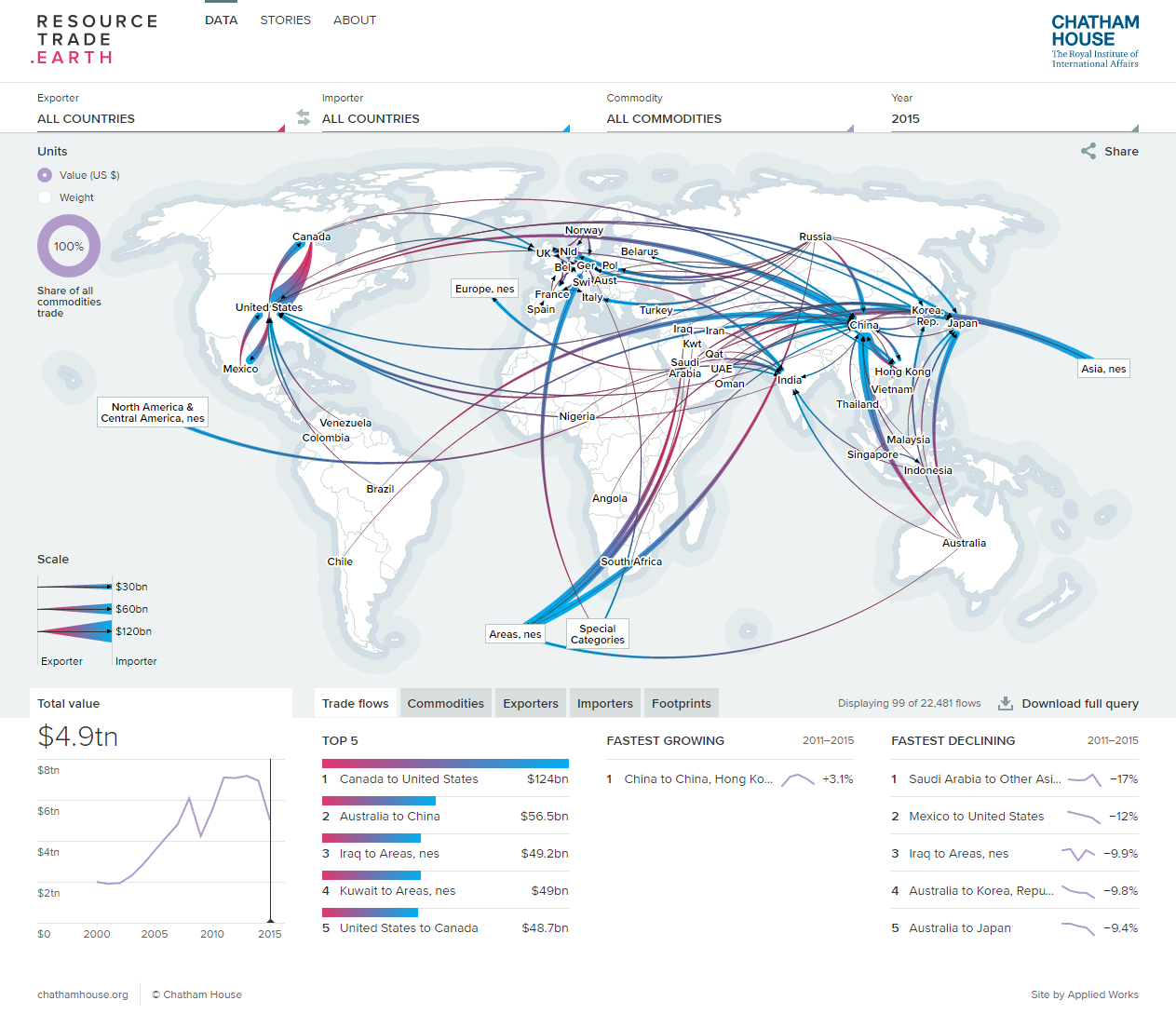
resourcetrade.earth features powerful interactive visualisations that provide easy access to an extensive and authoritative database of international trade in natural resources, developed from United Nations data. The Chatham House Resource Trade database reorganizes UN Comtrade data into a natural resource hierarchy, covering trade in over 1,350 different types of natural resources and resource products, including agricultural, fishery and forestry products, fossil fuels, metals and other minerals, and pearls and gemstones. The site allows users to easily interrogate resource trade flows between more than 200 countries and territories since the year 2000, by monetary value and by weight, at varying degrees of granularity and aggregation.The political economy of natural resources is increasingly shaped by large, structural shifts in the changing natural environment, in the deepening interrelationship between resource systems and actors, and in the rebalancing of global income and power. We consider these dynamics in the stories section of the site, which provides detailed explorations of different facets of resource trade and the economic, political, and environmental implications of resource interdependencies. Featuring expert analysis and insights from Chatham House and others, this section will continue to expand with new content over time. We launch with an overarching look at the scale and significance of resource trade, and Professor Tim Benton considers the state of agricultural trade, food security, and the potential impacts of an outbreak of protectionism affecting the key food commodities.


For the first time, resourcetrade.earth opens up complex patterns of resource trade for examination by non-experts as well as policy-makers, civil society groups, business analysts, and everyone with an interest in resource trade dynamics and their environmental impacts.

EU free trade deal will trap Vietnam in low-wage, low-skill cycle

EU lawmakers reject granting China the market economy status