PM green lights two large-scale reservoirs

vietnamnews

Update: April, 17/2017 – 10:19

Illustrative Image. — Photo baocongthuong.com.vn

HÀ NỘI – Prime Minister Nguyễn Xuân Phúc has given the investment green light to building two large-scale reservoirs with capacities of nearly a million cu.m each..

The Đồng Mít Reservoir in the central province of Bình Định and Cánh Tạng Reservoir in the northern province of Hòa Bình aim to improve irrigation for agriculture production, improve water supply and living standards in the two provinces. Tiếp tục đọc “PM green lights two large-scale reservoirs”

Mass fish deaths reported in fresh water cages

Update: April, 07/2017 – 18:00

A breeder and his dead fish. — VNS Photo Điền Quang

THỪA THIÊN- HUẾ — Fish breeding in floating cages in central Thừa Thiên-Huế Province’s river have died en mass, resulting in huge losses for breeders.

The fish deaths occurred earlier this week in Bồ River’s section running across the province’s Hương Toàn Commune in Hương Trà District. Breeders said the fish were almost ready to harvest; therefore, they were expected to incur significant losses for this breeding season. Tiếp tục đọc “Mass fish deaths reported in fresh water cages”

Letters from the Mekong: A Call for Strategic Basin-Wide Energy Planning in Laos

This issue brief—the third in Stimson’s “Letters from the Mekong” series — continues to challenge the prevailing narrative that the current rapid pace of dam construction on the Mekong River in mainland Southeast Asia will continue until the entire river is turned into a series of reservoirs. Certainly, the construction of even a few large dams will severely impact food security in the world’s most productive freshwater fishery and sharply reduce the delivery of nutrient-rich sediment needed to sustain agriculture, especially in Cambodia and Vietnam’s Mekong Delta. However, our team’s extensive research over a number of years, including site visits and meetings with regional policymakers, provides compelling evidence that not all of the planned dams will be built due to rising political and financial risks, including questions about the validity of current supply and demand projections in the greater Mekong region. As a consequence, we have concluded that it is not yet too late for the adoption of a new approach that optimizes the inescapable “nexus” tradeoffs among energy, export revenues, food security, and fresh water and protects the core ecology of the river system for the benefit of future generations.

In particular, through a continued examination of rising risks and local and regional responses to those risks, we believe that Laos and Cambodia will fall far short of current plans for more than 100 dams on the Mekong mainstream and tributaries. This reality will have particular implications for Laos, which seeks to become the “Battery of Southeast Asia” by setting the export of hydropower to regional markets as its top economic development priority.

In the case of Laos in particular, the reluctant recognition that its dream of damming the Mekong are in jeopardy may cause a reconsideration of its development policy options. Fewer Lao dams will mean that national revenue targets will not be met. Already the government has begun to make overtures for US and other donor assistance in managing the optimization of its hydropower resources. This is not surprising since Lao decision makers depend almost entirely on outside developers to build out its planned portfolio of dams under commercial build-own-operate-transfer (BOOT) concessions for export to neighboring countries. All of these dams are being constructed in a one-off, project-byproject manner with no prior input from the intergovernmental Mekong River Commission (MRC) or neighboring countries, and hence there is little practical opportunity for synergistic planning that could optimize the benefits of water usage on a basin-wide scale.

Because planners cannot see past the next project, it is impossible to determine to what extent the targets for the final power output of either Laos or the basin as a whole are achievable. Further, critical red lines of risk tolerance, particularly toward the environmental and social risks that impede dam construction, are unidentifiable because the government has little stake invested in the projects and derives few resources from the BOOT process to mitigate risk.

By 2020 roughly 30% of the Mekong basin’s power potential in Laos will be tapped by existing dams and those currently under construction. Beyond 2020 the prospect for completing the remaining 70 plus dams planned or under study by the Lao Ministry of Energy and Mines is unknowable. As Lao officials begin to realize they will not necessarily meet their development goals, there will still be time to transition to a basin-wide, strategic energy plan that meets projected revenue goals while minimizing impacts on key environmental flows through a combination of fewer dams and other non-hydropower sources of clean energy generation.

Tây Nguyên: Đầy nỗi lo vào mùa cà phê chín !

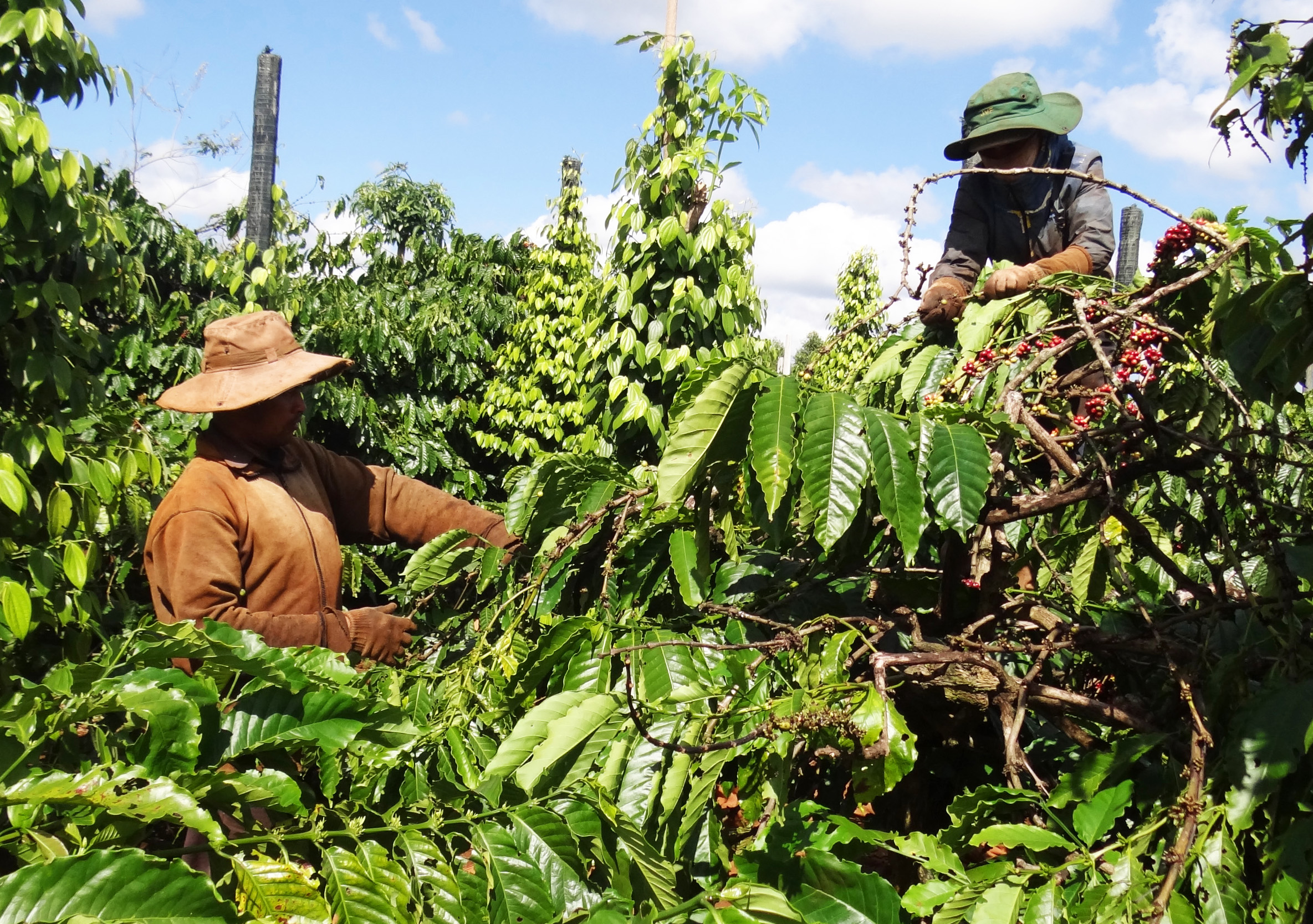
Những cánh đồng cà phê bát ngát trên Tây Nguyên những ngày này đã bắt đầu chín rộ, trái chín đỏ rực trên cành. Năm nay giá cà phê tăng rất cao so với cùng kỳ các năm trước. Tuy nhiên, niềm vui được giá lại không trọn vẹn, vì năng suất bình quân cà phê nhiều nơi giảm hẳn, và nạn trộm cà phê lại tái diễn…

Cà phê chín vào thời điểm giá cao nhưng năng suất bình quân lại thấp

Tiếp tục đọc “Tây Nguyên: Đầy nỗi lo vào mùa cà phê chín !”

Dams, Drought and Disaster Along the Mekong River

By: Jennifer Rigby
Date: Tuesday, May 10, 2016

This article originally appeared in IRIN News.

A dry riverbed in Cambodia.

A dry riverbed in Cambodia.IRIN

CHONG PRA LAY/CAMBODIA, 10 May 2016

internationalriver – The dry months before the monsoon rains arrive are often tough for Cambodian fishermen and farmers. But with rivers drying up and drinking water running out, conditions have rarely been as bad as they are now.

The current drought is linked to El Niño, which has been disrupting weather patterns around the world. But the harsh conditions today might only be foreshadowing far worse to come. Climate change will continue to affect the Mekong Basin region, while future droughts are expected to be exacerbated by a string of major hydropower dam projects.

Experts fear that the present crisis could become the new normal for Cambodia and its neighbours, which have also been hit hard by record temperatures and a long period of extremely dry weather.

“The combined effects of drought, climate change and dam building are pushing the resources of the Mekong Basin to the brink of disaster,” said Maureen Harris, Southeast Asia programme director of the river protection organisation, International Rivers. Tiếp tục đọc “Dams, Drought and Disaster Along the Mekong River”

Drought forces Vietnam’s Mekong Delta residents to leave home, family for work

May 6, 2016 by tuoitrenews Leave a Comment

tuoitrenews – The devastating effects of this year’s severe drought and salinization have forced many residents from Vietnam’s Mekong Delta to leave their hometown and earn their living elsewhere.

1881426-yfu3rshf

According to Tran Sang, an official in Soc Trang Province, previously, the situation was only evident in poorer households.

“Now, the climatic condition has been so serious this year that many citizens have lost thousands of square meters of crops, forcing them to abandon their homes to find work in other provinces,” Sang said.
Tiếp tục đọc “Drought forces Vietnam’s Mekong Delta residents to leave home, family for work”

Water resources, eroding land need saving

Updated  September, 28 2015 09:09:38
 Water management has become a major topic of discussion in recent years among Viet Nam’s lawmakers, experts and society. The country has been struggling to deal with water-related issues such as a rising sea level, land subsidence and saline intrusion in the Mekong Delta. Lawmakers and experts shared their views on water management with Viet Nam News reporters Thu Van and Hoang Anh.
Nguyen Thai Lai

Nguyen Thai Lai, deputy Minister of Natural Resources and Environment

What are the major problems that Viet Nam is facing in water management?

There is an actual risk of the degradation and depletion of water resources due to the impact of climate change and an increase in the exploitation and use of water in upstream countries. It is shown on the following aspects: Tiếp tục đọc “Water resources, eroding land need saving”