The Nuclear Waste Management Organization of Japan recently backed the further survey of two potential disposal sites for high-level radioactive waste in Hokkaidō. The government has struggled to convince municipalities to participate in review procedures, with a growing list of stakeholders calling for a new approach to the selection process.
A Three-Step Process
The Japanese government and nuclear power plant operators have long grappled with how to dispose of spent fuel and other high-level radioactive waste. Authorities finally settled on the approach of burying waste deep underground at facilities 300 or more meters below the surface. In 2002, NUMO, the Nuclear Waste Management Organization of Japan, began hunting for a storage location by inviting municipalities to put themselves forward as candidate sites. To date, this “volunteer” policy has netted only three participants, the towns of Suttsu and Kamoenai in Hokkaidō and Genkai in Saga.
The world is warming despite natural fluctuations from the El Niño cycle.
In 2024, the world was around 1.5°C warmer than it was in pre-industrial times.1 You can see this in the chart below, which shows average warming relative to average temperatures from 1861 to 1890.2
Temperatures, as defined by “climate”, are based on temperatures over longer periods of time — typically 20-to-30-year averages — rather than single-year data points. But even when based on longer-term averages, the world has still warmed by around 1.3°C.3
But you’ll also notice, in the chart, that temperatures haven’t increased linearly. There are spikes and dips along the long-run trend.
Many of these short-term fluctuations are caused by “ENSO” — the El Niño-Southern Oscillation — a natural climate cycle caused by changes in wind patterns and sea surface temperatures in the Pacific Ocean.
While it’s caused by patterns in the Pacific Ocean and most strongly affects countries in the tropics, it also impacts global temperatures and climate.
There are two key phases of this cycle: the La Niña phase, which tends to cause cooler global temperatures, and the El Niño phase, which brings hotter conditions. The world cycles between El Niño and La Niña phases every two to seven years.4 There are also “neutral” periods between these phases where the world is not in either extreme.
The zig-zag trend of global temperatures becomes understandable when you are taking the phases of the ENSO cycles into account. In the chart below, we see the data on global temperatures5, but the line is now colored by the ENSO phase at that time.6
The El Niño (warm phase) is shown in orange and red, and the La Niña (cold phase) is shown in blue.
You can see that temperatures often reach a short-term peak during warm El Niño years before falling back slightly as the world moves into La Niña years, shown in blue.
Since it came on the scene, magnetic resonance imaging (MRI), where a magnetic camera looks through the skull and captures pictures of a living brain, mountains of neuroimaging studies have been made by scientists eagerly delving into the most complex organ we have. It’s led to amazing discoveries and insights, and revolutionised our understanding of how we function.
But the neuroscientific investigation into brain health in relation to conditions only affecting women, girls, and people who have or have had menstrual periods, has been comparably pitifully small.
My name’s Livia. I’m a freelance science writer and journalism student, and I found myself diving into this as I wondered why hormonal birth control, several decades after its invention, still causes negative effects on many users’ moods and well-being. Shouldn’t somebody have looked into how our brains get affected when we go on the pill — and created something better?
It turns out that this large neuroscience knowledge gap leaves billions of people in the dark about the organ that creates their lived experiences, affects drug development, and is bad for science, generally.
When broadcaster Sandi Toksvig was studying anthropology at university, one of her female professors held up a photograph of an antler bone with 28 markings on it. “This,” said the professor, “is alleged to be man’s first attempt at a calendar.” Toksvig and her fellow students looked at the bone in admiration. “Tell me,” the professor continued, “what man needs to know when 28 days have passed? I suspect that this is woman’s first attempt at a calendar.”
Women have always tracked their periods. We’ve had to. Since 2015, I’ve been reliant on a period tracker app, which reassures me that there’s a reason I’m welling up just thinking about Andy Murray’s “casual feminism”. And then there’s the issue of the period itself: when you will be bleeding for up to seven days every month, it’s useful to know more or less when those seven days are going to take place. Every woman knows this, and Toksvig’s experience is a neat example of the difference a female perspective can make, even to issues that seem entirely unrelated to gender.
For most of human history, though, that perspective has not been recorded. Going back to the theory of Man the Hunter, the lives of men have been taken to represent those of humans overall. When it comes to the other half of humanity, there is often nothing but silence. And these silences are everywhere. Films, news, literature, science, city planning, economics, the stories we tell ourselves about our past, present and future, are all marked – disfigured – by a female-shaped “absent presence”. This is the gender data gap.
These silences, these gaps, have consequences. They impact on women’s lives, every day. The impact can be relatively minor – struggling to reach a top shelf set at a male height norm, for example. Irritating, certainly. But not life-threatening. Not like crashing in a car whose safety tests don’t account for women’s measurements. Not like dying from a stab wound because your police body armour doesn’t fit you properly. For these women, the consequences of living in a world built around male data can be deadly.
The gender data gap is both a cause and a consequence of the type of unthinking that conceives of humanity as almost exclusively male. In the 1956 musical My Fair Lady, phoneticist Henry Higgins is baffled when, after enduring months of his hectoring put-downs, his protege-cum-victim Eliza Doolittle finally bites back. “Why can’t a woman be more like a man?” he grumbles.
Viruses use bacteria’s chemical language to time their destruction; this might lead to new ways to fight infections
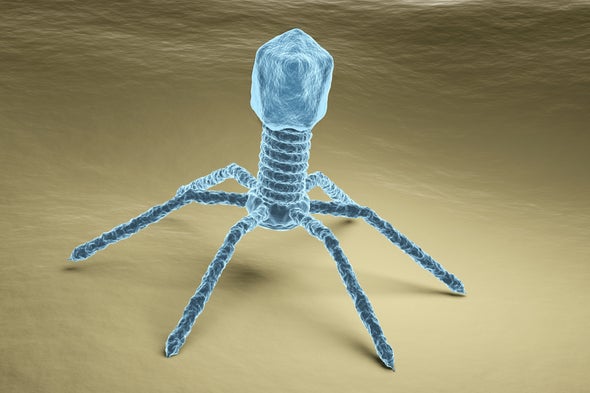
Bacteriophage virus electron microscopy image. Credit: Getty Images
In the early experiments it looked like the virus called VP882 was doing something that should be impossible for a thing that is not a bacterium, and not technically even alive: intercepting molecular messages exchanged by its host bacteria, and reading them to determine the best time to annihilate the whole bacterial colony. “As scientists, this is just unimaginable to us,” says Bonnie Bassler, a molecular biologist at Princeton University. “We were delighted and skeptical at the same time. It was almost too good to be true.”
Not only did it turn out to be true for VP882; Bassler learned there is a family of bacteria-infecting viruses (a subgroup of a kind called bacteriophages, or just “phages”) that eavesdrop on their hosts’ routine molecular communications with other bacteria. That means VP882’s kill trigger could be easily manipulated to target any bacteria, Bassler says—opening the possibility that the virus could be engineered into an ideal killing machine for dangerous pathogens.
Microbes buried beneath the sea floor for more than 100 million years are still alive, a new study reveals. When brought back to the lab and fed, they started to multiply. The microbes are oxygen-loving species that somehow exist on what little of the gas diffuses from the ocean surface deep into the seabed.
The discovery raises the “insane” possibility, as one of the scientists put it, that the microbes have been sitting in the sediment dormant, or at least slowly growing without dividing, for eons.
The new work demonstrates “microbial life is very persistent, and often finds a way to survive,” says Virginia Edgcomb, a microbial ecologist at the Woods Hole Oceanographic Institution who was not involved in the work
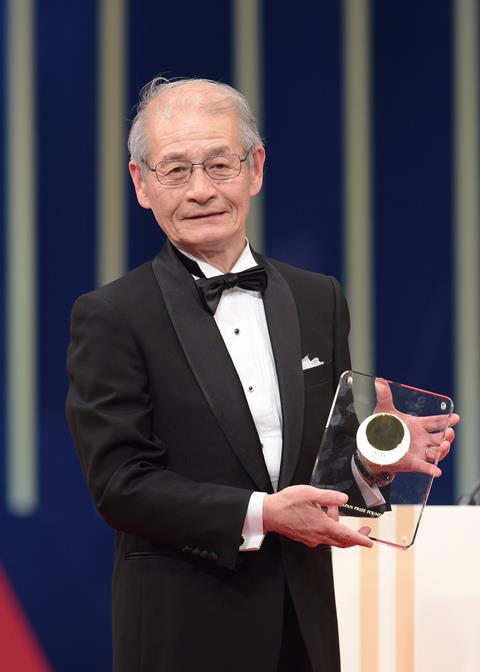
journey to winning Japan’s highest scientific honour
Akira Yoshino was about nine years old when his teacher gave him a book: Michael Faraday’s A chemical history of a candle. He’s never looked at a candle the same since. ‘There was a TV programme on the other day about candles and how they can only really be used on Earth. What happens when you’re in a zero gravity environment? The flame looks like it’s extinguished (it actually burns almost invisibly at a very slow rate). That fascinated me,’ he says with the broadest smile.
sciencedaily_Summary:The sequencing of the genome of Coffea arabica, the species responsible for more than 70 percent of global coffee production, has now been announced by researchers.
The first public genome sequence for Coffea arabica, the species responsible for more than 70 percent of global coffee production, was released today by researchers at the University of California, Davis.
Mấy năm trước học ở Singapore, mình ở ký túc xá cùng với một cô bạn (không phải người Việt). Bạn này rất xinh và hiền, nhưng sống hơi khép kín, không giao tiếp bạn bè nhiều và khá tiêu cực với thế giới xung quanh. Gần như lúc nào cô bạn cũng căng thẳng chuyện học hành. Ban đầu mình nghĩ cô bạn có tính ít nói nên cũng không để ý lắm. Sau đó mình biết là bạn học về công nghệ thông tin, chuyên thiết kế các trò chơi online và rất nhiều sản phẩm, trong đó có các trò chơi bạo lực chém giết. Trên bàn học cô có treo những poster là hình gươm dao súng đạn mà các bạn hay thấy trong các trò chơi điện tử. Mình chỉ thỉnh thoảng nói chuyện được và không biết làm thế nào giúp đỡ cô bạn đỡ căng thẳng hơn. Giờ nghĩ lại mình vẫn thấy thương bạn này và không rõ hậu quả cuộc sống stress đó đã và sẽ dẫn cô đến đâu. Mình không còn liên lạc được với cô ấy sau khi học xong ở đó nữa.
Cũng thời gian đó, mình có một cô bạn khác ở ngay phòng bên cạnh. Bạn này rất giỏi, thông minh, học về robotic và tự động hóa. Trước khi học tiếp PhD, cô được đề nghị một công việc ở Châu Âu. Nhưng sau khi phát hiện ra công ty có liên quan đến việc phát triển và buôn bán vũ khí, cô đã từ chối công việc để tiếp tục đi học PhD với mức lượng thấp hơn nhiều lần so với công việc kia. Tiếp tục đọc “TRÍ ÓC VÀ TÂM HỒN – KHOA HỌC VÀ HÒA BÌNH”→

 CVD
CVD 