Viet Nam to receive nearly 72 million USD from Green Climate Fund based on the country’s verified results in reducing deforestation

en.nhandan.vn Thursday, April 2, 2026 at 15:44
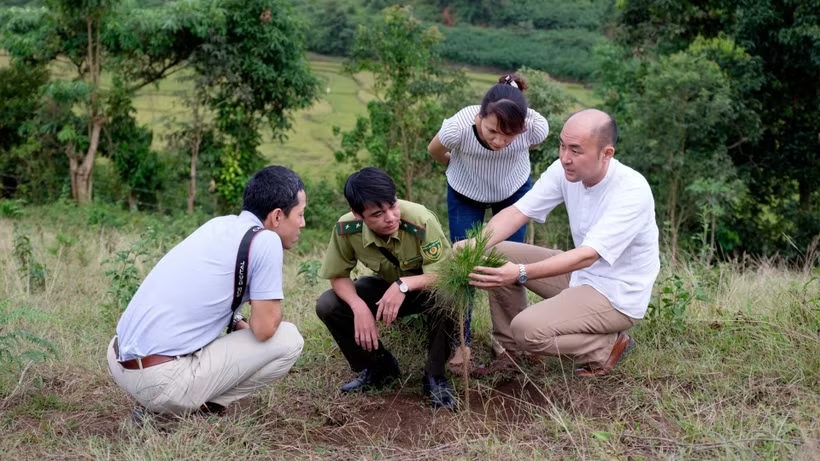
Baku Takahashi, a JICA expert, provides guidance on tree planting in Muong Phang Commune, Dien Bien Province. (Photo: JICA)

The Green Climate Fund has approved a funding proposal submitted by the Japan International Cooperation Agency (JICA) and the Government of Viet Nam for a results-based payment project on reducing emissions from deforestation and forest degradation (REDD+), recognising Viet Nam’s emission reduction achievements in 2014.

The proposal, titled “Viet Nam’s REDD+ Results-Based Payment for the Results Period of 2014,” was approved at the 44th meeting of the GCF Board held on March 26, 2026 in Republic of Korea.

Accordingly, Viet Nam will receive 71.96 million USD through a results-based payment mechanism, corresponding to independently verified greenhouse gas emission reductions. These results were achieved through efforts to curb deforestation and forest degradation, while increasing forest carbon stocks through tree planting and natural forest restoration. The funding from the project will be reinvested in strengthening forest-related policies, institutions and enforcement measures.
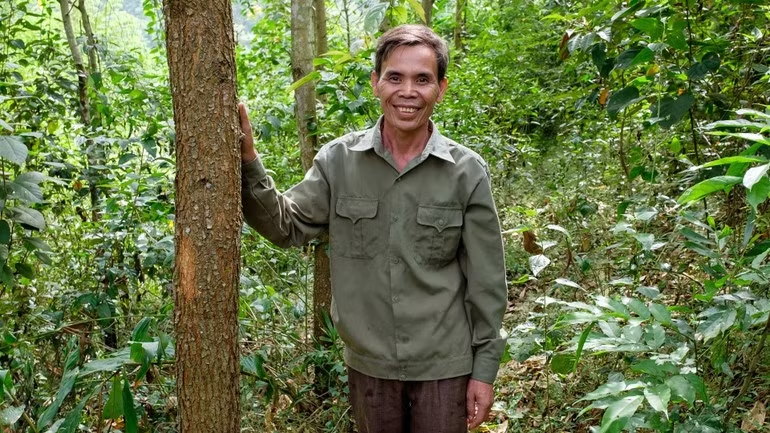
A local resident beside acacia trees planted in Phieng Ban Commune, Son La Province.

Through project activities, Viet Nam will gradually address the main causes of deforestation and forest degradation, promote sustainable forest management, and improve livelihoods for forest-dependent communities.

The project is expected to be implemented over six years, led by the Ministry of Agriculture and Environment of Viet Nam in coordination with provincial People’s Committees in the project areas. Target locations include provinces in the Northwest and Northeast regions, namely Dien Bien, Lai Chau, Lao Cai, Son La, Phu Tho and Tuyen Quang provinces.

The approval of this project further affirmed the long-standing and effective cooperation between JICA and Viet Nam in the field of REDD+, including support for development of policy, forest monitoring systems, the measurement, and calculation of emission reductions and elimination.

Great Green Walls: Hype, Myth, and Science

Annual Review of Environment and Resources Volume 48, 2023

ABSTRACT

Visions of planting walls of trees to block the expansion of the desert have long been promoted but never realized. The green wall myth persists today even though it is premised on outdated understandings of desertification. We review the history of the idea of green walls and focus on two sets of contemporary initiatives to assess their outcomes: peri-Saharan programs (Algeria’s Green Dam and Great Green Wall in sub-Saharan Africa) and China’s Three Norths Shelterbelt Program. This review reveals a mixed record of technical success with low rates of the establishment of monocultures of fast-growing trees vulnerable to disease. While there is evidence for reduced wind erosion in some areas, afforestation is also associated with reduced soil moisture and lowering of water tables. Social impacts include increased water scarcity for people and livestock in some cases, and resource enclosures that particularly work against pastoralist livelihoods.

1.  INTRODUCTION

Green walls refer to continuous bands of planted trees stretching across single or multiple countries in dryland regions. As socioecological projects, green walls invoke powerfully attractive images of maintaining life over the assumed sterility of the desert through human ingenuity and effort. A wall of planted trees is envisioned to hold back an expansionary desert from degrading the productivity of the lands behind the wall. Despite the persistent discursive power of this image, its scientific foundation rests on now discredited understandings of desertification. 1 Desertification, scientifically understood as land degradation due to human mismanagement, is less a regional phenomenon across a broad front than a highly localized phenomenon in areas of greater and more persistent human pressures. The power of the green wall vision is illustrated by its persistent use in promotions of a diverse array of dryland afforestation initiatives with different afforestation patterns (e.g., shelterbelts, scattered woodlots and larger afforested blocks, and agroforestry) and goals (ecological rehabilitation, carbon sequestration, and improved climate resilience). In short, green wall rhetoric mobilizes support and empowers certain actors rather than describing actual dryland afforestation practices. 2 This article focuses on the vision, practices, and effects of these programs.

This review was written during a period of global enthusiasm for trees and mobilization for mass afforestation, with the World Economic Forum’s Trillion Trees initiative the most prominent example ( https://www.1t.org/ ) but also a wide range of other afforestation efforts across the globe (3). While the arborocentrism of this moment has a long history (see below), concerns about climate change and an interest in increasing the sequestration of industrial carbon has led to a rapid rise of tree planting initiatives. The world’s drylands could be seen as “empty” and thus important “untapped” landscapes to store carbon. Through a consideration of the empirical record of green wall programs, this article outlines reasons to be cautious. Trees are often not suited for the arid zones where they are planted and, even if they are established, may have negative ecological and social impacts (4). By ignoring the need for ecological and social monitoring of afforestation impacts, green wall enthusiasm has often worked to hide the mixed record of these initiatives.

Tiếp tục đọc “Great Green Walls: Hype, Myth, and Science”

Trees alone will not save the world

economist.com

But better markets and better monitoring will let them do more

An image showing a trio of three-dimensional trees made out of an image of a leaf against a bark background.
image: ben denzer

“Everything you see, as far as the eye can see, belongs to us,” says David Beleznay. “Us” is Mosaic, a forest-management company that looks after the upkeep and logging of much of Vancouver Island; Mr Beleznay is its director of climate and watersheds. “As far as the eye can see” takes in a long, deep valley whose forested flanks rise to the rocky top of Mount Arrowsmith. Towering evergreens—Douglas fir, cedar, hemlock—drape the island from its central peaks to the water’s rocky edge.

This drapery is, though, a bit patchy in places. Directly behind Mr Beleznay’s parked pickup are some “polygons”, as the industry calls them, where the trees have been clear-cut, leaving behind jumbled soil, stumps and woody debris; tiny saplings poke through it higgledy-piggledy. Mosaic has an eye to water quality in forest streams, to maintaining biodiversity, to being a partner to the island’s first nations. But the forest it manages is also the basis of a timber business.

Tiếp tục đọc “Trees alone will not save the world”

National forest protection plan unveiled

vietnamnews

Update: May, 05/2017 – 09:20

Rangers in the central province of Thừa Thiên-Huế check on the growth of a mangrove forest in Hương Phong Commune along the Tam Giang Lagoon. — VNA/VNS Photo Quốc Việt

HÀ NỘI – Increasing forest cover to 45 per cent of national territory and contributing to an eight per cent reduction of greenhouse gas emissions by 2030 are among the targets of a national environmental action plan introduced yesterday in Hà Nội.

The National Action Programme aimed to trim greenhouse gas emissions by stemmig deforestation and forest degradation, sustainable management of forest resources, conservation and enhancement of forest carbon stocks by 2030. Tiếp tục đọc “National forest protection plan unveiled”

Certifying Vietnam’s timber plantations would help smallholders profit from lucrative export market

BOGOR, Indonesia (21 November, 2012)_If Vietnam wants its timber producers to benefit from the growing “eco-conscious” and more lucrative international furniture market, national forest institutions should look for ways to get plantation forests certified, said Louis Putzel, a senior scientist at the Center for International Forestry Research (CIFOR).

Related stories

  • The chicken or the egg?
  • Decoding Cameroon’s domestic timber trade
  • ‘Green deserts’ or functional forests?
  • Legalizing Cameroon’s timber production chain

The area of certified forests in Vietnam is vanishingly small. Ahmad Dermawan.

BOGOR, Indonesia (21 November, 2012)_If Vietnam wants its timber producers to benefit from the growing eco-conscious and more lucrative international furniture market, national forest institutions should look for ways to get smallholder plantation forests certified, said Louis Putzel, a senior scientist at the Center for International Forestry Research (CIFOR).

Eco-certification may become more important as countries start putting in place import restrictions, with the European Union ruling it will ban illegally harvested wood from entering its market as of March 2013. Tiếp tục đọc “Certifying Vietnam’s timber plantations would help smallholders profit from lucrative export market”