A Decade After the Paris Agreement, Climate Promises Still Leave the Poor Behind

time.com

Thousands of people take part in the so-called "Great People's March" in the sidelines of the COP30 UN Climate Change Conference in Belem, Para State, Brazil on November 15, 2025.

Thousands of people march in the sidelines of the COP30 UN Climate Change Conference in Belém, Brazil on Nov. 15, 2025.Pablo Porciuncula—AFP via Getty Image

by Brian Mukhaya Brian Mukhaya is the Africa Program Manager at Clean Air Task Force.

Ten years after the landmark Paris Agreement, the world is still trying to solve two crises as if they were separate: climate change and economic development. That’s a dangerous illusion. Climate progress cannot succeed if billions of people remain in poverty, without electricity, stable food systems, or the means to build better lives. And development, if it ignores climate risk, is little more than a short-term fix that will collapse under the weight of future disasters.

I saw this tension firsthand at COP30 in Belém, Brazil, the annual UN climate summit. The energy there was unmistakable—a mixture of urgency and frustration. Delegates from across Africa reminded the world that promises made in Paris have not been kept. Wealthy nations pledged to support developing countries as they cut emissions and adapted to rising temperatures. Yet, a decade later, those commitments remain largely unfulfilled.

At COP29 in Baku last year, developed countries agreed to mobilize at least $300 billion annually by 2035 for developing countries’ climate action, part of a broader aspirational target of $1.3 trillion per year. While this represents a tripling of the previous $100 billion goal, representatives from developing countries remain skeptical. More fundamentally, the $300 billion commitment falls far short of actual needs. The Independent High-Level Expert Group on Climate Finance estimates that developing countries (excluding China) need approximately $2.7 trillion annually by 2030 to meet climate and nature-related goals. The gap between promise and reality remains vast—and widening

But money is only part of the problem. Even when funding arrives, it often misses the mark. A new analysis by the Clean Air Task Force looked at 52 African countries’ climate and development plans. It found that the two rarely intersect. Climate strategies focus on emissions and energy transitions, while national development plans emphasize job creation and economic growth—but without embedding climate targets. The result is a patchwork of policies that fail to deliver either lasting prosperity or real emissions cuts.

As Bill Gates noted in a recent memo, global climate policy increasingly risks sidelining development altogether. Today, more than 600 million Africans lack access to electricity, while 900 million do not have clean cooking technologies—conditions that undermine productivity, constrain public services, and contribute to preventable deaths. 

Crucially, this should not be understood as an either/or dilemma. Wealthy nations already recognize that decarbonization must go hand in hand with economic growth to be politically viable at home. The same is true globally. Emerging and developing economies cannot be expected to choose between climate progress and economic progress. Insisting on a tradeoff between the two as a trade-off is both unrealistic and unjust.

When climate and development are treated as separate silos, everyone loses. Fragmented planning leads to inefficient allocation of scarce resources, missed opportunities for infrastructure investments with broad benefits, and policies that fail to produce either meaningful emissions reductions or durable socio-economic progress. Importantly, this is not a challenge restricted to Africa but a blind spot in international climate governance.  Even wealthy countries are discovering that climate action divorced from economic realities is politically unsustainable. When climate action appears to threaten economic growth, job creation, or living standards, political support erodes quickly. 

As negotiations in Belém draw to a close, one truth should be clear: climate and development are not competing agendas—they are the same story. Sustainable development is the foundation of lasting climate progress. And climate resilience is the only path to enduring prosperity. Any strategy that treats them separately is doomed to fail.

Development without climate action is a short-term fix. And climate action without development is an empty promise.

10 Years After a Breakthrough Climate Paris Agreement, Here’s Where We Are

nytimes.com Nov. 7, 2025

Almost exactly 10 years ago, a remarkable thing happened in a conference hall on the outskirts of Paris: After years of bitter negotiations, the leaders of nearly every country agreed to try to slow down global warming in an effort to head off its most devastating effects.

The core idea was that countries would set their own targets to reduce their climate pollution in ways that made sense for them. Rich, industrialized nations were expected to go fastest and to help lower-income countries pay for the changes they needed to cope with climate hazards.

So, has anything changed over those 10 years? Actually, yes. Quite a bit, for the better and the worse. For one thing, every country remains committed to the Paris Agreement, except one. That’s the United States.

Tiếp tục đọc “10 Years After a Breakthrough Climate Paris Agreement, Here’s Where We Are”

What The Ozone Layer Teaches Us About Climate Action

06 APR, 2021

when it comes to the Paris Agreement and climate action; namely that when individuals change their behaviour by consuming differently they can drive industries to change, as those industries are then caught between a ‘greening’ consumer demand and international and governmental policies focusing on climate action. 

UNFCCC

Credit: NOAA / Unsplash

Back in the 1980s, everyone was talking about the hole in the ozone layer, so what happened, and what can the international agreement to ban CFCs teach us about the importance of multilateral cooperation when it comes to climate action?

What exactly is the ozone layer?

The ozone layer is the part of the Earth’s atmosphere that protects the planet from ultraviolet radiation. It’s found in the Stratosphere which is around 10-50km above the surface of the earth. Think of it as a layer of sunscreen that protects us from all manner of harmful rays. Without it, life on Earth would be extremely unpleasant.

So, I’m guessing a hole in it is not a good thing

Exactly right, in fact it’s a very bad thing.

So what caused it?

Tiếp tục đọc “What The Ozone Layer Teaches Us About Climate Action”

Vietnam brings cement sector into new climate submission to the UN

The southeast Asian nation has made slight improvements to its 2030 climate plan but still expects emissions to increase rapidly over the next decade

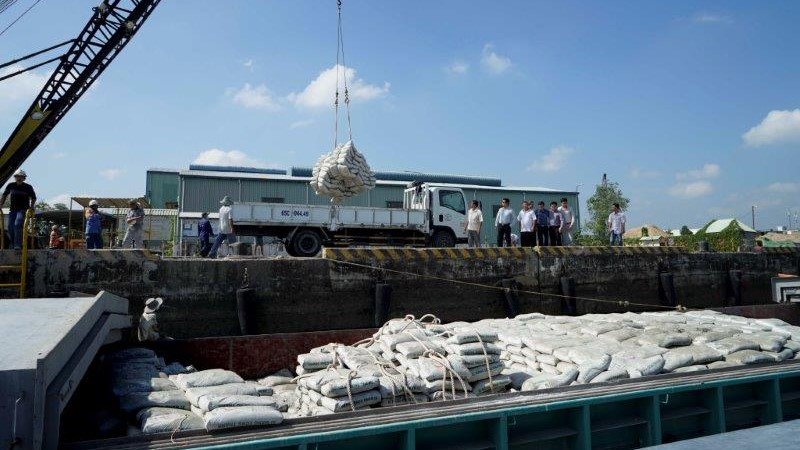
Bags of cement for export leaving the city of Can Tho, in southern Vietnam’s Mekong Delta region (Photo: Cong Thanh Group)

By 

Vietnam’s greenhouse gas emissions are set to grow significantly by 2030, under an updated climate plan submitted to the UN.

The country’s large cement sector is factored into the plan for the first time, which experts welcomed. But they said the overall target was not substantially more ambitious than the previous version.

Under the new plan, Vietnam committed to cut its emissions growth by 9% or nearly 84 million tonnes of CO2 by 2030 compared with business as usual projections, using a 2014 baseline. Emissions are still expected to grow by 844 million tonnes of CO2 during that time.

With international finance and support, Vietnam said it could increase its emissions cuts to 27% compared with business as usual, which would still see emissions grow by about 677 million tonnes by 2030. Tiếp tục đọc “Vietnam brings cement sector into new climate submission to the UN”

Hoàn thành cập nhật Đóng góp do quốc gia tự quyết định (NDC): Nâng mức đóng góp của Việt Nam cho ứng phó với BĐKH toàn cầu

baotainguyenmoitruong.vn

(TN&MT) – Ngày 24/7/2020, Thủ tướng Chính phủ đã phê duyệt Đóng góp do quốc gia tự quyết định (NDC) cập nhật của Việt Nam. Bằng nguồn lực trong nước, đến năm 2030 Việt Nam sẽ giảm 9% tổng lượng phát thải khí nhà kính so với Kịch bản phát triển thông thường (BAU) quốc gia, tương đương 83,9 triệu tấn CO2tđ.

Mức đóng góp 9% này có thể được tăng lên thành 27% so với BAU quốc gia (tương đương 250,8 triệu tấn CO2tđ) khi nhận được hỗ trợ quốc tế thông qua hợp tác song phương, đa phương và các cơ chế trong khuôn khổ Thỏa thuận Paris về biến đổi khí hậuNDC cập nhật của Việt Nam xác định các biện pháp giảm nhẹ phát thải khí nhà kính giai đoạn 2021-2030 và các nhiệm vụ chiến lược về thích ứng với biến đổi khí hậu, các giải pháp thích ứng nhằm giảm thiểu thiệt hại do các tác động liên quan đến những thay đổi của khí hậu gây ra trong tương lai được xác định cụ thể cho từng lĩnh vực. Tiếp tục đọc “Hoàn thành cập nhật Đóng góp do quốc gia tự quyết định (NDC): Nâng mức đóng góp của Việt Nam cho ứng phó với BĐKH toàn cầu”

Cuộc đua thực thi Thỏa thuận Paris

Thứ năm – 30/07/2020 16:42
Cuộc đua thực thi Thỏa thuận Paris
Theo số liệu từ Ngân hàng Thế giới, hiện có 30 quốc gia/vùng lãnh thổ đã áp dụng thuế các bon và 31 quốc gia/vùng lãnh thổ áp dụng hệ thống trao đổi tín chỉ các bon (ETS). Việt Nam đang nghiên cứu lựa chọn công cụ định giá các bon phù hợp với điều kiện của quốc gia, làm cơ sở phát triển thị trường các bon trong nước và đảm bảo tuân thủ các cam kết quốc tế từ sau năm 2020.

Đáp ứng yêu cầu chương trình tín chỉ các bon
Tiếp tục đọc “Cuộc đua thực thi Thỏa thuận Paris”

Trump Was Right to Leave the Paris Agreement. Why He Shouldn’t Have Had to Withdraw in the First Place.

(TĐH: The Daily Signal is the online paper of Heritage Foundation, most influential conservative thinktank of the US,located in Washington DC)

President Donald Trump announced on June 1 that the U.S. will withdraw from the Paris Agreement, which would have required the U.S. to ramp up energy regulations in coming years. (Photo: Kevin Dietsch/UPI/Newscom)

Supporters of the Paris Agreement have expressed considerable angst over President Donald Trump’s decision to leave the climate agreement last week.

Regardless of the merits of that decision—although for the record, Heritage Foundation analysts recommended that the U.S. withdraw—Trump should not have had to make that call.

The Paris Agreement had all the hallmarks of a treaty and should have been submitted by President Barack Obama to the Senate for advice and consent, as required under Article II of the U.S. Constitution.

Instead, Obama signed the Paris Agreement as an executive agreement. Tiếp tục đọc “Trump Was Right to Leave the Paris Agreement. Why He Shouldn’t Have Had to Withdraw in the First Place.”

China sees an opportunity to lead as Trump withdraws from Paris. But will it?

Chinese leaders are eager for more influence on the international stage and the US has created a void it could fill

China’s President Xi Jinping may see advantages to be had with America’s withdrawal from climate change agreements.
China’s President Xi Jinping may see advantages to be had with America’s withdrawal from climate change agreements. Photograph: JASON LEE / REUTERS / POOL/EPA

As Donald Trump walked off the stage in the Rose Garden after announcing the US would withdraw from the Paris climate agreement, one could practically hear the champagne corks popping in Beijing.

Chinese leaders are eager for more influence on the international stage, and Trump’s move opened up another opportunity for China to fill a void left by the US. Tiếp tục đọc “China sees an opportunity to lead as Trump withdraws from Paris. But will it?”

Setting the Post-Paris Climate Agenda

Photo courtesy of Kim Seng from https://www.flickr.com/photos/captainkimo/6702244011/
Dec 1, 2015

CSIS – UN climate negotiations are sort of like the holiday season. In the lead up there is always huge amounts of anticipation, lots of planning and logistics, and the promise of something new, merry, and important. The event itself is chaotic with lots of complicated family dynamics and the ever-present threat of someone storming off in a huff. The day after often brings plenty of leftovers to be dealt with, presents to be stored, regifted, or returned, and a sense that it is time to move on to all the things that had been put off while dealing with the big preparations.

There is no denying that for the climate community the last twelve months have been one big crescendo to Paris, a carefully orchestrated set of activities and announcements designed to drive momentum and activity toward the big moment. By any stretch this has been a tremendously successful crescendo. The country pledges that have been rolling in since this past spring total over 180 in number and cover approximately 95 percent of global emissions. By the UN’s own estimates, these pledges, if pursued in earnest, could keep the world in the ballpark of limiting temperature rise to 2.7 degrees Celsius above pre-industrial levels. Over 400 cities, 1,000 plus companies, and countless members of civil society pledged separate and additional actions. The Pope and several other groups of religious leaders weighed in on the moral imperative to tackle climate change and the United States denied the Keystone XL pipeline project – a major North American symbol of the environmentalist struggle to catalyze action on climate change. Unlike five years ago in Copenhagen , there is a lot on the table this time even before the talks get underway. Tiếp tục đọc “Setting the Post-Paris Climate Agenda”

Powering the Internet with renewable energy

December 3, 2015

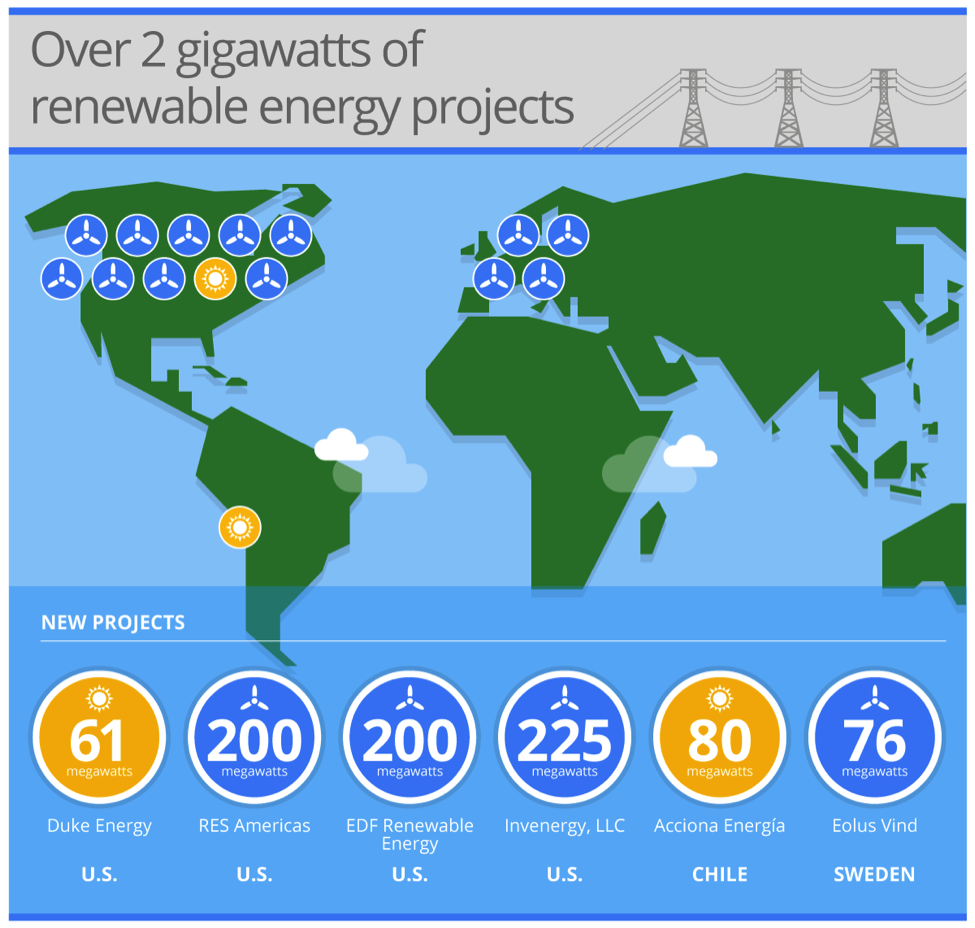
Googleblog – Today we’re announcing the largest, and most diverse, purchase of renewable energy ever made by a non-utility company. Google has already committed to purchase more renewable energy than any other company. Now, through a series of new wind and solar projects around the world, we’re one step closer to our commitment to triple our purchases of renewable energy by 2025 and our goal of powering 100% of our operations with clean energy. 842 MW of renewable energy around the world Today’s agreements will add an additional 842 megawatts of renewable energy capacity to power our data centers. Across three countries, we’re nearly doubling the amount of renewable energy we’ve purchased to date. We’re now up to 2 gigawatts—the equivalent to taking nearly 1 million cars off the road. These additional 842 megawatts represent a range of locations and technologies, from a wind farm in Sweden to a solar plant in Chile.

These long-term contracts range from 10-20 years and provide projects with the financial certainty and scale necessary to build these wind and solar facilities—thus bringing new renewable energy onto the grid in these regions. For our part, these contracts not only help minimize the environmental impact of our services—they also make good business sense by ensuring good prices. Our commitment to a sustainable energy future Since we opened our very first owned data center in 2006, we’ve been working to promote renewable and sustainable energy use in several ways:

  • First, we’re building the world’s most efficient computer infrastructure by designing our data centers to use as little energy as possible.

Tiếp tục đọc “Powering the Internet with renewable energy”