Japan Struggles to Find a Site for Its High-Level Radioactive Waste

nippon.com Jan 15, 2025 Matsumoto Sōichi [Profile]

The Nuclear Waste Management Organization of Japan recently backed the further survey of two potential disposal sites for high-level radioactive waste in Hokkaidō. The government has struggled to convince municipalities to participate in review procedures, with a growing list of stakeholders calling for a new approach to the selection process.

A Three-Step Process

The Japanese government and nuclear power plant operators have long grappled with how to dispose of spent fuel and other high-level radioactive waste. Authorities finally settled on the approach of burying waste deep underground at facilities 300 or more meters below the surface. In 2002, NUMO, the Nuclear Waste Management Organization of Japan, began hunting for a storage location by inviting municipalities to put themselves forward as candidate sites. To date, this “volunteer” policy has netted only three participants, the towns of Suttsu and Kamoenai in Hokkaidō and Genkai in Saga.

Tiếp tục đọc “Japan Struggles to Find a Site for Its High-Level Radioactive Waste”

The US is on the cusp of a nuclear renaissance. One problem: Americans are terrified of the waste

By Ella Nilsen and Bill Weir, CNN Published 6:00 AM EST, Mon November 25, 2024

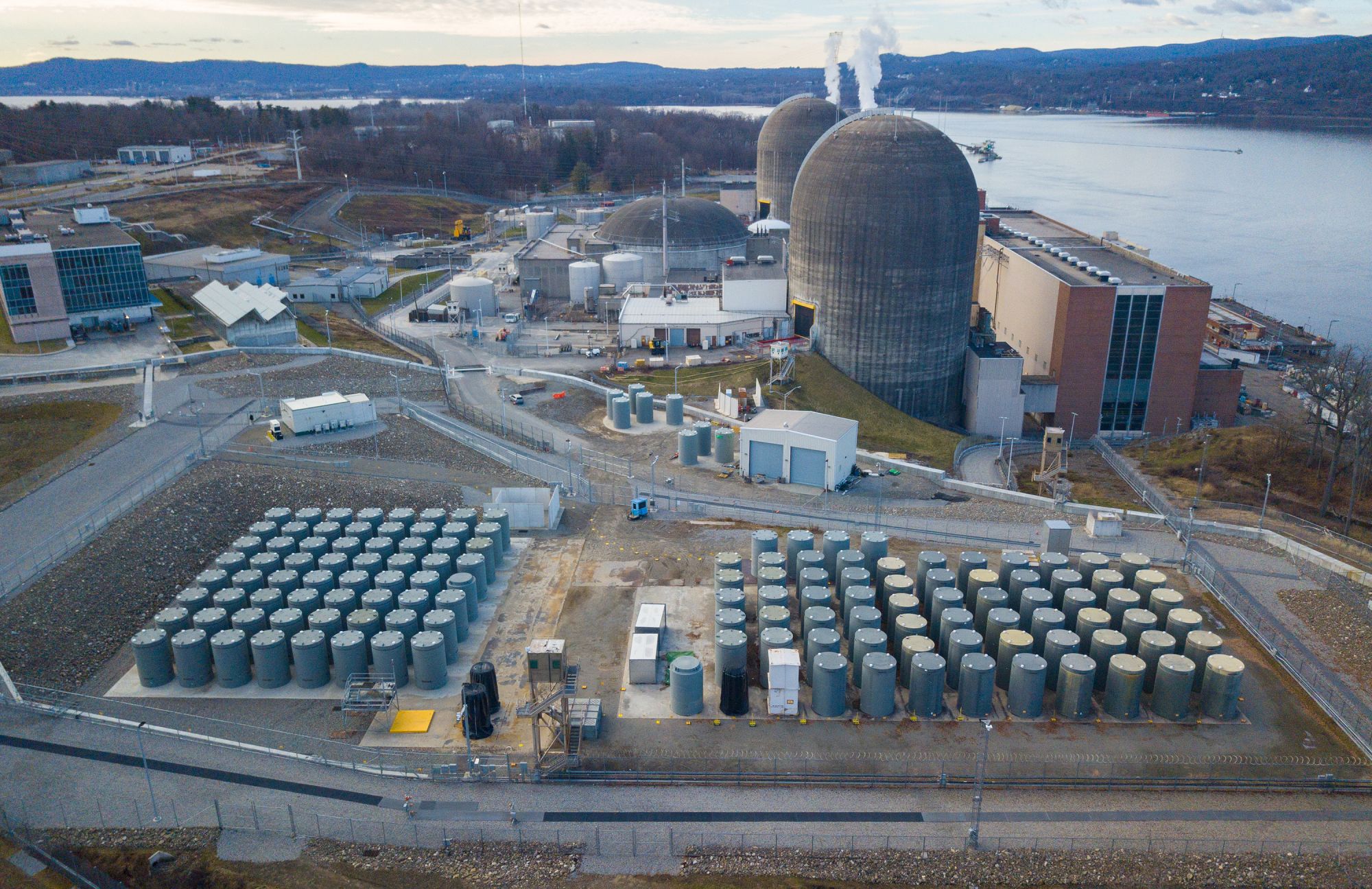
An array of containers storing nuclear waste sit at the decommissioned Indian Point nuclear power plant in Buchanan, New York.

An array of containers storing nuclear waste sit at the decommissioned Indian Point nuclear power plant in Buchanan, New York. Brian Vangor/HoltecBUCHANAN, New YorkCNN — 

The Indian Point nuclear power plant was an energy juggernaut for 50 years, generating a quarter of the electricity that powered New York City’s iconic, glowing skyline.

It is well into its decommissioning process after shutting down in 2021: The remaining waste of the radioactive fuel that once generated all of that power has been sealed inside more than 120 hulking metal and concrete canisters.

Tiếp tục đọc “The US is on the cusp of a nuclear renaissance. One problem: Americans are terrified of the waste”

Nuclear Power in China

world-nuclear.org

(Updated January 2023)

  • The impetus for nuclear power in China is increasingly due to air pollution from coal-fired plants.
  • China’s policy is to have a closed nuclear fuel cycle.
  • China has become largely self-sufficient in reactor design and construction, as well as other aspects of the fuel cycle, but is making full use of western technology while adapting and improving it.
  • Relative to the rest of the world, a major strength is the nuclear supply chain.
  • China’s policy is to ‘go global’ with exporting nuclear technology including heavy components in the supply chain.

Operable Reactors : 53,150 MWe

Reactors Under Construction: 21,867 MWe

Reactors Shutdown: 0 MWe

Electricity sector

Total generation (in 2019): 7541 TWh

Generation mix: 4899 TWh (65%) coal; 1304 TWh (17%) hydro; 406 TWh (5%) wind; 348 TWh (5%) nuclear; 226 TWh (3%) natural gas; 225 TWh (3%) solar; 121 (2%) biofuels & waste.

Import/export balance: 4.4 TWh net export (17.2 TWh imports; 21.7 TWh exports)

Total consumption: 6568 TWh

Per capita consumption: c. 4700 kWh in 2019

Source: International Energy Agency and The World Bank. Data for year 2019

Most of mainland China’s electricity is produced from fossil fuels, predominantly coal – 69% in 2019. Wind and solar capacity in 2019 was 21% of total installed generating capacity, but delivering under 9% of the electricity.

Rapid growth in demand has given rise to power shortages, and the reliance on fossil fuels has led to much air pollution. The economic loss due to pollution is put by the World Bank at almost 6% of GDP,1 and the new leadership from March 2013 prioritized this.* Chronic and widespread smog in the east of the country is attributed to coal burning.

* Official measurements of fine particles in the air measuring less than 2.5 micrometres, which pose the greatest health risk, rose to a record 993 micrograms per cubic metre in Beijing on 12 January 2013, compared with World Health Organization guidelines of no higher than 25.

The International Energy Agency (IEA) notes that since 2012, China has been the country with the largest installed power capacity, and it has increased this by 85% since then to reach 2011 GWe in 2019, about a quarter of global capacity.

In August 2013 the State Council said that China should reduce its carbon emissions by 40-45% by 2020 from 2005 levels, and would aim to boost renewable energy to 15% of its total primary energy consumption by 2020. In 2012 China was the world’s largest source of carbon emissions – 2626 MtC (9.64 Gt CO2), and its increment that year comprised about 70% of the world total increase. In March 2014 the Premier said that the government was declaring “war on pollution” and would accelerate closing coal-fired power stations.

Tiếp tục đọc “Nuclear Power in China”

Small Modular Reactor update: The fading promise of low-cost power from UAMPS’ SMR

November 17, 2022

David Schlissel, IEEFA


Download as PDF

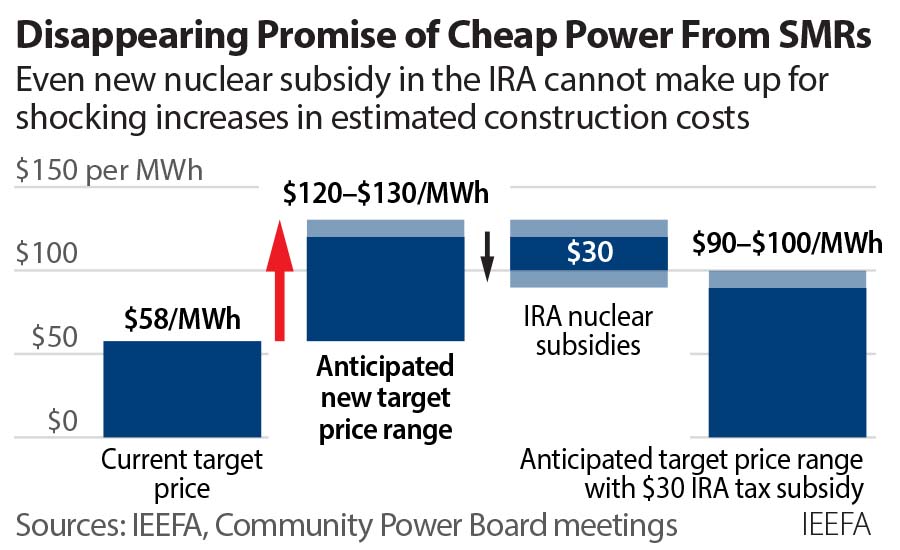
  • The original target power price for a planned 12-module SMR by UAMPS (Utah Associated Municipal Power Systems) and NuScale Power Corporation was $55 per megawatt-hour (MWh).
  • When UAMPS reduced the size of the carbon-free power plant (CFPP) to six modules in the summer of 2021, it raised the target power price to $58 per MWh.
  • Recent presentations to the power boards of Washington City and Hurricane, two of the Utah communities that have signed agreements to buy power from the CFPP, suggest that project power prices are now likely to end up in the range of $90-$100 per MWh.
  • The prices include an anticipated $1.4 billion subsidy from the U.S. Department of Energy and a new subsidy from the Inflation Reduction Act (IRA) on the order of $30 per MWh. The unsubsidized price of the power from the CFPP would be substantially higher than $100 per MWh, perhaps even double the current $58 target price.
  • The estimated target price of the power from the CFPP has gone up because projected building costs have increased. According to minutes of the October 2022 meeting of the Idaho Falls Power Board, the increased costs in the new Class 3 cost estimate currently being finalized for the CFPP have been shocking, even to NuScale and Fluor, the company responsible for overall management of the project.

IEEFA US SMR Cost Update
  • Even if the new target price is only in the range of $90 to $100 per MWh, there is no guarantee that this will be the actual price that communities will pay for the power from the CFPP. The power sales contract for the project binds communities to pay the actual costs and expenses of the project—no matter how much.
  • An official at the Hurricane, Utah, power board’s October meeting said the anticipated new cost estimate increase is a “big red flag in our face.” 
  • If the new estimated target price for the power from the CFPP is higher than the current price of $58 per MWh, which the power department director for Washington City, Utah, has said he believes will happen, communities will be able to terminate their power purchase agreements with UAMPS for the power from CFPP without any financial penalties. UAMPS also would have the option of cancelling the project. 

The CFPP Can Be Expected to Experience Additional Cost Increases 

  • UAMPS currently projects that the CFPP will be completed in 2030. That leaves eight years left in the project schedule to complete the project’s design, licensing, construction and pre-operational and startup testing.
  • NuScale has told the Nuclear Regulatory Commission that the project design work won’t be completed until an application for a combined operating license is submitted, which is not expected until early 2024. Nuclear-related construction is not expected to begin before late 2025.
  • Nuclear industry experience over the past four decades points to the likelihood of future cost increases and schedule delays during all phases of the project—design, construction, licensing, and testing. For example, the estimated all-in cost of the two new reactors at Georgia Power’s Vogtle project, the only new reactors currently being built in the U.S., has increased by 140% since nuclear construction began in 2011. Vogtle’s construction also has taken far longer than originally estimated; both reactors are currently more than six years behind schedule. 

Few New Utilities Have Signed Up to Buy Power From the CFPP

  • When IEEFA released its report on the NuScale SMR in February 2022, communities had signed up to buy only 101 megawatts (MW) of the 462MW CFPP. According to the presentations to the Washington City and Hurricane power boards, the situation appears not to have changed. For example, the Washington City power department director told the city’s power board on Nov. 1 that the biggest challenge to the CFPP is the number of MWs subscribed. Parties seem interested in the CFPP but are wary about potential cost overruns
  • It is reasonable to expect that if communities were reluctant to sign on to the CFPP at a target price of $58 per MWh, they’re likely to be much more wary if the project’s target price of power goes to $90 to $100 per MWh or higher.
  • The general manager of the Idaho Falls Power Board believes it would be difficult to secure financing for the CFPP without a fully subscribed project. 

Higher CFPP Power Prices Will Make It Even Less Competitive  

For more information, please contact David Schlissel at dschlissel@ieefa.org.

David Schlissel

David Schlissel is IEEFA’s Director of Resource Planning Analysis. His work focuses primarily on the technical and economic viability of resources being used or being proposed for use in the electric power sector.

Go to Profile

Are small modular reactors the solution to growing energy and climate problems?

Download study: Small Modular Reactors: The Next Phase for Nuclear Power in the Indo-Pacific?

By David Santoro and Carl Baker

David Santoro (david@pacforum.org) and Carl Baker (carl@pacforum.org) are respectively President/CEO and Senior Advisor at the Pacific Forum. Follow David Santoro on Twitter @DavidSantoro1.

The increasingly dominant view in the energy expert community is that nuclear power has a role to play in achieving the 17 “sustainable devaelopment goals” identified by the United Nations General Assembly in 2015 (and intended to be reached by 2030). There has thus been rising interest in nuclear power development in several parts of the world, especially in the Indo-Pacific, where growth is the strongest.

This renewed interest comes not long after the failed “nuclear renaissance” of the 2000s. That renaissance never materialized primarily because the devastating accidents at Japan’s Fukushima Daiichi Nuclear Power Plant in 2011 led many countries to reconsider their nuclear power ambitions. Now, however, national energy and climate objectives are again driving these same countries to put the nuclear option back on the table. This interest has only grown in the wake of Russia’s invasion of Ukraine, the subsequent efforts to choke off Russian natural gas and oil exports, and the resulting increase in global prices for fossil fuels. Tiếp tục đọc Are small modular reactors the solution to growing energy and climate problems?

The Role of Nuclear Energy in the Global Energy Transition

The paper provides a wealth of data about the current state of the nuclear industry and the potential for its growth over the next ten to twenty years, while also considering important questions about the geopolitical dimensions which underpin the relationships between the exporters and importers of nuclear technology and the ties, such as financing and provision of services in the nuclear energy value chain, which bind them over multiple decades

See full paper here at Oxford Institute for Energy Studies

We need to get serious about the renewable energy revolution—by including nuclear power

thebulletin.org

By Michael Edesess | May 5, 2022

One of my favorite quotes is from Sherlock Holmes: “Once you have eliminated the impossible, whatever remains, however implausible, must be the truth.”[1] This motto implicitly guides the ambitious plan to decarbonize all energy envisioned by most renewable energy enthusiasts. The only problem is that, not only is the alternative they dismiss not impossible, it could be much less implausible than the one they advocate.

The renewables army. A huge number of extremely earnest and bright people are working on trying to make the renewable energy future come true. They work at, or have passed through, the most elite institutions of our time, the top universities, the top financial firms, the most innovative corporations and startups. At the center of much of their effort is the Rocky Mountain Institute, the nonprofit research think-tank whose board I chaired more than 20 years ago. (They call it a “think-and-do” tank, which is more fitting.) RMI coordinates meetings (recently mostly Zoom meetings) with very smart participants from some of the foremost companies working on decarbonizing their businesses, companies like Google, Apple, Microsoft. It’s a pleasure to watch them think, discuss, and work out problems. It was an enormous pleasure to be on RMI’s board, especially to interact intellectually with the most brilliant individual I have ever met, RMI’s co-founder Amory Lovins.

Tiếp tục đọc “We need to get serious about the renewable energy revolution—by including nuclear power”

Hydrogen Production and Uses – The role of nuclear power

worldd-nuclear.org

(Updated November 2021)

  • Hydrogen is increasingly seen as a key component of future energy systems if it can be made without carbon dioxide emissions. 
  • It is starting to be used as a transport fuel, despite the need for high-pressure containment.   
  • The use of hydrogen in the production of liquid transport fuels from crude oil is increasing rapidly, and is vital where tar sands are the oil source. 
  • Hydrogen can be combined with carbon dioxide to make methanol or dimethyl ether (DME) which are important transport fuels. 
  • Hydrogen also has future application as industrial-scale replacement for coke in steelmaking and other metallurgical processes. 
  • Nuclear energy can be used to make hydrogen electrolytically, and in the future high-temperature reactors are likely to be used to make it thermochemically. 
  • The energy demand for hydrogen production could exceed that for electricity production today. 

Hydrogen is not found in free form (H2) but must be liberated from molecules such as water or methane. It is therefore not an energy source and must be made, using energy. It is already a significant chemical product, about half of annual pure hydrogen production being used in making nitrogen fertilisers via the Haber process and about one-quarter to convert low-grade crude oils (especially those from tar sands) into liquid transport fuels. There is a lot of experience handling hydrogen on a large scale, though it is not as straightforward as natural gas.  

Tiếp tục đọc “Hydrogen Production and Uses – The role of nuclear power”

Nuclear Technology Review 2021 – International Atomic Energy Agency

Full report here

The Agency’s 2020 projections remained largely in line with the previous year’s
projections. In the high case, global nuclear electricity generating capacity was
projected to increase by 82% to 715 gigawatts (electrical) (GW(e)) by 2050,
corresponding to 11% of global electricity generation, versus around 10% in
2019. The low case projected a decrease of 7% to 363 GW(e), representing a
6% share of global electricity generation.

At the end of 2020, the world’s total nuclear power capacity was 392.6 GW(e),
generated by 442 operational nuclear power reactors in 32 countries. The
nuclear sector adapted to national guidelines with regard to the coronavirus
disease (COVID-19) pandemic by taking effective measures. At the outset of the
pandemic in early 2020, the Agency established the COVID-19 Nuclear Power
Plant Operating Experience Network to help share information on measures
taken to mitigate the pandemic and its impact on the operation of nuclear power
plants (NPPs). None of the 32 countries with operating nuclear power plants
reported any impact on safe and reliable NPP operation due to the pandemic.

As a clean, reliable, sustainable and modern energy source, nuclear power makes
a significant contribution to reducing greenhouse gas emissions worldwide,
while fulfilling the world’s increasing energy demands and supporting sustainable
development and post COVID-19 pandemic recovery. Nuclear power supplied
2553.2 terawatt-hours of electricity in 2020, accounting for nearly a third of the
world’s low carbon electricity production. It is widely recognized that, to address
the challenges of a clean energy transition, nuclear power will have to play a
significant role.
Tiếp tục đọc “Nuclear Technology Review 2021 – International Atomic Energy Agency”

The controversial future of nuclear power in the U.S.

As the climate crisis worsens, the discussion intensifies over what role nuclear power should play in fighting it.

By LOIS PARSHLEY, PUBLISHED MAY 4, 2021• 15 MIN READ, National Geographic

President Joe Biden has set ambitious goals for fighting climate change: To cut U.S. carbon emissions in half by 2030 and to have a net-zero carbon economy by 2050. The plan requires electricity generation—the easiest economic sector to green, analysts say—to be carbon-free by 2035.

Where is all that clean electricity going to come from?

few figures from the U.S. Energy Information Administration (EIA) illustrate the challenge. In 2020 the United States generated about four trillion kilowatt-hours of electricity. Some 60 percent of that came from burning fossil fuels, mostly natural gas, in some 10,000 generators, large and small, around the country. All of that electricity will need to be replaced—and more, because demand for electricity is expected to rise, especially if we power more cars with it.

Tiếp tục đọc “The controversial future of nuclear power in the U.S.”

In Global Energy Crisis, Anti-Nuclear Chickens Come Home to Roost

In virtually every country that has closed nuclear plants, clean electricity has been replaced with dirty power.

By Ted Nordhaus

OCTOBER 8, 2021, 5:18 PM

The cooling tower at the Mülheim-Kärlich nuclear power plant collapses during a controlled demolition near Koblenz, Germany, on Aug. 9, 2019. The plant was shut down on Sept. 9, 1988. THOMAS FREY/DPA/AFP VIA GETTY IMAGES

For years, the proponents of wind and solar energy have promised us a green future with electricity too cheap to meter, new energy infrastructure with little environmental impact on the land, and deep cuts in carbon emissions. But despite the rapid growth of renewable energy, that future has yet to materialize. Instead, many of the places that are furthest along in transitioning to renewable energy are today facing a crisis of power shortages, sky-high electricity prices, and flat or rising carbon emissions.

In California, Gov. Gavin Newsom has ordered companies owning backup diesel generators to operate them nonstop when electricity demand is high in order to avoid rolling blackouts. In Britain, exploding natural gas prices have shuttered factories, bankrupted power companies, and threaten to cause food shortages. Germany, meanwhile, is set for the biggest jump in greenhouse emissions in 30 years due to surging use of coal for power generation, which the country depends on to back up weather-dependent wind and solar energy and fill the hole left by its shuttered nuclear plants.

The proximate cause of all these crises has been surging natural gas prices as the world recovers from the COVID-19 pandemic. But the underlying problem is that despite huge bets on renewable energy over the last several decades, California, Britain, and Germany have chosen fossil fuels over carbon-free nuclear energy to backstop their electrical systems.

Read more on Foreign Policy >>

It won’t take much for Vietnam to develop nuclear power

By Sebastien Eskenazi   April 7, 2021 | 07:00 am GMT+7 VNExpress

All it will take is VND1 million ($43) per person per year for Vietnam to get its entire power supply from nuclear plants.

Sebastien Eskenazi
Sebastien Eskenazi

Lately there has been a few articles about how Vietnam will feed its growing energy demand. And I usually feel sad for Vietnam when I read them because they support either coal and gas which pollute a lot or solar and windfarms which take a lot of space and need coal and gas to provide power when they don’t work anyway.

Humans using too much space is actually the first environmental threat according to the WWF. And a good example of the need for coal and gas when you have too much solar or windfarms is Germany. In contrast France produces the majority of its electricity from nuclear power and emits a lot less CO2 per megawatt.hour than Germany.

Tiếp tục đọc “It won’t take much for Vietnam to develop nuclear power”

Nuclear Vs Non-Nuclear Powered Countries: 2016 Facts

Britishbusinessenergy

https://i0.wp.com/britishbusinessenergy.co.uk/wp-content/uploads/nuclear-power-world-map.png

The map above shows which countries have operating commercial nuclear power stations and which ones do not as of April, 2016. At last count, 31 countries generate at least some of their electricity needs via nuclear power.

Here are 13 interesting facts about these countries and nuclear power. Tiếp tục đọc “Nuclear Vs Non-Nuclear Powered Countries: 2016 Facts”

William J. Perry on nuclear war and nuclear terrorism

thebulletin – On June 26, 1950, North Korea invaded South Korea, beginning an ugly war that resulted in more than a million casualties, and demonstrated to even the most optimistic that a Cold War was seriously underway. That was just two weeks after I got my master’s degree from Stanford, so it is no exaggeration to say that I am a child of the Cold War.

Indeed, throughout my career I always perceived a dark nuclear cloud hanging over my head, threatening no less than the extinction of civilization.

During the Cold War we had a half dozen nuclear crises, of which the Cuban Missile Crisis was the most dangerous, and I was close enough to these crises that they made a deep personal impression on me. I believed then, and I believe to this day, that we got through these crises and avoided a nuclear catastrophe as much by good luck as by good management. Tiếp tục đọc “William J. Perry on nuclear war and nuclear terrorism”