Đánh giá hệ thống ngăn mặn vùng ven biển Cửu Long và dự án Cái Lớn – Cái Bé

Download
– từ TBKTSG
– từ CVD

Nhóm thực hiện

 Lê Anh Tuấn, PGS.TS., Phó Viện trưởng Viện Nghiên cứu Biến đổi Khí hậu, Đại học
Cần Thơ, E-mail: latuan@ctu.edu.vn
 Nguyễn Hữu Thiện, ThS. Chuyên gia độc lập về Sinh thái, E-mail:
savingwetlands@gmail.com
 Dương Văn Ni, TS., Giảng viên Khoa Môi trường và Tài nguyên Thiên nhiên, Đại
học Cần Thơ, E-mail: dvni@ctu.edu.vn
 Nguyễn Hồng Tín, TS., Trưởng Bộ môn Hệ thống Nông nghiệp, Viện Nghiên cứu
Phát triển Đồng bằng Sông Cửu Long, Đại học Cần Thơ, E-mail: nhtin@ctu.edu.vn
 Đặng Kiều Nhân, TS.. Viện trưởng Viện Nghiên cứu Phát triển Đồng bằng Sông
Cửu Long, Đại học Cần Thơ, E-mail: dknhan@ctu.edu.vn

Community-based tourism and new livelihoods in Vietnam

Visitors to Camn Thanh in round bottom boats operated by locals as part of their community-based tourism. Credit: HanoiTV.vn

By Tran Thuy Binh

Can Thanh, Vietnam, September 17, 2018

Despite knowing the damage she was causing, Nguyen Thi Vang still walks through the coral reef in the Tam Hai sea to collect seaweed for her daily meals. “When I walk, I heard its broken sound and I feel painful,” said Nguyen. “Yet I need seaweed.”

When seaweed dies it floats on the water. But due to high demand locals pick the seaweed while it is still alive, walking over and often breaking parts of the coral reef. While the harvest season traditionally starts in May, Nguyen and other locals collect earlier. “People from other communes come and if we do not harvest they will collect it all,” said Nguyen. Tiếp tục đọc “Community-based tourism and new livelihoods in Vietnam”

A Damaged Delta – Mekong Delta

Mekongeye.com 

A young girl helps her family from the Khmer community collect snails during low-tide in Southern Soc Trang Province. These mangroves were destroyed completely by bombing during the Vietnam War but over the last 25 years were able to grow back naturally, finally being protected and expanded by Government initiatives. Now, over 20 families come to the beach daily to collect snails and other fish that returned with the healthy mangrove eco-system.

By Luke Duggleby

Mekong Delta, September 17, 2018

Vietnam’s Mekong Delta is one of the world’s most at-risk areas from the effects of climate change, posing challenges both for its environment and population in years to come. Tiếp tục đọc “A Damaged Delta – Mekong Delta”

Rainwater harvesting practices and attitudes in the Mekong Delta of Vietnam

Access to safe drinking water is limited in the Mekong Delta region of Vietnam. Rainwater harvesting (RWH) at household level is among the primary sources of drinking water in the region and is widely
practiced throughout Southeast Asia. It has recently been increasingly advocated as an alternative or supplemental approach to household water supply. However, relatively little research has been done on current RWH practices and attitudes. We interviewed residents of 619 households in three provinces to understand the current practice of and preferences for rainwater harvesting. We found that rainwater was the most common water source for all domestic activities in the rainy season; however, it was reserved for high-value uses in the dry season. Residents ranked color, perceived safety, smell, taste and reliability of rainwater very highly compared to other water sources. Most households practice daily first-flush and/or boil water before drinking. Storage capacity seems to be a major barrier to RWH providing an adequate supply of domestic water year-round. Because other improved water supplies are not widely available in the rural delta, rainwater harvesting seems to be a promising way to expand access to improved water sources for the residents

Read full article here http://se.ueh.edu.vn/wp-content/uploads/nghien-cuu/8-Pham-Khanh-Nam-Rainwater-harvesting-practices-and-attitudes-in-the-Mekong-Delta-of-Vietnam.pdf

Dự án Thủy lợi Cái Lớn – Cái Bé và Nghị quyết 120

Đất Việt –Diễn đàn trí thức

(Diễn đàn trí thức) – Các bước phê duyệt Dự án Hệ thống thủy lợi Cái Lớn–Cái Bé phải tuân thủ nghiêm túc Luật Đầu tư công và Nghị quyết 120.

Theo thông tin có được, Hội đồng thẩm định báo cáo tác động môi trường (ĐTM) sẽ họp trong những ngày cuối tháng 8/2018 để xem xét phê duyệt báo cáo ĐTM của Dự án Thủy lợi Cái Lớn – Cái Bé. Nếu đúng như vậy, thì quả thật rất đáng tiếc và không đúng với Nghị quyết 120/NQ-CP ngày 17/11/2017 của Chính phủ

Tiếp tục đọc “Dự án Thủy lợi Cái Lớn – Cái Bé và Nghị quyết 120”

Mekong Delta’s splendors now a relic of the past

VNE – By Dang Hung Vo   July 26, 2018 | 10:11 am GMT+7

Development policies have all but destroyed the natural bounty that the delta was blessed with.

Mekong Deltas splendors now a relic of the past
Dang Hung Vo, former Deputy Minister of Natural Resources and Environment

In 1954, when the French withdrew from Hanoi and peace reigned once more in our capital, I was only 8 years old. Where I am from, students could only study up to 3rd grade. Our teacher, originally from the south, was a child of the Mekong Delta.

He often told us stories about his hometown, about how it needed no dam to tame the Mekong River unlike our Red River since the Mekong people had learned to live with the behemoth. Tiếp tục đọc “Mekong Delta’s splendors now a relic of the past”

Việt Nam họp khẩn để bàn cách ứng phó với nước lũ từ đập thủy điện Lào


(NTD) – Ban chỉ đạo Trung ương về phòng chống thiên tai tổ chức cuộc họp khẩn chiều nay (25/7) để đánh giá những tác động của vụ vỡ đập thủy điện Xe Pian – Xe Namnoy đối với vùng đồng bằng sông Cửu Long của Việt Nam.TIN LIÊN QUAN

Attapeu8
Người dân Lào chuẩn bị sơ tán sáng 25/7. Dự báo nước lũ sẽ có thể tiếp tục dâng cao trong những ngày tới do mưa lớn ở Attapeu và các tỉnh phụ cận. (Ảnh: ABC Lao News)

Tiếp tục đọc “Việt Nam họp khẩn để bàn cách ứng phó với nước lũ từ đập thủy điện Lào”

Are rural youth in the Mekong region losing interest in farming?

Smallholder farmers in the Mekong region face increasingly insecure farming livelihoods as land resources are drawn into the hands of developers. SEI is exploring what this means for the future of rural youth and farming.

The livelihoods of millions of smallholder farmers in the Mekong region are tied to their land. But the demands for land for large-scale agriculture, industrial and energy development schemes such as monoculture plantations, special economic zones, and hydropower projects are taking away land from smallholders, giving rise to more landless farmers and increasing land inequality.

Meanwhile, national policies often fail to protect the rights of smallholder farmers who are poorly positioned to compete with these developers and to benefit from the outcomes of the investments.

This indicates a precarious future for smallholder farming-based livelihoods in the Mekong Region, the situation exacerbated by the failure of current labour markets to provide decent, secure jobs for the increasing number of landless people. Tiếp tục đọc “Are rural youth in the Mekong region losing interest in farming?”

Environmental changes in the Mekong Delta spell trouble for farmers

phys.org
July 23, 2018, University of Illinois at Urbana-Champaign
Environmental changes in the Mekong Delta spell trouble for farmers
Mekong Delta’s dams, dikes, and canals have made the area a major exporter of rice, shrimp, and other seafood, but they are bringing unintended consequences to local farmers. Credit: Mic Greenberg

The Mekong Delta is home to 15 million people, many of whom rely on the delta’s rich soil and water resources for farming and fishing. But their livelihoods are being threatened by rising sea levels, droughts, dams, and other hydrological shifts. A new article from researchers at the University of Illinois and Iowa State University explains the challenges.
Tiếp tục đọc “Environmental changes in the Mekong Delta spell trouble for farmers”

An integrated system for real-time monitoring of rice production and climate risks – Hệ thống giám sát tức thời sản lượng gạo và rủi ro khí hậu

In the Mekong River Delta of Vietnam, a map-based system is being develop for real-time monitoring of rice production and raising the alarm for various climate-related risks. Photo: Eisen Bernardo (CCAFS SEA)
(view original)ccafs.cgiar

May 29, 2018

For quick response to the climate-related impacts to rice production in the Mekong River Delta, an integrated GIS-based system is being developed.

In 2017, the Department of Crop Production (DCP) of the Ministry of Agriculture and Rural Development (MARD) of Vietnam, in cooperation with the CGIAR Research Program on Climate Change, Agriculture and Food Security Southeast Asia (CCAFS SEA), developed and implemented the Climate-Smart Maps and Adaptation Plans (CS MAP) project. CS MAP maps drought, flooding, and salinity intrusion, and develop long- and medium-term adaptive plans in the Mekong River Delta (MRD). The methodology used promotes stakeholders’ participation in identifying feasible solutions to address specific local problems for sustainable rice production at provincial level. Tiếp tục đọc “An integrated system for real-time monitoring of rice production and climate risks – Hệ thống giám sát tức thời sản lượng gạo và rủi ro khí hậu”

UB sông Mekong Việt Nam cần lên tiếng mạnh mẽ về thủy điện trên dòng chính Mekong

NĐT –  21:12 | Thứ tư, 20/06/2018 0

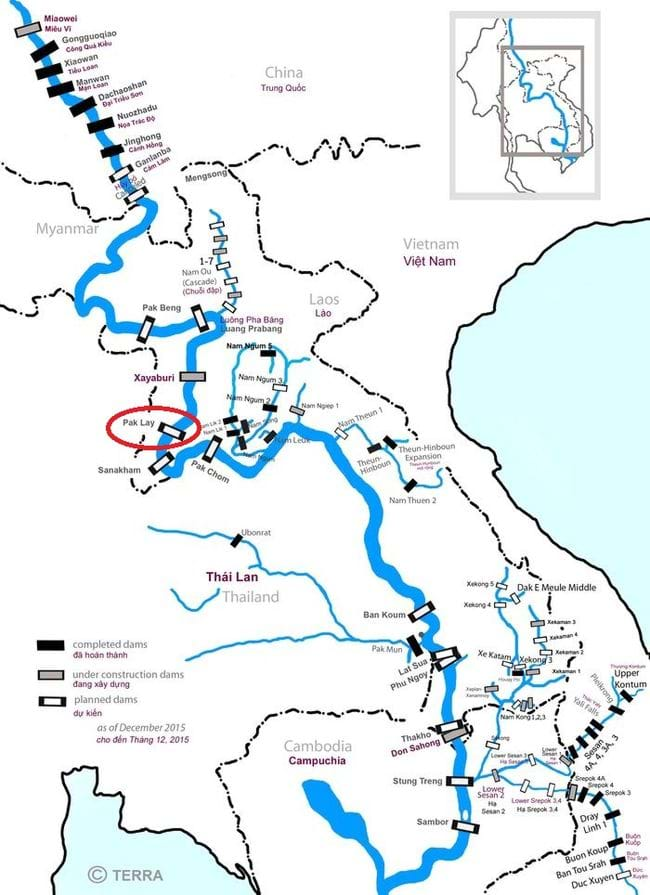
Trước thông tin đập thủy điện thứ 4, có tên Pak Lay của Lào được xây dựng trên dòng chính hạ lưu Mekong, hôm nay Mạng lưới Sông ngòi Việt Nam (VRN) vừa có thông cáo đề nghị Lào cần có đánh giá đầy đủ các tác động tổng thể, tích lũy của các dự án thủy điện trên dòng chính, thay vì thực hiện theo từng dự án thủy điện riêng rẽ như hiện nay.

Tiếp tục đọc “UB sông Mekong Việt Nam cần lên tiếng mạnh mẽ về thủy điện trên dòng chính Mekong”

Landslides in Mekong Delta get more severe

thesaigontimes.com
Van Huynh Tuesday,  May 29,2018,00:00 (GMT+7)
Zoom in

Zoom out

Add to Favorites

Print

Send to a friend

Five houses collapse after a landslide along the O Mon River’s in Can Tho City on May 21 – PHOTO: LE HOANG VU

CAN THO – Landslides across the Mekong Delta region are getting more unpredictable and increasing in terms of location and speed, according to the Southern Institute of Water Resources Research.

After two landslides along the O Mon River in Can Tho City this month, 12 houses sank into the river, 28 houses collapsed, 35 others were on the brink of sliding, and a long stretch of roads and riverside crops were destroyed.

According to the city’s committee for natural disaster prevention-control and search-rescue, the two landslides caused damages of some VND30 billion. The city has provided nearly VND600 million to support affected households.

Vung Liem District of Vinh Long Province nearby has also witnessed a serious landslide recently, resulting in several houses falling into the river. Following this, the provincial government has decided to ban sand exploitation at 19 sites along the rivers of Tien, Co Chien, Hau and Pang Tra with combined areas of over 1,200 hectares. Tiếp tục đọc “Landslides in Mekong Delta get more severe”

VRN phát động cuộc thi ảnh “Đồng bằng sông Cửu Long – Nước với Phụ nữ”

Đăng vào 27/04/2018 Mekong-Cuulong blog

Gần một thập niên trở lại đây,an ninh nguồn nước ở ĐBSCL đang ngày một nghiêm trọng. Nguồn nước bị suy thoái và ô nhiễm nghiêm trọng trên diện rộng khiến cho ĐBSCL nhiều năm chìm trong khô hạn và mùa mưa bị rút ngắn. Trong khi đó, sự gia tăng mực nước biển cho phép nước mặn ngày một xâm lấn vào sâu trong nội địa. Đây là hệ quả của nhiều yếu tố: biến đổi khí hậu, các dự án phát triển tại thượng nguồn và các hoạt động sản xuất, sinh hoạt của chính con người.

Nhằm thúc đẩy sự quan tâm của công chúng về vấn đề an ninh nguồn nước, Mạng lưới Sông ngòi Việt Nam tổ chức cuộc thi ảnh “Đối thoại với dòng sông” lần thứ tư, năm 2018. Đây là cơ hội để những người quan tâm đến tài nguyên nước  khai thác từ góc nhìn về  vấn đề giới trong quản lý, sử dụng và bảo vệ tài nguyên nước. Thông qua chủ đề “Đồng bằng sông Cửu Long – Nước với phụ nữ”, cuộc thi năm nay một lần nữa nhấn mạnh vào hình ảnh phụ nữ ĐBSCL trước các thách thức như ô nhiễm nguồn nước, xâm nhập mặn, thiếu nước sinh hoạt, thiếu nước sản xuất và biến đổi khí hậu.


Ảnh: Vào vụ cấy – Hoàng Ngọc Hải (Top 10 chung cuộc Đối thoại với dòng sông 2017)

Thời gian cuộc thi diễn ra  từ 1/5 đến 31/8/2018. Tham gia cuộc thi, ngoài cơ hội giới thiệu tác phẩm  tâm đắc, thể hiện trách nhiệm và thái độ của mình về vấn đề sông ngòi, tài nguyên nước, các tác giả còn có cơ hội  giành một số giải thưởng được trao hàng tháng, giải thưởng chung kết và giải thưởng phụ. Các tác phẩm sẽ được đánh giá nghiêm túc và khách quan từ Ban giám khảo gồm các chuyên gia, các nhiếp ảnh gia có chuyên môn sâu và kinh nghiệm trong lĩnh vực xã hội – môi trường.

Tác phẩm dự thi sẽ được chia sẻ trên trang mạng xã hội Facebook của cuộc thi và sẽ được VRN chia sẻ tới những người quan tâm đến sông ngòi tại ĐBSCL trong và ngoài nước. Kết thúc cuộc thi, VRN sẽ trao giải và tổ chức triển lãm  ảnh và câu chuyện được đánh giá cao để cùng góp sức tạo nên mối quan tâm chung của toàn xã hội đến vấn đề tài nguyên nước tại ĐBSCL.

Chi tiết về cách thức tham gia cuộc thi vui lòng xem tại đây.

Thông tin liên hệ:

Văn phòng Mạng lưới Sông ngòi Việt Nam
Email: rivervietnam@gmail.com
Facebook: https://www.facebook.com/DTVDS

Lưu vực sông Mê Công trước các thách thức

Tiến sĩ Dương Văn Ni
Đại học CầnThơ, Việt Nam
dvni@ctu.edu.vn

Lưu vực sông Mê Công

Sông Mê Công bắt nguồn từTrung Quốc, chảy qua Myanmar, Lào, TháiLan, Campuchia và Việt Nam

Tổng chiều dài: 4.350 Km

Đứng thứ 10 thế giới về độ dài (4350 km = 2700 dặm)

Đứng thứ14 thế giới về dòng chảy

…nhưng đứng đầu thế giới về dao động thủy văn

1.250 –67.000 m3.s-1

Dân số tại lưu vực sông Mê Công ~60 Millions Tiếp tục đọc “Lưu vực sông Mê Công trước các thách thức”

Nghị quyết Số 120/NQ-CP ngày 17/11/2017 về Phát triển bền vững ĐBSCL thích ứng với biến đổi khí hậu

CHÍNH PHỦ
——-

CỘNG HÒA XÃ HỘI CHỦ NGHĨA VIỆT NAM
Độc lập – Tự do – Hạnh phúc
—————

Số: 120/NQ-CP

Hà Nội, ngày 17 tháng 11 năm 2017


NGHỊ QUYẾT

VỀ PHÁT TRIỂN BỀN VỮNG ĐỒNG BẰNG SÔNG CỬU LONG THÍCH ỨNG VỚI BIẾN ĐỔI KHÍ HẬU

CHÍNH PHỦ

Căn cứ Luật Tổ chức Chính phủ ngày 19 tháng 6 năm 2015;

Căn cứ Nghị quyết số 24-NQ/TW ngày 03 tháng 6 năm 2013 của Ban Chấp hành Trung ương Đảng khóa XI về chủ động ứng phó với biến đổi khí hậu, tăng cường quản lý tài nguyên và bảo vệ môi trường;

Căn cứ Kết luận số 28-KL/TW ngày 14 tháng 8 năm 2012 của Bộ Chính trị về phương hướng, nhiệm vụ, giải pháp phát triển kinh tế – xã hội và bảo đảm an ninh, quốc phòng vùng đồng bằng sông Cửu Long đến năm 2020;

Trên cơ sở kết quả của Hội nghị về phát triển bền vững đồng bằng sông Cửu Long thích ứng với biến đổi khí hậu ngày 26 – 27 tháng 9 năm 2017; thảo luận, biểu quyết của các Thành viên Chính phủ tại phiên họp Chính phủ thường kỳ tháng 9 năm 2017,

QUYẾT NGHỊ:

Tiếp tục đọc “Nghị quyết Số 120/NQ-CP ngày 17/11/2017 về Phát triển bền vững ĐBSCL thích ứng với biến đổi khí hậu”