Singapore is reporting an increase in sightings of “shadow fleet” tankers carrying sanctioned cargo off its shores. These vessels often conceal their identities, change flags and switch off tracking systems. Most are old and poorly maintained, increasing the risk of accidents and environmental disasters. Experts say they pose serious safety concerns in one of the world’s busiest shipping lanes.
Al Jazeera’s Patrick Fok reports from Singapore. Jennifer Parker is a specialist in maritime law and security at the University of New South Wales and a former naval officer. She said shadow fleets are hard to track because they operate outside normal rules.
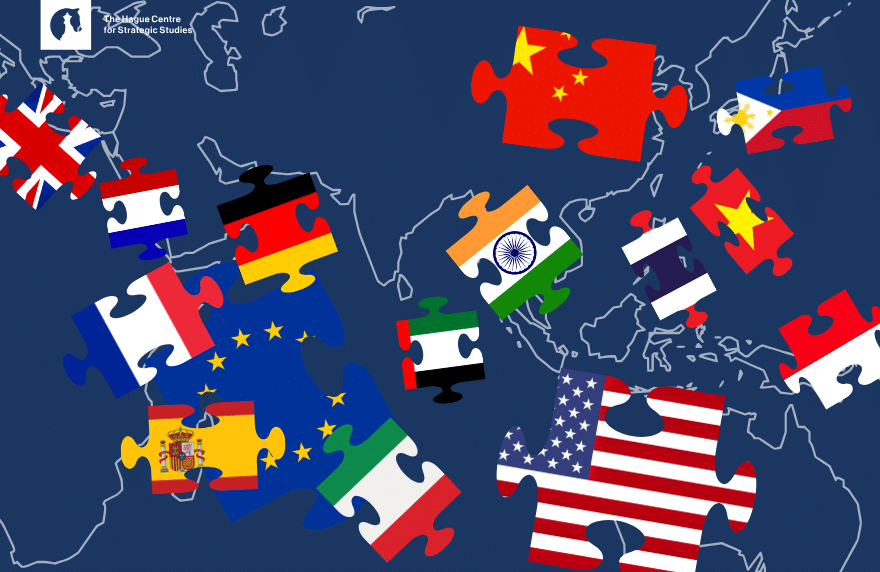
How should Europe strengthen its engagement with the Indo-Pacific? While the continent is highly dependent on trade from the region, it has limited capabilities to protect its interests in the face of growing Sino-American competition. This new HCSS report by Paul van Hooft, Benedetta Girardi and Alisa Hoenig examines how European states can engage in the Indo-Pacific by deepening cooperation with regional powers.
The Indo-Pacific comprises many actors, which are positioned along key chokepoints and share geopolitical and geoeconomic interests in protecting crucial sea lines of communication with Europe. This report does two things to establish pathways for deeper European engagement with Indo-Pacific states:
Based on relevance for maritime security and political affinity with European countries, it assesses the suitability of regional states as partners. Besides the usual suspects Australia, Japan and South Korea, it identifies an “inbetweener” group of countries, with whom cooperation can be fruitful but is not guaranteed, and states with whom engagement is unlikely to yield beneficial results.
It then zooms in on the “inbetweeners” to determine pathways for deepening ties. By comparing bilateral relations between different European and Indo-Pacific states along security, trade and investment, and capacity-building and infrastructure, the authors identify relative strengths and weaknesses of European states. Finally, they also contrast Europe’s involvement with that of China and the United States.
Based on the analysis, the report recommends to strengthen European collaboration with more ambivalent Indo-Pacific states, with a focus on trade and investment and capacity-building in the short- to medium-term.
The research for and production of this report has been conducted within the PROGRESS research framework agreement. Responsibility for the contents and for the opinions expressed, rests solely with the authors and does not constitute, nor should be construed as, an endorsement by the Netherlands Ministries of Foreign Affairs and Defence.
Most of the clothing and gadgets you buy in stores today were once in shipping containers, sailing across the ocean. Ships carry over 80% of the world’s traded goods. But they have a problem – the majority of them burn heavy sulfur fuel oil, which is a driver of climate change.
While cargo ships’ engines have become more efficient over time, the industry is under growing pressure to eliminate its carbon footprint.
Most of the big shippers’ fleets are less than 20 years old, but even the newer builds don’t necessarily have the most advanced technology. It takes roughly a year and a half to come out with a new build of a ship, and it will still be based on technology from a few years ago. So, most of the engines still run on fossil fuel oil.
TN – Cuối tháng 8, quốc hội Mỹ nhận báo cáo “Chiến lược an ninh hàng hải đối với châu Á – Thái Bình Dương” do Lầu Năm Góc đệ trình để vạch rõ chiến lược hành động trong thời gian tới.
Phần đầu tiên của báo cáo đã đánh giá tổng quan tình hình khu vực cũng như các mối nguy cơ đối với an ninh hàng hải tại đây. Trong đó, vấn đề tranh chấp chủ quyền tại biển Hoa Đông và Biển Đông bị cho là ảnh hưởng mạnh mẽ đến các sự ổn định trong khu vực.
(TNO) Lực lượng cảnh sát biển Thái Lan chính thức thừa nhận đã nổ súng bắn tàu cá Việt Nam trong khi chặn một tàu khác trong vùng biển gần Malaysia hồi tuần rồi, vụ việc khiến một ngư dân Việt Nam thiệt mạng và hai người khác bị thương, theo Reuters.
Vết đạn bắn thủng tàu của anh Huỳnh Văn Tửng – Ảnh: Đ.Tuyển
Thiếu tướng Grittapol Yeesakhorn, người đứng đầu lực lượng cảnh sát biển Thái Lan, ngày 16.9 cho biết ông không nắm được con số thương vong và cảnh sát biển Thái Lan phải phòng vệ khi tàu của họ bị bao vây bởi những tàu cá Việt Nam “gây hấn cố đâm vào tàu của họ” vào ngày 11.9, theo Reuters. Tiếp tục đọc “Cảnh sát biển Thái Lan lên tiếng vụ xả súng bắn chết ngư dân Việt Nam”→
VNN – Chính phủ cho phép các lực lượng tuần tra, kiểm soát trong khu vực biên giới biển sử dụng công cụ hỗ trợ, vũ khí trong trường hợp đã yêu cầu phương tiện nước ngoài vi phạm dừng lại để kiểm tra mà đối tượng không chịu dừng.
Chính phủ vừa ban hành Nghị định 71/2015 về quản lý hoạt động của người, phương tiện trong khu vực biên giới biển nước CHXHCN Việt Nam.
Tàu Cảnh sát biển VN. Ảnh: Vân Anh
Nghị định quy định 10 hành vi bị nghiêm cấm trong khu vực biên giới biển. Đó là: Xây dựng, lắp đặt trái phép các công trình, thiết bị hoặc có hành vi gây tổn hại đến sự an toàn của công trình biên giới; Tiếp tục đọc “Được phép dùng vũ khí khi truy đuổi tàu nước ngoài”→
The United States, Japan and Vietnam stand a lot to gain from expanding their strategic partnerships to battle regional maritime challenges.
Hoang Anh Tuan – Nguyen Vu Tung
June 19, 2015
The National Interest – Cooperation between Japan, the United States, and Vietnam has been improving dramatically over the last several years—a reflection of both the changing strategic environment in the region, as well as a deepening sense of trust among the three countries.
Recent events—especially when one examines specific instances of warming bilateral ties with Vietnam—demonstrate how far relations have come. For example, during U.S. secretary of defense Ashton Carter’s recent visit to Vietnam from May 31 to June 1, 2015, he and his Vietnamese counterpart, Gen. Phung Quang Thanh, signed a Joint Vision Statement on Defense Relations—a remarkable development in the defense ties between the two nations, as relations were only normalized just twenty years ago. Tiếp tục đọc “Growing Maritime Security Concerns in Southeast Asia: A Greater Need for Further Regional Cooperation”→
TT – Các hình ảnh vệ tinh mới nhất (công bố ngày 17 và 19-6) cho thấy việc xây dựng đảo nhân tạo, hay như cách một số chuyên gia gọi là chiến lược “đảo hóa”, của Trung Quốc vẫn tiếp tục được triển khai.
Hàng ngàn người Việt cùng bạn bè quốc tế tuần hành ở thủ đô Berlin của Đức hôm 14-6 phản đối Trung Quốc chiếm đóng và bồi đắp đảo trái phép ở Biển Đông – Ảnh: Trương Anh Tú
Bãi Xu Bi đã được mở rộng tới 74% chỉ trong vòng chưa tới hai tháng. Bãi Vành Khăn, vốn rộng gấp hai lần Xu Bi, cũng đã cải tạo được một nửa diện tích.
Q1: What has China announced about its land reclamation activities in the Spratly Islands?
A1: On June 16, China’s Foreign Ministry spokesperson Lu Kang announcedthat “as planned, the land reclamation project of China’s construction on some stationed islands and reefs of the Nansha (Spratly) Islands will be completed in the upcoming days.” He noted that after land reclamation was complete, China would continue to construct facilities on its islands.
Kang indicated that China’s position on its island building remained largely consistent. He reiterated that “the construction activities on the Nansha islands and reefs fall within the scope of China’s sovereignty, and are lawful, reasonable, and justified.” Kang also restated that the artificial islands have defense purposes, as well as civilian purposes, including search and rescue, scientific research, ecological conservation, and fishing. Kang declined to offerspecific details on which islands were close to complete. Tiếp tục đọc “China’s land reclamation announcement: A change in message, not in policy”→
TTO – Malaysia đã có sự thay đổi thái độ quan trọng khi ngày 8-6 tuyên bố sẽ phản đối những hoạt động xâm phạm của một tàu tuần duyên Trung Quốc vào lãnh hải nước này ở phía bắc Borneo.
Tàu Malaysia tiếp cận một tàu tuần duyên của Trung Quốc ngoài khơi Borneo – Ảnh:Getty Images
“Đó không phải là vùng chồng lấn. Chúng tôi sẽ phản đối qua đường ngoại giao”, Bộ trưởng An ninh quốc gia Malaysia Shahidan Kassim cho biết trong một cuộc phỏng vấn được tờ The Street Journal đăng ngày 8-6. Tiếp tục đọc “Malaysia phản đối Trung Quốc xâm phạm lãnh hải”→
AMTI – Secretary of Defense Ash Carter’s address at this weekend’s Shangri-La Dialogue was generally well received by conference attendees and Asia-security watchers. A few critics have argued that Carter was “just talk.” What none have noted, however, is the fact that the Secretary’s remarks were the latest installation in a series of moves by the administration to articulate a fact-based approach to the South China Sea. This approach is a nuanced one and does not necessarily constitute a “strategy” for countering China’s recent moves. It is, however, a wise way to engage two key audiences to whom Carter was speaking at Shangri-La: other states in the region and China itself. Let me explain.
Explore key maritime security developments from the 2015 Dialogue.
Ashton Carter, Secretary of Defense, United States
Secretary of Defense Ash Carter’s Saturday morning address was well-received by the Shangri-La audience. Carter’s speech included a strong stand against China’s building efforts in the South China Sea, and reaffirmed the United States’ intention to “fly, sail, and operate wherever international law allows.” This was, however, embedded in a broader message was that all countries in Asia should have the opportunity to rise peacefully. Carter called for a freeze on land reclamation by all South China Sea claimants, and has reportedly since taken up the issue with Vietnam on a visit to Hanoi.
TĐH: This declaration of G7 is a very well coordinated global maritime strategy to deal with all issues related to maritime security of the world. And it contains the strength of a dominant group of naval powers of the world: Canada, France, Germany, Italy, Japan, the United Kingdom, the United States of America and the European Union (which is very much the entire Europe, not just one country).
In this long document East and South China Sea is the first item of concern. So we need to understand that China’s aggressive behavior has the benefit of bringing the world together to deal with China, with laws and naval powers. China will see its undoing eventually. The world will slowly squeeze China in so many ways, on so many fronts, one step at a time.



 CVD
CVD 