
Improved aid access means there is no longer famine in Gaza, but the war-ravaged territory still faces emergency conditions, a UN-backed global hunger monitor said on Friday. Israel denied that there is a food shortage in Gaza, where around 1.6 million people are expected to face crisis levels of food insecurity in the coming months.
Thẻ: Israel
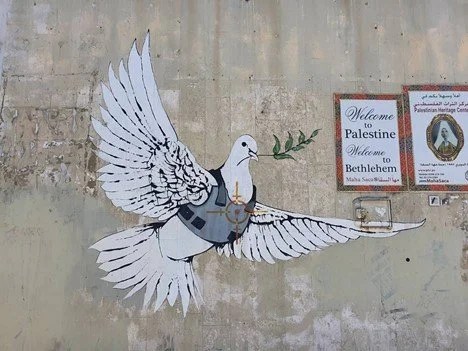
Writing on the Wall: Resistance Art in Palestine
By Sheridan Gunderson
It has many names. In Hebrew: “separation wall.” In Arabic: “wall of Apartheid.” In the media: “West Bank barrier,” “security fence,” “Apartheid wall,” or simply, “The Wall.” Whatever you call it, upon completion, it will encircle the West Bank stretching 708 kilometers (440 miles).[1]
Grey concrete slabs eight meters high and three meters thick snake around the landscape, annexing Palestinians from their farmland, communities, and places of work. About 80 percent of Palestinians separated from their land by the wall have not received permits from Israeli authorities to cultivate their fields.[2]
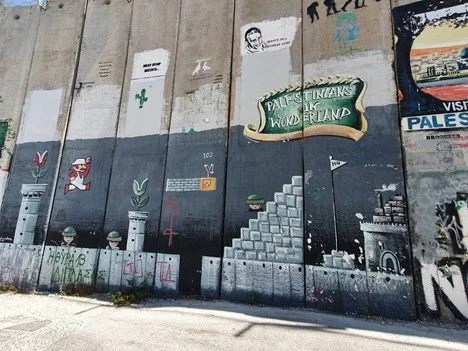
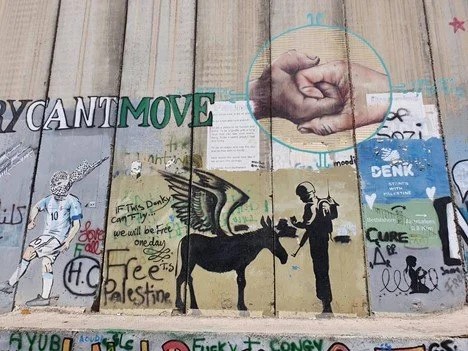
In 2007, the section of the wall in the Palestinian town of Bethlehem attracted the attention of the England-based street artist and political activist known as “Banksy.” He and other graffiti artists transplanted an annual, London-based pop-up art display known as “Santa’s Ghetto” to Bethlehem where Banksy painted four stencils on the wall. Some of the art born out of this project can still be seen today. While other pieces have been painted over, the site remains what could be the world’s largest fluid art installation. Over the course of just a few months in 2021, new art constantly appeared.
Tiếp tục đọc “Writing on the Wall: Resistance Art in Palestine”
Chương trình 20 điểm cho Trung Đông: Ánh sáng hay bóng tối ở cuối đường hầm?
SÁNG ÁNH 03/10/2025 18:47 GMT+7
TTCT – Tổng thống Mỹ Donald Trump, sau khi gặp gỡ nhiều nhà lãnh đạo thế giới, bao gồm Thủ tướng Israel Benjamin Netanyahu, đã trình ra một đề nghị hòa bình cho Trung Đông, nhưng hy vọng xem chừng vẫn khá mong manh.
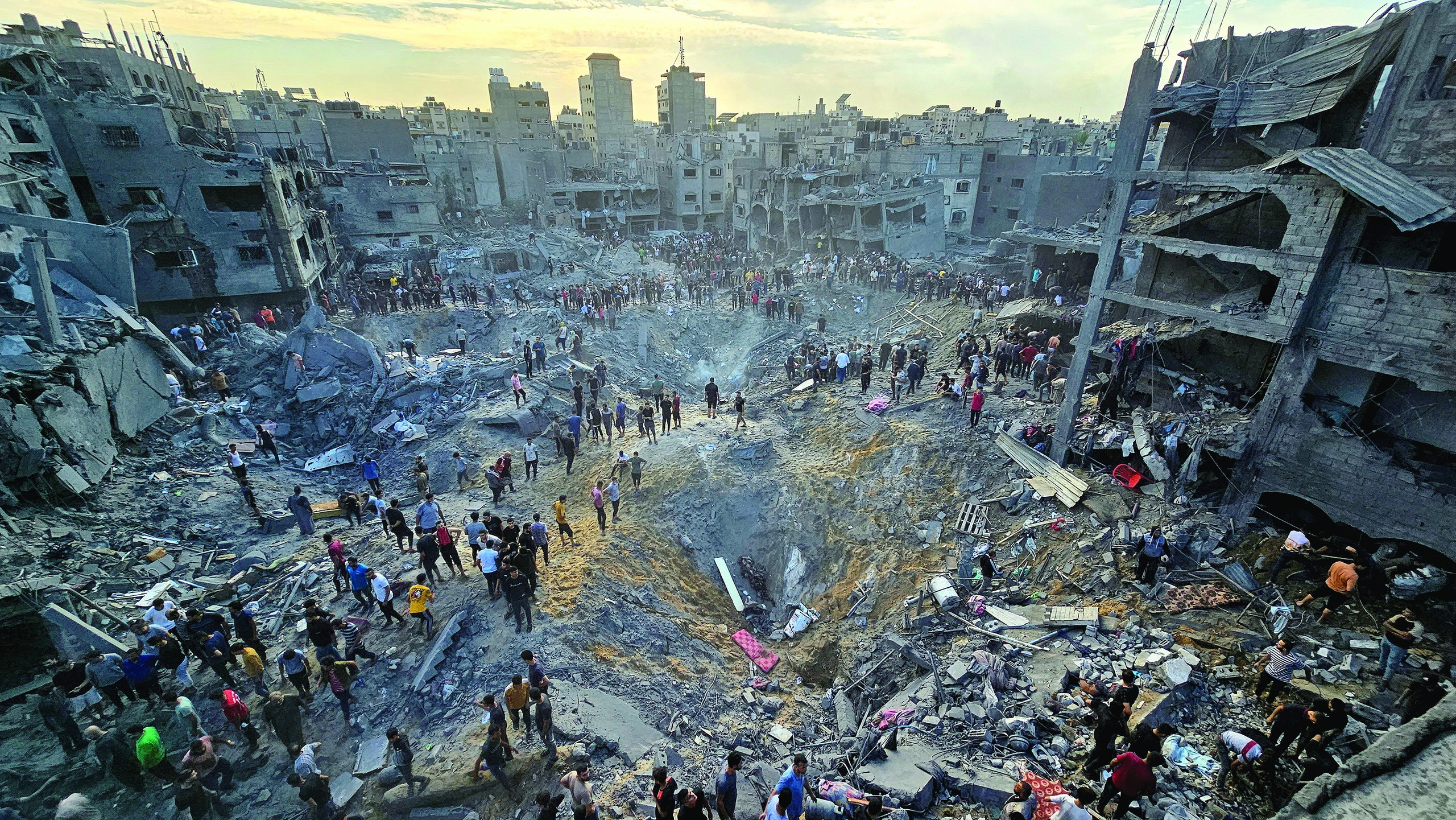
Đại hội đồng Liên hợp quốc (UNGA) tuần qua là dịp có mặt hầu hết các nguyên thủ thế giới tại New York. Năm nay đề tài chính là tình hình tại Gaza và bên lề UNGA thứ 80, Tổng thống Mỹ Donald Trump đã họp với các lãnh đạo Ả Rập và Hồi giáo hiện diện nhân dịp này để trình bày đề nghị hòa bình 21 điểm của Hoa Kỳ.
Tiếp tục đọc “Chương trình 20 điểm cho Trung Đông: Ánh sáng hay bóng tối ở cuối đường hầm?”Microsoft terminates services for Israeli military after investigation into mass surveillance of Palestinians
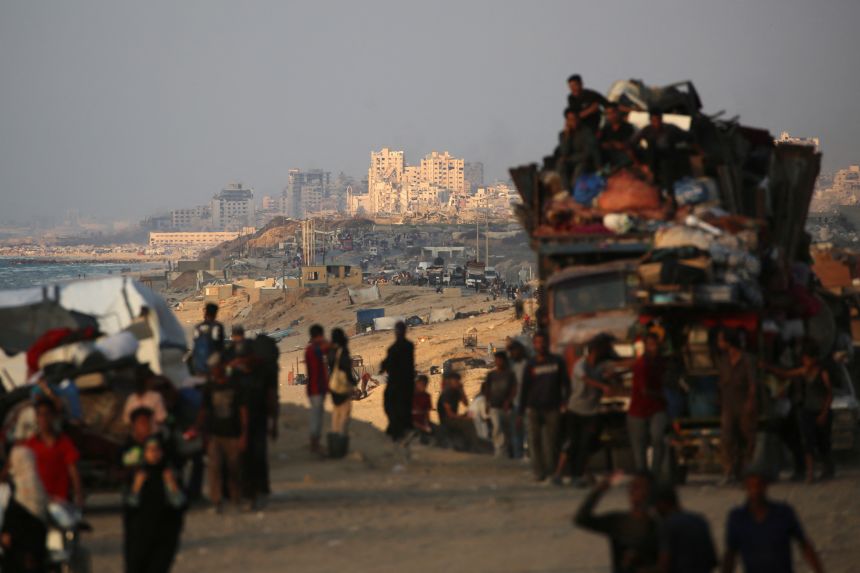
Displaced Palestinians move with their belongings southwards on a road in the Nuseirat refugee camp area in the central Gaza Strip. Eyad Baba/AFP/Getty Images
Microsoft has terminated a set of services for the Israeli military after an investigation suggested Israel was using the company’s cloud computing technology for mass surveillance of Palestinians.
In a statement posted the company’s blog, Microsoft President Brad Smith said the company had “ceased and disabled a set of services to a unit within the Israel Ministry of Defense.” The move comes after an investigation by The Guardian and Israel’s +972 Magazine in early-August reported that Israel’s military intelligence unit, known as 8200, relied on Microsoft Azure to store millions of phone calls made by Palestinians in Gaza and the occupied West Bank.
Microsoft announced on August 15 that it had begun a review of the allegations. Smith said Microsoft does not provide technology “to facilitate mass surveillance of civilians,” a principle it has applied “in every country around the world.” The review, Smith said, focused on business records, financial statements, internal documents and other records without accessing the content of the stored material.
During the investigation, the company says it found evidence that supports elements of the investigation from the news outlets, including Israel’s “consumption of Azure storage capacity in the Netherlands and the use of AI services.” Microsoft informed Israel of the decision “to cease and disable specific [Israel Defense Ministry] subscriptions and their services, including their use of specific cloud storage and AI services and technologies.”
An Israeli security official said, “There is no damage to the operational capabilities of the IDF.”
Microsoft said the review was still ongoing.
Is it too late for Gaza’s Children
| Thomson Reuter Foundation | |
| By Sadiya Ansari | Contributor | |
| This newsletter contains images that may be disturbing. Harrowing images of malnourished children in Gaza have intensified international pressure on Israel to increase humanitarian aid to the enclave.This week, Hamas-run health authorities in Gaza said that 93 children were among the 180 people who have already died from hunger-related causes. These deaths come on top of more than 60,000 Palestinians, mostly civilians, the health authorities in Gaza say have been killed since Israel launched its military offensive in the strip in October 2023. Almost 470,000 people in Gaza are enduring famine-like conditions, according to the World Health Organization (WHO), with 90,000 women and children in need of specialist nutrition treatments. WHO chief Tedros Adhanom Ghebreyesus described the situation as “mass starvation” that was “man-made”, laying the blame squarely at the Israeli blockade.While Israel has denied a policy of starvation, it controls most aspects of how food reaches and is distributed in Gaza. This includes access into Gaza, transport logistics and who is permitted to distribute aid. Today we’ll unpack the policy on aid entering the territory. 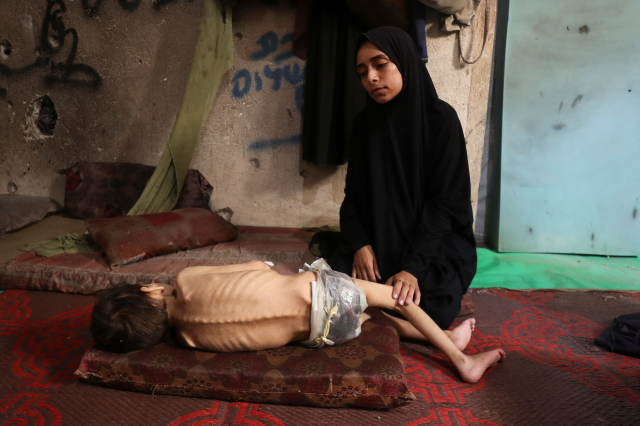 A Palestinian mother sits next to her malnourished son, at a school where they shelter amid a hunger crisis, in Gaza City, July 24, 2025. REUTERS/Mahmoud Issa A Palestinian mother sits next to her malnourished son, at a school where they shelter amid a hunger crisis, in Gaza City, July 24, 2025. REUTERS/Mahmoud IssaThe policy Israel controls access into Gaza, including for humanitarian organisations, as a result of a blockade by land, air and sea<a | |
Có một kế hoạch bỏ đói Gaza
SÁNG ÁNH – 09/08/2025 09:52 GMT+7
TTCT – Cuộc khủng hoảng nhân đạo ở Gaza đang gây ra những nỗi thống khổ vượt xa một cuộc chiến tranh thông thường. Chia sẻ của một người viết từng có nhiều năm sống ở Trung Đông.

Cuộc khủng hoảng nhân đạo Gaza hoàn toàn do con người gây ra và có thể giải quyết dễ dàng, nếu Israel cho phép. Ảnh: Reuters
Xét vai vế, tôi phải gọi ông là ông cậu. Ông là em út của bà ngoại vợ tôi. Mùa hè năm 1982 ở Beirut, ông đến nhà chỉ có bộ quần áo trên người và một cái túi ni lông. Nhà ông cách chúng tôi vài km và vừa ăn bom sập, nhưng may lúc đó ông đang ở ngoài.
Ông đi thẳng đến chỗ chúng tôi, trên đường thấy một cửa hàng thịt còn mở, thấy còn bao nhiêu ông mua hết, cả thảy 5kg thịt cừu lổn nhổn cả sườn cả mỡ… Buổi sáng hôm đó là ngày chót tiệm bánh mì mở cửa trước khi họ hết bột. Vợ tôi mua được 10kg.
Bánh mì Ả Rập dẹt như bánh xèo, bình thường giữ được đến một tuần, nhưng trong 5 tuần sau đó tại phía tây thành Beirut đang bị Israel công hãm, ngoài cá hộp thì 3 người chúng tôi chỉ có bằng ấy thực phẩm, bánh mì khô ăn với thịt cừu chiên kỹ.
The mathematics of starvation: how Israel caused a famine in Gaza
Israel controls the flow of food into Gaza. It has calculated how many calories Palestinians need to stay alive. Its data shows only a fraction has been allowed in
Emma Graham-Harrison Chief Middle East correspondentThu 31 Jul 2025 15.49 BSTShare
The mathematics of famine are simple in Gaza. Palestinians cannot leave, war has ended farming and Israel has banned fishing, so practically every calorie its population eats must be brought in from outside.
Israel knows how much food is needed. It has been calibrating hunger in Gaza for decades, initially calculating shipments to exert pressure while avoiding starvation.
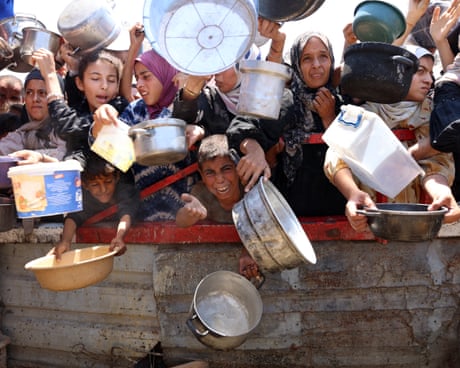
“The idea is to put the Palestinians on a diet, but not to make them die of hunger,” a senior adviser to the then prime minister, Ehud Olmert, said in 2006. An Israeli court ordered the release of documents showing the details of those macabre sums two years later.
Cogat, the Israeli agency that still controls aid shipments to Gaza, calculated then that Palestinians needed an average minimum 2,279 calories per person per day, which could be provided through 1.836kg of food.
Today, humanitarian organisations are asking for an even smaller minimum ration: 62,000 metric tonnes of dry and canned food to meet basic needs for 2.1 million people each month, or around 1kg of food per person per day.
Tiếp tục đọc “The mathematics of starvation: how Israel caused a famine in Gaza”
Watch The British-Soviet Invasion of Iran (1941)
The Anglo-Soviet invasion of Iran (Operation Countenance) occurred in August 1941, during World War II.
The invasion was carried out jointly by the United Kingdom and the Soviet Union, aiming primarily to secure Iranian territory against Axis influence and protect critical supply routes.
Here’s a comprehensive overview:
Lead-Up and Reasons
Strategic Importance:
- Iran had a strategically critical position, particularly as a transportation corridor between the Allies and the Soviet Union.
- Iranian infrastructure, notably the Trans-Iranian Railway, offered a route for delivering vital supplies from the Allies (mostly Britain and the U.S.) to the USSR following Germany’s invasion (Operation Barbarossa) in June 1941.
Iranian Position and Axis Influence:
- Although officially neutral, the Iranian ruler Reza Shah Pahlavi sympathized with Germany, partially due to historical rivalry with Britain and Russia.
- Germany had established substantial diplomatic and commercial influence in Iran, with many German nationals working in strategic industries, raising fears of espionage and sabotage among the Allies.
Diplomatic Tensions:
- Britain and the Soviet Union demanded Iran expel German nationals perceived as threats; Iran hesitated or refused, increasing Allied suspicions and tension.
Invasion: Operation Countenance
Date and Execution:
Began on August 25, 1941, when British forces advanced from the south and west, while Soviet forces attacked from the north.
Rapid military operations overwhelmed Iran’s defenses, which were relatively weak and poorly equipped compared to the invading powers.
Key Events:
- British forces captured key oil fields in Khuzestan (Abadan), securing critical petroleum resources.
- Soviet troops quickly took control of northern provinces, including major cities such as Tabriz and Mashhad.
- Air and naval superiority allowed quick suppression of Iranian resistance.
Iranian Response: The Iranian army, despite fighting briefly in several locations, was rapidly overwhelmed, with significant casualties but limited overall resistance.
Tehran quickly realized the futility of resistance and began negotiations.
Tiếp tục đọc “Watch The British-Soviet Invasion of Iran (1941)”
‘We are dying of hunger’: Gaza civilians collapse under total Israeli siege
A warning to our viewers – the images in this report are deeply disturbing.
Israel’s ongoing blockade on Gaza has led to an alarming rise in the number of people who have been starved to death. Gaza’s health ministry says 19 Palestinians have died of hunger in 24 hours.
The UN says it’s receiving ‘desperate messages of starvation’ while aid is stockpiled just outside and remains blocked.
Al Jazeera’s Um-e-Kulsoom Shariff reports.
Israel has abducted and jailed 1,000,000 Palestinians since 1967 — US group’s report.
Israel has abducted and jailed 1,000,000 Palestinians since 1967 — US group’s reportTel Aviv has jailed Palestinians at an average of 47 per day, says a new study, adding US “bankrolled this oppression” against Palestinians for nearly 700 months.
On February 24, Israeli occupation troops abducted Fidaa Assaf from the village of Kafr Laqif in Palestine’s Qalqilya governorate. She was returning from Ramallah Medical Complex after undergoing medical examinations.
Palestinian officials later revealed that the female prisoner, who is married and a mother, was subjected to multiple strip searches and verbal abuse.
They also noted that she was detained in a cell described as unhygienic and infested with insects, and was deprived of water and food for several days.
Tiếp tục đọc “Israel has abducted and jailed 1,000,000 Palestinians since 1967 — US group’s report.”
Chiến sự Israel – Iran: Hậu trường của hai phía
KH. ĐỖ – 20/06/2025 18:49 GMT+7
TTCT – Trong khi Hoa Kỳ còn đang đàm phán với Iran về vấn đề hạt nhân thì đột nhiên sáng 13-6, Israel dùng 200 phi cơ đánh quốc gia này. Hai nhà máy nguyên tử bị tấn công nhưng nhờ chôn giấu và các địa đạo bảo vệ nên không thiệt hại mấy.

Thành công của cuộc đột kích này nằm trong chuyện ám sát được mươi tướng lãnh cao cấp nhất Iran, trong đó có tư lệnh Lực lượng Vệ binh cách mạng và tổng tham mưu trưởng quân đội.
Các đợt đột kích trong ngày 13-6 cũng giết chết 6 khoa học gia hàng đầu và thay đổi bầu không khí chán nản tại Israel. 20 tháng giậm chân không kết quả và ngày ngày sát hại đàn bà trẻ con tay không ở Gaza khiến tinh thần của quân đội Israel xuống dốc.
Vì vậy, cuộc tấn công Iran và thành tích ” kiểu James Bond” (chữ của nhà báo Israel Gideon Levy) khiến họ tươi tỉnh lại. Ám sát là sở trường của các lực lượng Israel trong lịch sử quốc gia, từ buổi đầu khi bắn chết đặc sứ Folke Bernadotte của Liên hợp quốc năm 1948.
Tiếp tục đọc “Chiến sự Israel – Iran: Hậu trường của hai phía”Israeli tanks fired into a crowd trying to get aid from trucks in Gaza, killing at least 59 people
The US hypocrisy about Israel’s nuclear weapons must stop
thebulletin.org By Victor Gilinsky, Leonard Weiss | March 21, 2025
 Israeli space launch vehicle Shavit sends a military intelligence satellite into space in March 2023. The same Shavit rocket can launch ballistic missiles, including the nuclear-capable, three-stage Jericho III intermediate-range ballistic missile. The Jericho III reportedly has a range exceeding 4,000 kilometers, enough to reach all of Iran, Pakistan, Europe, and western Russia. Israel has not acknowledged the existence of its nuclear weapon arsenal despite being widely known. (Credit: Israel Defense Ministry)Share
An extraordinary three-part series on Israeli television, The Atom and Me, lays out how the country got its nuclear weapons. It takes for granted what anyone who pays attention has known for years. But the series goes well beyond a general discussion about Israel’s nuclear weapons. It shows the country’s single-minded determination to get the bomb no matter what it took, including stealing nuclear explosives and bomb components from the United States and violating a major nuclear arms control treaty to which Israel is a party—and lying about it.
Tiếp tục đọc “The US hypocrisy about Israel’s nuclear weapons must stop”
People from around the world are flying to Cairo to march on foot across the desert to reach Gaza
“Too little, too late”: The sudden surge of genocide critique over Gaza
More than 600 days into its genocidal war in Gaza, some of Israel’s closest allies have begun to condemn its actions. Alongside the changing global narrative, growing opposition in Israel to the Netanyahu government’s war methods has seeped into the media coverage – fracturing a consensus that dates back to October 7, 2023.
 CVD
CVD 