New research analyzing more than 3,000 tropical forest sites reveals that areas with fewer seed-dispersing animals store up to four times less carbon than forests with healthy wildlife populations.
The study found that 81% of tropical trees rely on animals to disperse their seeds, establishing an ancient partnership now threatened by human activities such as deforestation, road construction, and hunting.
Researchers mapped global “seed dispersal disruption” and found it explains a 57% reduction in carbon storage potential across proposed forest restoration areas.
– 2024 had the most tropical primary forest loss since our records began two decades ago — disappearing at a rate of 18 football (soccer) fields per minute, nearly double that of 2023. – Almost half of this loss was due to fires, around 5 times more than a typical year in the tropics. Latin America was particularly hard hit with major fires across Brazil, Bolivia and numerous other countries. – Fires also continued to drive tree cover loss outside of the tropics, with high levels of loss once again in Russia and Canada. Overall, the world lost an area of forests nearly the size of Panama.
This data must be a wake-up call for global policies and finance that incentivize keeping forests standing. Read our analysisfor more findings from the University of Maryland GLAD Lab’s annual data
Greenhouse gas emissions can be offset by carbon sinks such as forests, but expanding these areas can put Indigenous communities, reliant on the forests, at risk.
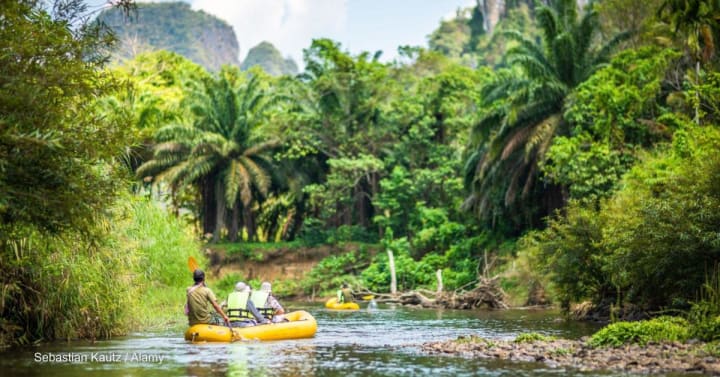
Khao Sok rainforest in Thailand. Photo by: Sebastian Kautz / Alamy
From Khao Sok National Park in the southwest to Phu Chi Fa Forest Park in the north, forests cover around 30% of Thailand’s total area. Approximately 23 million people live near or in these lush green landscapes, depending on them for sustenance and livelihoods. But that’s now at risk, due to both climate change-related threats and the policies implemented to protect the forests.
Warangkana Rattanarat, Thailand country director for The Center for People and Forests, warned that the arrival of El Niño earlier this year has caused long droughts and less rain, damaging crops and other forest resources. This has affected the availability of food, as well as the income local people can derive from forest resources, she added.
The country has also experienced floods and the highest temperatures on record this year, impacting forests and the communities within them. In theGermanWatch Global Climate Risk Index 2021, Thailand ranked at number nine globally for long-term climate risks.
Additionally, there are land and tenure rights issues for Indigenous forest communities to contend with, and national climate commitments that have the potential to negatively impact such communities, said experts.
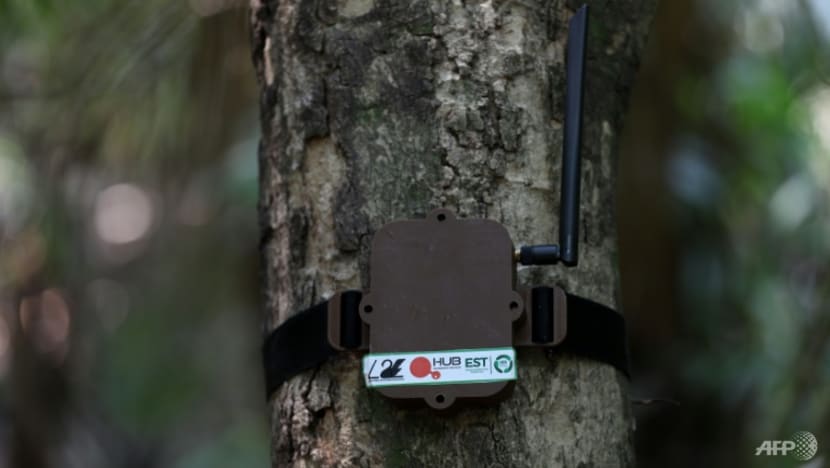
The Curupira sensors look like small internet modems but are in fact wireless and can relay data up to 1km via satellite to others in a network (Photo: AFP/Michael Dantas)
27 Sep 2023 11:58AM(Updated: 27 Sep 2023 12:06PM)
MANAUS, Brazil: Small, artificially intelligent boxes tied to tree trunks in the Brazilian Amazon are the latest weapon in the arsenal of scientists and environmentalists battling destructive jungle invaders.
The boxes, named Curupiras after a folkloric forest creature who preys on hunters and poachers, sport sensors and software trained “to recognise the sounds of chainsaws and tractors, or anything that could cause deforestation”, project manager Thiago Almeida told AFP.
“We recorded the sound of chainsaws and tractors in the forest … then, all the collected sounds were passed on to the AI team to train (the program) so that … it would only recognise these sounds and not the characteristic sounds of the forest, such as animals, vegetation and rain,” he explained.
Beneath our feet, remarkable networks of fungal filaments stretch out in all directions. These mycorrhizal fungi live in partnership with plants, offering nutrients, water and protection from pests in exchange for carbon-rich sugars.
How much bigger? These microscopic filaments take up the equivalent of more than a third (36%) of the world’s annual carbon emissions from fossil fuels – every year.
As we search for ways to slow or stop the climate crisis, we often look to familiar solutions: cutting fossil fuel use, switching to renewables and restoring forests. This research shows we need to look down too, into our soils.
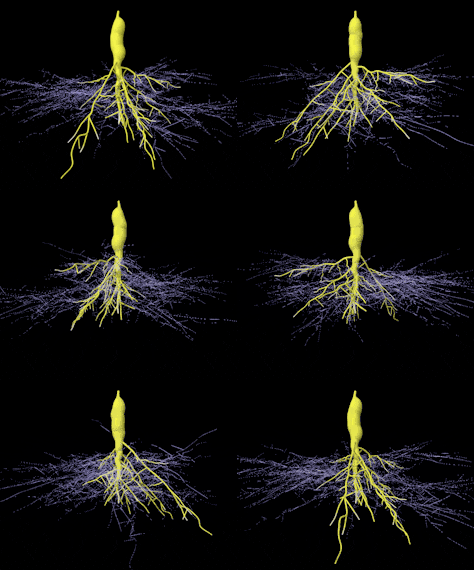
This shows how mycorrhizal fungi (fine white filaments) connect to plant root systems (yellow) and out into the soil. Scivit/Wikipedia
This fungi-plant partnership is 400 million years old
Mycorrhizal fungi are hard to spot, but their effects are startling. They thread networks of microscopic filaments through the soil and into the roots of almost every plant on earth.
But this is no hostile takeover. They’ve been partnering with plants for more than 400 million years. The length of these complex relationships has given them a vital role in our ecosystems.
For decades, people across South-east Asia have been hunting wild animals for food. But commercial pressures and cheaper snaring methods are causing the region’s forests to be emptied faster than they can be replenished — with repercussions for human and forest health.
They were taken to the wildlife rescue centre not in cages but in fine mesh bags, as though they were already fresh meat being sold by the gram.
But the four ferret badgers were still alive and kicking.
The mammals had been literally rescued from the jaws of death.
VIETNAM AND CAMBODIA – Local policemen had seized them from a restaurant and taken them to Save Vietnam’s Wildlife’s facility located within Cuc Phuong National Park, about a two-hour drive from Hanoi.
“The restaurant bought them from people who caught them from the forest,” said Mr Tran Van Truong, who as captive coordinator is in charge of the facility’s operations. “They are a bit stressed now, but they seem okay otherwise. We can probably release them back into the wild after a few days.”
Not all of man’s wild quarry are as lucky.
Demand for bushmeat and exotic pets from city dwellers is contributing to the emptying of South-east Asia’s forests. ST PHOTO: MARK CHEONG
Trapping wild animals for bushmeat may be illegal in Vietnam, but the practice is still widespread in the country. In other parts of South-east Asia too, the Covid-19 pandemic and its likely origins in the wildlife trade has had nary an impact on the region’s appetite for wild meat.
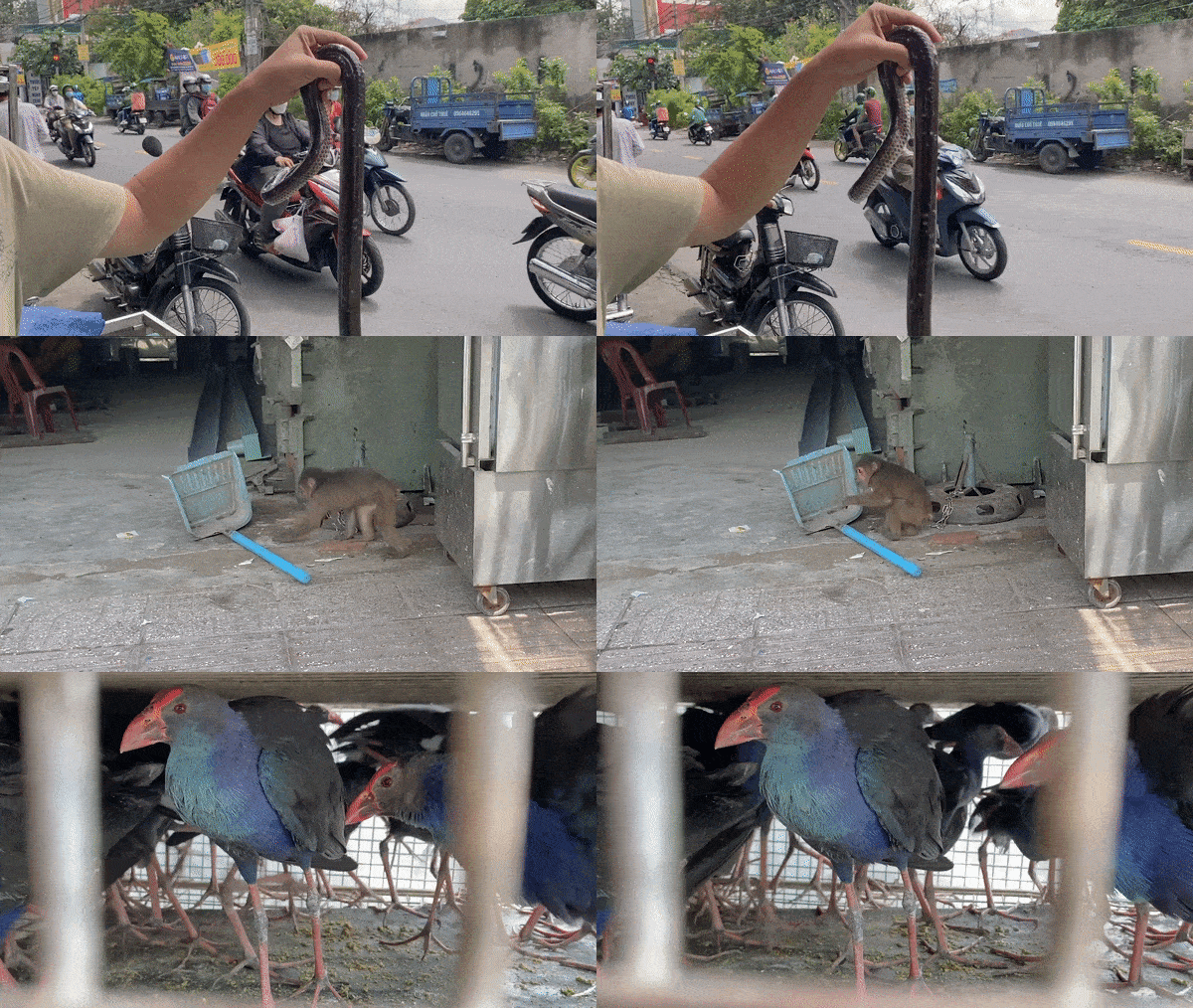
Wild animals are still being taken from the forests in large numbers, to be eaten or kept as pets, and we discovered how voracious appetites for them were still during visits to Vietnam and Cambodia in September.
Wild animals sold at a market in Ho Chi Minh City. VIDEO: ANTON L. DELGADO
New data on forest fires confirms what we’ve long feared: Forest fires are becoming more widespread, burning nearly twice as much tree cover today as they did 20 years ago.
Using data from a new study by researchers at the University of Maryland, we calculated that forest fires now result in 3 million more hectares of tree cover loss per year compared to 2001 — an area roughly the size of Belgium — and accounted for more than a quarter of all tree cover loss over the past 20 years.
Cantonal Hojancha was once a major cattle ranching region. Most of this area was cleared for pasture only 30 years ago. Now, many of the residents have moved into the service industry, and the pasture land has slowly converted back to forest. Photo by Aaron Minnick (World Resources Institute)
New analysis from The Nature Conservancy, WRI and others estimates that stopping deforestation, restoring forests and improving forestry practices could cost-effectively remove 7 billion metric tons of carbon dioxide annually, or as much as eliminating 1.5 billion cars—more than all of the cars in the world today!
In fact, forests are key to at least six of the study’s 20 “natural climate solutions,” which could collectively reduce 11.3 billion metric tons of greenhouse gas emissions per year. That’s as much as halting global oil consumption, and would get us one-third of the way toward limiting global warming to 2 degrees C (3.6 degrees F) above pre-industrial levels — the threshold for avoiding catastrophic effects of climate change — by 2030.
Trần Đức Minh (right) patrols forest. – Photo khuyennongvn.gov.vn
Viet Nam News QUẢNG NGÃI — The 65-year-old war veteran Trần Đức Minh has never forgotten the moment he stumbled on a tree trunk while chasing poachers in Nhàn mountain, leaving his feet bleeding.
Falling is merely one of many risks forest rangers face daily. Minh has volunteered to protect Nhàn Mountain in Tịnh Sơn Commune, Sơn Tịnh District, central Quảng Ngãi Province for nearly 40 years. Tiếp tục đọc “War veteran now fights for his local forest”→



 Cantonal Hojancha was once a major cattle ranching region. Most of this area was cleared for pasture only 30 years ago. Now, many of the residents have moved into the service industry, and the pasture land has slowly converted back to forest. Photo by


 CVD
CVD 