Environmental activist group Mother Nature Cambodia has been named one of Right Livelihood’s 2023 laureates.
The award, established in 1980, recognizes groups and individuals striving to preserve the environment and those who protect it.
Mother Nature Cambodia has played a key role in campaigns against environmentally destructive dams, logging and sand mining, resulting in the imprisonment of multiple group members and banishment of its founder.
PHNOM PENH — Mother Nature Cambodia, one of the country’s most prominent environmental activism groups, was named one of Right Livelihood’s 2023 laureates on Sept. 28, making it the first group of Cambodians recognized in the award’s 43-year history.
Born out of a refusal from the Nobel Foundation to issue awards recognizing changemakers who champion environmental and social justice issues, Stockholm-headquartered Right Livelihood rewards groups and individuals committed to advancing causes around the world. The award offers recipients “a megaphone and a shield” with what Right Livelihood calls “lifelong support” to activists striving to preserve the environment and protect those who depend on it.
“Mother Nature Cambodia is a group of fearless young activists fighting for environmental rights and democracy in the face of repression by the Cambodian regime,” Ole von Uexkull, Right Livelihood’s executive director, said in a statement. “Through innovative and often humorous protests, their activism defends nature and livelihoods, while upholding communities’ voices against corrupt and damaging projects. Despite arrests, legal harassment and surveillance, they continue to fight relentlessly for Cambodians’ environmental and civic rights.”
Right Livelihood’s jury said Mother Nature Cambodia was receiving the award “for their fearless and engaging activism to preserve Cambodia’s natural environment in the context of a highly restricted democratic space.”
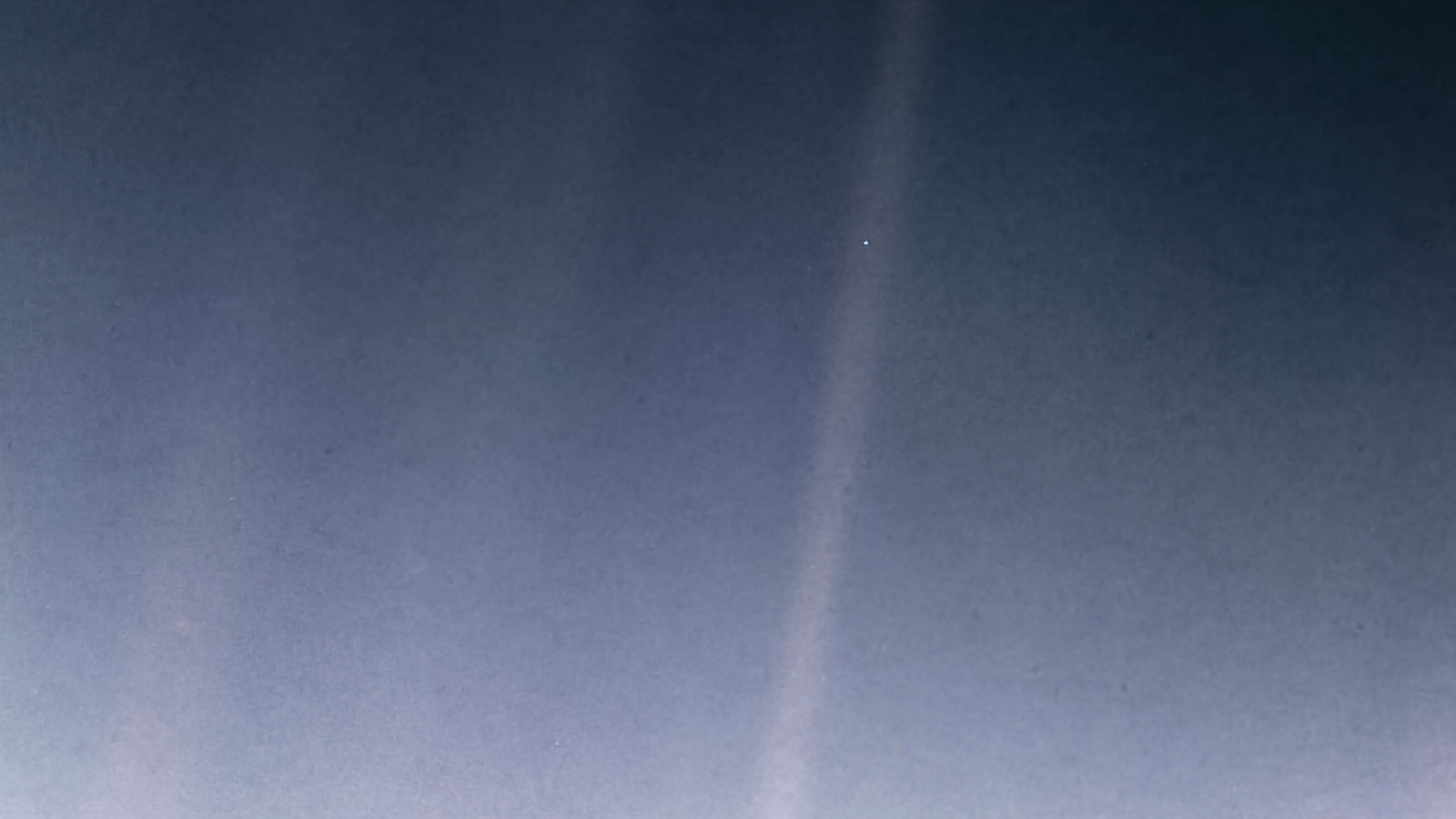
THE PALE BLUE DOT OF EARTH “That’s here. That’s Home. That’s us.”Image: NASA / JPL
“Hãy nhìn lại cái chấm đó. Cái Chấm đó chính là đây. Là nhà. Là chúng ta. Trên cái Chấm có tất cả những người thương yêu của bạn, có tất cả những ai bạn biết, những ai bạn từng nghe nhắc tới, và cả mọi con người đã từng tồn tại, từng sống trọn vẹn cuộc đời của họ. Cái Chấm đó là tổng hòa hỗn hợp của vui sướng và bất hạnh của mọi con người chúng ta, là hàng ngàn tôn giáo tín ngưỡng, mọi ý thức hệ, các học thuyết kinh tế, mọi thợ săn và thợ rèn, mọi anh hùng và kẻ hèn hạ, mọi nhà sáng lập và kẻ huỷ diệt nền văn minh, tất cả vua chúa và thường dân, tất cả đôi lứa đang yêu, tất cả ai làm cha mẹ và những đứa trẻ đầy triển vọng, mọi nhà phát minh và nhà thám hiểm, các thầy giảng các giáo viên, tất cả các chính trị gia tham nhũng, các “siêu sao”, các “lãnh đạo tối cao”, tất cả những vị thánh và kẻ tội đồ trong lịch sử loài người chúng ta đều sống ở đó – ở trên một cái Chấm hạt bụi lơ lửng trong một vệt nắng.
Trái Đất là một sân khấu siêu nhỏ trong một vũ đài vũ trụ mênh mông. Hãy nghĩ về những dòng sông đầy máu dưới tay của những vị tướng và hoàng đế, để mà trong vinh quang và chiến thắng, họ có thể trở thành những bá chủ nhất thời của một phần tí ti trong cái dấu Chấm đó. Hãy nghĩ về sự tàn khốc vô tận mà cư dân ở một góc tí ti này giáng xuống người dân ở một góc tí ti khác mà những con người ở đó thì đều giống nhau đến mức khó có thể phân biệt được, hãy nghĩ về mức độ nhầm lẫn thường xuyên của những con người đó, về sự háo hức tàn sát nhau về lòng căm thù sục sôi như thế.
Sự giả tạo của chúng ta, tự huyễn hoặc về cái sự quan trọng của chính mình, cái sự ảo tưởng rằng chúng ta có đặc quyền trong Vũ trụ bị thách thức bởi điểm Chấm mờ này. Hành tinh Trái Đất của chúng ta chỉ là một cái đốm lẻ loi, bao trùm bởi bóng tối vũ trụ bao la. Trong cái sự mù mờ của chúng ta, trong vũ trụ vô tận này, không hề có một dấu vết nào cho thấy sẽ có sự giúp đỡ đến từ một nơi nào khác (ngoài cái Chấm này) để cứu rỗi chúng ta khỏi chính mình.
Cho đến nay trong mọi nơi mà ta từng biết đến, Trái Đất là thế giới duy nhất cho phép sự sống neo đậu và trú ẩn. Không một hành tinh nào khác, ít nhất là trong tương lai gần, mà loài người chúng ta có thể di cư đến. Vâng, đến thăm thì được, chứ định cư thì chưa đâu. Dù muốn hay không, thì Trái Đất vẫn là nơi cho ta cư trú ở thời điểm hiện tại.
Người ta nói thiên văn học là một trải nghiệm khiêm nhường và để xây dựng chí khí. Có lẽ không có cách bày tỏ nào tốt hơn về sự tự phụ ngu xuẩn của loài người bằng hình ảnh xa xôi về thế giới nhỏ bé của chúng ta. Đối với tôi, hình ảnh cái Chấm này nhấn mạnh trách nhiệm của chúng ta để đối xử tử tế với nhau hơn, để giữ gìn và trân trọng cái Chấm xanh mờ nhạt này, ngôi nhà duy nhất mà con người chúng ta biết đến.”
— Carl Sagan, Pale Blue Dot, 1994
Look again at that dot. That’s here. That’s home. That’s us. On it everyone you love, everyone you know, everyone you ever heard of, every human being who ever was, lived out their lives. The aggregate of our joy and suffering, thousands of confident religions, ideologies, and economic doctrines, every hunter and forager, every hero and coward, every creator and destroyer of civilization, every king and peasant, every young couple in love, every mother and father, hopeful child, inventor and explorer, every teacher of morals, every corrupt politician, every “superstar,” every “supreme leader,” every saint and sinner in the history of our species lived there–on a mote of dust suspended in a sunbeam.
The Earth is a very small stage in a vast cosmic arena. Think of the rivers of blood spilled by all those generals and emperors so that, in glory and triumph, they could become the momentary masters of a fraction of a dot. Think of the endless cruelties visited by the inhabitants of one corner of this pixel on the scarcely distinguishable inhabitants of some other corner, how frequent their misunderstandings, how eager they are to kill one another, how fervent their hatreds.
Our posturings, our imagined self-importance, the delusion that we have some privileged position in the Universe, are challenged by this point of pale light. Our planet is a lonely speck in the great enveloping cosmic dark. In our obscurity, in all this vastness, there is no hint that help will come from elsewhere to save us from ourselves.
The Earth is the only world known so far to harbor life. There is nowhere else, at least in the near future, to which our species could migrate. Visit, yes. Settle, not yet. Like it or not, for the moment the Earth is where we make our stand.
It has been said that astronomy is a humbling and character-building experience. There is perhaps no better demonstration of the folly of human conceits than this distant image of our tiny world. To me, it underscores our responsibility to deal more kindly with one another, and to preserve and cherish the pale blue dot, the only home we’ve ever known.
Sand is the foundation of human construction and a fundamental ingredient in concrete, asphalt, glass and other building materials.
But sand, like other natural resources, is limited and its ungoverned extraction is driving erosion, flooding, the salination of aquifers and the collapse of coastal defences.
The United Nations Environment Programme (UNEP) has partnered with Kenyan spoken word poet Beatrice Kariuki to shed light on the problems associated with sand mining, part of a wider push towards a zero waste world.
“We must redouble our efforts to build a circular economy, and take rubble to build structures anew,” Kariuki says in a new video. “Because without new thinking, the sands of time will run out.”
Sand is the second-most used resource on Earth, after water. It is often dredged from rivers, dug up along coastlines and mined. The 50 billion tonnes of sand thought to be extracted for construction every year is enough to build a nine-storey wall around the planet.
A 2022 report from UNEP, titled Sand and Sustainability: 10 Strategic Recommendations to Avert a Crisis, found that sand extraction is rising about 6 per cent annually, a rate it called unsustainable. The study outlined the scale of the problem and the lack of governance, calling for sand to be “recognized as a strategic resource” and for “its extraction and use… to be rethought.”
The report builds on UNEP research from 2019 that found increasing demand for sand, which saw a three-fold growth over 20 years, had caused river pollution and flooding, while also shrinking aquifers and deepening droughts.
UNEP has identified solutions to the problems linked to sand mining, including the creation of legal frameworks for sand extraction. There is also a need to develop a circular economy for sand and other building materials, accurately map and monitor sand resources, and restore ecosystems damaged by sand mining.
Recycling construction material from demolition sites and developing the potential of ore-sand are two simple ways to reduce the consumption of new sand, while contributing to global circular economy ambitions, the Sand and Sustainability report found. Ore-sand is a by-product of mineral processing designed for construction and industrial application that reduces the production of mine tailings and potentially provide an alternative source of sand.
To fight the pervasive impact of pollution on society, UNEP launched #BeatPollution, a strategy for rapid, large-scale and coordinated action against air, land and water pollution. The strategy highlights the impact of pollution on climate change, nature and biodiversity loss, and human health. Through science-based messaging, the campaign showcases how transitioning to a pollution-free planet is vital for future generations.
Indian Roots of the Term Speak of a History of Non-Violent Resistance
The first tree huggers were 294 men and 69 women belonging to the Bishnois branch of Hinduism, who, in 1730, died while trying to protect the trees in their village from being turned into the raw material for building a palace. They literally clung to the trees, while being slaughtered by the foresters. But their action led to a royal decree prohibiting the cutting of trees in any Bishnoi village.
Photo courtesy Waging NonviolenceThe Chipko movement (which means “to cling”) started in the 1970s when a group of peasant women in Northern India threw their arms around trees designated to be cut down.
Show the slightest bit of concern for the environment and you get labeled a tree hugger. That’s what poor Newt Gingrich has been dealing with recently, as the other presidential candidates attack his conservative credentials for having once appeared in an ad with Nancy Pelosi in support of renewable energy. Never mind that he has since called the ad the “biggest mistake” of his political career and talked about making Sarah Palin energy secretary. Gingrich will be haunted by the tree hugger label the rest of his life. He might as well grow his hair out, stop showering and start walking around barefoot.
But is that what a tree hugger really is? Just some dazed hippie who goes around giving hugs to trees as way to connect with nature. You might be shocked to learn the real origin of the term.
The first tree huggers were 294 men and 69 women belonging to the Bishnois branch of Hinduism, who, in 1730, died while trying to protect the trees in their village from being turned into the raw material for building a palace. They literally clung to the trees, while being slaughtered by the foresters. But their action led to a royal decree prohibiting the cutting of trees in any Bishnoi village. And now those villages are virtual wooded oases amidst an otherwise desert landscape. Not only that, the Bishnois inspired the Chipko movement (chipko means “to cling” in Hindi) that started in the 1970s, when a group of peasant women in the Himalayan hills of northern India threw their arms around trees designated to be cut down. Within a few years, this tactic, also known as tree satyagraha, had spread across India, ultimately forcing reforms in forestry and a moratorium on tree felling in Himalayan regions.
Kachin State’s Chipwi Township in northernmost Myanmar is known for its pristine forests and crystal-clear water.
But 10 years ago, local residents started noticing the patches of land that had been cleared on the lush mountains surrounding their town, which borders China’s Yunnan province. It started with one patch of land, where all the trees were cut down. Then others followed.
Soon locals saw heavy machinery being moved through their town, heading to those barren plots of land. Then workers started flooding in. They excavated the ground and left open pits, many filled with chemically-laced water, in areas once rich in woodland. The water near those sites was no longer clean.
It became obvious at that stage that the newcomers were looking for something underneath the ground – rare earth, which contains elements widely used in high-tech products like smartphones, computer components, electric vehicles and solar cells.
The first Earth Day was in 1970. What’s changed since? Our population has doubled. We’re emitting 2.6 times more CO2. Sea levels have risen 12 centimeters
The Aral Sea was once the fourth-largest lake in the world. Fed primarily by snowmelt and precipitation flowing down from faraway mountains, it was a temperate oasis in an arid region. But in the 1960s, the Soviet Union diverted two major rivers to irrigate farmland, cutting off the inland sea from its source. The Aral Sea has been slowly disappearing ever since. These images show how the Aral Sea and its surrounding landscape has changed over the past few decades.
Author: Thang Nam Do, ANUVietnam needs to address environmental challenges to fully reap the benefits from its new free trade and investment agreements with the European Union. On 8 June, Vietnam’s National Assembly ratified the EU–Vietnam Free Trade Agreement and Investment Protection Agreement, following the European Parliament’s approval in February. Ratifying the agreement clears the path for Vietnam to expand exports to the potentially lucrative EU market and to attract more investment from the economic bloc.
China’s banks supporting BRI projects should apply environmental risk-management policies and oversight, says Divya Narain
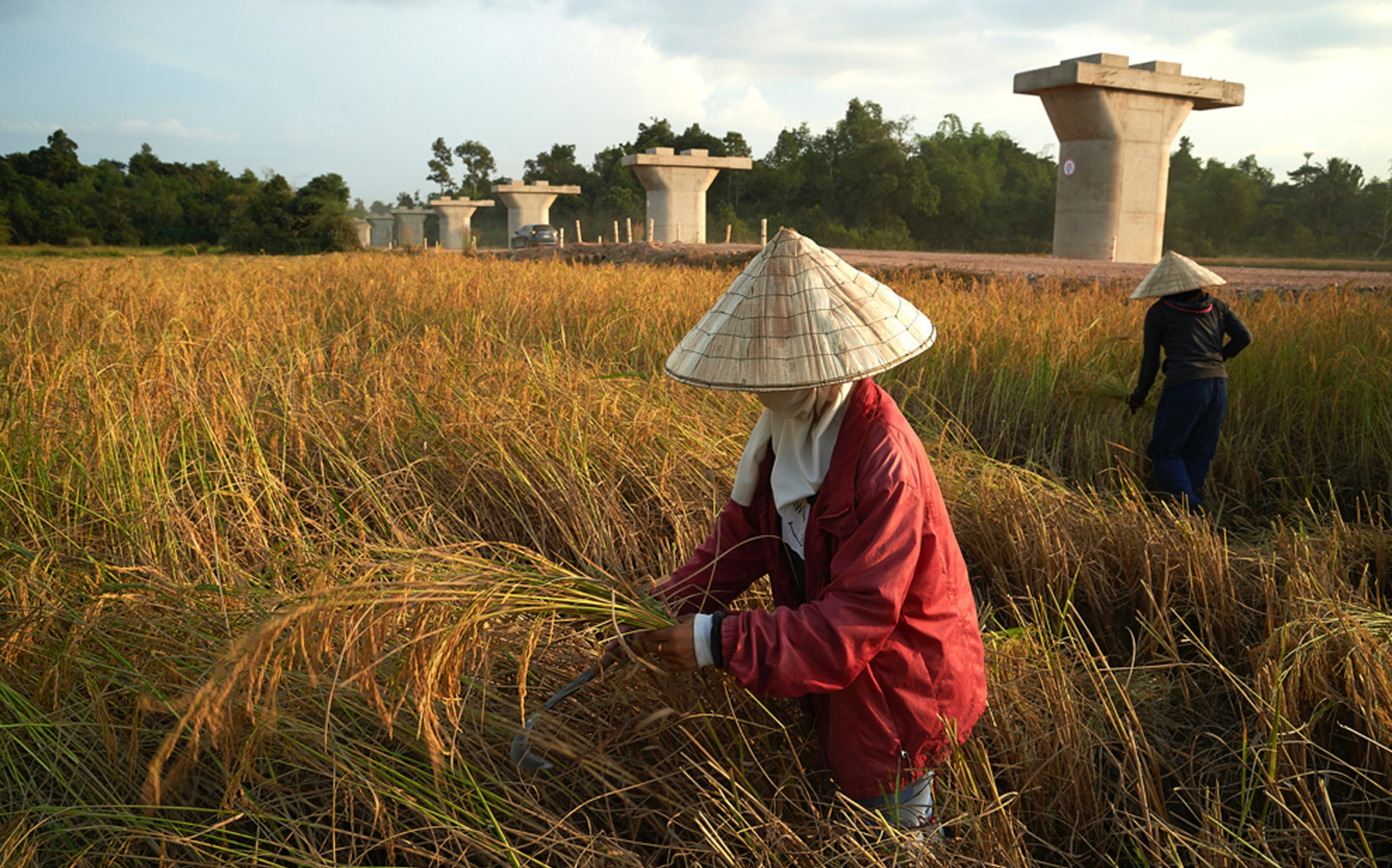
Rice harvesting near Vientiane in Laos. The pillars will support the Nam Khone bridge, the longest on the China–Laos high-speed railway (Image: Surya Chuen / China Dialogue)
China’s Belt and Road Initiative (BRI) is intended to catalyse the economies of countries around the globe.
Yet BRI projects overlap some of the most ecologically fragile places on earth. The multi-trillion-dollar initiative – to build transcontinental networks of roads, railways and ports, studded with dams, mines, power plants, and solar and wind farms – has its environmental impacts. These include air and water pollution, soil contamination and erosion, habitat and wildlife loss. Tiếp tục đọc “Banks need to take Belt and Road environmental risks seriously”→
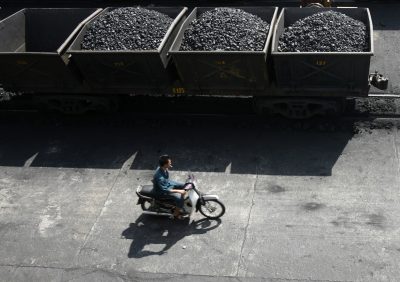
A pedestrian crosses a smog-shrouded street in Lianyungang, eastern China’s Jiangsu province on December 19, 2016. Hospital visits spiked, roads were closed and flights cancelled on December 19 as China choked under a vast cloud of toxic smog, with forecasters warning the worse was yet to come.
Source: STR/AFP
THE news that China is bracing for smog waves as the winter heating season begins has once again put the dangerous levels of air pollution in Asia in the spotlight. With the air in Beijing and adjacent areas expected to become heavily polluted over the next week, China will be facing concern – yet again – over its underwhelming response to the problem. Tiếp tục đọc “Will Vietnam follow China down the pollution path?”→
In early May, a mass poisoning event in Chetr Borei district in the Cambodian province of Kratie killed at least 13 people and caused acute levels of sickness for up to 300 more.
An investigation led by Cambodia’s Minister of Industry and Handicraft Cham Prasidh revealed high levels of cyanide in a nearby river, which is the source of drinking water for communities in the region that were affected by poisoning. However, Prime Minister Hun Sen dismissed the claim, saying the poisoning was caused by rice wine and agricultural chemicals.
Hình ảnh banner: Một nông dân đang cho ngựa ăn cỏ voi ở tỉnh Cao Bằng, cỏ được trồng để người nông dân không cho gia súc ăn cỏ bên trong một khu rừng được bảo vệ gần đó. Ảnh của Michael Tatarski / Mongabay.
Việt Nam đứng gần cuối Bảng thế giới trong xếp hạng toàn cầu về tự do báo chí
Tờ Phóng viên Không Biên giới xếp Việt Nam ở vị trí 175 trên 180 về chỉ số tự do báo chí năm 2017.
Các nhà báo môi trường ở Việt Nam, bao gồm cả các nhà báo công dân và blogger, thường phải đối mặt với nhiều rào cản, đôi khi là cả bị giam giữ.
Tuy không phải là một điều đáng ngạc nhiên, nhưng viết báo về môi trường ở Việt Nam không phải là một việc dễ dàng. Nhà nước một đảng Việt Nam gần đây đã được xếp hạng 175 trên 180 về Chỉ số Tự do Báo chí Thế giới năm 2017 của Tờ Phóng viên Không Biên giới, nằm giữa Sudan và Trung Quốc.
BANGKOK — Thirty million people depend for a living on the Mekong, the great Asian river that runs through Southeast Asia from its origins in the snowfields of Tibet to its end in the delta region of Vietnam, where it fertilizes one of the world’s richest agricultural areas. It’s the greatest freshwater fishery on the planet, second only to the Amazon in its riparian biodiversity. If you control its waters, then you control much of the economy of Southeast Asia. Tiếp tục đọc “China’s Mekong Plans Threaten Disaster for Countries Downstream”→
From Cambodia to California, industrial-scale sand mining is causing wildlife to die, local trade to wither and bridges to collapse. And booming urbanisation means the demand for this increasingly valuable resource is unlikely to let up
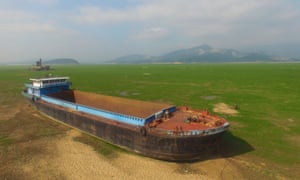
A boat is stranded on the Poyang Lake in east China, site of one of the world’s biggest sand mines. Photograph: Xinhua/Barcroft Images
The Guardian, Vince Beiser Monday 27 February 2017 02.15 EST
Times are good for Fey Wei Dong. A genial, middle-aged businessman based near Shanghai, China, Fey says he is raking in the equivalent of £180,000 a year from trading in the humblest of commodities: sand.
Fey often works in a fishing village on Poyang Lake, China’s biggest freshwater lake and a haven for millions of migratory birds and several endangered species. The village is little more than a tiny collection of ramshackle houses and battered wooden docks. It is dwarfed by a flotilla anchored just offshore, of colossal dredges and barges, hulking metal flatboats with cranes jutting from their decks. Fey comes here regularly to buy boatloads of raw sand dredged from Poyang’s bottom. He ships it 300 miles down the Yangtze River and resells it to builders in booming Shanghai who need it to make concrete.
The demand is voracious. The global urbanisation boom is devouring colossal amounts of sand – the key ingredient of concrete and asphalt. Shanghai, China’s financial centre, has exploded in the last 20 years. The city has added 7 million new residents since 2000, raising its population to more than 23 million. In the last decade, Shanghai has built more high-rises than there are in all of New York City, as well as countless miles of roads and other infrastructure. “My sand helped build Shanghai Pudong airport,” Fey brags. Tiếp tục đọc “Sand mining: the global environmental crisis you’ve probably never heard of”→






 CVD
CVD 