Fast and dubious: How electric cars are tiring the Mekong – Xe điện phát triển nóng đang bào mòn Mê Kông

mekongeye.com

This five-part series explores how the acceleration of electric vehicle adoption could increase the demand for rubber—a commodity that has historically driven deforestation and land grabbing across the Mekong region. Experts say the EV transition will boost rubber demand, as EVs need specialized tires that can bear heavier vehicle weight and high torque.

This matters to the Mekong region. Our data analysis shows that Cambodia, Laos, Myanmar, Thailand, and Viet Nam together supply nearly 50% of the world’s natural rubber. About 70% of global rubber goes into tires. Without effective traceability in place, deforestation and land conflicts, many of which are ongoing and affecting the lives and livelihoods of local communities—are unlikely to be solved.

Story by Mekong Eye’s investigation team
This series was produced in partnership with Earth Journalism Network and the Pulitzer Center

Electric vehicles (EVs) are on the rise — from Bangkok to Hanoi to Vientiane — promising a cleaner future as part of the global shift to clean energy, with more than 17 million electric cars sold worldwide in 2024.

But there is still a cost to pay for these ‘green cars’. With their heavier battery weight and higher torque, EVs wear out their tires faster than gasoline-powered cars, and therefore consume more tires throughout their lifetime.

In every tire is natural rubber, the key raw material that ensures durability, elasticity and strength.

The growing demand for EV tires has had significant implications for the Mekong region — Cambodia, Laos, Myanmar, Thailand and Viet Nam — which produces about 50% of the world’s natural rubber and hosts major plants for multinational tire manufacturers and EV makers.
Tiếp tục đọc “Fast and dubious: How electric cars are tiring the Mekong – Xe điện phát triển nóng đang bào mòn Mê Kông”

Despite reforms, mining for EV metals in Congo exacts steep cost on workers

washingtonpost.com
After revelations of child labor and treacherous conditions in many cobalt mines, automakers and mineral companies said they would adhere to international safety standards

The Shabara artisanal mine, where cobalt and copper are dug out by hand, near the Congolese boomtown of Kolwezi.

By Katharine Houreld and  Arlette Bashizi

Aug. 4 at 5:00 p.m.

Correspondent Katharine Houreld and photographer Arlette Bashizi traveled together across southeastern Congo, visiting industrial and artisanal mines in the country’s three largest cobalt mining towns. Houreld is The Washington Post’s East Africa bureau chief, based in Nairobi, with responsibilities stretching from the Horn of Africa to the continent’s southern tip. Bashizi is a Congolese photographer, based in Goma, focusing on issues related to health, environment and culture.

FUNGURUME, Democratic Republic of Congo — Alain Kasongo, burly and goateed, worked for four years driving the heavy trucks that hauled away tons of cobalt ore from a gaping hole at one of the biggest mines in Congo. The vibrations from the equipment and the jolts of driving over rough ground during his 12-hour shifts could be bone-rattling, he said. Finally, the pain in his spine grew so unbearable that he needed surgery.

His older brother, Patchou Kasongo Mutuka, worked the same job at the same mine. He suffered the same injury and required the same surgery — as did 13 other drivers of excavators and trucks at the mine who were interviewed. They lifted their shirts to reveal surgical scars and spread out carefully folded medical records confirming their accounts. They in turn named seven more colleagues who had suffered the same fate, all within a two-year period.

“It hurt so badly when I went home, I would lie awake at night,” said Alain Kasongo, 43, displaying bumps and ridges on his body from what he said were three operations.

Tiếp tục đọc “Despite reforms, mining for EV metals in Congo exacts steep cost on workers”

Competitive market key to expanding Electric Vehicle charging network

renewableenergymagazine.com

Electric vehicle (EV) charging stations will better serve EV owners if lawmakers and regulators enable a level playing field for competitive providers, concludes a new report entitled “Serving Customers Best: The Benefits of Competitive Electric Vehicle Charging Stations.”

New report finds competitive market key to expanding EV charging network

Courtesy of Ernest Ojeh, Unsplash.

The 52-page report addresses a key aspect of the clean energy transition, finding that utility ownership of EV charging stations is generally not in the public interest and that allowing monopoly utilities to own charging stations will deliver less efficient, lower-quality service and choice to EV owners. This will result in unfair cost shifting to other electricity consumers.

“Regulators and legislators will serve the EV charging public best if they provide for a competitive and nondiscriminatory environment for public charging stations” said Rob Gramlich, President of Grid Strategies and one of the four co-authors of the study. “We should enable the market to work if we want to build-out EV charging infrastructure and give drivers the best prices and services possible along the way.”

The report stresses that extending the monopoly position of utilities into the EV charging sector would hurt the EV charging public and, by extension, the overall effort to electrify transportation.

Frank Lacey, a co-author, emphasises a key finding in the study: “Regulators should proclaim EV charging to be a competitive service and then focus on policies to support the development of the charging network. Competition in charging will lead to the best results for the build-out of EV charging, for consumer pricing of electricity, and for service of EV drivers. The time to make these policy choices is now, before charging becomes monopolised.”

The report makes the following recommendations:

Regulated Rate Policies – Regulators need to consider the impact of regulated rates and rate design on EV charging stations and station owners.

Utility Ownership – Regulators should ban or disfavor utility ownership of charging stations.

Distribution Planning – Regulators should support an increased focus on planning using state-of-the-art tools and should allow for proactive, rather than reactive, development of the distribution systems.

Interconnection Policies – Regulators should support the development of dedicated interconnection personnel, work with utilities to standardise and streamline timelines and processes, allow more flexible policies with respect to inventory and supply chain issues, and ensure that nonutility owners of charging stations receive fair and equal service from the utility when developing charging stations.

Private Sector Access – Regulators should work with utilities to develop, train, and certify third parties to work with private investors to build out the distribution network, where feasible.

Cost Allocation – Regulators should create cost-allocation policies fair to all parties to recover the costs of developing the infrastructure required for robust EV charging.

Meeting Public Need at the Lowest Cost – If a public need arises, regulators should look for solutions other than a utility to meet the need.

Divestiture of utility-owned charging stations – Regulators should have utilities sell any utility-owned EV charging stations to nonutility entities.

The report was sponsored by the National Association of Convenience Stores (NACS), which represents a business sector with considerable investment in robust distribution and service networks designed to meet the motoring public’s needs. Convenience stores sell an estimated 80 percent of the fuels purchased by drivers.

For additional information:

Grid Strategies

Report: “Serving Customers Best: The Benefits of Competitive Electric Vehicle Charging Stations.”

Why Investors Should Consider Vietnam’s Electric Vehicle Market

 June 29, 2021 Posted byVietnam Briefing Written byPritesh Samuel Reading Time:6 minutes

  • Vietnam’s electric vehicle market remains in its infancy, but there are plenty of opportunities as we are likely to see a paradigm shift from gasoline to electric-powered vehicles.
  • With a rising population and an expanding middle class, consumers are increasingly aware of the environment, fuel efficiency, and increasing pollution levels in cities.
  • Vietnam Briefing outlines the opportunities in Vietnam’s electric vehicle market despite the slow progress till date.

The electric vehicle market in Vietnam has not garnered as much attention compared to other countries in the region and globally, but this doesn’t mean that opportunities are not there. Electric vehicles are an irreversible trend and will be the future as governments move towards clean energy and consider the environment. This means that investors that are interested can set up the groundwork including production facilities, supply chains, and manpower to prepare for this future shift.

With a population of more than 96 million, about half of Vietnam’s population owns motorcycles, while car ownership is at a ratio of 23 per 1,000 people. Major cities such as Hanoi and Ho Chi Minh City are gridlocked with motorbikes on streets, alleys, and even sidewalks. This in turn has resulted in increased pollution and congestion. Hanoi and Ho Chi Minh City have ranked high in pollution levels globally several times. A poll by IQAir listed Vietnam as the 15th most polluted country in the world.

Tiếp tục đọc “Why Investors Should Consider Vietnam’s Electric Vehicle Market”

Top 10 Priorities for President Biden to Tackle the Climate Crisis

WRI.org

Former U.S. Vice President Joseph R. Biden and his running mate Kamala Harris are widely recognized as having won the 2020 U.S. presidential election, with a majority in the Electoral College and a resounding majority in the popular vote. The Democratic Party has retained control of the U.S. House of Representatives, while the results for the U.S. Senate are very close and the outcome is undetermined at this time. In this WRI Commentary, WRI U.S. Director Dan Lashof suggests a 10-point plan for the new administration.


DOWNLOAD

President-elect Biden will be sworn into office in the midst of four deeply intertwined crises: the health crisis, the economic crisis, the racial injustice crisis and the climate crisis. He has promised to build back better by taking bold action on all four simultaneously, including making unprecedented investments in health care, infrastructure and clean energy.
Tiếp tục đọc “Top 10 Priorities for President Biden to Tackle the Climate Crisis”

Global energy storage market to surge to 15 GW by 2024

Tiếp tục đọc “Global energy storage market to surge to 15 GW by 2024”

Quá trình tái chế đơn giản, hiệu quả năng lượng cho pin Lithium-Ion

&English: Simple, Energy-Efficient Recycling Process for Lithium-Ion Batteries

Có một quá trình tái chế mới chỉ cần một nửa năng lượng so với kỹ thuật thông thường và sản xuất những vật liệu âm cực sẵn sàng để sử dụng.

Một quá trình tái chế mới đơn giản phục hồi cực âm của pin lithium cũ chỉ sử dụng một nửa năng lượng của quá trình tái chế hiện tại. Không giống như những phương pháp tái chế hiện nay, phá vỡ cực âm thành những phần tử riêng biệt mà rồi lại cần ghép chúng lại một lần nữa, công nghệ mới tạo ra hợp chất mà đã sẵn sàng để đi vào một cục pin mới.

Phương pháp này sử dụng được trong pin lithium coban oxit dung trong máy tính xách tay và điện thoại thông minh, và trong pin phức hợp lithium-niken-mangan-coban có trong xe điện. Tiếp tục đọc “Quá trình tái chế đơn giản, hiệu quả năng lượng cho pin Lithium-Ion”

How Internal Combustion Engines Will Die Out in Eurasia

Did You Know – The First Cars Were Electric? Những chiếc ô tô đầu tiên là xe điện – Lịch sử xe điện

PBS.org

Timeline: History of the Electric Car

1832-1839
Scottish inventor Robert Anderson invents the first crude electric carriage powered by non-rechargeable primary cells.

1835
American Thomas Davenport is credited with building the first practical electric vehicle — a small locomotive.

1859
French physicist Gaston Planté invents the rechargeable lead-acid storage battery. In 1881, his countryman Camille Faure will improve the storage battery’s ability to supply current and invent the basic lead-acid battery used in automobiles. Tiếp tục đọc “Did You Know – The First Cars Were Electric? Những chiếc ô tô đầu tiên là xe điện – Lịch sử xe điện”

Carmakers and big tech struggle to keep batteries free from child labor

Car and tech companies are scrambling for supplies of cobalt, a mineral they need to power electric vehicles and smartphones. But they have a problem: Much of the cobalt used in lithium-ion batteries comes from a country where children work in mines.

Is there such a thing as an ethical electric car?

A CNN investigation has found that child labor is still being used to mine the valuable mineral at some operations in the Democratic Republic of Congo (DRC). This country produces about two-thirds of the world’s cobalt and is estimated to sit atop half of the globe’s reserves.

Tiếp tục đọc “Carmakers and big tech struggle to keep batteries free from child labor”

Mines Linked to Child Labor Are Thriving in Rush for Car Batteries

bloomberg.com

Tom Wilson and Jack Farchy

https://www.bloomberg.com/api/embed/iframe?id=eb78dae4-3892-4fd7-8793-9db6c721238e

The appetite for electric cars is driving a boom in small-scale cobalt production in the Democratic Republic of Congo, where some mines have been found to be dangerous and employ child labor.

Production from so-called artisanal mines probably rose by at least half last year, according to the estimates of officials at three of the biggest international suppliers of the metal, who asked not to be named because they’re not authorized to speak on the matter. State-owned miner Gecamines estimates artisanal output accounted for as much as a quarter of the country’s total production in 2017. Tiếp tục đọc “Mines Linked to Child Labor Are Thriving in Rush for Car Batteries”

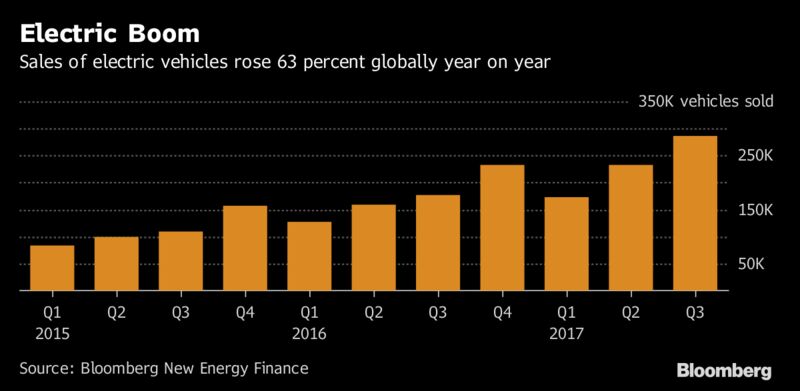
Global Electric Car Sales Jump 63 %

  • China made more than half of EV purchases in the third quarter
  • Bloomberg New Energy Finance expects 1 million sold this year

Electric vehicles sales surged to a record in the third quarter, largely driven by strong demand in China.

Sales of battery electric vehicles and plug-in hybrids exceeded 287,000 units in the three months ended in September, 63 percent higher than the same quarter a year ago and up 23 percent from the second quarter, according to a report released Tuesday by Bloomberg New Energy Finance. China accounted for more than half of global sales as its market for electric cars doubled amid government efforts to curb pollution.

“The Chinese government is very focused on pushing up EV sales,” said Aleksandra O’Donovan, advanced transport analyst at BNEF and one of the authors of the report. “One reason for that is the local pollution levels in the cities, and a second is for China to build domestic heroes to compete internationally in this market.”

BNEF expects global EV sales to surpass 1 million units this year for the first time. The market for electrified transport is starting to pick up speed as charging infrastructure becomes more accessible and manufacturers roll out models with longer driving ranges. In 2017, many established carmakers from Jaguar Land Rover to Volvo Cars announced plans to bring electric versions of their vehicles to market in the next few years. Tiếp tục đọc “Global Electric Car Sales Jump 63 %”

Battery swapping can propel India’s electric car revolution

Published on Monday, 23 October 2017

Motorists can charge their vehicles automatically in less than a minute with the battery-swapping system.

adb.org_Imagine you’re buying a car, and the manufacturer forces you to purchase not only the vehicle itself but also demanded you pay upfront for 10 years worth of fuel. About $25,000 for the car and another $50,000 for the gas. Would you still purchase the car? Absolutely not, unless the gasoline was given at a discount price, right?

Anyone shopping for an electric car could be forgiven for thinking that manufacturers are asking to pay upfront for future energy use. These vehicles are still on average about 35% more expensive than non-electric cars – despite gradually declining battery prices and the promise of practically zero maintenance fees. Tiếp tục đọc “Battery swapping can propel India’s electric car revolution”