Author Mehebub SahanaLeverhulme Early Career Fellow, Geography, University of Manchester
China recently approved the construction of the world’s largest hydropower dam, across the Yarlung Tsangpo river in Tibet. When fully up and running, it will be the world’s largest power plant – by some distance.
Yet many are worried the dam will displace local people and cause huge environmental disruption. This is particularly the case in the downstream nations of India and Bangladesh, where that same river is known as the Brahmaputra.
The proposed dam highlights some of the geopolitical issues raised by rivers that cross international borders. Who owns the river itself, and who has the right to use its water? Do countries have obligations not to pollute shared rivers, or to keep their shipping lanes open? And when a drop of rain falls on a mountain, do farmers in a different country thousands of miles downstream have a claim to use it? Ultimately, we still don’t know enough about these questions of river rights and ownership to settle disputes easily.
The Yarlung Tsangpo begins on the Tibetan Plateau, in a region sometimes referred to as the world’s third pole as its glaciers contain the largest stores of ice outside of the Arctic and Antarctica. A series of huge rivers tumble down from the plateau and spread across south and south-east Asia. Well over a billion people depend on them, from Pakistan to Vietnam.
Escalating construction costs, the rise of solar and wind power, and mounting public opposition have led to a precipitous decrease in massive new hydropower projects. Experts say the world has hit “peak dams,” which conservationists hail as good news for riverine ecosystems.
Numerous recently published reports reflect this planet-altering fact. One study, conducted by scholars at the United Nations University’s Institute for Water, Environment and Health, found that construction of large dams globally fell from a late-1970s peak of about 1,500 a year to around 50 a year in 2020. “There will not be another ‘dam revolution’ to match the scale of the high-intensity dam construction experienced in the early to middle 20th century,” the 2021 study concluded.
Data compiled by the International Renewable Energy Agency (IRENA), an intergovernmental organization that promotes renewable energy, including hydropower, show that in the 21st century, newly installed hydropower capacity peaked in 2013 at 45,000 megawatts a year and then dropped every year but one through 2021, when it reached only 18,900 megawatts. Similarly, investments in new hydropower dropped from a peak of $26 billion in 2017 to an estimated $8 billion in 2022, according to IRENA.
Dam building in China declined sharply around 2015 and has stagnated ever since.
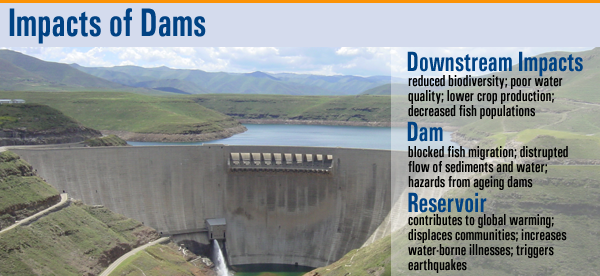
Earthquakes can be induced by dams. Globally, there are over 100 identified cases of earthquakes that scientists believe were triggered by reservoirs (see Gupta 2002). The most serious case may be the 7.9-magnitude Sichuan earthquake in May 2008, which killed an estimated 80,000 people and has been linked to the construction of the Zipingpu Dam.
How Do Dams Trigger Earthquakes?
In a paper prepared for the World Commission on Dams, Dr. V. P Jauhari wrote the following about this phenomenon, known as Reservoir-Induced Seismicity (RIS): “The most widely accepted explanation of how dams cause earthquakes is related to the extra water pressure created in the micro-cracks and fissures in the ground under and near a reservoir. When the pressure of the water in the rocks increases, it acts to lubricate faults which are already under tectonic strain, but are prevented from slipping by the friction of the rock surfaces.”
Given that every dam site has unique geological characteristics, it is not possible to accurately predict when and where earthquakes will occur. However, the International Commission on Large Dams recommends that RIS should be considered for reservoirs deeper than 100 meters.
Depth of the reservoir is the most important factor, but the volume of water also plays a significant role in triggering earthquakes.
RIS can be immediately noticed during filling periods of reservoirs.
RIS can happen immediately after the filling of a reservoir or after a certain time lag.
Many dams are being built in seismically active regions, including the Himalayas, Southwest China, Iran, Turkey, and Chile (see map). International Rivers calls for a moratorium on the construction of high dams in earthquake-prone areas.
By 2015, the dam industry had choked more than half of the Earth’s major rivers with some 57,000 large dams. The consequences of this massive engineering program have been devastating. The world’s large dams have wiped out species; flooded huge areas of wetlands, forests and farmlands; and displaced tens of millions of people.
Courtesy of James Syvitski at Colorado University, who produced the video with Bob Stallard of the USGS and Albert Kettner at CSDMS. Data from Alex de Sherbinin (CIESIN, University of Colorado), and Bernhard Lehner (Department of Geography, McGill University).
The “one-size-fits-all” approach to meeting the world’s water and energy needs is also outdated: better solutions exist. While not every dam causes huge problems, cumulatively the world’s large dams have replumbed rivers in a massive experiment that has left the planet’s freshwaters in far worse shape than any other major ecosystem type, including tropical rainforests. In response, dam-affected communities in many parts of the world are working to resolve the legacies of poorly planned dams. Elsewhere (and especially in North America), communities are starting to take down dams that have outlived their usefulness, as part of a broader river restoration movement.
Chỉ một phần ba trong số 242 con sông dài nhất thế giới vẫn có dòng chảy không gián đoạn suốt chiều dài, đa số các con sông không gián đoạn nằm ở những vùng hẻo lánh ở Bắc Cực, lưu vực sông Amazon, và lưu vực sông Congo, theo như một nghiên cứu sắp xuất bản trên tạp chí Nature.
Nhóm chuyên gia quốc tế thực hiện nghiên cứu này, dẫn đầu bởi Gunther Grill thuộc ĐH McGill (Canada) xác định rằng trong số 91 con sông có chiều dài hơn 1000 ki-lô-mét (khoảng 600 dặm) đổ ra biển, chỉ còn 21 dòng vẫn có dòng chảy không bị cản trở từ thượng nguồn ra đến biển.
Các con đập và những hồ đập chứa nước là nguyên nhân lớn nhất cản trở dòng chảy của sông, các nhà nghiên cứu tuyên bố. Hiện tại trên thế giới đã có gần 60000 đập lớn, và có đến 3700 đập thủy điện lớn nữa đang trong quá trình lên kế hoạch hoặc đang xây dựng.
Những con sông khỏe mạnh mang lại nhiều lợi ích cho con người, từ hoạt động vui chơi đến đảm bảo lương thực. Đảm bảo sự liên kết của những con sông tự do còn lại trên thế giới cũng mang tính tối quan trọng để bảo tồn đa dạng sinh học của những hệ thống nước ngọt.

 CVD
CVD 