Find more statistics at Statista
Monthly number of ransomware victims worldwide from January 2023 to November 2024

Find more statistics at Statista
Conversations on Vietnam Development

TĐH: Traditional cybersecurity strategies are no longer sufficient for today’s cyberwar. The Zero Trust strategy is a new concept in cyberwar. To help understand this concept, I post here a paper by the US Department of Defense entitle “DOD Zero Trust Strategy.” This concept will involve not just DOD or military institutions, but also many private enterprises and individuals. Indeed, it involves the entire nation. I select the DOD presentation to post because, by nature of its job, DOD is probaly concerned about cybersecurity more than anyone else. Below is the Foreword of the DOD paper.
DOD ZERO TRUST STRATEGY
Foreword
Our adversaries are in our networks, exfiltrating our data, and exploiting the Department’s users. The rapid growth of these offensive threats emphasizes the need for the Department of Defense (DoD) to adapt and significantly improve our deterrence strategies and cybersecurity implementations. Defending DoD networks with high-powered and ever-more sophisticated perimeter defenses is no longer sufficient for achieving cyber resiliency and securing our information
enterprise that spans geographic borders, interfaces with external partners, and support to millions of authorized users, many of which now require access to DoD networks outside traditional boundaries, such as work from home. To meet these challenges, the DoD requires an enhanced cybersecurity framework built upon Zero Trust principles that must be adopted across the Department, enterprise-wide, as quickly as possible as described within this document.
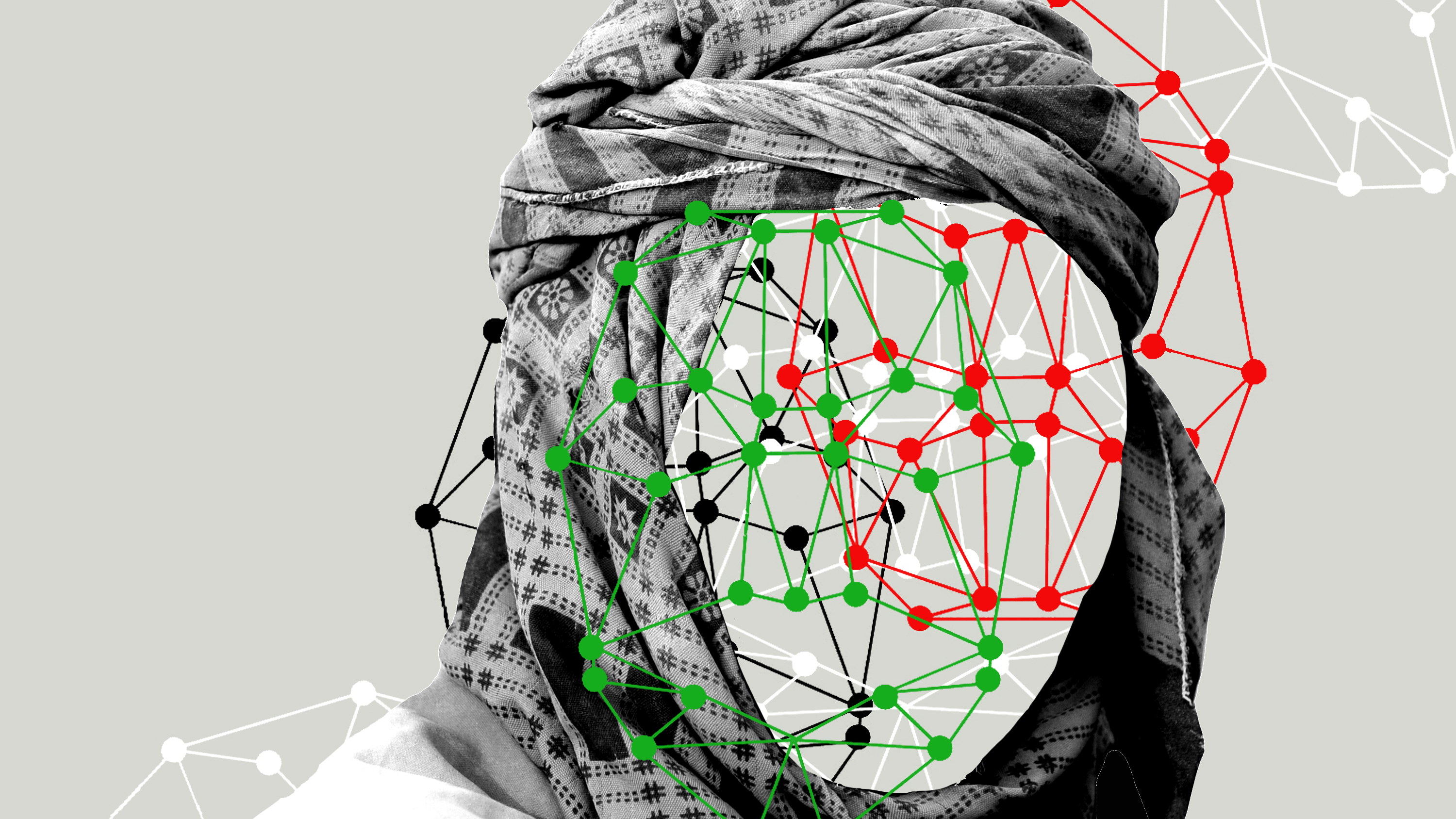
By capturing 40 pieces of data per person—from iris scans and family links to their favorite fruit—a system meant to cut fraud in the Afghan security forces may actually aid the Taliban.By
August 30, 2021
ANDREA DAQUINO
As the Taliban swept through Afghanistan in mid-August, declaring the end of two decades of war, reports quickly circulated that they had also captured US military biometric devices used to collect data such as iris scans, fingerprints, and facial images. Some feared that the machines, known as HIIDE, could be used to help identify Afghans who had supported coalition forces.
According to experts speaking to MIT Technology Review, however, these devices actually provide only limited access to biometric data, which is held remotely on secure servers. But our reporting shows that there is a greater threat from Afghan government databases containing sensitive personal information that could be used to identify millions of people around the country.
MIT Technology Review spoke to two individuals familiar with one of these systems, a US-funded database known as APPS, the Afghan Personnel and Pay System. Used by both the Afghan Ministry of Interior and the Ministry of Defense to pay the national army and police, it is arguably the most sensitive system of its kind in the country, going into extreme levels of detail about security personnel and their extended networks. We granted the sources anonymity to protect them against potential reprisals.
Tiếp tục đọc “This is the real story of the Afghan biometric databases abandoned to the Taliban”
By Nguyễn Vũ 3/8/2019, 06:36
|
English: Massive cyberattack targeting 99 countries causes sweeping havoc 13.05.2017 – Bệnh viện, các công ty lớn và các văn phòng chính phủ vừa bị đánh bởi đợt tấn công mạng khổng lồ trên toàn cầu, bị kiểm soát máy tính cho đến khi các nạn nhân trả một khoản tiền chuộc.
Công ty an ninh mạng Avast cho biết họ đã xác định hơn 75.000 cuộc tấn công của ransomware (phần mềm tống tiền) ở 99 quốc gia, khiến nó trở thành một trong những cuộc tấn công mạng lớn nhất và gây hại nhất trong lịch sử thế giới. Avast nói phần lớn các cuộc tấn công nhắm vào Nga, Ukraine và Đài Loan. Nhưng các bệnh viện ở U.K., các trường đại học Trung Quốc và các công ty toàn cầu như Fedex (FDX) cũng báo cáo rằng họ đã bị tấn công. |
The wave of cyberattacks wreaking havoc across the globe is “at an unprecedented level”, European Union’s law enforcement agency Europol said.
The attacks will “require a complex international investigation to identify the culprits”, the agency, which is working with countries and companies hit by the attacks, said in a statement on Saturday.
Dozens of countries were hit by the ransomware attack on Friday that locked up computers and held users’ files for ransom at a multitude of hospitals, companies and government agencies.
It was believed to the biggest attack of its kind ever recorded. Tiếp tục đọc “Europol: Ransomware attack is of unprecedented level”
English: 6 tips to debunk fake news stories by yourself
“Dưới đây là danh sách các cách để bạn có thể tự phát hiện những tin giả mạo mà dành cho người nghiệp dư hay các nhà báo chưa được đào tạo về kỹ năng kiểm tra xác minh hay kiểm tra sự thực.”
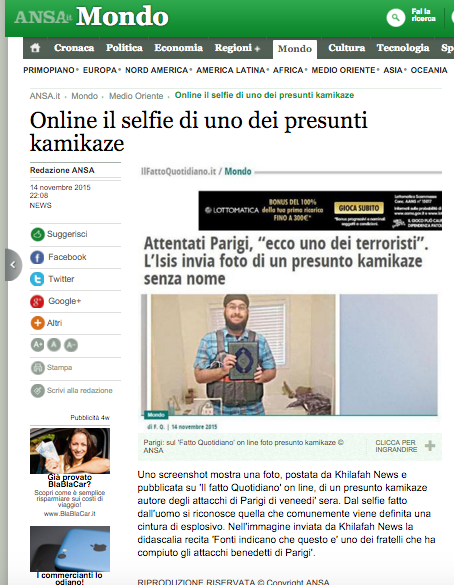
Việc tìm kiếm sự thật bắt đầu vào thời điểm khi ngày càng có nhiều vụ nổi lên từ việc các kênh truyền thông lâu năm bị đánh lừa về vụ tấn công tại Paris.
Ví dụ kỳ quái nhất có lẽ là bức ảnh với nụ cười lớn của Veerender Jubbal, một người đàn ông theo đạo Sikh sống ở Canada, gắn trong bộ trang phục trong một bức ảnh của một kẻ cầm đầu các cuộc tấn công. Ảnh chụp trên trang nhất của La Razón ở Tây Ban Nha, được thực hiện tại Ý bởi hãng tin ANSA và Sky TG24. Vào thời điểm viết bài này, chín ngày sau đó, bức ảnh giả mạo vẫn còn ở trên tài khoản Twitter của Sky TG24, mà có gần 2 triệu người theo dõi và 2 triệu người chuyển đi
 CVD
CVD