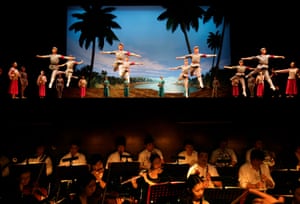
Chinese ballet show draws protests for ‘glorifying Red Army’

Minister says staging The Red Detachment of Women is a privilege but protest organiser says government needs to understand what the story is about

Red Detachment of Women
A performance of The Red Detachment of Women in Tianjin, China. Photograph: Jason Lee/Reuters

@naamanzhou

Protesters in Melbourne have called for a boycott of a visiting Chinese ballet performance that they say “glorifies the Red Army”.

The National Ballet of China is performing The Red Detachment of Women, created in 1964, , at the Arts Centre in Melbourne.

The state minister for creative industry, Martin Foley, said staging the ballet was a “privilege”, but protest organiser Frank Ruan described it as “like putting salt on the wounds of some Chinese people”. Tiếp tục đọc “Chinese ballet show draws protests for ‘glorifying Red Army’”

Cách mạng dưới lòng đất: vấn đề mai táng và chôn cất ở châu Á

English:  Underground revolution: Asia’s grave problem

Để giải quyết vấn đề thiếu đất, nhiều quốc gia châu Á đã khuyến khích “mai táng sinh thái” bao gồm quá trình hoả thiêu. Nhưng xét đến các tác động môi trường của việc hoả thiêu, lợi ích đạt được nhiều nhất có lẽ cũng chỉ là tạm thời

Các ngôi mộ lớn, công phu nhưu thế này ở Trung Quốc là một biểu tượng của lòng hiếu thảo và kính trọng tổ tiên, nhưng cái giá phải trả cho vấn đề môi trường là bao nhiêu? Tiếp tục đọc “Cách mạng dưới lòng đất: vấn đề mai táng và chôn cất ở châu Á”

Underground revolution: Asia’s grave problem

To solve land shortages, many Asian countries have encouraged “eco-burials” that involve the cremation process. But considering the environmental effects of cremation, the benefits may be short-term at best.

Tiếp tục đọc “Underground revolution: Asia’s grave problem”

Colonial Mentality: A Filipino Heritage?

Một bài viết rất thú vị về tâm lý thuộc địa của người Phillipines. Trong cùng một bối cảnh của bài viết, nếu thay người Phillipines thành người Việt Nam, chúng ta sẽ thấy rất nhiều điểm tương đồng trong tâm lý thuộc địa của người Phillipines, người Việt Nam và các nước thuộc địa khác như thế nào?


This is a very interesting article. In the same context, if we replace the Filipinos by the Vietnamese, we’ll see many similarities in the colonial mentality of the Filipinos, of the Vietnamese and other colonial countries.

ĐTH

——————————————————————————————————–

by: Maris Cay E. Garbones

“Tangkilikin ang saraling atin,” (Patronize what is ours), we hear this statement spoken quite often. Cliché as it may sound but Filipinos do not live by it.

Skechers, Havaianas, Converse and Crocs’ sales in the Philippines reach hundred millions a year while the Marikina Shoe industry remains an underdog. A kid prefers to eat Hershey’s Kisses rather than enjoy Goya chocolate. The Hunger Games and other Hollywood films attract more audiences than Ang Babae sa Septic Tank and other Filipino movies. The current trend in the Philippines is very far from what former President Carlos P. Garcia had envisioned when he initiated the Filipino First Policy during his administration. The program’s main objective was to free the Philippine economy from foreign control and supervision. Although there are Filipinos who try to follow the path of nationalism that Jose Rizal and other heroes had taken, there are more who are driven by colonial mentality. Tiếp tục đọc “Colonial Mentality: A Filipino Heritage?”

Sexuality Education

UNESCO

https://i0.wp.com/www.unesco.org/new/fileadmin/MULTIMEDIA/HQ/HIV-AIDS/images/teacher_sex_education.haiti.amelia.shaw_photoshare.jpg

Comprehensive Sexuality Education (CSE) is an age-appropriate, culturally relevant approach to teaching about sex and relationships by providing scientifically accurate, realistic, non-judgemental information. Sexuality education provides opportunities to explore one’s own values and attitudes and to build decision-making, communication and risk reduction skills about many aspects of sexuality.   Tiếp tục đọc “Sexuality Education”

Background on Southeast Asian Parenting: Helping Youth Succeed: Bicultural Parenting for Southeast Asian Families

University of Minnesota – Extension  

Background on Southeast Asian Parenting

Daniel Detzner, College of Human Ecology, University of Minnesota; Blong Xiong, College of Human Ecology, University of Minnesota; Patricia A. Eliason, General College, University of Minnesota

Reviewed April 2010 by the author (Daniel Detzner).

Eastern Values and Beliefs

To understand Southeast Asian parenting and chlld-rearing practices, we must first understand the cultural values and beliefs that influence parents, especially regarding family life and interpersonal relationships.

Traditionally, Southeast Asians tend to have a large extended family, usually up to three or four generations living together (Vandeusen et al., 1980). Nuclear families typically have four to eight children, depending on socioeconomic status and ethnic group. Tiếp tục đọc “Background on Southeast Asian Parenting: Helping Youth Succeed: Bicultural Parenting for Southeast Asian Families”