|
Thẻ: CSIS
2015 South China Sea Developments: A Five Minute Guide
cogitASIA • July 15, 2015
By Emily Chen
The CSIS Freeman Chair in China Studies has prepared a timeline summarizing security developments in the South China Sea during the first half of 2015. The included chronology and infographic covers events through July 15, 2015 and provides a short assessment of present power projection capabilities among the relevant countries. Tiếp tục đọc “2015 South China Sea Developments: A Five Minute Guide”
CSIS – Southeast Asia from Scott Circle – July 9, 2015

Battle over Myanmar Constitution Caught Washington in its Crossfire
By Phuong Nguyen (@PNguyen_DC), Research Associate, Sumitro Chair for Southeast Asia Studies (@SoutheastAsiaDC), CSIS
July 9, 2015
Myanmar’s union parliament on June 25 voted to reject five of six major amendments to the 2008, military-drafted constitution, in a decision that has critical implications for Myanmar’s political landscape and puts U.S. policymakers in a delicate position. Tiếp tục đọc “CSIS – Southeast Asia from Scott Circle – July 9, 2015”
CSIS: AMTI Brief – July 2, 2015
AMTI Brief – July 2, 2015

S&ED Analysis plus New Spratly Imagery
This week, AMTI has released exclusive new imagery of ongoing facility construction at Johnson South Reef and Fiery Cross Reef in the Spratly Islands. With the conclusion of the U.S.-China Strategic and Economic Dialogue last week, AMTI has also released a video interview with CSIS Senior Adviser Bonnie Glaser explaining the significance and the takeaways from this meeting. Finally, AMTI has released updated sizes for all China’s reclaimed features.

Expert Analysis
Tiếp tục đọc “CSIS: AMTI Brief – July 2, 2015”
CSIS: Southeast Asia from Scott Circle – June 25th, 2015
|
Diplomacy changes, construction continues: New images of Mischief and Subi Reefs


amti.csis – On June 16, 2015, China’s Foreign Ministry spokesman Lu Kang announced that “as planned, the land reclamation project of China’s construction on some stationed islands and reefs of the Nansha (Spratly) Islands will be completed in the upcoming days.” He went on to note that after land reclamation on existing features was complete, China would continue to construct facilities on its new islands. As of June 17, AMTI assesses that two of China’s land reclamation projects are fully complete, three are nearly complete, and two are ongoing, with active land reclamation still taking place. The map below shows the current status of China’s Spratly building projects.
Tiếp tục đọc “Diplomacy changes, construction continues: New images of Mischief and Subi Reefs”
China’s land reclamation announcement: A change in message, not in policy


June 17, 2015
Q1: What has China announced about its land reclamation activities in the Spratly Islands?
A1: On June 16, China’s Foreign Ministry spokesperson Lu Kang announcedthat “as planned, the land reclamation project of China’s construction on some stationed islands and reefs of the Nansha (Spratly) Islands will be completed in the upcoming days.” He noted that after land reclamation was complete, China would continue to construct facilities on its islands.
Kang indicated that China’s position on its island building remained largely consistent. He reiterated that “the construction activities on the Nansha islands and reefs fall within the scope of China’s sovereignty, and are lawful, reasonable, and justified.” Kang also restated that the artificial islands have defense purposes, as well as civilian purposes, including search and rescue, scientific research, ecological conservation, and fishing. Kang declined to offerspecific details on which islands were close to complete. Tiếp tục đọc “China’s land reclamation announcement: A change in message, not in policy”
Massive island-building and international law


AMTI. CSIS – Within the short span of a year, China’s rapid construction of artificial islands in the disputed Spratlys has radically changed the geographical and security landscapes in the South China Sea.
This island construction has so far created over eight million square metres of real estate in the open sea, outstripping other countries’ reclamation activities by far, and shows no sign of abating. Hundreds of millions of tons of sand and coral have been dredged from the seabed and dumped atop fragile coral reefs that are vital components of the maritime ecology. Marine experts expect that the work has already caused disastrous and essentially irreversible environmental impacts. Tiếp tục đọc “Massive island-building and international law”
Southeast Asia’s Geopolitical Centrality and the U.S.-Japan Alliance

JUN 11, 2015
CSIS – Building on a careful analysis of Southeast Asia’s recent history, politics, economics, and place within the Asia Pacific, this report looks forward two decades to anticipate the development of trends in the region and how they will impact the U.S.-Japan alliance. How will Southeast Asian states come to grips with the political and economic rise of China? How will they modernize their military forces and security relationships, and what role can the United States and Japan play? How will they manage their disputes in the South China Sea, and how will they pursue greater regional integration? These questions will prove critical in understanding Southeast Asia’s role in the Asia Pacific, and in the U.S.-Japan alliance, in the decades ahead.
Publisher CSIS/Rowman & Littlefield
ISBN 978-1-4422-4086-5 (pb); 978-1-4422-4087-2 (eBook)
Retreat or Revivial: A Status Report on Democracy in Asia
-
Thursday, June 11, 2015

-
Murray Hiebert, CSIS deputy director and senior fellow, Sumitro Chair for Southeast Asia Studies, testifies before the House Committee on Foreign Affairs, Subcommittee on Asia and the Pacific on “Retreat or Revivial: A Status Report on Democracy in Asia.”

Civil society activist beaten by plainclothes police officers; prominent blogger released
CSIS
Civil society activist beaten by plainclothes police officers; prominent blogger released. Civil society activist Pham Thanh Nghien was beaten by plainclothes police officers on June 2 in front of her home outside Hanoi. Blogger Nguyen Ngoc Nhu Quynh, who was traveling to Nghien’s home with two other bloggers for a meeting, said that plainclothes police officers beat Nghien in order to force Quynh and the other bloggers to leave, according to Radio Free Asia. Separately, authorities on May 26 released well-known blogger Truong Duy Nhat, who was sentenced to two years in jail for “abusing democratic freedoms.”
Australia Has a Larger Role to Play in the South China Sea
by Gregory Poling • June 4, 2015

Both the tone and substance of South China Sea discussions in Australian policy circles has undergone an important shift in recent months. What was previously a second-tier security concern to be watched closely and engaged diplomatically, but at a safe distance, has become a heated discussion about concrete responses. Australian policymakers are as concerned as anyone about China’s breakneck land reclamation in the Spratly Islands and the threats, both legal and military, they pose to the global commons. Australian officials and thinkers are seriously considering options to contest Chinese assertiveness, in tandem with the United States and other partners, which would have seemed distant possibilities a year ago. Tiếp tục đọc “Australia Has a Larger Role to Play in the South China Sea”
CSIS – Southeast Asia Sit-Rep June 4, 2015
|

Sabah’s Shadow on the South China Sea
• By Jay L. Batongbacal I May 27, 2015

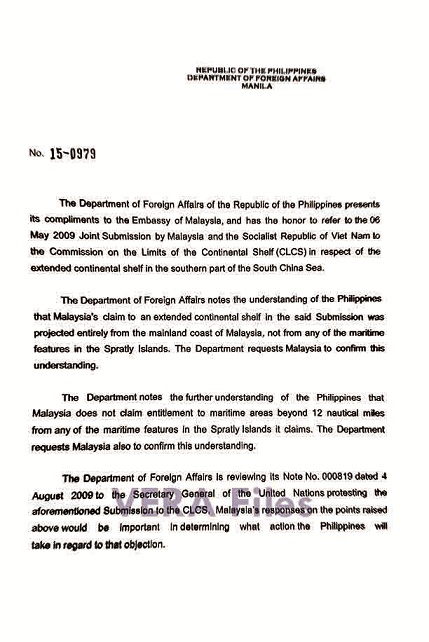
cogitasia – Philippine media went into a minor frenzy with the startling news that Manila purportedly offered Kuala Lumpur a quid pro quo in March: dropping the Philippine claim to North Borneo (Malaysia’s Sabah State) in exchange for Malaysian support for Manila’s arbitration case over the South China Sea. The media reports were quickly denied by the Philippines Department of Foreign Affairs, which noted the total absence of any reference to such a deal in the note that set off the firestorm. Recently, President Benigno Aquino III had to reiterate that his administration was not dropping the claim, prompting Malaysia to summon the Philippine Charge d’Affaires. Tiếp tục đọc “Sabah’s Shadow on the South China Sea”
Enter Science & China’s Blue Economy in the South China Sea’s Policy Discussion
By James Borton

cogitasia – The role of marine science and the emergence of China’s blue economy helped frame a new narrative on the South China Sea’s policy debate, as shown at a CSIS discussion on May 21titled “The Convergence of Marine Science and Geopolitics in the South China Sea.” Two of the panelists John McManus from the University of Miami’s Rosentiel School of Marine & Atmospheric Science and Kathleen Walsh from the U.S. Naval War College agree that the South China Sea is not simply a sovereignty dispute but is likely to be recognized as one of the most significant environmental issues of the 21st century. Tiếp tục đọc “Enter Science & China’s Blue Economy in the South China Sea’s Policy Discussion”
 CVD
CVD