Number of internally displaced people tops 80 million for first time

“Internal displacement refers to the forced movement of people within the country they live in.” 

Internal-displacement.org

     –  83.4 million people were living in internal displacement at the end of 2024, more than twice as many as only six years ago (2018).

     –  90 per cent had fled conflict and violence. In Sudan, conflict led to 11.6 million internally displaced people (IDPs), the most ever for one country. Nearly the entire population of the Gaza Strip remained displaced at the end of the year.

     –  Disasters triggered nearly twice as many movements in 2024 as the annual average over the past decade. The 11 million disaster displacements in the United States were the most ever recorded for a single country. 

GENEVA, Switzerland – The number of internally displaced people (IDPs) reached 83.4 million at the end of 2024, the highest figure ever recorded, according to the Global Report on Internal Displacement 2025 published today by the Internal Displacement Monitoring Centre (IDMC). This is equivalent to the population of Germany, and more than double the number from just six years ago.  

“Internal displacement is where conflict, poverty and climate collide, hitting the most vulnerable the hardest,” said Alexandra Bilak, IDMC director“These latest numbers prove that internal displacement is not just a humanitarian crisis; it’s a clear development and political challenge that requires far more attention than it currently receives.”

Tiếp tục đọc “Number of internally displaced people tops 80 million for first time”
Another year, another rise in food insecurity – including famine

UN.org

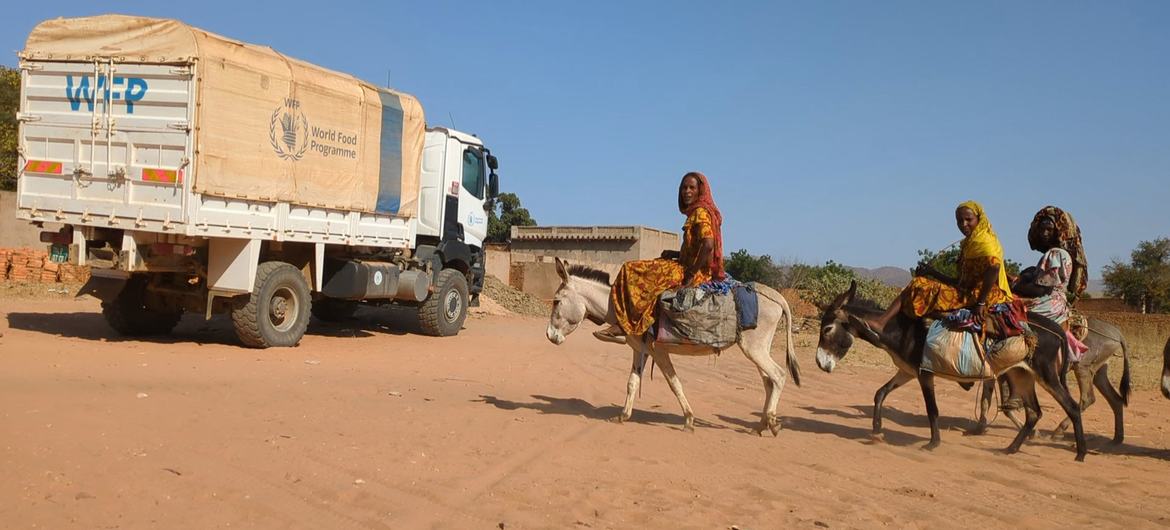
Hundreds of thousands of Sudanese have sought refuge in Chad due to the ongoing conflict and resulting food shortages.

© WFP/Lena von Zabern

Hundreds of thousands of Sudanese have sought refuge in Chad due to the ongoing conflict and resulting food shortages.

 Humanitarian Aid

In July 2024, famine was detected in the Sudan’s Zamzam IDP camp. In the following months, the official alert expanded to other camps in Darfur and Western Nuba Mountains. From December until now, famine has been confirmed in five other areas of the war-torn country. A further 17 areas are at risk. 

It is the first time since 2017 that a famine has been declared anywhere on Earth.

In the 20 months since the war between rival militaries erupted, 13 million Sudanese have been forcibly displaced and over 30.4 million are in desperate need of humanitarian assistance, according to UN estimates.

Tiếp tục đọc “Another year, another rise in food insecurity – including famine”

The lessons from Hamas’s assault on Israel

economist.com Oct 8th 2023

Two decades of Israeli policy towards the Palestinians have gone up in flames

image: ap

It is hard to see past the shock of Hamas’s bloodthirsty assault on Israel. That is because it involved thousands of rockets, and fighters attacking the south of the country by land, sea and air. And because it was completely unforeseen despite its scale, inflicting a humiliating blow against Israel’s vaunted intelligence services. But most of all because of the killing of hundreds of innocent people and the taking of scores of hostages by Hamas. As the Israel Defence Forces (idf) ponder how to respond, the world’s attention will be caught up in their desperate plight.

Tiếp tục đọc “The lessons from Hamas’s assault on Israel”

Why Sudan’s conflict matters to the rest of the world

By The Associated Press April 21, 2023

Fighting in Sudan between forces loyal to two top generals has put that nation at risk of collapse and could have consequences far beyond its borders.

Both sides have tens of thousands of fighters, foreign backers, mineral riches and other resources that could insulate them from sanctions. It’s a recipe for the kind of prolonged conflict that has devastated other countries in the Middle East and Africa, from Lebanon and Syria to Libya and Ethiopia.

RELATED COVERAGE

The fighting, which began as Sudan attempted to transition to democracy, already has killed hundreds of people and left millions trapped in urban areas, sheltering from gunfire, explosions and looters.

A look at what is happening and the impact it could have outside Sudan.

WHO IS FIGHTING?

Gen. Abdel Fattah Burhan, head of the armed forces, and Gen. Mohammed Hamdan Dagalo, the leader of a paramilitary group known as the Rapid Support Forces that grew out of Darfur’s notorious Janjaweed militias, are each seeking to seize control of Sudan. It comes two years after they jointly carried out a military coup and derailed a transition to democracy that had begun after protesters in 2019 helped force the ouster of longtime autocrat Omar al-Bashir. In recent months, negotiations were underway for a return to the democratic transition.

Tiếp tục đọc “Why Sudan’s conflict matters to the rest of the world”

Islam’s Sunni-Shia Divide, Explained

history.com

The split between the two main sects within Islam goes back some 1,400 years.

Though the two main sects within Islam, Sunni and Shia, agree on most of the fundamental beliefs and practices of Islam, a bitter split between the two goes back some 14 centuries. The divide originated with a dispute over who should succeed the Prophet Muhammad as leader of the Islamic faith he introduced.

Today, about 85 percent of the approximately 1.6 billion Muslims around the world are Sunni, while 15 percent are Shia, according to an estimate by the Council on Foreign Relations. While Shia represent the majority of the population in Iran, Iraq, Bahrain and Azerbaijan and a plurality in Lebanon, Sunnis are the majority in more than 40 other countries, from Morocco to Indonesia.

Despite their differences, Sunni and Shia have lived alongside each other in relative peace for most of history. But starting in the late 20th century, the schism deepened, exploding into violence in many parts of the Middle East as extreme brands of Sunni and Shia Islam battle for both religious and political supremacy.

The Aftermath of Muhammad’s Death

The roots of the Sunni-Shia divide can be traced all the way back to the seventh century, soon after the death of the prophet Muhammad in A.D. 632. While most of Muhammad’s followers thought that the other elite members of the Islamic community should choose his successor, a smaller group believed only someone from Muhammad’s family—namely his cousin and son-in-law, Ali—should succeed him. This group became known as the followers of Ali; in Arabic the Shiat Ali, or simply Shia.

“The essence of the problem is that Muhammad died without a male heir, and he never clearly stated who he would want to be his successor,” says Lesley Hazleton, author of After the Prophet: The Epic Story of the Sunni-Shia Split in Islam“This was important, because by the time he died, he had basically brought all the tribes of Arabia together into a kind of confederation that became the ummah—the people or nation of Islam.”

Eventually the Sunni majority (named for sunna, or tradition) won out, and chose Muhammad’s close friend Abu Bakr to become the first caliph, or leader, of the Islamic community. Ali eventually became the fourth caliph (or Imam, as Shiites call their leaders), but only after the two that preceded him had both been assassinated.

Tiếp tục đọc “Islam’s Sunni-Shia Divide, Explained”

The Nord Stream gas pineline leaks the worst ever greenhouse gas event? Why it happened and what are the damages to the climate?

*Nord Stream is a network of natural gas pipelines run under the Baltic Sea from Russia to Germany

Nord Stream gas leaks may be biggest ever, with warning of ‘large climate risk’

theguardian.com

‘Colossal amount’ of leaked methane, twice initial estimates, is equivalent to third of Denmark’s annual CO2 emissions or 1.3m cars

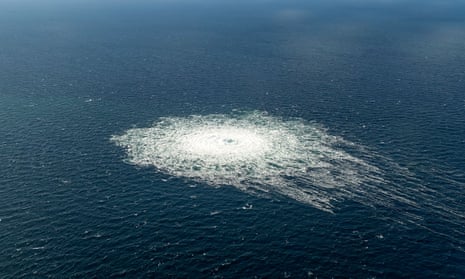
gas leak bubbling to surface of Baltic Sea
Scientists estimate the leaks could release up to 400,000 tonnes of methane into the atmosphere. Photograph: Danish Defence/AFP/Getty

Seascape: the state of our oceans is supported by

Scientists fear methane erupting from the burst Nord Stream pipelines into the Baltic Sea could be one of the worst natural gas leaks ever and pose significant climate risks.

Neither of the two breached Nord Stream pipelines, which run between Russia and Germany, was operational, but both contained natural gas. This mostly consists of methane – a greenhouse gas that is the biggest cause of climate heating after carbon dioxide.

Tiếp tục đọc “The Nord Stream gas pineline leaks the worst ever greenhouse gas event? Why it happened and what are the damages to the climate?”

West Bank garden of teargas canisters – in pictures

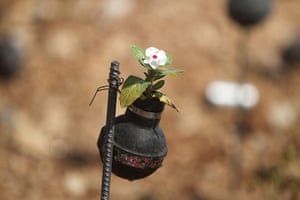
theguardian _ The Palestinian residents of Bilin have come up with a novel use for the teargas canisters left over from clashes with Israeli soldiers during the weekly protest against the West Bank separation barrier

Tiếp tục đọc “West Bank garden of teargas canisters – in pictures”