In the past two years, digital nomad enclaves have been springing up across China’s rural towns and villages. The country’s biggest digital nomad hubs are both in Anji County, in the Eastern Chinese province of Zhejiang. How have DN Yucun and DN Anji become magnets for a wave of young Chinese professionals seeking to redefine their approach to work and life?
Elsewhere, Chinese youth are leaving prestigious jobs in big internet firms in Beijing and Shanghai and returning to their rural roots.
In the west of China, in the province of Sichuan, a former ByteDance product manager gave up a career at ByteDance to become a new farmer, with plans to revolutionise farming practices in his rural hometown. Not far from him, a young couple with postgraduate degrees, left their jobs in Beijing – and an annual salary of 800,000 yuan, or 110,000 US dollars – to pursue dreams of being rural influencers. What enticed them to do so? Discover why attitudes towards rural living have been changing in China.
Fish caught by Chinese vessels and processed in Chinese factories end up on dinner plates around the world.
China’s seafood industry is the world’s biggest, accounting for a fifth of international fishing trade.
But onboard China’s ships and in its processing plants, alleged human rights abuses and labour trafficking are rampant.
With footage filmed over several years on the high seas and additional reporting on land, 101 East investigates the deadly secrets of China’s massive fishing fleet, and the price we pay for seafood.
An actor playing a spy shows off his multiple identity cards in a propaganda video released by China’s Ministry of State Security to warn the public about foreign spies. Ministry of State Security
By Nectar Gan, CNN Published 8:38 PM EDT, Sun April 21, 2024
TĐH: China sees ghost everywhere and this sickly fear will pull China down to the abyss. You can’t live with fear for so long
Editor’s Note: Sign up for CNN’s Meanwhile in China newsletter which explores what you need to know about the country’s rise and how it impacts the world.Hong KongCNN —
In a slick video marking the National Security Education Day, China’s top spy agency has a stern message for Chinese people: foreign spies are everywhere.
As ominous music plays, a broad-faced, beady-eyed man disguises himself as a street fashion photographer, a lab technician, a businessman and a food delivery driver – he even sets up an online honey trap – to glean sensitive state secrets in various places and industries.
Trong một động thái đáng chú ý ở khu vực Nam Á, Maldives yêu cầu Ấn Độ rút binh sĩ đang đồn trú tại nước này trước ngày 15/3.
Maldives là quốc đảo nhỏ ở khu vực Nam Á, vốn phụ thuộc đáng kể vào nước láng giềng Ấn Độ về nguồn cung lương thực, xây dựng hạ tầng và công nghệ. Tuy nhiên mối quan hệ này gần đây xuất hiện dấu hiệu căng thẳng.
Tổng thống Maldives Mohamed Muizzu. Ảnh: AP
Trong khi đó, trong chuyến thăm Trung Quốc hồi tuần trước của Tổng thống Maldives, hai bên nhất trí nâng cấp lên “quan hệ đối tác hợp tác chiến lược toàn diện”. Các nhà phân tích cho rằng động thái của Maldives phản ánh phần nào sự chuyển hướng chính sách của một số quốc gia ở Nam Á trước cuộc cạnh tranh ảnh hưởng giữa các nước lớn.
II. An Answer to the Call of the Times and a Blueprint for the Future
III. Deep Roots in History and Cultural Traditions
IV. Direction and Path
V. China’s Action and Contribution
Conclusion
Preface
In the universe there is only one Earth, the shared home of humanity. Unfortunately, this planet on which we rely for our subsistence is facing immense and unprecedented crises, both known and unknown, both foreseeable and unforeseeable. Whether human civilization can survive these has become an existential issue that must be squarely faced. More and more people have come to the realization that rather than amassing material wealth, the most pressing task is to find a guiding beacon for the sustainable development of human civilization, because we all care about our future.
Ten years ago President Xi Jinping propounded the idea of building a global community of shared future, answering a question raised by the world, by history, and by the times: “Where is humanity headed?” His proposal lights the path forward as the world fumbles for solutions, and represents China’s contribution to global efforts to protect our shared home and create a better future of prosperity for all.
Scientists expected a surge in respiratory disease, but what is happening in China is unusual.
Parents wait for their children to be treated for respiratory disease in Chongqing, China.Credit: Costfoto/NurPhoto via Getty
China is grappling with a surge in respiratory illnesses, including pneumonia, in children. The World Health Organization (WHO) said last week that common winter infections — rather than any new pathogens — are behind the spike in hospitalizations. A surge of infections was expected in the country this winter, China’s first without COVID-19 restrictions since the pandemic began in 2020. What is unusual, say epidemiologists, is the high prevalence of pneumonia in China. When COVID-19 restrictions were eased in other countries, influenza and respiratory syncytial virus (RSV) drove most spikes in illness.
The WHO requested information, including laboratory results and data on recent trends in the spread of respiratory illnesses, from China’s health authorities last week. This followed reports from the media and the Program for Monitoring Emerging Diseases — a publicly available system run by the International Society for Infectious Diseases — about clusters of “undiagnosed pneumonia”.
In a 23 November statement, the WHO said that China’s health authorities have attributed the rise in hospitalizations since October to known pathogens, such as adenoviruses, influenza virus and RSV, which tends to cause only mild, cold-like symptoms. However, an increase in children being admitted to hospital since May, particularly in northern cities such as Beijing, is mainly due to Mycoplasma pneumoniae, a bacterium that infects the lungs. It is a common cause of ‘walking pneumonia’, a form of the disease that is usually relatively mild and doesn’t require bed rest or hospitalization, but that is hitting children hard this year.
Benjamin Cowling, an epidemiologist at the University of Hong Kong, is not surprised by the wave of illness. “This is a typical ‘winter surge’ in acute respiratory infections,” he says. “It is happening slightly earlier this year, perhaps because of increased population susceptibility to respiratory infections resulting from three years of COVID measures.”
(KTSG) – Tốc độ tăng giá nhà luôn gần như gấp đôi tốc độ tăng trưởng thu nhập bình quân đầu người của Trung Quốc trong vòng 20 năm qua, nó cũng tăng gấp tám lần mức độ tăng trưởng của đô thị hóa. Nhưng khi các chính sách siết chặt tài chính với tên gọi “ba lằn ranh đỏ” được công bố vào năm 2021, cộng với thời gian dài phong tỏa để thực hiện chính sách zero-Covid, các trục trặc đã xuất hiện. Rất nhanh chóng, phản ứng domino xảy ra giữa các công ty bất động sản và lan sang ngân hàng bóng mờ (shadow banking).
It is the 10th year of the Belt and Road Initiative (BRI). From Central and Southeast Asia to the Middle East and Africa, how has China’s mega infrastructure project changed the world? In this retrospective on the 10th anniversary of the BRI, Insight looks at the developments in Asia and Africa that have sprung from China’s marquee project. From growing trade links to environmental impacts to political influence, the BRI has undeniably changed the region. But with growing economic headwinds and a flagging Chinese economy, will Beijing continue to invest in the BRI? What will the next decade bring?
Chinese leader Xi Jinping speaks at the China-Central Asia Summit held this past May in Xi’an.Huang Jingwen/Xinhua/Getty Images
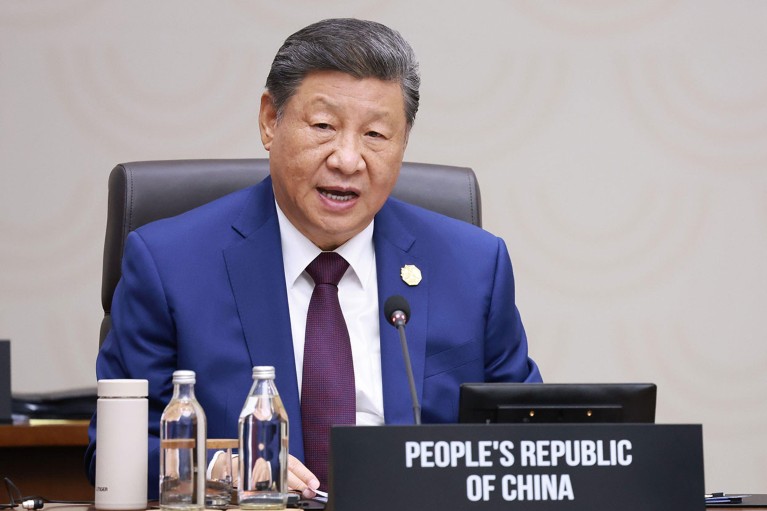
BeijingCNN — Chinese leader Xi Jinping is gathering world leaders in Beijing this week for a high profile forum with a clear set of goals: laud China’s role backing economic development over the past decade and project its expanding ambitions as an alternative global leader to the United States.
That bid takes on heightened significance as renewed conflict in Israel and Gaza threatens to trigger broader instability in the Middle East, a region where the US is the traditional power broker, but China has been growing its influence and efforts to play a role in peace.
The Three Gorges Dam is a hydroelectric gravity dam that spans the Yangtze River, in Central China. It is the world’s largest hydroelectric power station, but all that power comes with great responsibility. According to NASA, the dam delays the rotation of the Earth by 0.06 microseconds. This happens when the dam raises trillions of pounds of water 574 feet (175 m) above sea level increasing the Earth’s moment of inertia and thus slowing its rotation. Will the dam cause major consequences in our future or will the very minor delay not be noticeable for thousands of years?
Every country should have the ability to tell its story to the world. However, a nation’s narrative should be based on facts and rise and fall on its own merits. The PRC employs a variety of deceptive and coercive methods as it attempts to influence the international information environment. Beijing’s information manipulation spans the use of propaganda, disinformation, and censorship. Unchecked, the PRC’s efforts will reshape the global information landscape, creating biases and gaps that could even lead nations to make decisions that subordinate their economic and security interests to Beijing’s.
PRC Information Manipulation
The PRC spends billions of dollars annually on foreign information manipulation efforts.2 Beijing uses false or biased information to promote positive views of the PRC and the Chinese Communist Party (CCP). At the same time, the PRC suppresses critical information that contradicts its desired narratives on issues such as Taiwan, its human rights practices, the South China Sea, its domestic economy, and international economic engagement. More broadly, the PRC seeks to cultivate and uphold a global incentive structure that encourages foreign governments, elites, journalists, and civil society to accept its preferred narratives and avoid criticizing its conduct.
The PRC’s approach to information manipulation includes leveraging propaganda and censorship, promoting digital authoritarianism, exploiting international organizations and bilateral partnerships, pairing cooptation and pressure, and exercising control of Chinese-language media. Collectively, these five elements could enable Beijing to reshape the global information environment along multiple axes:
Overt and covert influence over content and platforms. Beijing seeks to maximize the reach of biased or false pro-PRC content. It has acquired stakes in foreign media through public and non-public means and sponsored online influencers. Beijing has also secured sometimes restrictive content sharing agreements with local outlets that can result in trusted mastheads providing legitimacy to unlabeled or obscured PRC content. In addition, Beijing has also worked to coopt prominent voices in the international information environment such as foreign political elites and journalists. Beyond focusing on content producers, the PRC has targeted platforms for global information dissemination, for example, investing in digital television services in Africa and satellite networks.
Constraints on global freedom of expression. On issues it deems sensitive, the PRC has employed online and real-world intimidation to silence dissent and encourage self-censorship. The PRC has also taken measures against corporations in situations where they are perceived to have challenged its desired narratives on issues like Xinjiang. Within democratic countries, Beijing has taken advantage of open societies to take legal action to suppress critical voices. On WeChat, an application used by many Chinese-speaking communities outside the PRC, Beijing has exercised technical censorship and harassed individual content producers. Notably, data
harvested by PRC corporations operating overseas have enabled Beijing to fine-tune global censorship by targeting specific individuals and organizations.
An emerging community of digital authoritarians. The PRC promotes digital authoritarianism, which involves the use of digital infrastructure to repress freedom of expression, censor independent news, promote disinformation, and deny other human rights.3 Through disseminating technologies for surveillance and censorship, often through capabilities bundled under the umbrella of “smart” or “safe cities,” the PRC has exported aspects of its domestic information environment globally. Beijing has also propagated information control tactics, with a particular focus on Africa, Asia, and Latin America. In parallel, the PRC has promoted authoritarian digital norms that other countries have adopted at a rapid pace. As other countries emulate the PRC, their information ecosystems have become more receptive to Beijing’s propaganda, disinformation, and censorship requests.
Future Impact
The PRC’s global information manipulation is not simply a matter of public diplomacy – but a challenge to the integrity of the global information space. Unchecked, Beijing’s efforts could result in a future in which technology exported by the PRC, coopted local governments, and fear of Beijing’s direct retaliation produce a sharp contraction of global freedom of expression. Beijing would play a significant – and often hidden – role in determining the print and digital content that audiences in developing countries consume. Multilateral fora and select bilateral relationships would amplify Beijing’s preferred narratives on issues such as Taiwan and the international economy. Access to global data combined with the latest developments in artificial intelligence technology would enable the PRC to surgically target foreign audiences and thereby perhaps influence economic and security decisions in its favor. Lastly, Beijing’s global censorship efforts would result in a highly curated international information environment characterized by gaps and inherent pro-PRC biases.
BEIJING, Sept. 26 (Xinhua) — China’s State Council Information Office on Tuesday released a white paper titled “A Global Community of Shared Future: China’s Proposals and Actions.”
Please see the attachment for the document. Enditem
Enormous water diversion projects spark concern across region
Water is released from the Xiaolangdi Reservoir Dam on the Yellow River in a sand-discharging operation. July 2022, Luoyang, China. (Footage via Getty Images)
Drought in China dried up parts of the Yangtze river last year – but the largest water transfer apparatus ever built still drew from it to supply Beijing’s needs.
More than a billion cubic meters flowed through the colossal South-to-North Water Diversion Project in 2022. It traveled from a reservoir in central China to millions of households in the capital 1,200 kilometers away. The journey, via underground tunnels and canals that cross the Yellow River, roughly equaled the distance between Amsterdam and Rome.
The movement highlights the scale of China’s measures to shore up water security – and the profound potential effects these have on neighboring countries.
Many of Asia’s transboundary rivers originate in the Indo-Tibetan plateau in China. They flow into 18 downstream nations such as India, Kazakhstan, Bangladesh and Vietnam, delivering water to a quarter of the world’s population.
That alone makes the world’s second most populous nation an upstream superpower with enormous influence over irrigation of much of the continent. Projects such as building dams and hydropower plants potentially fuel existing regional political tensions – and create new ones.