Dark fleet tankers: Estonia’s case study warning for Southeast Asia

The increasing number of false-flagged and stateless tankers is reshaping maritime security challenges across the world’s sea lanes.

imarest.org

There are tankers that exploit gaps in international law by fraudulently registering under flags of convenience or assuming false identities to avoid enforcement. Indeed, approximately 100+ false-flagged tankers now operate with limited scrutiny in critical regions like the Indian Ocean and South China Sea, bringing new impetus to the questions for coastal states: do they have the legal right to act, and should they exercise that right? 

Estonia’s recent boarding of the tanker Kiwala has put these questions in the spotlight. Acting within its territorial sea, the Estonian Navy relied on the powers granted under the United Nations Convention on the Law of the Sea (UNCLOS) to intervene when a vessel’s passage is no longer ‘innocent’. The vessel was known to be operating under a false flag — a clear violation of international shipping norms. 

Tiếp tục đọc “Dark fleet tankers: Estonia’s case study warning for Southeast Asia”

Europe’s youth have more realistic view of China

chinadaily.com By Kerry Brown,Zhang Li and Ivona Rajevac | China Daily | Updated: 2026-02-09 07:32

MA XUEJING/CHINA DAILY

Editor’s note: The Institute of European Studies of the Chinese Academy of Social Sciences released a survey report in Beijing on Feb 4 examining European youth’s perceptions of China and China-EU relations. The report is based on a large-scale survey of nearly 20,000 respondents conducted across 36 European countries. Scholars and policy experts discussed the findings at the briefing. Below are excerpts of the remarks by three of the experts.

Opening their eyes to the real China

Europe stands at a critical juncture in evaluating its stance toward China, especially as the global geopolitical landscape grows increasingly complex in 2026. The survey findings reveal a nuanced mosaic of attitudes. Young Europeans, in particular, are engaging with China not merely through an ideological lens but by examining its tangible economic, technological and social footprint. This growing sophistication reflects both the accessibility of information through digital platforms and the lived realities of globalization, where China’s influence touches supply chains, consumer goods, education and technology.

The perception of China as a significant player in global technology is gaining traction. For European youth, understanding China is no longer a simple matter of curiosity; it is increasingly about engaging with a country that is transforming before their eyes. Long-held notions of China as a technologically backward or peripheral actor are rapidly fading. China’s investments in research and development now far exceed those of the United Kingdom, many European countries, and even the European Union in aggregate. In the 15th Five-Year Plan (2026-30) period, China is set to strengthen its capabilities in life sciences, pharmaceuticals, healthcare and other critical sectors.

Tiếp tục đọc “Europe’s youth have more realistic view of China”

Bố Cái Đại Vương dùng điệu múa “Con đĩ đánh bồng” để khích lệ quân sĩ chiến đấu?

Chào các bạn,

Ngày nay chúng ta thỉnh thoảng nghe nói đến Phùng Hưng, Bố Cái Đại Vương, là thủ lĩnh chống lại ách đô hộ An Nam của nhà Đường năm 791, thời Bắc thuộc lần thứ 3 (602-905) trong lịch sử VN. Vương hiệu Bố Cái Đại Vương được coi là một trong những trường hợp sử dụng chữ Nôm cổ nhất VN – Bố Cái là cha mẹ.

Theo sách Việt điện u linh tập của Lý Thế Xuyên thì ông sinh vào năm 760, lên ngôi năm 791, và mất năm 802. Vậy là ông làm vua được 11 năm.

Ngày nay, chúng ta cũng thường nghe lưu truyền trong dân gian câu truyện cho rằng Phùng Hưng đã dùng điệu múa “Con đĩ đánh bồng” để khích lệ tinh thần binh sĩ trước ngày tấn công doanh trại đầu não của nhà Đường ở An Nam. Và câu truyện này có vẻ không được ổn về tâm lý, chiến lược quân sự, cũng như văn hóa chính trị trường kỳ.

Bố Cái Đại Vương Phùng Hưng
Tiếp tục đọc “Bố Cái Đại Vương dùng điệu múa “Con đĩ đánh bồng” để khích lệ quân sĩ chiến đấu?”

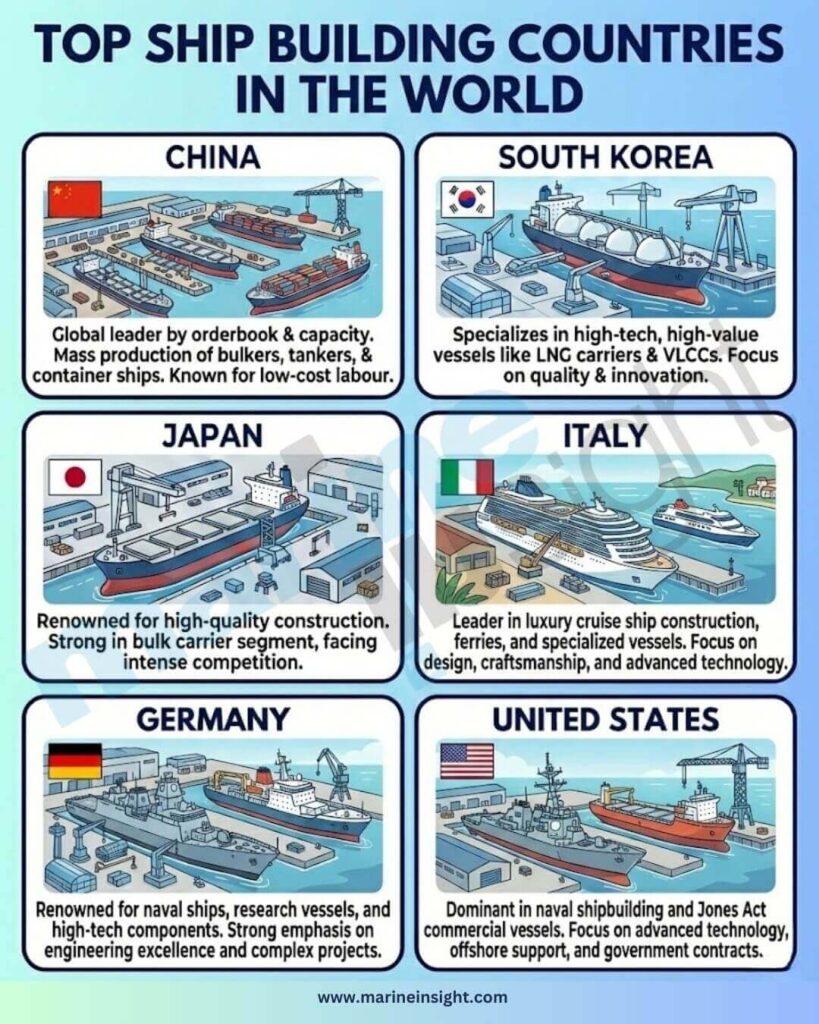
Top 10 Ship Building Countries In The World (Vietnam is on the list)

China, South Korea, Japan, Italy, USA, Germany, France, The Netherlands, The Philippines, Vietnam

marineinsight.com ByZahra AhmedFebruary 11, 2025

The shipbuilding industry is growing at a tremendous rate, with its market size expected to increase from USD 155.58 billion in 2025 to 203.76 billion in 2033, owing to greater container and dry bulk trade and the opening of new markets, per Straits Research. Around 85% of shipbuilding activities are concentrated in China, Japan, and South Korea, which are the top shipbuilding countries in the world.

Shipbuilding, which involves the construction of large seagoing vessels, manufacturing marine equipment, and refurbishing old vessels is a lucrative industry, propelled by the rising sea trade between countries, as the world population increases amidst rising consumer demands worldwide.

Apart from commercial vessels, naval vessels are also witnessing an increased demand with several navies like the Chinese and American, building new ships to showcase naval prowess.

ship building countries

In this article, we will mention the top 10 shipbuilding countries in the world, the majority of which are in Asia, Europe and the Americas, leading through their technological breakthroughs, and strategic investments in port infrastructure and ship equipment.

Tiếp tục đọc “Top 10 Ship Building Countries In The World (Vietnam is on the list)”

The latest on what’s happening in China from Asia Society Policy Institute’s  Center for China Analysis

(https://asiasociety.org/policy-institute/)

THIS WEEK:
Politburo meeting projects institutional continuity after purges, Xi balances Putin and Trump diplomacy, Beijing signals reserve-currency ambitions, “future industries” take center stage in the 15th Five-Year Plan, and Shanxi marks a clean-energy turning pointRead back issues in the China 5 Archive.

China’s President Xi Jinping stands with Politburo Standing Committee members at the Monument to the People’s Heroes on Martyrs’ Day in Beijing’s Tiananmen Square on September 30, 2025. (Photo by Greg Baker/AFP via Getty Images)

1. A Signal of Institutional Stability Following High-Profile Purges

What Happened: On January 30, Xi Jinping chaired a routine Politburo meeting to review the annual Party affairs work reports of the National People’s Congress, the State Council, the Chinese People’s Political Consultative Conference, the Supreme People’s Court, the Supreme People’s Procuratorate, and the Chinese Communist Party Central Secretariat. The meeting also discussed “other matters,” a phrase sometimes used to conceal politically sensitive issues from public reporting. Tiếp tục đọc “The latest on what’s happening in China from Asia Society Policy Institute’s  Center for China Analysis”

Nuclear Deterrence in the 21st Century

chatthamhouse.org Research paper Published 20 April 2020 ISBN: 978 1 78413 391 7

Royal Navy Vanguard Class submarine HMS Vigilant returning to HMNB Clyde after extended deployment. The four Vanguard-class submarines form the UK's strategic nuclear deterrent force. Photo: Ministry of Defence.

Royal Navy Vanguard Class submarine HMS Vigilant returning to HMNB Clyde after extended deployment. The four Vanguard-class submarines form the UK’s strategic nuclear deterrent force. Photo: Ministry of Defence.21st century. Researchers at Chatham House have worked with eight experts to produce this collection of essays examining four contested themes in contemporary policymaking on deterrence.

Tiếp tục đọc “Nuclear Deterrence in the 21st Century”

China unveils ‘world’s first’ autonomous drone that can hunt submarines: is it all hype?

The Wing Loong X debuts as China’s first long-endurance UAV designed for independent ASW missions.

IE.com Nov 22, 2025 06:14 AM EST

Wing Loong II
Image of a Wing Loong II at the Dubai Air Show, circa 2017.Mztourist/Wikimedia Commons

China has officially unveiled its latest large autonomous drone, the Wing Loong X, at the Dubai Airshow 2025. Ostensibly the same as its predecessor, Wing Loong drone siblings, this new drone is reportedly the first unmanned aerial vehicle (UAV) in the world capable of fully independent anti-submarine warfare (ASW).

If true, this is a big deal, as anti-submarine missions are widely considered the most difficult of all maritime military aviation operations. The new drone is huge, with a reported wingspan of well over 65.6 feet, or 20 meters (that’s roughly the same size as a small business jet).

Tiếp tục đọc “China unveils ‘world’s first’ autonomous drone that can hunt submarines: is it all hype?”

China’s “artificial sun” just broke a fusion limit scientists thought was unbreakable

Sciencedaily.com Date:January 4, 2026

Source:Chinese Academy of Sciences Headquarters

Summary: Researchers using China’s “artificial sun” fusion reactor have broken through a long-standing density barrier in fusion plasma. The experiment confirmed that plasma can remain stable even at extreme densities if its interaction with the reactor walls is carefully controlled. This finding removes a major obstacle that has slowed progress toward fusion ignition. The advance could help future fusion reactors produce more power


Fusion Breakthrough Shatters Density Limits
China’s “artificial sun” fusion reactor has crossed a critical plasma density threshold that scientists once thought was unreachable. The result brings fusion ignition closer than ever. Credit: Shutterstock

Scientists working with China’s fully superconducting Experimental Advanced Superconducting Tokamak (EAST) have successfully reached a long-theorized “density-free regime” in fusion plasma experiments. In this state, the plasma remains stable even when its density rises far beyond traditional limits. The results, published in Science Advances on January 1, shed new light on how one of fusion energy’s most stubborn physical barriers might finally be overcome on the road to ignition.

Tiếp tục đọc “China’s “artificial sun” just broke a fusion limit scientists thought was unbreakable”

Rutte’s private text to Trump has caused an uproar in Europe, China ends up as collateral damage.

QUORA .

Icon for China - World Leader.

China – World Leader. Post by Wesley Shaw Thu

President Trump posted on his social media account a private message sent to him by NATO Secretary-General Rutte. It sparked a storm of criticism.

Many European social media users angrily denounced Rutte’s remarks as kowtowing to power and betraying Europe.

Tiếp tục đọc “Rutte’s private text to Trump has caused an uproar in Europe, China ends up as collateral damage.”

How Greenland’s Rare Earth Reserves Compare to the Rest of the World

 visualcapitalist January 19, 2026

How Greenland’s rare earth reserves compare globally and why its untapped minerals are drawing Trump’s attention.

Key Takeaways

China dominates global rare earth mining, but undeveloped reserves elsewhere could reshape future supply chains.

Greenland holds an estimated 1.5 million metric tons of rare earth reserves despite having no commercial production.

U.S. President Donald Trump has once again put Greenland at the center of global attention.

His renewed threat to assert U.S. control over the Arctic territory has drawn sharp reactions from European leaders and Denmark, which governs Greenland as an autonomous territory.

While the island’s strategic location is often cited, another underlying motivation is increasingly tied to its vast mineral potential. In particular, Greenland’s rare earth reserves have become a focal point in a world racing to secure critical resources.

This visualization compares rare earth mine production and reserves across countries, placing Greenland’s untapped resources in a global context. 

The data for this visualization comes from the U.S. Geological Survey (USGS), as of 2024.

China’s Grip on Rare Earth Supply

China remains the backbone of the global rare earth market. In 2024, it produced roughly 270,000 metric tons, accounting for well over half of global output.

China also controls the largest reserves, estimated at 44 million metric tons. This combination of scale and integration gives Beijing significant leverage over industries ranging from electric vehicles to defense systems.

CountryReserves (Metric Tons)Rare Earth Production 2024 (Metric Tons)
🇨🇳 China44.0M270,000
🇧🇷 Brazil21.0M20
🇮🇳 India6.9M2,900
🇦🇺 Australia5.7M13,000
🇷🇺 Russia3.8M2,500
🇻🇳 Vietnam3.5M300
🇺🇸 United States1.9M45,000
🇬🇱 Greenland1.5M0
🇹🇿 Tanzania890K0
🇿🇦 South Africa860K0
🇨🇦 Canada830K0
🇹🇭 Thailand4.5K13,000
🇲🇲 Myanmar031,000
🇲🇬 Madagascar02,000
🇲🇾 Malaysia0130
🇳🇬 Nigeria013,000
🌍 Other01,100
🌐 World total (rounded)>90,000,000390,000

Large Reserves, Limited Production Elsewhere

Outside China, many countries with sizable reserves play only a minor role in production.

Brazil holds an estimated 21 million metric tons of rare earth reserves yet produces almost nothing today. India, Russia, and Vietnam show similar patterns.

Why Greenland Matters

Greenland’s estimated 1.5 million metric tons of rare earth reserves exceed those of countries like Canada and South Africa. Yet the island has never had commercial rare earth production.

Environmental protections, infrastructure constraints, and local political opposition have slowed development. Still, as supply chain security becomes a priority for major economies, Greenland’s position is becoming harder to ignore.

Trump’s interest in Greenland is driven by more than symbolism. Rare earths are essential for advanced manufacturing, clean energy technologies, and military hardware. With China firmly entrenched as the dominant supplier, policymakers in Washington are increasingly focused on alternative sources.

Déjà vu? The global LNG industry risks repeating the coal bust of the 2010s

IEEFA November 20, 2025 Amandine Denis-Ryan

 Key Findings

In the early 2010s, the coal industry attracted a large wave of investment, banking on surging coal imports from China and India.

When this growth didn’t materialise, coal oversupply and depressed prices sent major companies bankrupt with significant value destruction for shareholders.

The LNG industry risks repeating the coal industry’s mistakes, as investment levels outstrip future demand, with potentially more severe consequences for the capital-intensive industry.

Peddling a ‘supercycle’ for coal in the 2010s

In the early 2010s, the coal industry was on the rise. Global trade had tripled between 1990 and 2011, with the 2000s experiencing “the largest growth in coal demand in history – greater than the previous four decades combined”. This growth was expected to accelerate after China and India entered the global coal import market (Figure 1). Between 2011 and 2012, global coal imports increased by 13% and coal prices doubled (Figure 2).

Tiếp tục đọc “Déjà vu? The global LNG industry risks repeating the coal bust of the 2010s”

More Than Half Of China’s Adults Now Obese Or Overweight

CNA More than half of Chinese adults are overweight or obese, a potential ticking timebomb for the country’s healthcare sector. So, last March, China announced greater efforts to tackle rising obesity rates, with health authorities rolling out a nationwide weight management campaign during the annual ‘Two Sessions’ meeting.

How did China go from food scarcity two generations ago to rapid weight gain now? What does diet, lifestyle and education have to do with it? As beating obesity becomes a national priority, can China beat the bulge?

China’s Tourism Explodes in 2025: 100% More Visitors, and Here’s Why

If you’ve been following travel trends this year, you might have noticed something interesting: social media feeds are filling up with foreigners riding Chinese high-speed trains, walking through ancient towns, and paying for everything with their phones—in China.

From Space highlights

Icon for China Focus

China Focus · Jiangqin Huang Dec 10, 2025

Posted by 

China’s Tourism Explodes in 2025: 100% More Visitors, and Here’s Why

China Focus · Jiangqin Huang Dec 10, 2025

China’s Tourism Explodes in 2025: 100% More Visitors, and Here’s Why

If you’ve been following travel trends this year, you might have noticed something interesting: social media feeds are filling up with foreigners riding Chinese high-speed trains, walking through ancient towns, and paying for everything with their phones—in China.

According to data from the Chinese online travel platform Ctrip, inbound tourism to China surged by over 100% in 2025 compared to last year. And it’s not just about more arrivals—spending is up sharply, with U.S. tourist expenditure growing 50% and French visitors’ spending jumping an astonishing 160%.

Tiếp tục đọc “China’s Tourism Explodes in 2025: 100% More Visitors, and Here’s Why”

China is overplaying its rare earth hand in Japan

CNA Few countries are better prepared against China threatening their rare earth supplies than Japan, says David Fickling for Bloomberg Opinion.

Commentary: China is overplaying its rare earth hand in Japan
A labourer works at a site of a rare earth metals mine at Nancheng county, Jiangxi province, China, on Mar 14, 2012. (File photo: Reuters)
David Fickling 09 Jan 2026 05:59AM(Updated: 09 Jan 2026 09:30AM)

SYDNEY: To a hammer, every problem is a nail. If your most potent means of geopolitical leverage is threatening supplies of high-strength magnets, rare earth elements will always be the solution. 

That’s the latest approach Beijing is taking in its dispute with Tokyo sparked by comments from Japanese Prime Minister Sanae Takaichi about the possibility of military conflict over Taiwan. Exports of all items with potential military applications to Japan will be immediately banned, China’s Ministry of Commerce said on Tuesday (Jan 6)

The most obvious victim of this threat will be rare earth magnets made with the elements neodymium and praseodymium, and increasingly spiced up with rarer samarium, dysprosium and terbium. They’re used everywhere from charging cables to the switchgear in wind turbines to motors powering electric vehicles, missile guidance systems and aircraft flaps.

Tiếp tục đọc “China is overplaying its rare earth hand in Japan”