Whether by choice or circumstance, China is looking inward for its economic growth.
President Xi Jinping wants Chinese consumers to spend their way to growth, buying up domestically made goods. At the same time, the government will invest more in “New Productive Forces” – A.I, Green Tech and Advanced Computing – all for the goal of moving up the value chain and shedding China’s reliance on foreign technology.
In this period of “de-coupling” and trade wars, Beijing might have little choice but to become more self-sufficient. Yet, an overly inward-looking and nationalistic China could discourage foreign investors. Are domestic consumption and production enough to jumpstart China’s sputtering economy?
Defaults by Chinese borrowers have surged to a record high since the outbreak of the coronavirus pandemic, highlighting the depth of the country’s economic downturn and the obstacles to a full recovery.
A total of 8.54mn people, most of them between the ages of 18 and 59, are officially blacklisted by authorities after missing payments on everything from home mortgages to business loans, according to local courts. That figure, equivalent to about 1 per cent of working-age Chinese adults, is up from 5.7mn defaulters in early 2020, as pandemic lockdowns and other restrictions hobbled economic growth and gutted household incomes.
The soaring number of defaulters will add to the difficulty of shoring up consumer confidence in China, the world’s second largest economy and a crucial source of global demand. It also throws a spotlight on the country’s lack of personal bankruptcy laws that might soften the financial and social impact of soaring debt.
Under Chinese law, blacklisted defaulters are blocked from a range of economic activities, including purchasing aeroplane tickets and making payments through mobile apps such as Alipay and WeChat Pay, representing a further drag on an economy plagued by a property sector slowdown and lagging consumer confidence. The blacklisting process is triggered after a borrower is sued by creditors, such as banks, and then misses a subsequent payment deadline.
“The runaway increase in defaulters is a product of not only cyclical but also structural problems,” said Dan Wang, chief economist at Hang Seng Bank China. “The situation may get worse before it gets better.” The personal debt crisis follows a borrowing spree by Chinese consumers. Household debt as a percentage of gross domestic product almost doubled over the past decade to 64 per cent in September, according to the National Institution for Finance and Development, a Beijing-based think-tank. But mounting financial obligations have become increasingly unmanageable as wage growth has stalled or turned negative in the midst of the economic malaise.
As a growing number of cash-strapped Chinese consumers have struggled to make ends meet, many have stopped paying their bills. More Chinese residents are also struggling for work: youth unemployment hit a record 21.3 per cent in June, prompting authorities to stop reporting the data. “I will pay my Rmb28,000 ($4,000) credit card balance when I have a job,” said John Wang, a Shanghai-based office worker who defaulted on his payments after being laid off in May. “I don’t know when that will happen.” China Merchants Bank said this month that bad loans from credit card payments that were 90 days overdue had increased 26 per cent in 2022 from the year before.
(KTSG) – Tốc độ tăng giá nhà luôn gần như gấp đôi tốc độ tăng trưởng thu nhập bình quân đầu người của Trung Quốc trong vòng 20 năm qua, nó cũng tăng gấp tám lần mức độ tăng trưởng của đô thị hóa. Nhưng khi các chính sách siết chặt tài chính với tên gọi “ba lằn ranh đỏ” được công bố vào năm 2021, cộng với thời gian dài phong tỏa để thực hiện chính sách zero-Covid, các trục trặc đã xuất hiện. Rất nhanh chóng, phản ứng domino xảy ra giữa các công ty bất động sản và lan sang ngân hàng bóng mờ (shadow banking).
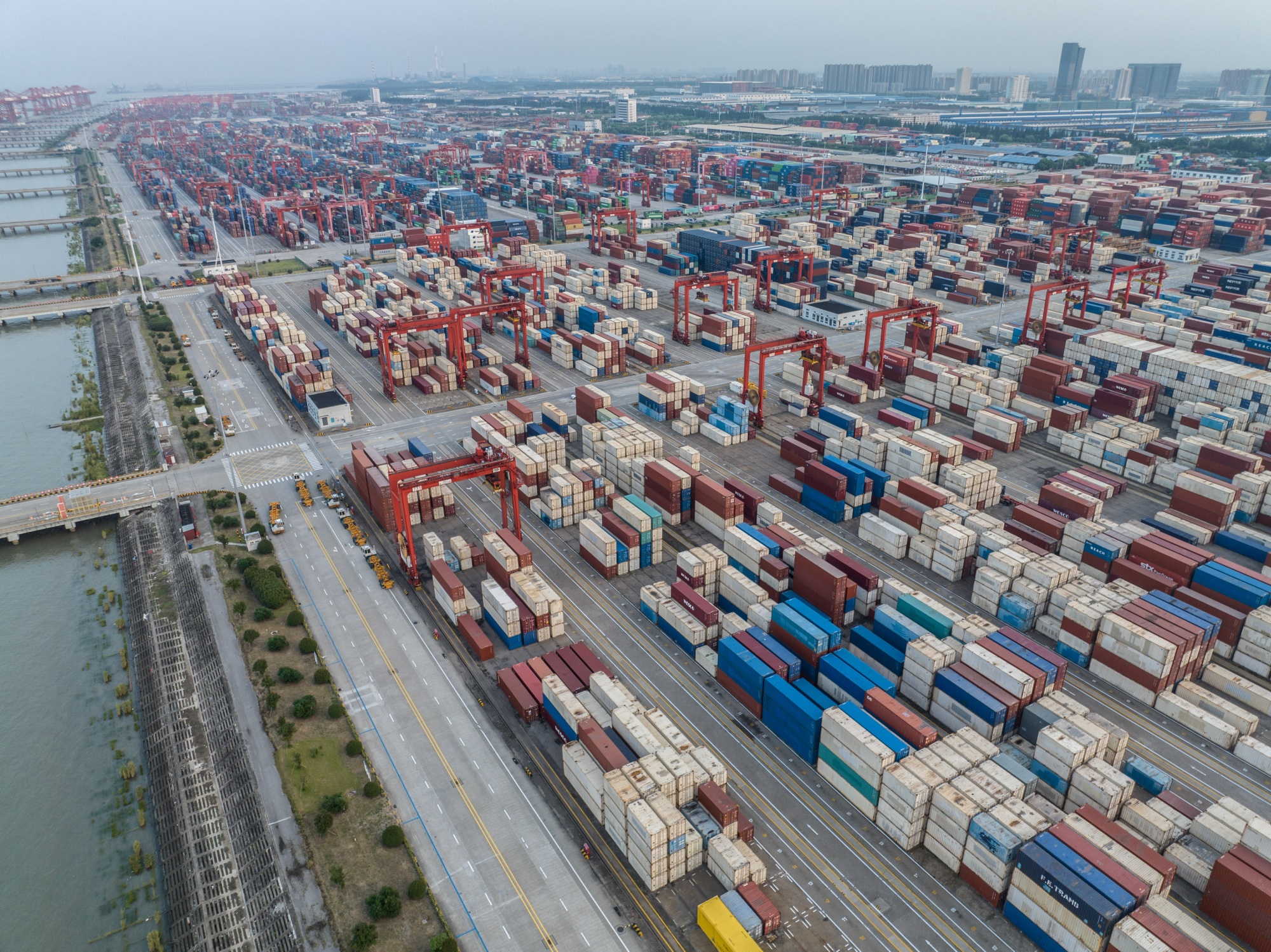
Shipping containers in China’s Jiangsu Province. The economic slowdown in recent months is sounding alarm bells across the world.Bloomberg
Today, I’ll tell you all you need to know about the slowdown in the world’s second-biggest economy.
If I had to use one word to describe the current situation, it would be fragile. The economic data we’ve gotten over the past few months have largely painted a gloomy picture. Chinese households are spending less than expected and saving more instead. Businesses are borrowing and investing at a reduced pace. And while the overall jobs situation has been stable, unemployment among the country’s youth has jumped so much that Beijing decided to stop releasing the data.
As downbeat as all that is, it is important to note the economy is not crashing. Economists are still expecting Chinese gross domestic product to grow 5.1% this year, 4.5% next year and 4.6% in 2025. By comparison, the US is forecast to grow 2% this year, 0.9% next year and 1.9% in 2025.
An increasingly autocratic government is making bad decisions
Aug 24th 2023
Whatever has gone wrong? After China rejoined the world economy in 1978, it became the most spectacular growth story in history. Farm reform, industrialisation and rising incomes lifted nearly 800m people out of extreme poverty. Having produced just a tenth as much as America in 1980, China’s economy is now about three-quarters the size. Yet instead of roaring back after the government abandoned its “zero-covid” policy at the end of 2022, it is lurching from one ditch to the next.
China’s economy showed further signs of weakness in May. Industrial output and retail sales both missed forecasts. Beijing is expected to increase its efforts to boost the economy to try to shore up its post-COVID-19 recovery.
Al Jazeera’s Katrina Yu reports from Beijing, China.
Published October 28, 2021Last updated July 21, 2022
China has a massive amount of corporate debt. At $27 trillion, it boasts a debt-to-GDP ratio of 159%, almost 60% higher than the global rate and nearly twice that of the US, according to research published this month by S&P Global Ratings.
“China’s growth has been largely driven by two contours: One is credit, and the other is carbon,” says Eunice Tan, one of the report’s lead authors and head of credit research for S&P Global Ratings’ Asia-Pacific region.
Beijing now wants to tame both those economic engines—credit and carbon—while maintaining stability and control, and while continuing to hit GDP growth targets. On the carbon front, it has released a high-level policy framework outlining a path to peaking carbon emissions by 2030. On the credit front, the central bank has sought to tame debt in the property sector and shield banks from exposure to troubled developers.
Evergrande: the end of China’s property boom | FT Film
Financial Times – 10-3-2022
The rapid expansion of China’s property sector was powered by a great migration from the farms to the cities – and built on cheap credit. The FT tells the story of Evergrande, the most indebted property developer in the world, which now stands on the brink of collapse. It’s a story that changes the outlook for China’s position as the locomotive of global economic growth. But is this China’s Lehman Brothers moment? Read more at https://on.ft.com/3tNHO0j
— Central authorities deem the 2020-2022 period a “crucial stage” for SOE reform. Making the state-owned economy more competitive, innovative and resistant to risks is among the major goals they have in mind. — The transition into modern enterprises is imperative as China continues to level the playing field, creating a fairer competition environment. Key industries, such as energy, railway, automobile, telecommunications and public utilities, have been gradually opened for private and foreign investment. — Regulators are giving SOE executives more autonomy in making corporate decisions, including drafting annual investment schemes, arranging mixed-ownership reform of subsidiaries, and issuing short-term bonds.
by Xinhua writers Wang Xiuqiong, Zhao Yang, Wang Xi
BEIJING, Jan. 29 (Xinhua) — As a three-year action plan kicks reform into high gear, changes are gathering steam to remold China’s state-owned enterprises (SOEs) — the country’s economic backbone. The 2020-2022 action plan, part of the decades-long efforts to transform SOEs into competitive, modern enterprises, is expected to leave a strong mark on the world’s second-largest economy.
(TBKTSG Online) – Đi một vòng quanh đặc khu kinh tế Tân Hải ở Thiên Tân, cách Bắc Kinh một giờ chạy xe hơi, bạn sẽ thấy những tòa nhà chưa hoàn chỉnh nằm kế những tòa nhà dang dở khác, những mặt tiền trống rỗng với nước sơn đen gạch chéo cửa ra vào.
TS. Phạm Sỹ Thành (*)Thứ Bảy, 2/12/2017, 09:06 Để giải quyết gánh nặng dư thừa sản lượng và tỷ lệ nợ gia tăng của các doanh nghiệp trong nước, Trung Quốc đã đẩy mạnh các sáng kiến kinh tế đối ngoại, thúc giục các nước phối hợp với Trung Quốc để xây dựng các mô hình hợp tác kinh tế chưa từng có tiền lệ. Ảnh: Internet
(TBKTSG) – Theo một báo cáo của J.P. Morgan tháng 9-2017, tổng nợ của Trung Quốc tương đương 289% GDP, tức là khoảng 30.000 tỉ đô la Mỹ, tăng gần 30 điểm phần trăm so với năm 2015 (260% GDP). Điều đáng nói là sau các chính sách kích thích kinh tế để chống chọi với khủng hoảng tài chính toàn cầu, tỷ lệ này đã tăng gấp đôi chỉ trong vòng chín năm (năm 2008 là 141,3% GDP), bằng với mức tăng trưởng kinh tế. Ngân hàng đầu tư đa quốc gia Goldman Sachs cho rằng sẽ mất khoảng nửa thập kỷ để ổn định tỷ lệ này. Hãng S&P Global Ratings hôm 29-9-2017 cảnh báo tổng nợ Trung Quốc có thể tăng đến 46.000 tỉ đô la Mỹ vào năm 2021.
Bài dịch dưới đây là một Chương trong quyển sách nhan đề Bá Chủ: Kế Hoạch Của Trung Quốc Để Thống Trị Á Châu và Thế Giới, xuất bản năm 2000, và được Dân Biểu Quốc Hội Hoa Kỳ Dana Rohrabacher đánh giá là “có giá trị hơn cả các sự thuyết trình của Cơ Quan Tình Báo Trung Ương (CIA)”. Tiếp tục đọc “Bản đồ thế giới của bá quyền Trung Quốc”→
Một nhà máy thép tại Đường Sơn, Hà Bắc, Trung Quốc đã đóng cửa và chuyển đi nơi khác vì thua lỗ. Ảnh: GettyImages
(TBKTSG) – Lần đầu tiên trong lịch sử, biến động của một mặt hàng (thép) lại trở thành đề tài nổi bật tại một hội nghị thượng đỉnh, vốn chỉ thảo luận những vấn đề hết sức vĩ mô: hội nghị G-20 tại Hàng Châu, Trung Quốc vừa diễn ra cuối tuần trước.
Nhiều doanh nghiệp lớn của Trung Quốc được khuyến khích đầu tư ra nước ngoài.
***
SGĐT – LTS: Trong nhiều thập niên qua, Trung Quốc đã nổi lên như một cường quốc về đầu tư toàn cầu. Gần đây, nước này cũng trở thành một nguồn đầu tư trực tiếp ra nước ngoài (outward foreign direct investment – OFDI) tăng vọt, vào cả thị trường đang phát triển và phát triển. Cũng từ đó, Trung Quốc, đã chuyển đổi từ một nước xuất khẩu hàng hóa lớn sang một nước xuất khẩu vốn lớn. Hệ quả bức tranh kinh tế toàn cầu sẽ diễn biến ra sao?Tiếp tục đọc “Hệ lụy Trung Quốc vươn ra toàn cầu – 3 kỳ”→




 Để giải quyết gánh nặng dư thừa sản lượng và tỷ lệ nợ gia tăng của các doanh nghiệp trong nước, Trung Quốc đã đẩy mạnh các sáng kiến kinh tế đối ngoại, thúc giục các nước phối hợp với Trung Quốc để xây dựng các mô hình hợp tác kinh tế chưa từng có tiền lệ. Ảnh: Internet
_-_IMG_1104.jpg)

 Một nhà máy thép tại Đường Sơn, Hà Bắc, Trung Quốc đã đóng cửa và chuyển đi nơi khác vì thua lỗ. Ảnh: GettyImages
 CVD
CVD 