Việt Nam nguy cơ thành ‘vùng trũng’ carbon của hàng hải toàn cầu

tienphong.vn

TPO – Theo Cục Đăng kiểm Việt Nam, nếu không phát triển hạ tầng một cách nhanh chóng, Việt Nam có nguy cơ trở thành “vùng trũng” carbon trong mạng lưới hàng hải toàn cầu, bị các tuyến vận tải lớn né tránh để ưu tiên những trung tâm xanh hơn. Tháng 4 vừa qua, Hội nghị Bảo vệ môi trường hàng hải (MEPC 83) của Tổ chức hàng hải quốc tế (IMO), thuộc Liên Hợp Quốc (UN) đã đạt được một thỏa thuận mang tính bước ngoặt nhằm ứng phó với biến đổi khí hậu. Tại đây, cơ chế định giá carbon toàn cầu đối với khí thải từ vận tải biển quốc tế đã được thiết lập, dự kiến chính thức áp dụng từ năm 2028.

Theo Aljazeera, đến năm 2030, các tàu biển phải giảm cường độ phát thải xuống 8% so với mức cơ sở năm 2008; đến năm 2035, mức giảm bắt buộc sẽ là 30%. Với ngưỡng khắt khe hơn, yêu cầu cắt giảm lần lượt là 21% vào năm 2030 và 43% vào năm 2035. Những tàu đáp ứng mức phát thải thấp hơn ngưỡng nghiêm ngặt này sẽ được cấp tín chỉ phát thải có thể giao dịch, tạo động lực cho việc sớm áp dụng công nghệ xanh.

Cục Đăng kiểm Việt Nam (ĐKVN) đánh giá, các quyết định tại MEPC 83 không chỉ là những thay đổi về mặt quy định, mà còn là một tín hiệu mạnh mẽ về một cuộc chuyển đổi toàn diện của ngành hàng hải.

Cơ chế định giá carbon toàn cầu đối với khí thải từ vận tải biển quốc tế dự kiến chính thức áp dụng từ năm 2028. Ảnh: ĐKVN.

Tiếp tục đọc “Việt Nam nguy cơ thành ‘vùng trũng’ carbon của hàng hải toàn cầu”
Hidden carbon: Fungi and their ‘necromass’ absorb one-third of the carbon emitted by burning fossil fuels every year

theconversation.com

Beneath our feet, remarkable networks of fungal filaments stretch out in all directions. These mycorrhizal fungi live in partnership with plants, offering nutrients, water and protection from pests in exchange for carbon-rich sugars.

Now, new research shows this single group of fungi may quietly be playing a bigger role in storing carbon than we thought.

How much bigger? These microscopic filaments take up the equivalent of more than a third (36%) of the world’s annual carbon emissions from fossil fuels – every year.

As we search for ways to slow or stop the climate crisis, we often look to familiar solutions: cutting fossil fuel use, switching to renewables and restoring forests. This research shows we need to look down too, into our soils.

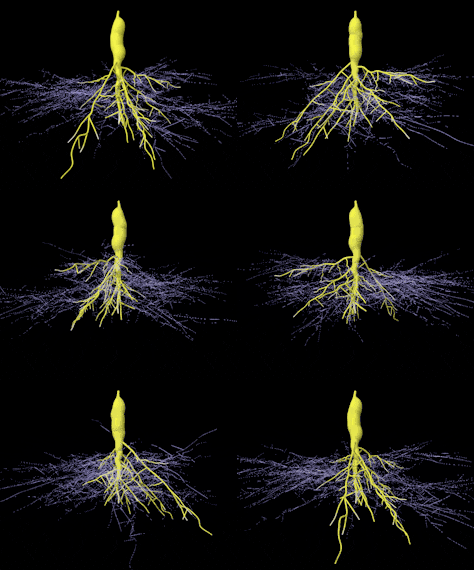
This shows how mycorrhizal fungi (fine white filaments) connect to plant root systems (yellow) and out into the soil. Scivit/Wikipedia

This fungi-plant partnership is 400 million years old

Mycorrhizal fungi are hard to spot, but their effects are startling. They thread networks of microscopic filaments through the soil and into the roots of almost every plant on earth.

But this is no hostile takeover. They’ve been partnering with plants for more than 400 million years. The length of these complex relationships has given them a vital role in our ecosystems.

Tiếp tục đọc “Hidden carbon: Fungi and their ‘necromass’ absorb one-third of the carbon emitted by burning fossil fuels every year”

Global shipping is under pressure to stop its heavy fuel oil use fast – that’s not simple, but changes are coming

theconversation.com

Published: April 24, 2023 1.26pm BST

Most of the clothing and gadgets you buy in stores today were once in shipping containers, sailing across the ocean. Ships carry over 80% of the world’s traded goods. But they have a problem – the majority of them burn heavy sulfur fuel oil, which is a driver of climate change.

While cargo ships’ engines have become more efficient over time, the industry is under growing pressure to eliminate its carbon footprint.

European Union legislators reached an agreement to require an 80% drop in shipping fuels’ greenhouse gas intensity by 2050 and to require shipping lines to pay for the greenhouse gases their ships release. The International Maritime Organization, the United Nations agency that regulates international shipping, also plans to strengthen its climate strategy this summer. The IMO’s current goal is to cut shipping emissions 50% by 2050. President Joe Biden said on April 20, 2023, that the U.S. would push for a new international goal of zero emissions by 2050 instead.

We asked maritime industry researcher Don Maier if the industry can meet those tougher targets.

Our mission is to share knowledge and inform decisions.

About us

Why is it so hard for shipping to transition away from fossil fuels?

Economics and the lifespan of ships are two primary reasons.

Most of the big shippers’ fleets are less than 20 years old, but even the newer builds don’t necessarily have the most advanced technology. It takes roughly a year and a half to come out with a new build of a ship, and it will still be based on technology from a few years ago. So, most of the engines still run on fossil fuel oil.

Tiếp tục đọc “Global shipping is under pressure to stop its heavy fuel oil use fast – that’s not simple, but changes are coming”

Can the world’s most polluting heavy industries decarbonize?

Grist.org

The production of steel, cement, and ammonia emit about one-fifth of all human-caused CO2. Technologies are emerging to decarbonize these problem industries, but analysts warn that big challenges remain.

A blast furnace at a steel mill in Salzgitter, Germany.
A blast furnace at a steel mill in Salzgitter, Germany. PLUS49 / CONSTRUCTION PHOTOGRAPHY / AVALON / GETTY IMAGES

This story was originally published by Yale Environment 360 and is reproduced here as part of the Climate Desk collaboration.

We know how to decarbonize energy production with renewable fuels and land transportation with electric vehicles. Blueprints for greening shipping and aircraft are being drawn up. But what about the big industrial processes? They look set to become decarbonization holdouts — the last and hardest CO2 emissions that we must eliminate if we are to achieve net-zero emissions by mid-century. In particular, how are we to green the three biggest globally-vital heavy industries: steel, cement, and ammonia, which together emit around a fifth of anthropogenic CO2? 

Our modern urban environments are largely constructed from concrete — which is made from cement — and steel. Most of our food is grown through the application of fertilizer made from ammonia. These most ubiquitous industrial materials are produced at huge expense of energy and carbon dioxide emissions. 

Tiếp tục đọc “Can the world’s most polluting heavy industries decarbonize?”

Is it possible to make steel without fossil fuels?

Greenbiz.com

By Josh Owens

September 24, 2020

Steel production
Steel production is an incredibly energy intensive process.

Steel is arguably the single most important resource when it comes to constructing infrastructure.

From roads to railways and the skeleton of most buildings, it is at the very heart of nearly every city on earth. Within those cities, the cars on the road, the cutlery in our kitchens and the furniture in our offices all rely on steel production. Steel production, however, is an incredibly energy intensive process, and the vast majority of this energy comes from fossil fuels.

Globally, steel is responsible for 7-9 percent of all direct emissions from fossil fuels. Most of those emissions come from the burning of coal, which makes up 89 percent of the energy input for blast furnace-basic oxygen furnace (BF-BOF) and 11 percent of the energy input of electric arc furnaces (EAF). Of those two types of steel production, BF-BOF is far more common, making up 75 percent of steel that is produced compared to 25 percent from EAF. Globally, steel is responsible for 7-9% of all direct emissions from fossil fuels.

Tiếp tục đọc “Is it possible to make steel without fossil fuels?”

Carbon Pricing Aids Vietnam’s Efforts Towards Decarbonization

Image

worldbank.org

STORY HIGHLIGHTS

  • Vietnam’s revised Law on Environmental Protection (LEP) to be effective as of January 1, 2022 legalizes the establishment of a carbon market.
  • The carbon market aims to address multiple goals: reducing greenhouse gas (GHG) emissions, enhancing Vietnam’s contribution to global climate change goals, and encouraging greener and cleaner technology innovation.

Tiếp tục đọc “Carbon Pricing Aids Vietnam’s Efforts Towards Decarbonization”

Revealed: the 20 firms behind a third of all carbon emissions

theguardian.com 

New data shows how fossil fuel companies have driven climate crisis despite industry knowing dangers

by  and 

The Guardian today reveals the 20 fossil fuel companies whose relentless exploitation of the world’s oil, gas and coal reserves can be directly linked to more than one-third of all greenhouse gas emissions in the modern era.

New data from world-renowned researchers reveals how this cohort of state-owned and multinational firms are driving the climate emergency that threatens the future of humanity, and details how they have continued to expand their operations despite being aware of the industry’s devastating impact on the planet.

The analysis, by Richard Heede at the Climate Accountability Institute in the US, the world’s leading authority on big oil’s role in the escalating climate emergency, evaluates what the global corporations have extracted from the ground, and the subsequent emissions these fossil fuels are responsible for since 1965 – the point at which experts say the environmental impact of fossil fuels was known by both industry leaders and politicians. Tiếp tục đọc “Revealed: the 20 firms behind a third of all carbon emissions”

Training a Single AI Model Can Emit As Much Carbon As Five Cars

Futurism.com 

Researchers at the University of Massachusetts, Amherst, found that training large artificial intelligence models produces an astonishing amount of carbon emissions — an unexpected cost to the environment.

The process puts out the equivalent amount of carbon dioxide as five lifetime emissions of the average American car, as calculated by MIT Technology Review. That’s more than 626,000 pounds of carbon dioxide — as much as flying from New York to London and back every week for nearly three years.

Carbon Footprint

Tiếp tục đọc “Training a Single AI Model Can Emit As Much Carbon As Five Cars”