Vietnam hopes for Chinese restraint in South China Sea in 2020

DECEMBER 17, 2019 / 12:42 PM

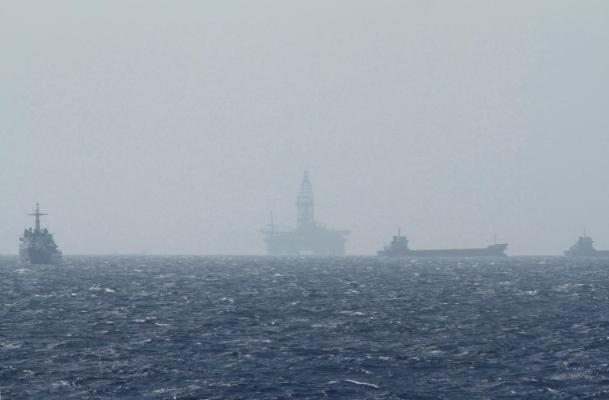
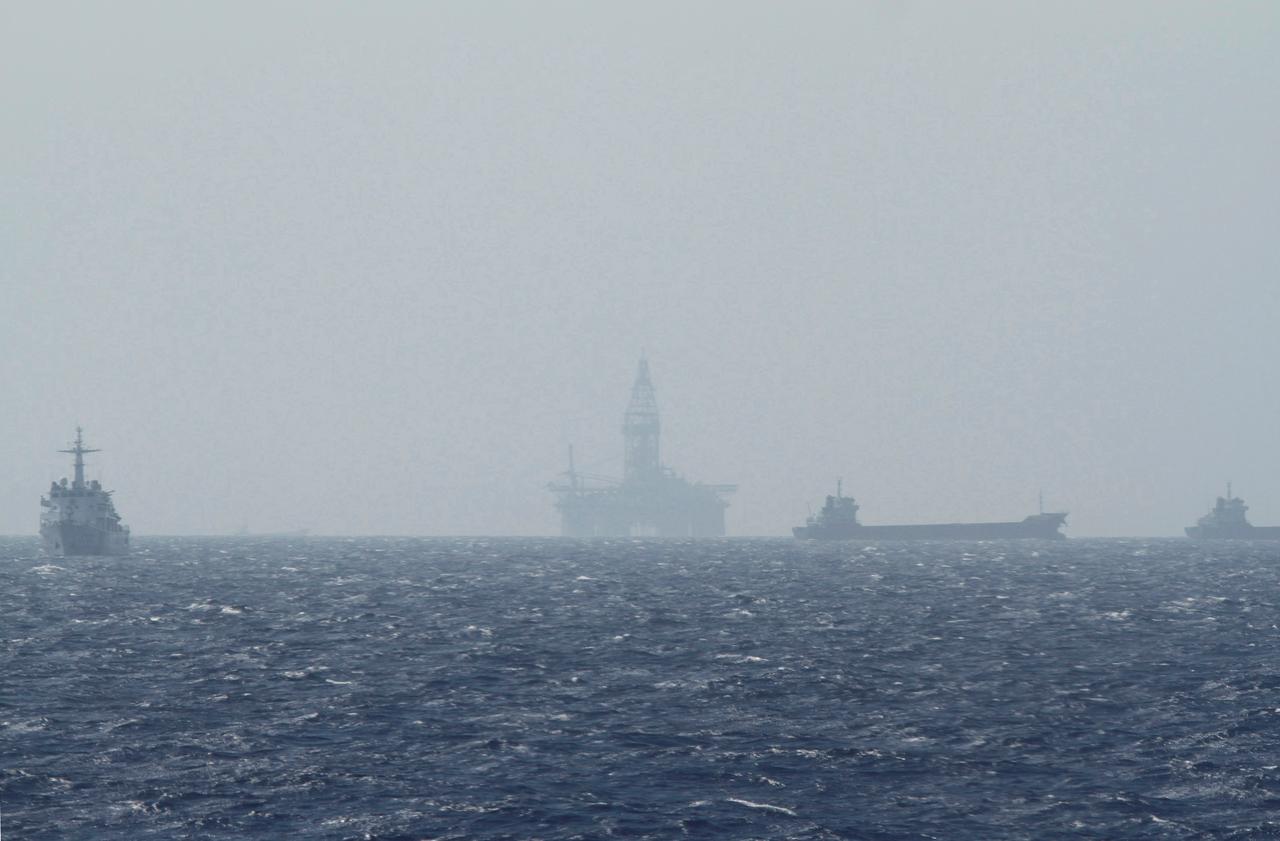
FILE PHOTO: An oil rig (C) which China calls Haiyang Shiyou 981, and Vietnam refers to as Hai Duong 981, is seen in the South China Sea, off the shore of Vietnam in this May 14, 2014 file photo. REUTERS/Minh Nguyen/File Photo

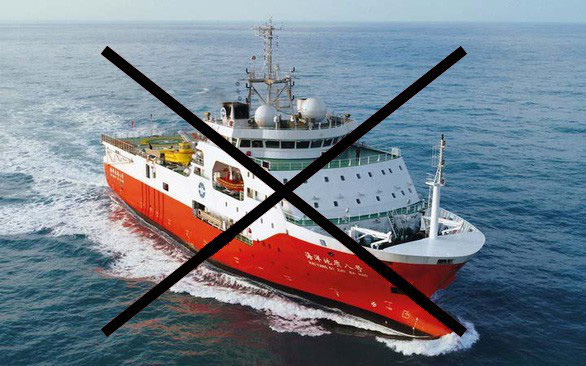
SINGAPORE (Reuters) – Vietnam said it hoped China would show restraint in the South China Sea next year after a Chinese oil survey vessel and its escorts spent months within Vietnam’s exclusive economic zone in what Hanoi called a blatant violation of its sovereignty.

Vietnam, the region’s most forceful challenger of China’s extensive maritime claims to the busy waterway, will take on the rotating chairmanship of the Association of Southeast Asian Nations (ASEAN) in 2020. Tiếp tục đọc “Vietnam hopes for Chinese restraint in South China Sea in 2020”

Sina: Mấy điểm nước lớn cần đề phòng với HQVN

VN Youtuber – 25 thg 11, 2019

Trong bài báo gần đây của Sina, tác giả đã phân tích nhiều mặt và đi đến kết luận rằng: Tuy Hải quân Việt Nam hãy còn những vấn đề thế này thế khác nhưng cũng có những chỗ mạnh không nên coi thường.

Update: China Risks Flare-up over Malaysian, Vietnamese Gas Resources


December 13, 2019  |  AMTI Brief

Update: China Risks Flare-up over Malaysian, Vietnamese Gas Resources

The Chinese survey vessel Haiyang Dizhi 8 along with its coast guard and paramilitary escorts left Vietnam’s exclusive economic zone on October 23, ending a standoff with Vietnamese ships that began more than four months earlier. The de-escalation seems to have been in response to the departure a day earlier of the drilling rig Hakuryu 5 from Vietnam’s oil and gas Block 06-01, which is operated by Russia’s Rosneft.

The standoff began on June 16 when a China Coast Guard (CCG) ship started harassing the Hakuryu 5 and the offshore supply vessels servicing it. Automatic Identification System (AIS) data shows that several CCG ships were deployed in succession to keep up the harassment over the course of the standoff, including the 35111, 45111, 4203, 3308, 5303, and 2305. As ships were relieved, they often traveled to the Chinese outpost on Fiery Cross Reef to resupply before either joining the escort mission around the Haiyang Dizhi 8 or heading back to China.

Exactly how many Chinese and Vietnamese vessels were involved in these two related operations over the course of the standoff is unclear. Those broadcasting AIS—mostly the CCG—almost certainly account for just a small percentage of the total number. Some Vietnamese law enforcement vessels had broadcast AIS during the early weeks of the standoff in July, but soon ceased doing so. In October, Vietnamese Major General Nguyen Minh Hoang announced that 50 Vietnamese and 40 Chinese vessels were involved, while others reported as many as 80 Chinese participants.

Only a few opposing ships seem to have been regularly deployed around the Hakuryu 5 throughout the standoff, suggesting that most of these reported vessels were busing escorting the Haiyang Dizhi 8 or, in the case of the Vietnamese, trying to block its operations. A satellite image from late August captured a Vietnam Fisheries Resource Surveillance vessel positioned between the Hakuryu 5, which was being serviced by an offshore supply vessel (identified via AIS as the Crest Argus 5), and CCG ship 5303. The 56-meter Vietnamese vessel is effectively unarmed and less than half the size of the 138-meter 5303, one of China’s advanced Type 818 Zhaoduan-class cutters which sports a 76-mm cannon.

The Hakuryu 5 broadcast AIS only sporadically during the standoff. Its signal was last seen in Block 06-01 on October 17 and then again in port at Vung Tau, Vietnam, on October 26. This lends credence to social media reports that it had left Block 06-01 on October 22 after completing its drilling work. AIS data shows that the last CCG vessel assigned to the area, the 31302 (since renamed the 2305) left the same day heading north. It joined up with the Haiyang Dizhi 8 and its escorts a day later and together the group returned to Hainan.

As for the Haiyang Dizhi 8, it moved north after the first few weeks of the standoff, extending its survey over a much wider area for the next three months. In hindsight, it is clear that the survey area closely matched a group of oil and gas exploration blocks that the China National Offshore Oil Corporation unsuccessfully offered up for foreign bidding in 2012.

Over the course of the standoff, the Haiyang Dizhi 8 and its CCG escorts made multiple resupply trips to Fiery Cross Reef. While ultimately unsuccessful in persuading Vietnam to halt Rosneft’s drilling work in block 06-01, China’s operations demonstrated that its Spratly outposts now allow it to conduct extended pressure campaigns, increasing the costs and risks for its neighbors to operate within the nine dash line.

###

The Center for Strategic and International Studies (CSIS) is a bipartisan, nonprofit organization founded in 1962 and headquartered in Washington, D.C. It seeks to advance global security and prosperity by providing strategic insights and policy solutions to decisionmakers.

Vietnam and China promise to keep talking as they look to settle differences over South China Sea

  • Three-day meeting in Beijing ends with pledges to continue working towards a peaceful solution in the disputed waters
  • Talks follow prolonged stand-off in resource-rich waters
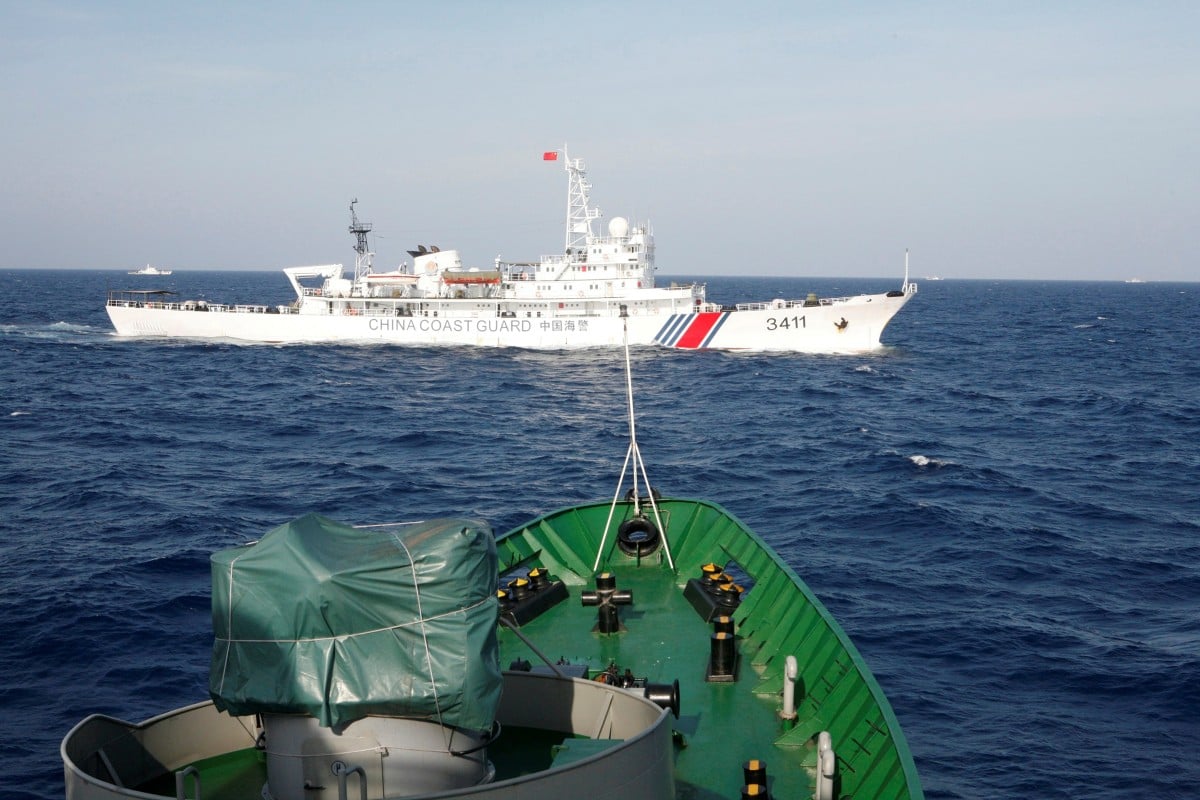
A Chinese coast guard ship photographed from a Vietnamese vessel in the South China Sea. Photo: Reuters

China and Vietnam said that they would continue to look for ways to peacefully resolve their conflict over the South China Sea at the end of a three-day meeting to discuss border issues.

A statement from the Chinese foreign ministry on Friday said the vice-ministerial level talks had discussed border cooperation on land and, more sensitively, maritime issues.

Tiếp tục đọc “Vietnam and China promise to keep talking as they look to settle differences over South China Sea”

Introducing Bach Long Vi island in northern Vietnam

Saturday, November 23, 2019, 15:39 GMT+7 Tuoi Tre
Introducing Bach Long Vi island in northern Vietnam

Bach Long Vi, or “White Dragon’s Tail,” is an island district about 130 kilometers off the northern coastal city of Hai Phong and Vietnam’s furthest territory in the Gulf of Tonkin.

Though the island’s acreage is small, only about 2.5 square kilometers during high tide and four square kilometers during low tide, Bach Long Vi still boasts an impressive combination of golden-yellow sandy beaches and mountains, making it the ideal place to admire gorgeous coastal sunrises and sunsets.

Getting to the island can be a little tricky. It takes up to ten hours to travel from Hai Phong to Bach Long Vi and the 100-seat boat which travels the route only operates three to four times a month.

US warships sail in disputed South China Sea amid tensions

For the U.S., Vietnam Is a Friend in Need

The threat of China should bring two former enemies into a tight security relationship.

Vietnam chasing China at sea. Photographer: Hoang Dinh Nam/AFP/Getty Images

Vietnam is a country bursting with youthful energy. The nearly 100 million Vietnamese have an average age of just 31, and despite living under single-party communist rule, they have a thriving capitalist economy that may hit 10% growth this year. And, of great importance to the U.S. and its allies, Vietnam is strategically positioned along the western side of the South China Sea, and has a series of maritime disputes with its neighbors, especially China.
< Tiếp tục đọc “For the U.S., Vietnam Is a Friend in Need”

Vietnam Shows Malaysia And The Philippines How To Fight The South China Sea Wars

Beijing should either get the South China Sea map right or forget the Vietnamese market — for every Chinese product, from smartphones to automobiles.

Tiếp tục đọc “Vietnam Shows Malaysia And The Philippines How To Fight The South China Sea Wars”

Chuyên gia Nhật: Cần chỉ đích danh nước nào đang thách thức luật pháp quốc tế ở Biển Đông

Thứ Hai, 18/11/2019 06:31 AM GMT+7

(VTC News) – Việt Nam và các nước ASEAN cần sử dụng tất cả các kênh truyền thông chỉ đích danh nước nào đang thách thức hệ thống pháp luật quốc tế trong vấn đề Biển Đông.

Thời gian qua, Việt Nam và một số nước ASEAN rất bức xúc trước việc hàng loạt các mặt hàng, ấn phẩm từ sách, bản đồ, phim ảnh, ứng dụng điều hướng trên ô tô… bị Trung Quốc cài cắm “đường lưỡi bò”. Thủ đoạn xảo quyệt, tinh vi này được xem là một phần trong chiến dịch tổng thể, nhằm mưu đồ chiếm trọn Biển Đông của Trung Quốc.

Tiến sĩ Takashi Hosoda, người Nhật, hiện là giảng viên Đại học Tổng hợp Charles (Cộng hòa Séc) trả lời PV VTC News liên quan đến chiến dịch tâm lý nhằm phổ biến “đường lưỡi bò” bất hợp pháp của Trung Quốc trong khu vực. Tiếp tục đọc “Chuyên gia Nhật: Cần chỉ đích danh nước nào đang thách thức luật pháp quốc tế ở Biển Đông”

Foreign experts criticize China’s actions in East Vietnam Sea

Foreign experts criticize China’s actions in East Vietnam Sea
Vietnamese Deputy Minister of Foreign Affairs Le Hoai Trung speaks at the 11th [East Vietnam Sea] International Conference in Hanoi on November 6, 2019. Photo: Nhat Dang / Tuoi Tre

Sự bịa đặt, vu cáo trắng trợn của Cảnh Sảng

Thứ Tư, 13/11/2019 16:38 PM GMT+7

(VTC News) – Phát biểu của ông Cảnh Sảng vu cáo Việt Nam “chiếm đảo” là sự leo thang mới trong những bịa đặt, vu cáo trắng trợn của Trung Quốc liên quan Biển Đông.

Ngày 8/11, tại buổi họp báo thường kỳ của Bộ Ngoại giao Trung Quốc, trả lời câu hỏi của phóng viên về việc “Việt Nam có thể xem xét các lựa chọn pháp lý để giải quyết tranh chấp với Trung Quốc ở Biển Đông, phản ứng của Trung Quốc là gì?”, người phát ngôn Bộ Ngoại giao Trung Quốc Cảnh Sảng ngang ngược cho biết: “Cốt lõi của vấn đề Biển Đông là vấn đề lãnh thổ, liên quan đến sự chiếm đóng quần đảo Nam Sa của Trung Quốc bởi Việt Nam và các nước khác có liên quan”.

Tiếp tục đọc “Sự bịa đặt, vu cáo trắng trợn của Cảnh Sảng”

Chinese ship Haiyang Dizhi 8 exits Vietnam’s waters: marine data

tuoitrenews – Friday, October 25, 2019, 10:28 GMT+7
Chinese ship Haiyang Dizhi 8 exits Vietnam's waters: marine data
The Chinese geological survey vessel Haiyang Dizhi 8.

A Chinese oil survey vessel that had been operating illegally in Vietnam’s Exclusive Economic Zone (EEZ) and Continental Shelf for more than three months made its exit from Vietnam’s waters on Thursday, Reuters reported.

The Chinese vessel, the Haiyang Dizhi 8, was tracked speeding away from Vietnam’s EEZ towards China on Thursday under the escort of at least two Chinese ships, Reuters reported, citing data from Marine Traffic, a website that tracks vessels. Tiếp tục đọc “Chinese ship Haiyang Dizhi 8 exits Vietnam’s waters: marine data”

US is helping improve Vietnam Coast Guard capabilities: Admiral

hanoitimes – Updated at Tuesday, 22 Oct 2019, 10:42

The support focuses on maintenance and maintenance augmentation together with key leader exchange.

The US Coast Guard Commandant, Admiral Karl L. Schultz, has said that they are working with other US government agencies to build out the Vietnamese Coast Guard and its capabilities and capacities.

The US Coast Guard Commandant, Admiral Karl L. Schultz. Source: Maritimeexecutive

“We’re really focused on maintenance support or maintenance augmentation,” Admiral Karl L. Schultz said in a teleconference on October 21. “I’d say cooperation with Vietnam is very strong.” Tiếp tục đọc “US is helping improve Vietnam Coast Guard capabilities: Admiral”