The countries’ opposing ideologies amid clashing sovereignty claims could lead to years of militarisation and confrontation in the region if not contained, analysts warn
Manila has been boosting defence ties with various countries with the aim of building ‘collective deterrence’ in the event of conflict in the region
The recent trading of barbs between China and the Philippines over ideological differences highlights the “perennial mistrust” between the two neighbours, experts say, noting that their disparate approaches to democracy and authoritarianism are likely to further escalate tensions in the South China Sea.
The Blue Security Program engages with and facilitates high quality research on issues of critical maritime security across the Indo-Pacific.
Bringing together leading regional experts in politics, international law and strategic studies, Blue Security focuses on three key pillars of maritime security: order, law and power.
Blue Security is a collaboration between La Trobe Asia, Griffith Asia Institute (GAI), University of New South Wales Canberra (ADFA), University of Western Australia’s Defence and Security Institute (DSI), United States Studies Centre at the University of Sydney and the Asia-Pacific Development, Diplomacy & Defence Dialogue (AP4D). It produces working papers, commentaries, and scholarly publications related to maritime security for audiences across the Indo-Pacific.
China’s alleged abuse of the world’s oceans was examined in recent studies into its vast fishing fleet, which is accused of destroying maritime ecosystems far from its shores and perpetuating the industry’s forced labor practices.
China-flagged ships on the high seas were involved in “theft on a grand scale, unrestricted warfare on natural resources,” said a report by the SeaLight project, which says it uses “commercially available technology to shed light on the maritime ‘gray zone.'”
Illegal, unregulated and unreported (IUU) fishing by Chinese vessels was happening throughout the Asia-Pacific, including within other countries’ exclusive economic zones (EEZ), according to SeaLight, which is under Stanford’s Gordian Knot Center for National Security Innovation.
China’s predatory fishing fleets are denuding fish stocks and marine ecosystems on an unprecedented industrial scale. International collective action is urgently needed.
The desecration of maritime habitats and life-sustaining coral reefs is a clear and present threat at the hands of China’s massive fishing fleet. The maritime equivalent to poisoning a sovereign nation’s local farms, this threat has already had multi-generational impacts to the economy, climate and food supplies. Collaborative and bold solutions are imperative.
Admiral Linda Fagan, Commandant of the U.S. Coast Guard, identified China as one of the prime culprits in illegal, unregulated and unreported fishing, committing “theft of a nation’s natural resources.” Chinese fishing vessels steal coral for jewelry, giant clams for the ivory industry, and fish stocks to feed its own population. This is theft on a grand scale, unrestricted warfare on natural resources. The pilfering is happening across Asia, throughout the Pacific as far west as the Galapagos Islands, and off the West African coast, even within exclusive economic zones (EEZ) to which countries have a sovereign right to all natural resources.
Do not clam up on this issue just because it is only coral, clams and fish. Coral and giant clams are the life source of the ocean, easing the impacts of climate change, providing a protective breeding ground for fish, and serving as water filters. Giant clams increase the biodiversity of the coral which supports vital fisheries in the South China Sea. These fisheries account for 12% of the world’s catch and 28% of the protein to sustain human life in the region. The ongoing destruction at the hands of Chinese fishermen guarantees a loss of environmental and food security for future generations across the region.
US-China: Is A New NATO Emerging In Asia? | When Titans Clash 2 – Part 1/3 | CNA Documentary
CNA Insider – 29-4-2022
As the Ukraine crisis unfolds, China accuses the US of creating an Indo-Pacific version of NATO, and warns of a “Ukraine style tragedy” for Asia. On the other hand, countries like Japan, Philippines, India, Australia and South Korea, seek closer ties to the US as concerns emerge over China’s actions. Could Asia witness a war in the years ahead? Tiếp tục đọc “When titans clash 2 (3 parts)”→
China’s People’s Liberation Army celebrates its centenary in 2027, what are its goals for this date? The PLA is already the largest army in the world with over 2 million soldiers. It also has the biggest number of warships. But China’s defense budget is still climbing amidst increasing geopolitical tensions. How exactly is the PLA “preparing for Dangerous Storms” as tasked by President Xi?
Amidst rising tensions in the South China Sea and the Taiwan Strait, the American military is set to expand its presence in the Philippines. The Marcos administration wants to increase the number of US forces in the country, by allowing Americans access to four additional military bases including Palawan and Cagayan, through the Enhanced Defense Cooperation Agreement (EDCA). This move reverses the cooling US-Filipino ties under President Duterte. But the long, storied history between the two countries could complicate the return of US troops. At the same time, Chinese investments in the archipelago are in jeopardy, as Beijing protests the move. What is behind this troop buildup in the Philippines, and could this raise the temperature in the region, as China reacts to the growing American might at its doorstep?
As the two superpowers compete for dominance in the Pacific, Dena Takruri asks Filipinos how they feel being caught in the middle. Who is the bigger threat to the Philippines: the U.S. or China?
At the 56th ASEAN Ministerial Meeting and its related meetings in Jakarta in July, it was announced that negotiations for the Code of Conduct of Parties in the South China Sea (COC) had achieved progress on two fronts. First, the second reading of the Single Draft COC Negotiating Text was completed. Second, a set of Guidelines for Accelerating the Early Conclusion of an Effective and Substantive Code of Conduct in the South China Sea was adopted at the Post Ministerial Conference 10+1 Meeting with China. As a matter of fact, these developments are rather more procedural (and perhaps political) than substantive.
This PacNet was developed as a part of the United States-Japan-Republic of Korea Trilateral Next-Generation Leaders Dialogue to encourage creative thinking about how this vital partnership can be fostered. For previous entries please click here and here.
The AUKUS security agreement, cemented between Australia, the United States, and the United Kingdom in September 2021, enhances regional partnership in the Indo-Pacific by facilitating technology sharing, strengthened supply chains, and the acquisition of nuclear powered, conventionally armed submarines for Australia. The pact also creates a pathway to establish engagements focused on renewing, strengthening, and expanding military cooperation between AUKUS, South Korea, and Japan.
Hunter Marston is an Adjunct Research Fellow at La Trobe Asia with La Trobe University, Melbourne, a PhD candidate in International Relations at Australian National University in the Coral Bell School of Asia-Pacific Affairs, and an Associate with 9DashLine. He was previously a 2021 nonresident WSD-Handa Fellow at the Pacific Forum in Honolulu and the recipient of a Robert J. Myers Fellows Fund from the Carnegie Council for Ethics in International Affairs. From 2015-2019, he was a Senior Research Assistant for the Center for East Asia Policy Studies and The India Project at the Brookings Institution. He also worked in the Center for Strategic & International Studies’ (CSIS) Southeast Asia program. He completed his Masters in Southeast Asia Studies and Masters in Public Administration at the University of Washington in 2013. In 2012 Hunter was a Harold Rosenthal Fellow in International Relations in the U.S. Embassy in Myanmar. He is the co-host of the Undiplomatic Podcast on international affairs and writes regularly on Southeast Asian politics and U.S. foreign policy. His work has appeared in Contemporary Southeast Asia, the New York Times, Foreign Affairs, Foreign Policy, and the Washington Post.
Dr. Bich Tran is a postdoctoral fellow at the Lee Kuan Yew School of Public Policy, National University of Singapore. In addition to being an adjunct fellow at the Center for Strategic and International Studies (CSIS) in Washington DC, she has been a visiting fellow at the East West Center, International Institute for Strategic Studies (IISS-Asia), and ISEAS-Yusof Ishak Institute among others. Dr. Tran obtained her PhD in Political Science from the University of Antwerp in Belgium. Her research interests include Vietnam’s grand strategy, Southeast Asian states’ relations with major powers, and political leadership. She has published on various platforms, including Asia Pacific Issues, Asian Perspective, Asian Politics & Policy, The Diplomat, East Asia Forum, and Fulcrum. Dr. Tran is the author of “Vietnam’s Strategic Adjustments and US Policy” (Survival 64, no. 6, 77–90)
Elina Noor is a senior fellow in the Asia Program at Carnegie where she focuses on developments in Southeast Asia, particularly the impact and implications of technology in reshaping power dynamics, governance, and nation-building in the region. Previously, Elina was director of political-security affairs and deputy director of the Washington, D.C. office at the Asia Society Policy Institute. Prior to that, Elina was an associate professor at the Daniel K. Inouye Asia-Pacific Center for Security Studies in Honolulu. She spent most of her career at the Institute of Strategic and International Studies Malaysia, where she last held the position of director, foreign policy and security studies. Elina was also formerly with the Brookings Institution’s Project on U.S. Relations with the Islamic World. Between 2017 and 2019, Elina was a member of the Global Commission on the Stability of Cyberspace. She currently serves on the ICRC’s Global Advisory Board on digital threats during conflict.
Javad Heydarian is a Senior Lecturer at the University of the Philippines, Asian Center, a columnist at the Philippine Daily Inquirer, and a Television Host at TV5 Network. He has written for the world’s leading publications, including The New York Times, Washington Post, The Guardian, and Foreign Affairs. He is the author of, among others, “Asia’s New Battlefield” (Zed, 2015), The Rise of Duterte: A Populist Revolt against Elite Democracy” (Palgrave Macmillan, 2017) and “The Indo-Pacific: Trump, China, and the New Global Struggle for Mastery” (Palgrave Macmillan, 2019). He is also a regular contributor to leading global think tanks such as Center for Strategic and International Studies (CSIS), Brooking Institution, and Council on Foreign Relations (CFR). His forthcoming book is “China’s New Empire” (Melbourne University Press)
INTRODUCTION
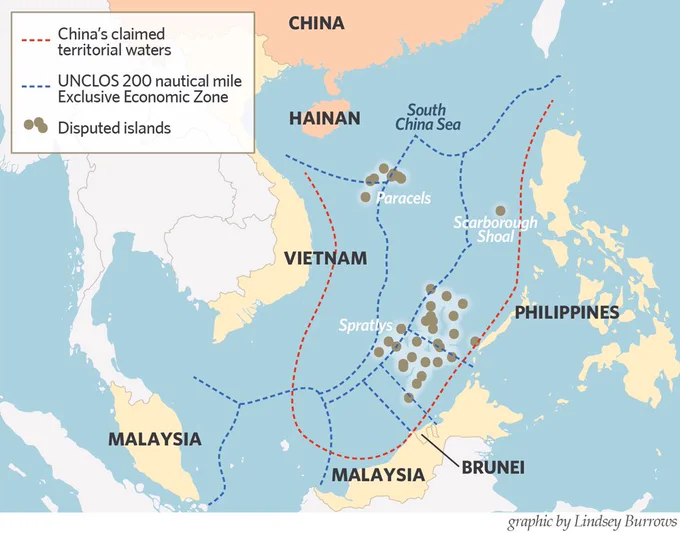
Sailors have an expression, “fair winds and following seas,” to describe the favourable conditions which they desire when setting out to sea. Much like these seafarers, Southeast Asian maritime nations seek stable and peaceful waters for their security and prosperity. The South China Sea has long vexed regional policymakers and security strategists due to both the number and complexity of overlapping maritime territorial claims among regional actors, including Brunei, China, Malaysia, the Philippines, Taiwan and Vietnam.
In the past two decades, China’s increasingly expansionist tendencies and willingness to use force to coerce or intimidate smaller claimants has reinforced growing threat perceptions vis-à-vis Beijing and fuelled hedging strategies. In February 2023, a Chinese Coast Guard (CCG) vessel targeted Filipino counterparts with a military-grade laser in the Spratly Islands.1 The following month, a CCG vessel caused a dangerous encounter with Vietnamese patrol boats during a patrol of Vietnamese oil and gas fields around Vanguard Bank. Around this time, a CCG vessel was also seen operating in close proximity to Malaysia’s Kasawari gas project near Luconia Shoals, prompting the Malaysian Navy to dispatch a Keris-class littoral ship to the area.
As a result of Chinese intimidation, Southeast Asian states have begun to prioritise maritime security as a central component of national defence and security strategies. While power asymmetry between regional states and China makes a concerted pushback against Chinese coercion unpalatable, arguably no state has mounted a consistent or coherent response to deal with this security challenge. Rather, Southeast Asian countries have adopted an array of hedging tactics to deepen engagement with China while bolstering their own domestic defence capabilities and simultaneously expanding security cooperation with a variety of external partners, including Australia, Japan, and Korea.
Hedging refers to insurance-seeking behaviour meant to signal ambiguity in a state’s alignment while cultivating fall-back options to preserve maximum autonomy. Few existing studies of hedging have considered the central role that maritime security plays in regional countries’ foreign policies. This paper therefore clarifies the maritime security strategies of three Southeast Asian claimant states (Malaysia, the Philippines, and Vietnam) to assess how such strategies map onto or deviate from existing notions of hedging. In each of the case studies below, maritime security strategy is reflective of a state’s broader hedging strategy and mirrors the same fundamental tensions: power asymmetry, geographic proximity to a security threat, lack of political consensus, and profound strategic uncertainty, namely fears of abandonment or entrapment in a great power conflict. Seen in this light, maritime security strategy is a manifestation of states’ deeply ingrained preferences for ambiguity and unwillingness to choose sides in brewing superpower competition.
The paper concludes with a brief summary assessing the parallels between the three case studies and what they tell us about hedging and maritime security strategy






 CVD
CVD 