
thebulletin.com
By David Spratt, January 16, 2020
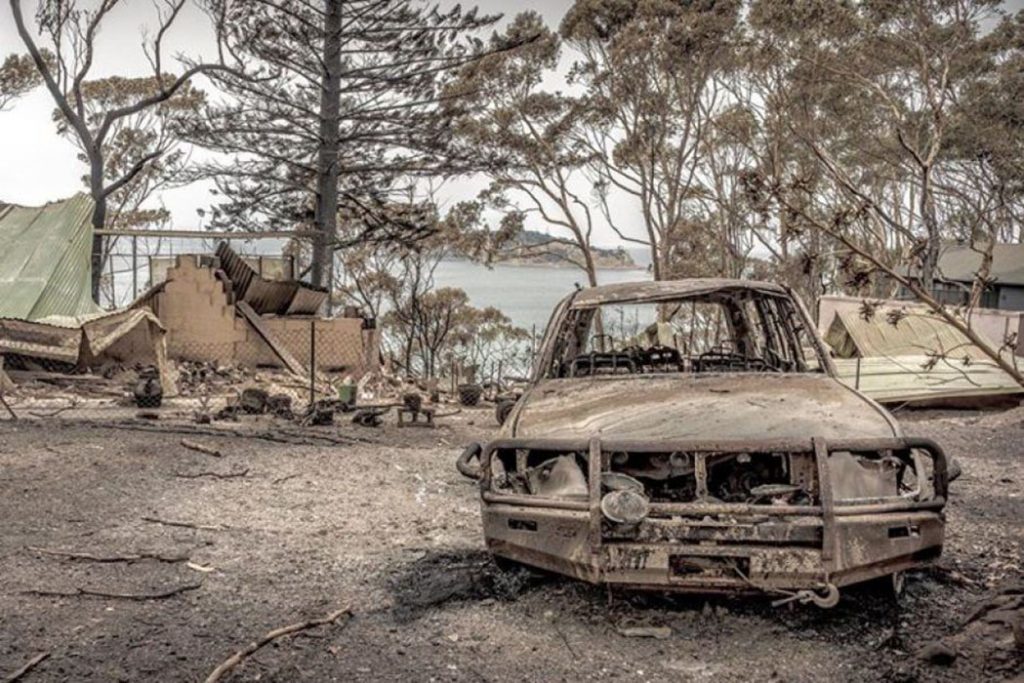 Aftermath of January 2020 wildfires in Rosedale, Victoria, about 184 kilometers east of Melbourne, Australia. Image courtesy Alan Meredith
“We are unleashing hell on Australia.”
Those were the words that David Karoly of the University of Melbourne used to portray the wildfires ravaging the lands down-under more than a decade ago. Yes, you read that right: this professor of climate change and climate variability had described an Australia of increased heat, drought, and catastrophic fire way back in 2009—not long after a round of wildfires had previously ravaged the landscape.
It turns out that while Australia’s 2019-20 summer wildfires may well be harbingers of death on a hotter planet for at least the rest of this century, they did not come without advance warning. The question now is: What are we going to do about it?
But first, let’s go back to those warnings, and how we got to this position.
Karoly’s research had, in part, focused on what is known here as Black Saturday—February 7, 2009—when devastating fires killed 173 people. (And another 374 extreme-heat-related deaths were attributed to the record-breaking heatwave across southern Australia that had set the stage for the flames.) Firefighters faced unprecedented conditions: high winds, very low humidity, a land dried by 10 years of drought, and a fire index reaching 170 on a 0-to-100 scale. The temperature hit a record 115.5 degrees Fahrenheit in the city of Melbourne and 119.8 degrees Fahrenheit in Victoria as a whole—the Australian state in which Melbourne sits. The amount of energy released by the fires was estimated to be the equivalent of around 1,500 Hiroshima atomic bombs.
Tiếp tục đọc “On a hotter planet, we are all Australians”
 CVD
CVD 