Hope for Hanoi? New bus system could cut pollution … if enough people use it

A new $53m BRT (bus rapid transit) system has the power to reduce Hanoi’s dreadful air pollution. Persuading residents of Vietnam’s rapidly expanding capital to ditch their motorbikes and private cars, however, will be another story
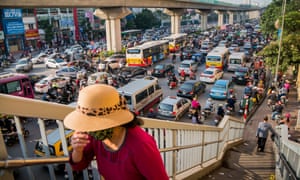
Traffic jam in Hanoi
The swarm of motorbikes and cars is the main cause of Hanoi’s air pollution. Photograph: Linh Pham/Getty Images

From his high-rise office building in Hanoi, Tran Dung can barely see his city’s skyline behind the thick layer of smog. Before leaving work, the 25-year-old executive assistant checks the pollution reading on his AirVisual app, which provides real-time measurements of PM2.5 – the tiny particles found in smog that can damage your throat and lungs.

Hanoi’s PM2.5 levels typically range from 100 to 200 micrograms per cubic metre – regularly within the globally acknowledged “unhealthy” category. But on 19 December last year, they hit “hazardous levels” at 343μg/m3, which was higher than Beijing. Tiếp tục đọc “Hope for Hanoi? New bus system could cut pollution … if enough people use it”

‘We had to sue’: the five lawyers taking on China’s authorities over smog

In an unprecedented legal case, a group of Chinese lawyers have charged the governments of Beijing, Tianjin and Hebei with failing to protect their citizens from air pollution, which is linked to a third of all deaths in the country

Pinterest
Airpocalypse now: time-lapse video of smog posted by Beijing-based Briton Chas Pope on 1 January this year

Who is responsible for China’s chronic and deadly air pollution? That depends on who you ask. Officials blame the weather or outdoor barbecues, activists blame steel companies and coal-fired power plants. But Yu Wensheng blames only one actor: the government.

The 50-year-old lawyer recently launched an unprecedented suit against the authorities in three regions in China, claiming they have failed in their responsibilities. For a government with the motto “Serve the People”, Yu feels the officials are serving other interests by allowing nearly half a billion people to choke on toxic smog. Tiếp tục đọc “‘We had to sue’: the five lawyers taking on China’s authorities over smog”

Energy and Air Pollution 2016 – World Energy Outlook Special Report

World Energy Outlook: Released on 27 June 2016

Full reportAcknowledgements | Table of Contents

Executive Summaries
Chinese | English | French

‌‌• Around 6.5 million premature deaths each year can be attributed to air pollution
• Energy production and use are by far the largest man-made sources of air pollutants
• Technologies to tackle air pollution are well known

Clean air is vital for good health. Yet despite growing recognition of this imperative, the problem of air pollution is far from solved in many countries, and the global health impacts risk intensifying in the decades to come.

The scale of the public health crisis caused by air pollution and the importance of the energy sector to its resolution are the reasons why the IEA is focusing on this critical topic for the first time.

Based on new data for pollutant emissions in 2015 and projections to 2040, this special report, the latest in the World Energy Outlook series, provides a global outlook for energy and air pollution as well as detailed profiles of key countries and regions: the United States, Mexico, the European Union, China, India, Southeast Asia and Africa.

In a Clean Air Scenario, the report proposes a pragmatic and attainable strategy to reconcile the world’s energy requirements with its need for cleaner air. Alongside the multiple benefits to human health, this strategy shows that resolving the world’s air pollution problem can go hand-in-hand with progress towards other environmental and development goals.

See related material

‌• Press release
Presentation to the press