TTCT – Cuối tháng 6 này, thao diễn hải quân hằng năm RIMPAC của Mỹ, quy tụ hải quân 26 quốc gia, sẽ khai diễn. Trước đó, từ cuối tháng 5, hải quân Trung Quốc và Nga đã độc lập diễn tập cũng trên Thái Bình Dương. Bên cạnh quan hệ đối kháng sẵn có, năm nay còn thêm tác động của cuộc chiến Ukraine, nên các cuộc diễn tập này càng hàm chứa tính đối đầu.
Hôm 3-6, Hãng tin Thổ Nhĩ Kỳ AA loan tin 40 tàu chiến và 20 máy bay tham gia diễn tập thuộc hạm đội Thái Bình Dương của Nga tại phía đông nước này từ ngày 3 tới 10-6.
Cũng theo AA, cuộc tập trận nhằm phối hợp nhóm tàu trên với không quân của hải quân trong việc rèn kỹ năng săn ngầm, tác xạ các mục tiêu trên mặt nước và trên không, đồng thời tổ chức tiếp tế trên biển cho hải quân trong vùng biển Thái Bình Dương.
Binh sĩ các nước Úc, Mỹ, Sri Lanka, Malaysia, Brunei, Nhật Bản, và New Zealand chụp ảnh chung trên tàu sân bay trực thăng HMAS Adelaide trong cuộc tập trận RIMPAC 2018. Ảnh: navy.mil
The Partnership for Global Infrastructure and Investmentwill deliver game-changing projects to close the infrastructure gap in developing countries, strengthen the global economy and supply chains, and advance U.S. national security
President Biden will announce new flagship projects and lay out the Administration’s comprehensive effort to execute the Partnership for Global Infrastructure and Investment.
At the 2021 G7 Summit, President Biden and G7 leaders announced their intent to develop a values-driven, high-impact, and transparent infrastructure partnership to meet the enormous infrastructure needs of low- and middle-income countries and support the United States’ and its allies’ economic and national security interests. Over the past year, members of the Administration have traveled to hear directly from countries on how we can meet their infrastructure needs, deepened our coordination across the U.S Government and with the G7, honed our infrastructure investment tools, and closed game-changing deals.
‘Years of economic mismanagement’: Why Sri Lanka has a fuel crisis 05:11
(CNN Business)In Sri Lanka, people queue for miles to fill a tank of fuel. In Bangladesh, shops shut at 8 p.m. to conserve energy. In India and Pakistan, power outages force schools to shut, businesses to close and residents to swelter without air conditioning through deadly heat waves in which temperatures top 100 degrees Fahrenheit (37 degrees Celsius).
These are just some of the more eye-catching scenes playing out in the Asia Pacific region, where various countries are facing their worst energy crisis in years — and grappling with the growing discontent and instability caused by knock-on increases in the cost of living.
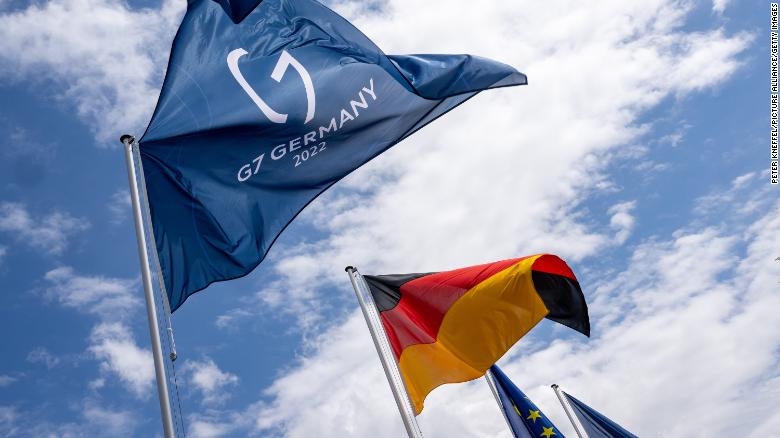
Flags representing the G7 Summit, Germany and the European Union fly ahead of the summit, scheduled to take place at Schloss Elmau in Germany’s Bavaria region from June 26 to 28.
(CNN)What a difference a year makes. Enormous challenges, some of them barely imaginable when the G7 leaders last met 12 months ago, are bearing down on the world’s most prosperous democratic nations as they prepare to meet in Germany.
Optimism was in the air at the Cornish beach resort of Carbis Bay in 2021 as the G7‘s presidents, prime ministers and chancellor met face-to-face for the first time since the Covid-19 pandemic began.
Together they vowed to “beat Covid-19 and build back better,” to “reinvigorate economies,” to “protect our planet” and to “strengthen partnerships.”
But global events have since overtaken their best efforts, and it is far from clear if they will be able to build on those goals this year. Russia’s unprompted invasion of Ukraine is a large and singular cloud, but other thunderheads are gathering too.
Over the next few days, the leaders of Japan, Canada, the United States, the United Kingdom, France, Italy, the European Union and host Germany will meet amid the seclusion of Bavaria’s luxurious Schloss Elmau retreat.
Andrew MullenDeputy Editor, Political Economy 25 June 2022
Dear Global Impact Readers,
Space, they say, is the final frontier. But how far does that frontier go and what’s out there?
China, has in recent years, accelerated all things space as part of its busy science programme we recapped a few weeks ago, from landing a rover on Mars to nearing completion of its Tiangong space station.
This weekend marks the end of Pride month, as cities across the country host events to celebrate the L.G.B.T.Q. community.
It is also a fraught moment in public health: A global outbreak of monkeypox is causing concern, with many of the cases clustered around men who have sex with men.
Experts are now trying to strike a delicate balance, warning people who may be at higher risk, without stigmatizing a community that has often been scapegoated for health scares in the past.
The Supreme Court in a 5-4 decision overturned Roe v. Wade, the landmark ruling that established the constitutional right to abortion.
Roe since 1973 had permitted abortions during the first two trimesters of pregnancy in the United States.
Almost half the states are expected to outlaw or severely restrict abortion as a result of the Supreme Court’s decision on a Mississippi case known as Dobbs v. Jackson Women’s Health Organization.
Justice Samuel Alito wrote the majority opinion. The court’s other five conservatives, including Chief Justice John Roberts, joined in the judgment, which was opposed by the three liberal justices.
Supreme Court overturns Roe v. Wade, ending decades of federal abortion rights
The Supreme Court in a 5-4 decision on Friday overturned Roe v. Wade, the landmark ruling that established the constitutional right to abortion in the U.S. in 1973.
The court’s controversial but expected ruling gives individual states the power to set their own abortion laws without concern of running afoul of Roe, which had permitted abortions during the first two trimesters of pregnancy.
The International Centre for Settlement of Investment Disputes (ICSID) has published the2022 ICSID Rules and Regulationsfor resolving international investment disputes, which come into effect on July 1, 2022.
The updated rules for arbitration, mediation, conciliation, and fact-finding are the outcome of over 5 years of collaboration with State officials, legal counsel, adjudicators, businesses representatives, and civil society. They incorporate innovations designed to make ICSID cases more efficient for parties, to broaden access to ICSID’s facilities and services, and to ensure greater public transparency in the conduct and outcome of proceedings.
This is the first amendment to the ICSID rules since 2006, and the most extensive modernization of ICSID procedures in the Centre’s history.
Innovations introduced in the 2022 Rules and Regulations include:
Tom DannenbaumAssociate Professor of International Law, Tufts University
Alex De WaalResearch Professor and Executive Director of the World Peace Foundation at The Fletcher School, Tufts University
Daniel MaxwellHenry J. Leir Professor in Food Security, Friedman School of Nutrition Science and Policy, Tufts University
Disclosure statement
Alex de Waal is affiliated with the World Peace Foundation.
Daniel Maxwell receives funding from the US Agency for International Development (USAID) and the British Foreign, Commonwealth and Development Office (FCDO). He is a member of the Famine Review Committee for IPC analysis.
Tom Dannenbaum does not work for, consult, own shares in or receive funding from any company or organisation that would benefit from this article, and has disclosed no relevant affiliations beyond their academic appointment.
Partners
Tufts University provides funding as a founding partner of The Conversation US.
Republish our articles for free, online or in print, under Creative Commons licence.
______
A hideous contradiction is playing out in war-torn Ukraine. Thousands of Ukrainians are starving in cities besieged by Russian forces. Meanwhile, the country’s grain stores are bursting with food, and the government is begging for international assistance to export Ukrainian grain to world markets.
Cooking, cleaning, laundry, childcare—domestic labor is essential labor in any society. In Vietnam, a rapidly growing middle class has produced skyrocketing demand for paid domestic workers—both live-in and hourly—particularly in large metropolises like Hanoi and Ho Chi Minh City, and domestic workers have become an important part of the gig economy.
Vấn đề điện hạt nhân tiếp tục được đề cập tại kỳ họp Quốc hội vừa qua. Theo Ủy ban Kinh tế, với lộ trình giảm phát thải tiến tới đạt mức phát thải ròng bằng 0 vào năm 2050, đây là lĩnh vực cần được nghiên cứu, xem xét trong quá trình phát triển giai đoạn tiếp theo.
Quốc hội nước ta đã phê duyệt chủ trương xây dựng nhà máy điện hạt nhân Ninh Thuận năm 2009 và Thủ tướng đã phê duyệt quy hoạch 8 địa điểm xây dựng các nhà máy. Năm 2016 vì các lý do khách quan, Quốc hội ban hành nghị quyết dừng thực hiện dự án này. 8 địa điểm đã được quy hoạch trong quyết định của Thủ tướng, trong đó có 2 địa điểm ưu tiên tại Ninh Thuận (Phước Dinh và Vĩnh Hải) được sử dụng cho nhà máy điện hạt nhân đầu tiên, đến nay về nguyên tắc đang được bảo lưu, chờ quyết định mới của Thủ tướng.
Tại nghị trường vừa qua, một đại biểu đề nghị xóa bỏ quy hoạch các địa điểm này, số khác muốn duy trì để sử dụng khi tái khởi động dự án điện hạt nhân Ninh Thuận trong tương lai. Bộ trưởng Bộ Công Thương thì khẳng định việc dừng thực hiện chủ trương đầu tư dự án điện hạt nhân Ninh Thuận không có nghĩa là “hủy bỏ”. Như vậy đây là vấn đề còn bỏ ngỏ, chờ quyết định cuối cùng của cấp có thẩm quyền.
Trong những ngày liên tục có các lãnh đạo, nhân viên ngành y bị bắt, tôi nhận được nhiều lời động viên, an ủi và cả câu hỏi rằng, chỗ chúng tôi “có xao động gì không”.
Tôi không xao động, không bối rối vì những sự việc ấy xảy ra dễ hiểu. Nhiều nguyên nhân dẫn đến hành vi phạm pháp trong ngành đã được nói đến từ lâu. Có thể kể đến: Mức đãi ngộ thấp dẫn tới tham nhũng vặt để “tự cứu lấy mình”; Bổ nhiệm lãnh đạo không đủ rõ ràng, thậm chí không căn cứ vào chuyên môn, mở đường cho “yếu tố” đồng tiền xuất hiện; Những kẽ hở của pháp luật như mời chào người ta phạm luật, không khác gì cái bẫy.
Giá thuốc là một cái bẫy, một nguyên nhân dẫn đến tham nhũng trong ngành y, điều mà những người lăn lộn trong ngành sẽ thấy rõ.
By Tran Đinh Hoanh Tran Đinh Hoanh is an international litigator and writer in Washington DC.
[TĐH: I’ve tried to make this piece ultra-short, simple, and easy
to remember, with sufficient citations for those who’d like to dig
deeper into UNCLOS]
During China Foreign Ministry Spokesperson Wang Wenbin’s Regular Press Conference on June 13, he responded to a Bloomberg question concerning the legal status of the Taiwan Strait. Asked about Chinese military officials’ contention that the Taiwan Strait does not constitute “international waters,” he said that Taiwan is “an inalienable part of China’s territory. …According to UNCLOS and Chinese laws, the waters of the Taiwan Strait, extending from both shores toward the middle of the Strait, are divided into several zones including internal waters, territorial sea, contiguous zone, and the Exclusive Economic Zone. China has sovereignty, sovereign rights and jurisdiction over the Taiwan Strait.”
He went on to say that calling the strait international waters is “a false claim” by “certain countries” searching for a pretext for “threatening China’s sovereignty and security.”
The Quadrilateral grouping of Australia, India, Japan, and the United States (the Quad) has come a long way from its origins, establishing itself as a crucial pillar of the Indo-Pacific regional architecture and significantly shifting in tone and focus from its early iterations. Since its revival in 2017, the Quad has been elevated to a leader-level dialogue, it has begun issuing joint statements, and it has developed a new working-group structure to facilitate cooperation. It has also significantly broadened and deepened its agenda to include vaccines, climate change, critical and emerging technologies, infrastructure, cyber, and space.
These recent changes to the Quad raise several questions about its future trajectory. What are the drivers of engagement, the domestic support, and the bureaucratic capacity in the four countries to continue investing in the Quad? How well does the Quad’s new working-group structure function, and will the working groups be able to deliver tangible results? How has the Quad’s agenda evolved, and will it return to its initial focus on security challenges? Are the Quad countries open to cooperation with additional countries and, if so, what form will this take?
This paper analyzes these questions drawing on recent publications, official statements, and interviews with key experts and policymakers in the four countries. In doing so, it offers five key takeaways into the Quad as an evolving part of the Indo-Pacific architecture, as well as a vehicle for achieving the goals of its four member countries.
Since its revival in 2017, the Quad has been elevated to a leader-level dialogue, it has begun issuing joint statements, and it has developed a new working-group structure to facilitate cooperation
First, in terms of institutionalization and internal goals, there is little interest among the member countries in further institutionalizing the Quad by establishing a secretariat or adopting a charter. All four consider the flexible nature of the grouping to be an asset. At the same time, the Quad partners have increased their alignment on strategic issues and aim to continue doing so in the near future by solidifying ties within the grouping.



 Andrew MullenDeputy Editor, Political Economy 25 June 2022


 We believe in the free flow of information



 CVD
CVD 