
| Top of the Agenda OPEC+ Weighs Deep Supply Cuts Despite U.S. Concerns The Organization of the Petroleum Exporting Countries (OPEC) and oil producers such as Russia are considering a sizable cut (NYT) in their oil output as they meet in Vienna today. The bloc and its allies, a grouping known as OPEC+, could cut production by two million barrels per day, or about 2 percent of global supply. The United States has lobbied Saudi Arabia against such a measure. Also today, European Union (EU) countries agreed (Reuters, AFP) to impose a price cap on Russian oil sales to third countries as part of a new sanctions package on Russia. The idea for a price cap was originally proposed by the Group of Seven (G7). G7 countries that aren’t part of the EU are expected to enact laws (NYT) similar to the EU’s to enforce the price cap. |
Người ươm mầm cây rừng
SGGP Thứ Sáu, 17/6/2022 10:02
Từng là người chặt gỗ trong các cánh rừng miền tây Quảng Bình, ông Nguyễn Đức Sự (ở thôn Tân Tiến, xã Cao Quảng, huyện Tuyên Hóa, tỉnh Quảng Bình) không nghĩ có ngày trở thành người giảng dạy cho nông dân nhiều vùng trồng rừng bằng chính kiến thức của mình học được. Không những thế, ông còn trở thành nhà thực vật thực thụ khi tiến hành ươm mầm gần 2.500 loài thực vật có hạt từ các cánh rừng quê ông.
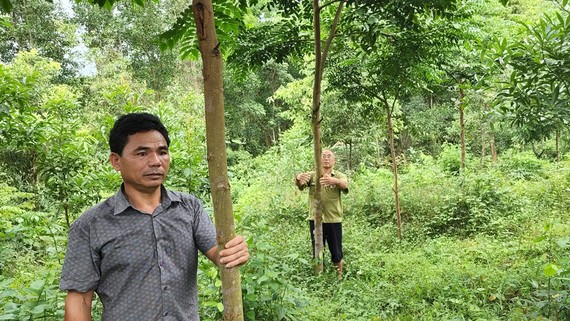
Một góc rừng lim 3 năm tuổi do ông Sự ươm trồng tại xã Cao Quảng, huyện Tuyên Hóa, Quảng Bình
How Russian timber bypasses U.S. sanctions by way of Vietnam
A new report says Russian birch wood is routed through Asia before being shipped to American stores.
Washingtonpost – By Michael Tatarski

Plywood allegedly made from Russian birch is being loaded on a ship in Haiphong, Vietnam, for export to the United States in May 2022. (Obtained by Environmental Investigation Agency)
October 1, 2022 at 2:00 a.m. EDT
HO CHI MINH CITY, Vietnam — Russian birch wood has continued to flow to American consumers, disguised as Asian products, despite U.S. economic sanctions imposed on Russia over its invasion of Ukraine, a new report says.
The Environmental Investigation Agency (EIA), a nonprofit watchdog group based in Britain, has found that most birch products currently being exported from Vietnam to the United States originate in Russia. According to Vietnam customs data, roughly 40,000 cubic meters of birch wood is transported every month from Russia andChina into Vietnam, where it’s assembled into furniture and plywood.
Tiếp tục đọc “How Russian timber bypasses U.S. sanctions by way of Vietnam”
Vietnam GDP grows 13.67% in Q3 on brisk exports to U.S.
Big leap also benefited from year-earlier contraction and consumer spending

Recovery in private consumption contributed Vietnam’s double-digit growth in the third quarter. © AP
TOMOYA ONISHI, Nikkei staff writerSeptember 29, 2022 11:11 JSTUpdated on September 29, 2022 11:56 JST
HANOI — Vietnam’s economy as measured by gross domestic product grew 13.67% in real terms in the July-September period from a year earlier as exports to the U.S. surged, the government said on Thursday.
A sharp recovery in personal consumption also contributed to the first quarterly growth of more than 10% since 2009, when comparable data began to be compiled, according to the General Statistics Office of Vietnam.
Tiếp tục đọc “Vietnam GDP grows 13.67% in Q3 on brisk exports to U.S.”Ambassador Thomas-Greenfield’s Remarks at the UN Security Council (Following a Vote on a Resolution Condemning Russia’s Sham Referenda)
United States Mission to the United Nations
Ambassador Thomas-Greenfield’s Remarks at the UN Security Council Stakeout Following a Vote on a Resolution Condemning Russia’s Sham Referenda
Ambassador Linda Thomas-Greenfield
U.S. Representative to the United Nations
New York, New York
September 30, 2022
AS DELIVERED
Let me thank all of you for waiting to see us this afternoon.
The illegal referenda that Russia held in Ukraine and the purported annexations of Ukrainian territory by force are a violation of the UN Charter and international law. They change nothing about the status and borders of Ukraine. That is the firmly-held conviction of the United States. This is the firmly-held conviction of the Secretary-General. And as you saw just now, that is the conviction of the Security Council – besides, of course, Russia.
Tiếp tục đọc “Ambassador Thomas-Greenfield’s Remarks at the UN Security Council (Following a Vote on a Resolution Condemning Russia’s Sham Referenda)”Asia’s ticking debt bomb: Sri Lanka crisis sounds alarm bells across region
Disaster looms in Laos, Bangladesh and elsewhere as China seems reluctant to take losses on Asian loans

CHANDANA POKUNA, Sri Lanka — Every day after 4 p.m., residents in this quiet, leafy village listen for the putt-putting of motorbikes on the sandy road next to their homes. When they hear it, they know to shut their doors and turn off their lights. Their children are instructed to run inside and not let anyone in.
A motorbike is the vehicle of choice for local debt collectors, who fan out through places like Chandana Pokuna, some 500 brick-faced, rundown houses in Sri Lanka’s rice-farming north central district of Polonnaruwa. The motorcycle men, agents of microlending companies, start work in the late afternoon, when they know residents will be at home.
Tiếp tục đọc “Asia’s ticking debt bomb: Sri Lanka crisis sounds alarm bells across region”
Vietnam preparing rules to limit news posts on social media accounts – sources
By Fanny Potkin and Phuong Nguyen, Reuters

SINGAPORE/HANOI, Sept 28 (Reuters) – Vietnam is preparing new rules to limit which social media accounts can post news-related content, three people familiar with the matter said, as authorities tighten their control over news and information sources in the country.
The rules, expected to be announced by the year-end and with details yet to be hammered out, would establish a legal basis for controlling news dissemination on platforms like Facebook and YouTube while placing a significant moderation burden on platform providers, two of the sources added.
Tiếp tục đọc “Vietnam preparing rules to limit news posts on social media accounts – sources”NATO Secretary General Jens Stoltenberg press point (on Russian annexation of Ukraine territories)
NATO Secretary General Jens Stoltenberg press point at NATO Headquarters in Brussels, 30 September 2022
NATO Secretary General Jens Stoltenberg condemned Russia’s attempts to annex four regions of Ukraine as “illegal and illegitimate.” Speaking to press on Friday (20 September 2022), he underlined that NATO Allies do not and will not recognise any of this territory as part of Russia. “We call on all states to reject Russia’s blatant attempts at territorial conquest,” he said.
Good evening.
President Putin has now claimed four more regions of Ukraine as part of Russia.
This is the largest attempted annexation of European territory by force since the Second World War.
Another 15 percent of Ukraine’s territory. An area roughly the size of Portugal. Illegally seized by Russia at gunpoint.
The sham referendums were engineered in Moscow. And imposed on Ukraine. In total violation of international law. This land grab is illegal and illegitimate.
NATO Allies do not, and will not, recognise any of this territory as part of Russia.
We call on all states to reject Russia’s blatant attempts at territorial conquest. These lands are Ukraine. Donetsk is Ukraine. Luhansk is Ukraine. Kherson is Ukraine. Zaporizhzhia is Ukraine. Just like Crimea is Ukraine.
This is the second time Russia has taken Ukrainian territory by force. But it does not change the nature of the conflict. This remains Russia’s brutal war of aggression against Ukraine.
And it does not change our commitment to support Ukraine. NATO is not party to the conflict. But we provide support to Ukraine so it can uphold its right for self-defence, enshrined in the UN Charter. Ours is a defensive Alliance.
We stand united and determined to defend and protect every NATO Ally. And every inch of Allied territory. This is a pivotal moment. Putin has mobilised hundreds of thousands of more troops. Engaged in irresponsible nuclear sabre-rattling. And now illegally annexed more Ukrainian territory. Together, this represents the most serious escalation since the start of the war. None of this shows strength. It shows weakness. It is an admission that the war is not going to plan. And that Putin has utterly failed in his strategic objectives.
Putin bears full responsibility for this war. And it is his responsibility to end it. To end the immense suffering of the brave Ukrainian people. To end the energy and food crisis that is affecting so many around the world.
If Russia stops fighting, there will be peace. If Ukraine stops fighting, it will cease to exist as an independent sovereign nation in Europe.
NATO reaffirms our unwavering support for Ukraine’s independence, sovereignty and territorial integrity. We remain resolute in providing support to Ukraine as it continues to defend itself against Russia’s aggression. For as long as it takes.
And with that, I am ready to take your questions.
▬▬▬▬▬▬▬▬▬▬▬▬▬▬▬▬▬▬
Statement by the Members of the European Council (on Russian annexation of Ukraine territories)
- European Council
- Statements and remarks
- 30 September 2022
- 14:40
Statement by the Members of the European Council
We firmly reject and unequivocally condemn the illegal annexation by Russia of Ukraine’s Donetsk, Luhansk, Zaporizhzhia and Kherson regions. By wilfully undermining the rules-based international order and blatantly violating the fundamental rights of Ukraine to independence, sovereignty and territorial integrity, core principles as enshrined in the UN Charter and international law, Russia is putting global security at risk.
Tiếp tục đọc “Statement by the Members of the European Council (on Russian annexation of Ukraine territories)”G7 Foreign Ministers’ Statement on the Illegal Annexation of Sovereign Ukrainian Territory
US STATE DEPARTMENT
MEDIA NOTE
SEPTEMBER 30, 2022
The text of the following statement was released by the G7 foreign ministers of Canada, France, Germany, Italy, Japan, the United Kingdom, and the United States of America, and the High Representative of the European Union.
Begin Text
We, the G7 Foreign Ministers of Canada, France, Germany, Italy, Japan, the United Kingdom, the United States of America, and the High Representative of the European Union, are united in our condemnation in the strongest possible terms of Russia’s war of aggression against Ukraine and its continued violations of Ukraine’s sovereignty, territorial integrity, and Independence.
President Putin’s efforts to incorporate Donetsk, Luhansk, Kherson and Zaporizhzhya regions into the territory of the Russian Federation constitute a new low point in Russia’s blatant flouting of international law, and yet another example of Russia’s unacceptable violations of Ukraine’s sovereignty, the UN Charter, and the commonly agreed principles and commitments of the Helsinki Final Act and the Paris Charter.
Tiếp tục đọc “G7 Foreign Ministers’ Statement on the Illegal Annexation of Sovereign Ukrainian Territory”Council on Foreign Relations – The World This Week September 30, 2022
| Waiting for Thermidor: America’s Iran Foreign Policy Ray Takeyh and Reuel Marc Gerecht A member of the Islamic Revolutionary Guard Corps waves the Iranian flag during a rally in downtown Tehran. Morteza Nikoubazl/NurPhoto/Getty ImagesThe Islamic Republic of Iran may be on an accelerated schedule for revolutionary decay, at least if compared to the USSR. Read the opinion |
Có tới 53,6% các ca phá thai là mang thai ngoài ý muốn
ĐN – 27.09.2022 02:14
Theo nghiên cứu trong giai đoạn 2020- 2021, tỷ lệ phá thai cao nhất là ở phụ nữ độ tuổi từ 25- 29 tuổi, tình trạng phá thai lặp lại còn khá phổ biến.
Theo Tổng cục Dân số- Kế hoạch hóa gia đình (KHHGĐ), ước tính trong Điều tra các mục tiêu phát triển bền vững về trẻ em và phụ nữ Việt Nam 2020-2021 cho thấy, tỷ lệ phá thai cao nhất là ở phụ nữ độ tuổi từ 25- 29 tuổi (9 lần/1.000 phụ nữ), tiếp theo là nhóm từ 20- 24 tuổi (7 lần/1.000 phụ nữ), rồi đến nhóm từ 30-39 tuổi (6 lần/1.000 phụ nữ). Nhóm vị thành niên từ 15- 19 tuổi có tỷ lệ phá thai là 1 lần/1.000 phụ nữ.

Tư vấn chăm sóc sức khỏe sinh sản cho phụ nữ trong độ tuổi mang thai tại CDC Đồng Nai.
Tiếp tục đọc “Có tới 53,6% các ca phá thai là mang thai ngoài ý muốn”
Council on Foreign Relations – Daily news brief Sept. 29, 2022
| Top of the Agenda Putin Announces Plan to Annex Four Ukrainian Regions Russian President Vladimir Putin will sign a decree to annex (FT) the Ukrainian regions of Donetsk, Luhansk, Kherson, and Zaporizhzhia tomorrow, a Kremlin spokesperson said. This major escalation in the war in Ukraine comes after Moscow orchestrated votes, widely denounced as a sham, for the regions to join Russia. The regions compose some 15 percent of Ukrainian territory. Russia’s annexation will be the largest forceful takeover of European territory since World War II, according to the Financial Times. The United States and European Union plan to impose new sanctions over the annexation, Reuters reported. Yesterday, military leaders from over forty countries met in Brussels (NYT) to plan long-term military support for Ukraine. |
THE WORLD MOSQUITOES PROGRAM
WHEN AEDES AEGYPTI MOSQUITOES CARRY NATURAL BACTERIA CALLED WOLBACHIA, THEY REDUCE THE MOSQUITOES’ ABILITY TO TRANSMIT VIRUSES LIKE DENGUE, ZIKA, CHIKUNGUNYA AND YELLOW FEVER. FIND OUT HOW.
How mosquitoes spread disease
Mosquitoes pick up viruses by biting infected people. When they bite again, they can transmit the virus to the next person. This is how mosquito-borne diseases spread.
Mosquitoes do not naturally carry viruses – they can only get them from infected people.
Since only female mosquitoes bite humans, only female mosquitoes can transmit viruses.
The Aedes aegypti mosquito is the main transmitter of dengue, Zika, chikungunya and yellow fever viruses.
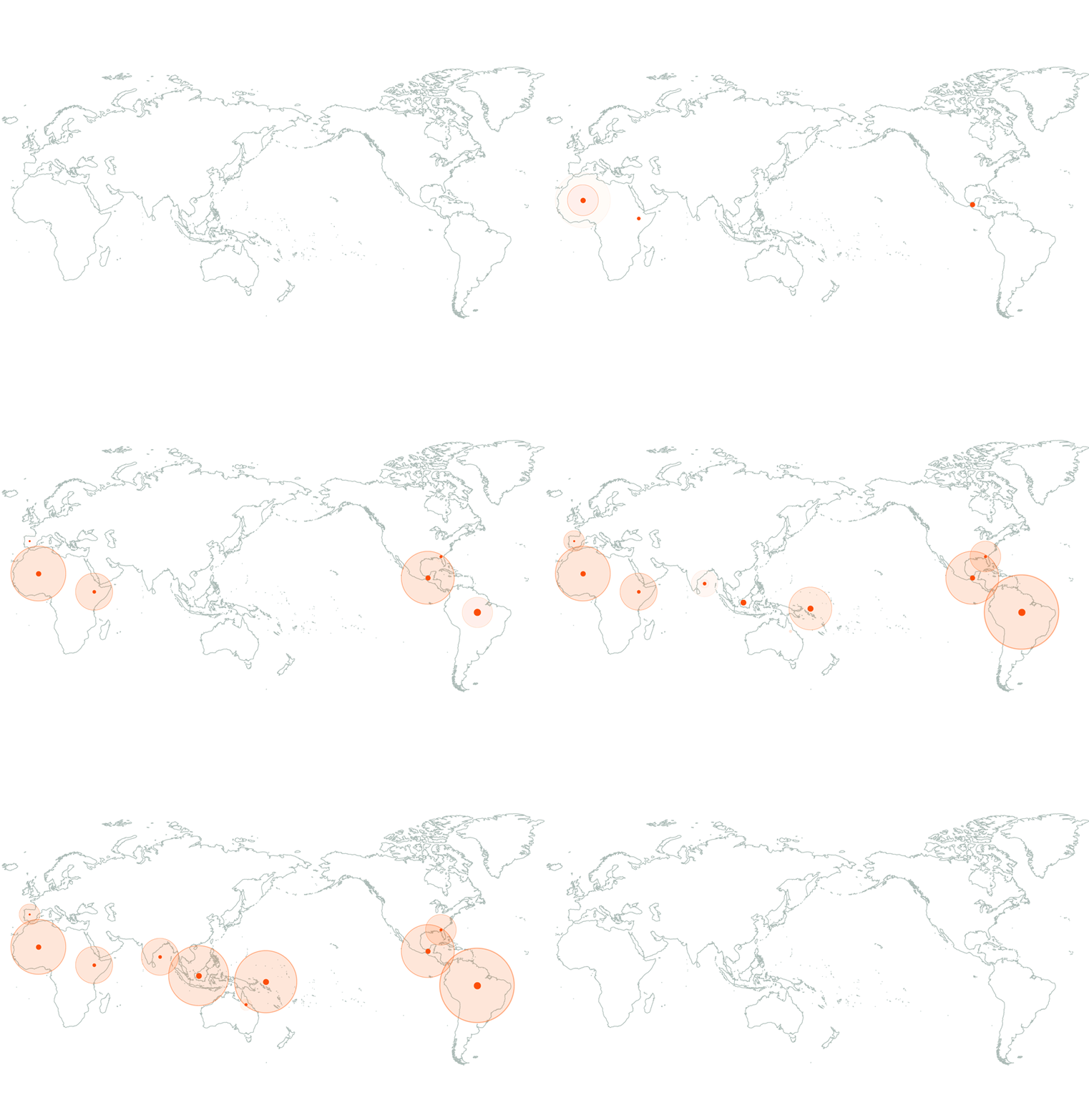
Aedes aegypti mosquitoes originated in Africa, but they have spread through tropical and subtropical regions around the world.
Dengue fever a growing threat in Asia

A World Mosquito Program project staff member hangs a mosquito-box from a tree in Colombo, Sri Lanka. | WORLD MOSQUITO PROGRAM
- BY ALEX JACKSON Jun 16, 2022
For Kasun Chameera, who lives in Sri Lanka’s densely populated capital Colombo, dengue fever is a disease which has afflicted many loved ones, including his brother.
“We fear death when we hear about dengue,” Chameera said. “It’s present almost everywhere in my district, and spreads faster in the city than in the villages.”
His brother “suffered a lot from it,” Chameera said. “For at least one to two months, he would be tired walking just 10 steps. We were very scared.”
Also known as breakbone fever because of the severe pain it can cause, the disease is a growing threat across Asia, where 70% of the world’s dengue cases occur. The virus is transmitted to humans through the bites of the female aedes aegypti and aedes albopictus mosquitoes, which thrive in both tropical and subtropical urban areas.
Worldwide, it is estimated to infect about 390 million people every year, with more than half of the global population now at risk.
Recent weeks have seen soaring cases in Singapore, Malaysia and Vietnam, despite the peak season usually lasting from June to October. Reported cases in Singapore topped the 10,000 mark in the first five months of this year, already exceeding the 5,258 cases reported in all of 2021.
In Japan, 461 cases were reported in 2019 — mainly found in travelers from Asian countries. But with the borders effectively closed during the pandemic, the number of cases dropped to 43 and eight in 2020 and 2021, respectively.

