‘Deadliest outbreak ever seen’: climate crisis fuels Bangladesh’s worst dengue epidemic

theguardian.com

Mosquito-borne disease once largely limited to Dhaka spreads countrywide as higher rainfall and heat lead to fivefold rise in cases in a year, with children the hardest hit
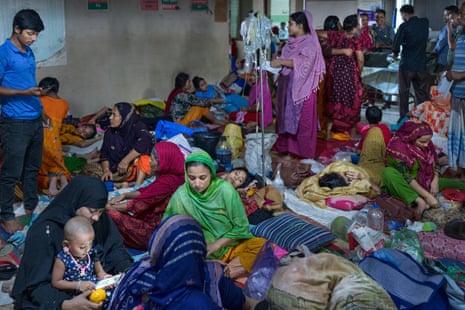
People lie on mattresses in a crowded corridor with drips on stands in the middle. Most of the people are children and women in colourful saris

Corridors in Dhaka Medical College hospital crowded with dengue patients amid a shortage of beds. Bangladesh’s worst outbreak of dengue on record comes after unusually heavy rain, torrid temperatures and high humidity led to an explosion in the mosquito population

 All photographs by Fabeha Monir for WHO

In a small, dimly lit control room at the Directorate General of Health Services (DGHS) in Dhaka, data on Bangladesh’s dengue outbreak flashes across multiple computer screens. Government analysts here have been busy collecting and monitoring the impact of the disease across the country since cases were first reported last April.

In 2023, the total reported cases of dengue numbered 321,179, with 1,705 deaths recorded, a massive jump from the year before, when 62,000 people were known to have had the virus, and 281 died. It was the highest number of annual deaths caused by the mosquito-transmitted disease ever recorded in Bangladesh.

We can’t afford to admit her to hospital so I’ve been doing whatever I can to protect her at home

Masuma Begum

The deaths last year included at least 113 children. According to Save the Children, the majority of these deaths were of children under the age of 10, with 38 deaths among those under five.

“Children make up around 30% of all dengue cases in Bangladesh and are particularly vulnerable to the virus because of underdeveloped immune systems,” says Dr Shamim Jahan, Bangladesh director of Save the Children. “Those under five are particularly at risk from developing severe symptoms, such as dehydration and shock.”

Over the past few months, the surge in cases has pushed Bangladesh’s health system to the limit, with hospital corridors overflowing with patients as wards run out of beds.


Tiếp tục đọc “‘Deadliest outbreak ever seen’: climate crisis fuels Bangladesh’s worst dengue epidemic”

What were the death tolls from pandemics in history?

ourworldindata.org

Pandemics have killed millions of people throughout history. How many deaths were caused by different pandemics, and how have researchers estimated their death tolls?

By: Saloni Dattani December 7, 2023

COVID-19 has brought the reality of pandemics to the forefront of public consciousness. But pandemics have afflicted humanity for millennia. Time and again, people faced outbreaks of diseases – including influenzacholera, bubonic plague, smallpox, and measles – that spread far and caused death and devastation.

Our ancestors were largely powerless against these diseases and unable to evaluate their true toll on the population. Without good record-keeping of the number of cases and deaths, the impact of outbreaks was underrecognized or even forgotten. The result is that we tend to underestimate the frequency and severity of pandemics in history.

Tiếp tục đọc “What were the death tolls from pandemics in history?”

What’s behind China’s mysterious wave of childhood pneumonia?

nature.com

Scientists expected a surge in respiratory disease, but what is happening in China is unusual.

Many adults and children, a lot of them wearing masks, in a hospital waiting room.
Parents wait for their children to be treated for respiratory disease in Chongqing, China.Credit: Costfoto/NurPhoto via Getty

China is grappling with a surge in respiratory illnesses, including pneumonia, in children. The World Health Organization (WHO) said last week that common winter infections — rather than any new pathogens — are behind the spike in hospitalizations. A surge of infections was expected in the country this winter, China’s first without COVID-19 restrictions since the pandemic began in 2020. What is unusual, say epidemiologists, is the high prevalence of pneumonia in China. When COVID-19 restrictions were eased in other countries, influenza and respiratory syncytial virus (RSV) drove most spikes in illness.

The WHO requested information, including laboratory results and data on recent trends in the spread of respiratory illnesses, from China’s health authorities last week. This followed reports from the media and the Program for Monitoring Emerging Diseases — a publicly available system run by the International Society for Infectious Diseases — about clusters of “undiagnosed pneumonia”.

In a 23 November statement, the WHO said that China’s health authorities have attributed the rise in hospitalizations since October to known pathogens, such as adenoviruses, influenza virus and RSV, which tends to cause only mild, cold-like symptoms. However, an increase in children being admitted to hospital since May, particularly in northern cities such as Beijing, is mainly due to Mycoplasma pneumoniae, a bacterium that infects the lungs. It is a common cause of ‘walking pneumonia’, a form of the disease that is usually relatively mild and doesn’t require bed rest or hospitalization, but that is hitting children hard this year.

Benjamin Cowling, an epidemiologist at the University of Hong Kong, is not surprised by the wave of illness. “This is a typical ‘winter surge’ in acute respiratory infections,” he says. “It is happening slightly earlier this year, perhaps because of increased population susceptibility to respiratory infections resulting from three years of COVID measures.”

A familiar pattern

Tiếp tục đọc “What’s behind China’s mysterious wave of childhood pneumonia?”

61 người tử vong vì bệnh dại trong 8 tháng

tuoitre.vn

>> 5 triệu con chó và 1 triệu con mèo bị buôn bán, giết thịt mỗi năm

  • Theo Tổ chức Y tế thế giới, từ đầu năm đến nay Việt Nam đã có 61 trường hợp tử vong do bệnh dại ở 26 tỉnh, thành, cao hơn đáng kể so với cùng kỳ năm ngoái.
Chó dữ tấn công người - Ảnh: MXH
Chó dữ tấn công người – Ảnh: MXH

Người tử vong vì bệnh dại vẫn cao

Ngày Thế giới phòng chống bệnh dại năm nay (ngày 28-9) có chủ đề “Tất cả vì Một, Một Sức khỏe cho tất cả”. Với kế hoạch chiến lược toàn cầu “Zero by 30”, thế giới có một mục tiêu chung nhằm loại bỏ hoàn toàn các ca tử vong do bệnh dại ở người vào năm 2030.

Theo Tổ chức Y tế thế giới (WHO), mặc dù Việt Nam đã đạt được một số tiến bộ trong 10 năm qua, thế nhưng mỗi năm vẫn ghi nhận có từ 70 đến 100 trường hợp tử vong do bệnh dại.

Trong 8 tháng đầu năm, cả nước đã có 61 trường hợp tử vong ở 26 tỉnh thành, cao hơn đáng kể so với cùng kỳ năm ngoái. Mặc dù số ca tử vong do bệnh dại ở một số tỉnh đã giảm đáng kể, chỉ số này vẫn tăng ở 20 tỉnh trong giai đoạn 5 năm (2017-2021), so với giai đoạn 2011-2016.

Tiến sĩ Angela Pratt, trưởng đại diện WHO tại Việt Nam, nhấn mạnh sự cần thiết về một cam kết mạnh mẽ và hướng mục tiêu vào các lĩnh vực ưu tiên nhằm loại bỏ tử vong do bệnh dại vào năm 2030.

Tiếp tục đọc “61 người tử vong vì bệnh dại trong 8 tháng”

Mosquito-borne diseases become climate reality in warming Pacific

Aljazeera.com

Disease surveillance by the WHO shows mosquito-borne diseases such as malaria and dengue fever are rising sharply.

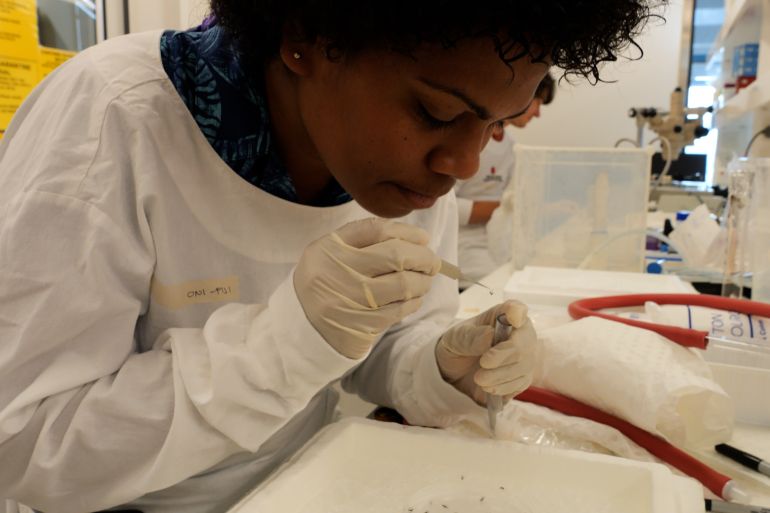
A researcher at a mosquito control laboratory in Brisbane She is wearing a white lab coat and latex gloves and is putting a mosquito into a tube
Experts say countries need to invest in new ways to control mosquitoes [Courtesy of QIMR Berghofer Medical Research Institute]

By Catherine Wilson

Published On 22 Feb 202322 Feb 2023

Climate change forecasters have warned for years that the warmer and wetter world created by the climate crisis will drive a surge in mosquito-borne diseases, such as malaria and dengue fever.

Experts say that in the Pacific Islands, such predictions are now becoming a reality.

Tiếp tục đọc “Mosquito-borne diseases become climate reality in warming Pacific”

Perilous Pathogens: How Climate Change Is Increasing the Threat of Diseases

Climate change is creating many pathways for zoonotic diseases to reach people. Four cases show how the climate crisis is altering disease threats and how the world can respond.

cfr.org

Article by Claire Klobucista and Lindsay Maizland November 4, 2022 4:12 pm (EST)

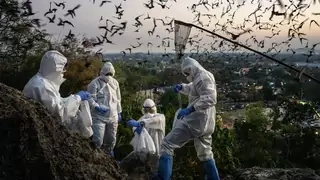
THAILAND: Infectious-disease researchers catch bats to study. Adam Dean/New York Times/Redux

The world is already witnessing the consequences of human-caused climate change, including hotter temperatures, rising sea levels, and more frequent and severe storms. What’s harder to see are climate change’s effects on the spread of disease: on the mosquito that carries a virus, or the pathogenic bacteria on a piece of fruit.

Tiếp tục đọc “Perilous Pathogens: How Climate Change Is Increasing the Threat of Diseases”

Dengue fever a growing threat in Asia

japantimes.co.jp

A World Mosquito Program project staff member hangs a mosquito-box from a tree in Colombo, Sri Lanka. | WORLD MOSQUITO PROGRAM

A World Mosquito Program project staff member hangs a mosquito-box from a tree in Colombo, Sri Lanka. | WORLD MOSQUITO PROGRAM

For Kasun Chameera, who lives in Sri Lanka’s densely populated capital Colombo, dengue fever is a disease which has afflicted many loved ones, including his brother.

“We fear death when we hear about dengue,” Chameera said. “It’s present almost everywhere in my district, and spreads faster in the city than in the villages.”

His brother “suffered a lot from it,” Chameera said. “For at least one to two months, he would be tired walking just 10 steps. We were very scared.”

Also known as breakbone fever because of the severe pain it can cause, the disease is a growing threat across Asia, where 70% of the world’s dengue cases occur. The virus is transmitted to humans through the bites of the female aedes aegypti and aedes albopictus mosquitoes, which thrive in both tropical and subtropical urban areas.

Worldwide, it is estimated to infect about 390 million people every year, with more than half of the global population now at risk.

Recent weeks have seen soaring cases in Singapore, Malaysia and Vietnam, despite the peak season usually lasting from June to October. Reported cases in Singapore topped the 10,000 mark in the first five months of this year, already exceeding the 5,258 cases reported in all of 2021.

In Japan, 461 cases were reported in 2019 — mainly found in travelers from Asian countries. But with the borders effectively closed during the pandemic, the number of cases dropped to 43 and eight in 2020 and 2021, respectively.

Tiếp tục đọc “Dengue fever a growing threat in Asia”

58% of human infectious diseases can be worsened by climate change – we scoured 77,000 studies to map the pathways

theconversation.com

Published: August 8, 2022 4.00pm BST

Climate change can exacerbate a full 58% of the infectious diseases that humans come in contact with worldwide, from common waterborne viruses to deadly diseases like plague, our new research shows

Our team of environment and health scientists reviewed decades of scientific papers on all known pathogenic disease pathogens to create a map of the human risks aggravated by climate-related hazards.

The numbers were jarring. Of 375 human diseases, we found that 218 of them, well over half, can be affected by climate change.

Flooding, for example, can spread hepatitis. Rising temperatures can expand the life of mosquitoes carrying malaria. Droughts can bring rodents infected with hantavirus into communities as they search for food.

With climate change influencing more than 1,000 transmission pathways like those and climate hazards increasingly globally, we concluded that expecting societies to successfully adapt to all of them isn’t a realistic option. The world will need to reduce the greenhouse gas emissions that are driving climate change to reduce these risks.

Monkeypox and the gay community

The New York Times newsletter

This weekend marks the end of Pride month, as cities across the country host events to celebrate the L.G.B.T.Q. community.
It is also a fraught moment in public health: A global outbreak of monkeypox is causing concern, with many of the cases clustered around men who have sex with men.
Experts are now trying to strike a delicate balance, warning people who may be at higher risk, without stigmatizing a community that has often been scapegoated for health scares in the past.

Tiếp tục đọc “Monkeypox and the gay community”

Singapore’s dengue ’emergency’ is a climate change omen for the world

By Heather Chen, CNN

Updated 0213 GMT (1013 HKT) June 7, 2022

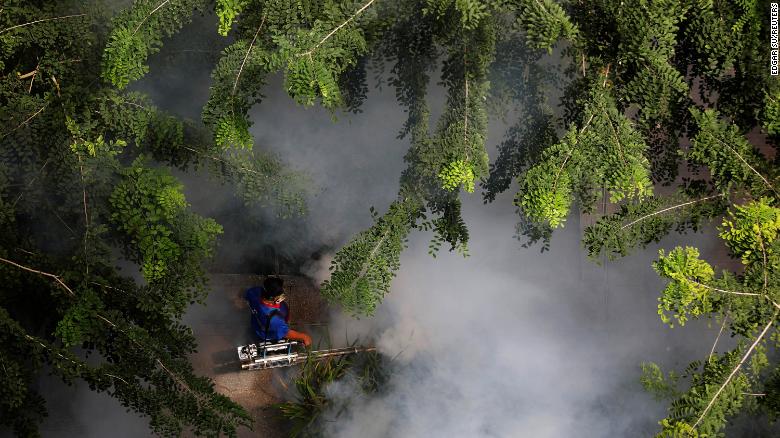
A worker fogs a housing estate for mosquitoes in Singapore on August 27, 2020.

A worker fogs a housing estate for mosquitoes in Singapore on August 27, 2020.

(CNN)Singapore says it is facing a dengue “emergency” as it grapples with an outbreak of the seasonal disease that has come unusually early this year.

The Southeast Asian city-state has already exceeded 11,000 cases — far beyond the 5,258 it reported throughout 2021 — and that was before June 1, when its peak dengue season traditionally begins.

Experts are warning that it’s a grim figure not only for Singapore — whose tropical climate is a natural breeding ground for the Aedes mosquitoes that carry the virus — but also for the rest of the world. That’s because changes in the global climate mean such outbreaks are likely to become more common and widespread in the coming years.

Tiếp tục đọc “Singapore’s dengue ’emergency’ is a climate change omen for the world”

Vietnam an easier destination after return to pre-COVID rules

A Nikkei reporter reflects on a milestone in the country’s path out of pandemic

Roadblocks in Ho Chi Minh City were common in October, but now Vietnam has eliminated almost all COVID restrictions for foreign and domestic travel. (Photo by Lien Hoang)

LIEN HOANG, Nikkei staff writerMay 24, 2022 12:23 JST NIKKEI

HO CHI MINH CITY — Last week after a trip to California, I returned to Vietnam with a COVID vaccine certificate, negative PCR test and smartphone tracing app in hand. The green-uniformed immigration officer at the airport asked for none of it. Inside his plexiglass cage, the 20-something officer gestured for me to pull down my mask for a second. I spent less than a minute and zero words at passport control and then was back outside on the balmy, car horn-filled streets of Ho Chi Minh City.

Tiếp tục đọc “Vietnam an easier destination after return to pre-COVID rules”

Lawmakers reveal mixed thoughts over $15 bln stimulus package

By Hoai Thu, Hoang Thuy   January 5, 2022 | 04:30 pm GMT+7 vnexpressLawmakers reveal mixed thoughts over $15 bln stimulus packageA man prepares food inside an eatery in Hanoi, December 26, 2021. Photo by VnExpress/Pham Chieu

Lawmakers have expressed mixed opinions on the government’s VND347 trillion ($15 billion) stimulus package, with some urging for more cash while others worry about inflation.

“We plan to provide a large amount through fiscal policy but the amount through monetary policy is not meeting expectations from businesses and the people,” said Trinh Xuan An, a member of the National Assembly’s National Defense and Security Committee.

Tiếp tục đọc “Lawmakers reveal mixed thoughts over $15 bln stimulus package”

86 percent of Covid patients in HCMC hospitals are vaccinated: survey – 86% ca nhiễm tại TP HCM đã tiêm vaccine

By Thu Anh   November 5, 2021 | 09:33 am GMT+786 percent of Covid patients in HCMC hospitals are vaccinated: surveyA doctor takes care of a coronavirus patient in HCMC’s Thu Duc City. Photo by VnExpress/Quynh TranAround 86 percent of people hospitalized with Covid-19 in HCMC have been vaccinated at least once, a survey by its Department of Health found.

The survey began on Tuesday at hospitals, deputy director of the city Department of Health, Nguyen Van Vinh Chau, said.

Of the remaining 14 percent, 90 percent are children under 18, and were found mostly at industrial parks and quarantine zones around the city, he said.

Tiếp tục đọc “86 percent of Covid patients in HCMC hospitals are vaccinated: survey – 86% ca nhiễm tại TP HCM đã tiêm vaccine”

Biden’s Covid Summit

New York Timses newsletter

At the opening of a virtual Covid-19 summit organized with the U.N., President Biden called on world leaders, pharmaceutical executives, philanthropists and civil society organizations to forge a global consensus around a plan to fight the coronavirus crisis.

“We need to go big,” Biden said. “It’s an all-hands-on-deck crisis.”

The president pointed to two especially urgent challenges: vaccinating the world and solving a global oxygen shortage, which is leading to unnecessary Covid deaths. Tiếp tục đọc “Biden’s Covid Summit”