Russia’s Continuing Ties to Southeast Asia—and How They Factor Into the Ukraine War: Part 1
Longstanding ties and weapons sales to a number of countries in Southeast Asia insulate Russia from ASEAN criticism over Ukraine war.
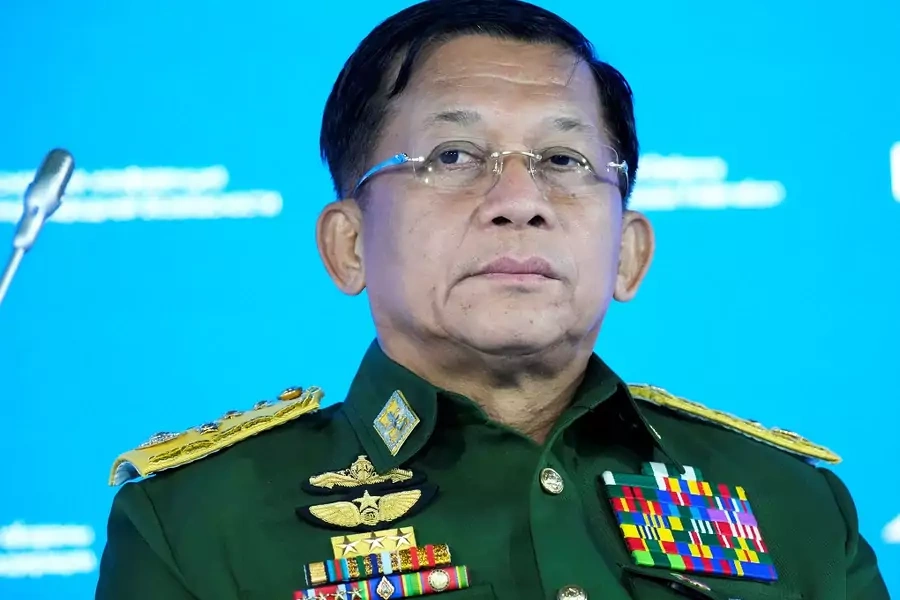
Commander-in-Chief of Myanmar’s armed forces, Senior General Min Aung Hlaing, attends the IX Moscow conference on international security in Moscow, Russia, on June 23, 2021. Alexander Zemlianichenko/Pool via Reuters
In recent years, Russia, which had not had much of a strategic or economic presence in Southeast Asia, has become a more involved player once again. It has cultivated close ties with Myanmar, regularly selling weapons to Myanmar and cultivating strategic ties. Particularly after the February 2021 Myanmar coup, when even Beijing seemed to have doubts about how the coup had destabilized the country and led to potential risks to China’s investments, Russia stood strongly behind the junta. Russian officials participated in a prominent military ceremony in Myanmar after the coup, Russian continued to supply large numbers of arms to the junta, even as it launched a scorched earth policy against coup opponents and ethnic minority groups, and the Kremlin invited junta leader Min Aung Hlaing to Moscow in June (before he had any major visits to Beijing), sending a strong signal of support to Naypyidaw.
Statement of the G7 Foreign Ministers on Russia’s war of aggression against Ukraine
07.04.2022 – Press release
1. We, the G7 Foreign Ministers of Canada, France, Germany, Italy, Japan, the United Kingdom, and the United States of America, and the High Representative of the European Union, condemn in the strongest terms the atrocities committed by the Russian armed forces in Bucha and a number of other Ukrainian towns. Haunting images of civilian deaths, victims of torture, and apparent executions, as well as reports of sexual violence and destruction of civilian infrastructure show the true face of Russia’s brutal war of aggression against Ukraine and its people. The massacres in the town of Bucha and other Ukrainian towns will be inscribed in the list of atrocities and severe violations of international law, including international humanitarian law and human rights, committed by the aggressor on Ukrainian soil.
Tuyên bố của các Bộ trưởng Ngoại giao G7 về chiến tranh xâm lược Ukrainecủa Nga
07.04.2022 – Thông cáo báo chí
1. Chúng tôi, Bộ trưởng Ngoại giao G7 của Canada, Pháp, Đức, Ý, Nhật, Vương quốc Anh và Hoa Kỳ, và Đại diện Cao cấp của Liên minh châu Âu, cùng lên án bằng những lời lẽ mạnh mẽ nhất những dã man do quân đội Nga ở Bucha và một số thị trấn khác của Ukraine gây ra. Những hình ảnh ám ảnh về những cái chết của dân thường, nạn nhân bị tra tấn, và hành quyết rõ ràng, cũng như các báo cáo về hãm hiếp và phá hủy cơ sở hạ tầng dân sự cho thấy bộ mặt thật của chiến tranh xâm lược tàn bạo của Nga đối với Ukraine và dân Ukraine. Những thảm sát ở thị trấn Bucha và các thị trấn khác của Ukraine sẽ được khắc vào danh sách những dã man và vi phạm nghiêm trọng luật quốc tế, kể cả luật nhân đạo và nhân quyền quốc tế, do kẻ xâm lược gây ra trên đất Ukraine.
We, the G7 Foreign Ministers of Canada, France, Germany, Italy, Japan, the United Kingdom, and the United States of America, and the High Representative of the European Union, condemn in the strongest terms the atrocities committed by the Russian armed forces in Bucha and a number of other Ukrainian towns. Haunting images of civilian deaths, victims of torture, and apparent executions, as well as reports of sexual violence and destruction of civilian infrastructure show the true face of Russia’s brutal war of aggression against Ukraine and its people. The massacres in the town of Bucha and other Ukrainian towns will be inscribed in the list of atrocities and severe violations of international law, including international humanitarian law and human rights, committed by the aggressor on Ukrainian soil.
In the presence of the Foreign Minister of Ukraine, Dmytro Kuleba, we expressed today our heart-felt solidarity with the Ukrainian people and our deepest condolences to the victims of this war and their families. We underline our unwavering support for Ukraine within its internationally recognised borders and express our readiness to assist further, including with military equipment and financial means, to allow Ukraine to defend itself against Russia’s aggression and to rebuild Ukraine.
We underscore that those responsible for these heinous acts and atrocities, including any attacks targeting civilians and destruction of civilian infrastructure, will be held accountable and prosecuted. We welcome and support the ongoing work to investigate and gather evidence of these and other potential war crimes and crimes against humanity, including by the ICC Office of the Prosecutor, the Commission of Inquiry mandated by the UN Human Rights Council, the Human Rights Monitoring Mission Ukraine of the OHCHR, and the OSCE’s mission of experts mandated by OSCE Participating States. We will provide investigative support, technical experts and funding. We will continue to promote accountability for all those complicit in Moscow’s war of choice, including the Lukashenka regime in Belarus. We are convinced that now is the time to suspend Russian membership of the Human Rights Council.
Russia must immediately comply with the legally binding order of the International Court of Justice (ICJ) to suspend the military operations that it commenced on 24 February 2022 in the territory of Ukraine. Further, we urge Russia to withdraw completely its military forces and equipment from the entire territory of Ukraine within its internationally recognised borders.
We warn against any threat or use of chemical, biological or nuclear weapons. We recall Russia’s obligations under international treaties of which it is a party, and which protect us all. Any use by Russia of such a weapon would be unacceptable and result in severe consequences. We condemn Russia’s unsubstantiated claims and false allegations against Ukraine, a respected member of the Biological and Toxin Weapons Convention and the Chemical Weapons Convention that is in compliance with its legal obligations under those instruments. We express concern about other countries and actors that have amplified Russia’s disinformation campaign.
We express our gravest concern with Russia forcefully seizing control of nuclear facilities, and other violent actions in connection with a number of nuclear facilities, nuclear and other radioactive material, which have caused and continue to pose serious and direct threats to the safety and security of these facilities and their civilian personnel, significantly raising the risk of a nuclear accident or incident, which endangers the population of Ukraine, neighbouring States and the international community.
We reiterate our demand that Russia upholds its obligations under international humanitarian law and desists from further blatant abuses. The Russian leadership must immediately provide for safe, rapid and unimpeded humanitarian access and make safe passages work, enabling humanitarian aid to be delivered to besieged cities and civilians to reach safety.
We commit to supporting the Government of Ukraine’s humanitarian coordination structure and to disburse humanitarian support quickly. We ask others to join in this effort. A humanitarian push including more funding is urgently needed for Ukraine and beyond as Russia’s ruthless war and actions are having massive consequences on global commodity and food prices. The resulting rise in food insecurity is being felt disproportionately by the most vulnerable. We stand in solidarity with our partners across the world who have to bear the rising price of President Putin’s unilateral choice to wage war in Europe. We will make coherent use of all instruments and funding mechanisms to address food insecurity, keep markets open, and build resilience in the agriculture sector on all continents. We will actively counter Russia’s narrative that Western sanctions have caused the rise in global food prices and call it out for what it is: a blatant lie.
In light of Russia’s ongoing aggression against Ukraine, carried out with Belarus’ complicity, we have already adopted unprecedented and coordinated economic and financial sanctions against Russia that impose a significant cost on its economy. We stress the necessity of further increasing the economic pressure inflicted on Russia and the Lukashenka regime in Belarus. Together with international partners, the G7 will sustain and increase pressure on Russia by imposing coordinated additional restrictive measures to effectively thwart Russian abilities to continue the aggression against Ukraine. We will work together to stop any attempts to circumvent sanctions or to aid Russia by other means. We are taking further steps to expedite plans to reduce our reliance on Russian energy, and will work together to this end.
We commend those neighbouring states to Ukraine that demonstrated great solidarity and humanity by welcoming Ukrainian refugees and third country nationals affected by the conflict. We confirm the need for increased international assistance and will continue to support these countries, including by receiving more refugees. President Putin’s war of aggression against Ukraine has already forced millions of civilians, especially women, children, and elderly, to flee their homes. Over 4.2 million crossed the border to other countries, almost all of them to the EU and the Republic of Moldova. We reiterate our concern about the risk to this vulnerable population, including the risk of human trafficking and our commitment to protect these refugees.
Ministers paid special attention to the Republic of Moldova, which hosts the largest group of refugees from Ukraine per capita. The Ministers agreed to further coordinate their assistance for Moldova’s humanitarian response and long-term resilience following the Moldova Support Conference co-hosted by Germany, France and Romania on 5 April in Berlin and the establishment of the Moldova Support Platform.
Southeast Asian nations have been rather subdued in their responses to Russia’s invasion of Ukraine, although all but two—Vietnam and Laos—voted in the United Nations in early March to condemn Moscow’s aggression. The fighting erupted thousands of miles away, but the effects, particularly of the sanctions imposed by the United States, Europe, Japan, Australia, and others, will still have economic reverberations in Southeast Asia.
Overall, Russia and Ukraine are relatively minor economic players in Southeast Asia, with Russia making up just over 0.64 percent of global trade with the region while Ukraine accounts for just 0.11 percent, according to ASEANstats. But Moscow’s Economic Development Ministry has said that it will work to boost trade and economic links with Asia to balance sanctions.
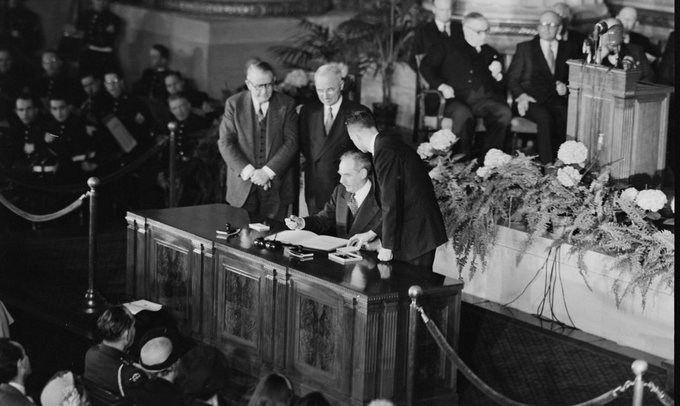
On April 4, 1949, Secretary of State Dean Acheson and President Harry S Truman were present for the signing of the treaty that created North Atlantic Treaty Organization.
OVERVIEW
Formed in 1949 with the signing of the Washington Treaty, NATO is a security alliance of 30 countries from North America and Europe. NATO’s fundamental goal is to safeguard the Allies’ freedom and security by political and military means. NATO remains the principal security instrument of the transatlantic community and expression of its common democratic values. It is the practical means through which the security of North America and Europe are permanently tied together. NATO enlargement has furthered the U.S. goal of a Europe whole, free, and at peace.
Article 5 of the Washington Treaty — that an attack against one Ally is an attack against all — is at the core of the Alliance, a promise of collective defense. Article 4 of the treaty ensures consultations among Allies on security matters of common interest, which have expanded from a narrowly defined Soviet threat to the critical mission in Afghanistan, as well as peacekeeping in Kosovo and new threats to security such as cyber attacks, and global threats such as terrorism and piracy that affect the Alliance and its global network of partners.
In addition to its traditional role in the territorial defense of Allied nations, NATO leads the UN-mandated International Security Assistance Force (ISAF) in Afghanistan and has ongoing missions in the Balkans and the Mediterranean; it also conducts extensive training exercises and offers security support to partners around the globe, including the European Union in particular but also the United Nations and the African Union.
MEMBER STATES
The NATO Alliance consists of 30 member states from North America and Europe. Article Five of the treaty states that if an armed attack occurs against one of the member states, it should be considered an attack against all members, and other members shall assist the attacked member, with armed forces if necessary.
Over the past two decades, the Alliance has developed a network of structured partnerships with countries from the Euro-Atlantic area, the Mediterranean and the Gulf region, as well as individual relationships with other partners across the globe. NATO pursues dialogue and practical cooperation with many partner countries and engages actively with other international actors and organisations on a wide range of political and security-related issues.
NATO is comprised of two main parts, the political and military components. NATO Headquarters is where representatives from all the member states come together to make decisions on a consensus basis. It also offers a venue for dialogue and cooperation between partner countries and NATO member countries, enabling them to work together in their efforts to bring about peace and stability.The key elements of NATO’s military organisation are the Military Committee, composed of the Chiefs of Defence of NATO member countries, its executive body, the International Military Staff, and the military Command Structure (distinct from the Force Structure), which is composed of Allied Command Operations and Allied Command Transformation, headed respectively by the Supreme Allied Commander Europe (SACEUR) and the Supreme Allied Commander, Transformation (SACT).
The primary role of Alliance military forces is to protect peace and to guarantee the territorial integrity, political independence and security of the member states. Alliance forces must be able to deter and defend effectively. The Alliance remains subject to a wide variety of military and non-military risks that are multi-directional and often difficult to predict.
The term NATO Military Exercise includes all exercises for which NATO is the initiating or the joint initiating authority. Associated with NATO Military Exercises are building blocks, such as: seminars, study periods and workshops.
A NATO Military Exercise is scheduled by a NATO Commander. It aims to establish, enhance and display NATO’s Military Capability across the Alliance’s full mission spectrum which is based on the three Alliance military missions:
Article 5 Collective Defence;
Non-Article 5 Crisis Response; and
Consultation and Co-operation.
OPERATIONS
NATO is an active and leading contributor to peace and security on the international stage. It promotes democratic values and is committed to the peaceful resolution of disputes. However, if diplomatic efforts fail, it has the military capacity needed to undertake crisis-management operations, alone or in cooperation with other countries and international organisations. Through its crisis-management operations, the Alliance demonstrates both its willingness to act as a positive force for change and its capacity to meet the security challenges of the 21st century.
Foreign Ministers Meetings and Defense Ministers Meetings provide an opportunity for NATO Allies to address many of NATO’s most pressing security challenges at the some of the highest levels of government. Key strategic issues discussed at these meetings have included Afghanistan, Capabilities, Kosovo, and Missile Defense. Generally attended also by many of NATO’s partners, these meetings are a chance for NATO to strengthen its relationships around the world.
WHY NATO MATTERS
As a political and military alliance, what we do together at NATO directly contributes to the security, the prosperity, and liberty of the people of the United States and every Ally.Our NATO links are solid, forged over 70 years of history. NATO promotes democratic values and encourages consultation and cooperation on defense and security issues to build trust and, in the long run, prevent conflict. NATO is committed to the peaceful resolution of disputes. If diplomatic efforts fail, it has the military capacity needed to undertake crisis-management operations. These are carried out under Article 5 of the Washington Treaty — NATO’s founding treaty — or under a UN mandate, alone or in cooperation with other countries and international organizations. In the history of NATO, Article 5 has been invoked just once, and that was in response to the 9/11 terrorist attacks in the United States.
Soha – Đại sứ Nguyễn Quang Khai – 24/03/2022 20:12
Ngày 20/3 năm nay, người Iraq tưởng nhớ lại 19 năm ngày liên quân 49 nước do Mỹ cầm đầu xâm lược đất nước của họ vào năm 2003, lật đổ chế độ của Tổng thống Saddam Hussein.
Rạng sáng ngày 20/3/2003, cuộc tấn công mở màn bằng các cuộc không kích nhắm vào toà nhà chính phủ và bộ máy lãnh đạo Iraq. Tổng thống Mỹ George W. Bush tuyên bố chiến dịch “Tự do cho Iraq – Operation Iraqi Freedom” bắt đầu. Các lực lượng bộ binh của Mỹ và Anh được máy bay, xe tăng, đại bác… yểm trợ từ Kuwait vượt biên giới tràn vào lãnh thổ Iraq.
Iraq bị đánh hội đồng. Hội đồng Bảo an Liên hợp quốc không có cuộc họp nào, không có lệnh trừng phạt được áp đặt, không có nghị quyết lên án Mỹ và đồng minh.
Following is a joint statement on Armed Forces Day in Myanmar issued by the High Representative on behalf of the European Union and the Foreign Ministers of Albania, Australia, Bosnia and Herzegovina, Canada, Georgia, Iceland, Liechtenstein, Marshall Islands, the Federated States of Micronesia, Montenegro, New Zealand, North Macedonia, Norway, Palau, Republic of Korea, Serbia, Switzerland, Ukraine, the United Kingdom, and the United States.
Begin text:
On Armed Forces Day, we remember those killed and displaced by violence over the last year, including at least 100 people killed on this day alone one year ago.
Some countries continue to supply lethal assistance to Myanmar’s military regime, enabling its violence and repression. We urge all countries to support the people of Myanmar by immediately stopping the sale or transfer of arms, military equipment, materiel, dual-use equipment, and technical assistance to Myanmar, in line with UN General Assembly Resolution A/RES/75/287. We reiterate our call on the military to cease its violence and restore Myanmar’s path to democracy.
Mar 23, 2022
In an exclusive interview for Eurovision News in Kyiv, Ukrainian President Volodymyr Zelenskyy has told TV reporters that he is ready to discuss a commitment from his country not to seek NATO membership in exchange for a cease-fire, Russian troop withdrawal and guarantee of Ukraine’s security.
In an exclusive interview for Eurovision News in Kyiv, Ukrainian President Volodymyr Zelenskyy has told TV reporters that he is ready to discuss a commitment from his country not to seek NATO membership in exchange for a cease-fire, Russian troop withdrawal and guarantee of Ukraine’s security.
We, the Leaders of the G7, met today in Brussels at the invitation of the German G7 Presidency, to further strengthen our cooperation in light of Russia’s unjustifiable, unprovoked and illegal aggression and President Putin’s war of choice against independent and sovereign Ukraine. We will stand with the government and people of Ukraine.
We are united in our resolve to restore peace and stability and uphold international law. Following the United Nations General Assembly resolution on March 2022, we will continue to stand with the overwhelming majority of the international community, in condemning Russia’s military aggression and the suffering and loss of life it continues to cause.
We remain appalled by and condemn the devastating attacks on the Ukrainian population and civilian infrastructure, including hospitals and schools. We welcome the investigations of international mechanisms, including by the Prosecutor of the International Criminal Court. We will work together to support the gathering of evidence of war crimes. The siege of Mariupol and other Ukrainian cities, and the denial of humanitarian access by Russian military forces are unacceptable. Russian forces must immediately provide for safe pathways to other parts of Ukraine, as well as humanitarian aid to be delivered to Mariupol and other besieged cities.
The Russian leadership is obligated to immediately comply with the order of the International Court of Justice to suspend the military operations that it commenced on 24 February 2022 in the territory of Ukraine, without any further delay. We also urge Russia to withdraw its military forces and equipment from the entire territory of Ukraine.
We further call upon the Belarusian authorities to avoid further escalation and to refrain from using their military forces against Ukraine. Moreover, we urge all countries not to give military or other assistance to Russia to help continue its aggression in Ukraine. We will be vigilant regarding any such assistance.
We will spare no efforts to hold President Putin and the architects and supporters of this aggression, including the Lukashenko regime in Belarus, accountable for their actions. To this end, we will continue to work together, along with our allies and partners around the world.
We underline our resolve to impose severe consequences on Russia, including by fully implementing the economic and financial measures we already imposed. We will continue to cooperate closely, including by engaging other governments on adopting similar restrictive measures to those already imposed by G7 members and on refraining from evasion, circumvention and backfilling that seek to undercut or mitigate the effects of our sanctions. We task the relevant Ministers in a focused initiative to monitor the full implementation of sanctions and to coordinate responses related to evasive measures, including regarding gold transactions by the Central Bank of Russia. We stand ready to apply additional measures as required, continuing to act in unity as we do so. We commend those partners who have aligned with us in these efforts.
Russia’s attack has already risked the safety and security of nuclear sites in Ukraine. Russian military activities are creating extreme risks for the population and the environment, with the potential for catastrophic result. Russia must comply with its international obligations and refrain from any activity that imperils nuclear sites, allowing unhindered control by the Ukrainian authorities, as well as full access by and cooperation with the International Atomic Energy Agency.
We warn against any threat of the use of chemical, biological and nuclear weapons or related materials. We recall Russia’s obligations under the international treaties to which it is a signatory, and which protect us all. In this regard, we categorically denounce Russia’s malicious and completely unfounded disinformation campaign against Ukraine, a state in full compliance with international non-proliferation agreements. We express concern about other countries and actors that have amplified Russia’s disinformation campaign.
We are resolved in our support to the Ukrainian people in their heroic resistance to Russia’s unjustifiable and illegal aggression. We will step up our support to Ukraine and neighbouring countries. We thank all those who are already providing humanitarian aid to Ukraine and ask others to join. We will furthermore collaborate in our efforts to bolster democratic resilience and defend human rights in Ukraine and neighbouring countries.
We will continue efforts to support Ukraine in defending its networks against cyber incidents. In preparation for any Russian malicious cyber response to the actions we have taken, we are taking steps to increase the resilience of the infrastructure in our respective nations by strengthening our coordinated cyber defences and improving our shared awareness of cyber threats. We will also work to hold accountable those actors that engage in destructive, disruptive, or destabilising activities in cyberspace.
We further commend neighbouring states for their solidarity and humanity in welcoming Ukrainian refugees and third country nationals from Ukraine. We highlight the need to further increase international assistance to countries neighbouring Ukraine, and, as a concrete contribution to this end, underline our commitment to receiving, protecting, and supporting refugees and displaced persons as a consequence of the conflict. We thus all stand ready to welcome them on our territories. We will take further steps to broaden our support to Ukraine and neighbouring countries.
We are concerned by the escalating and reinforced repression against the Russian people and the increasingly hostile rhetoric of the Russian leadership, including against ordinary citizens. We deplore the Russian leadership’s attempt to deprive Russian citizens of access to unbiased information through censorship, and denounce its malicious disinformation campaigns, which we will not leave unaddressed. We express our support to those Russian and Belarusian citizens standing up against the unjustified war of aggression against their close neighbour Ukraine. The world sees them.
The people of Russia must know that we hold no grievances against them. It is President Putin, his government and supporters, including the Lukashenko regime in Belarus, who are imposing this war and its consequences on Russians and it is their decision that besmirches the history of the Russian people.
We are taking further steps to reduce our reliance on Russian energy, and will work together to this end. At the same time, we will ensure secure alternative and sustainable supplies, and act in solidarity and close coordination in the case of possible supply disruptions. We commit to actively support countries willing to phase out their dependency on Russian gas, oil and coal imports. We call on oil and gas producing countries to act in a responsible manner and to increase deliveries to international markets, noting that OPEC has a key role to play. We will work with them and all partners to ensure stable and sustainable global energy supplies. This crisis reinforces our determination to meet the goals of the Paris agreement and of the Glasgow climate pact and limit the rise in global temperatures to 1.5°C, by accelerating reduction of our reliance on fossil fuels and our transition to clean energy.
We stand in solidarity with our partners who have to bear the rising price of President Putin’s unilateral choice to wage war in Europe. His decision is putting the global economic recovery at risk, undermines the resilience of global value chains and will have severe impacts on the most fragile countries. We call on the international community to take action by fully recognising Russia’s responsibility and protecting the most vulnerable countries, with the support of international and regional institutions.
More immediately, President Putin’s war places global food security under increased pressure. We recall that the implementation of our sanctions against Russia takes into account the need to avoid impact on global agricultural trade. We remain determined to monitor the situation closely and do what is necessary to prevent and respond to the evolving global food security crisis. We will make coherent use of all instruments and funding mechanisms to address food security, and build resilience in the agriculture sector in line with climate and environment goals. We will address potential agricultural production and trade disruptions, in particular in vulnerable countries. We commit to provide a sustainable food supply in Ukraine and support continued Ukrainian production efforts.
We will work with and step up our collective contribution to relevant international institutions including the World Food Programme (WFP), in parallel with Multilateral Development Banks and International Financial Institutions, to provide support to countries with acute food insecurity. We call for an extraordinary session of the Council of the Food and Agriculture Organization (FAO) to address the consequences on world food security and agriculture arising from the Russian aggression against Ukraine. We call on all participants of the Agriculture Markets Information System (AMIS) to continue to share information and explore options to keep prices under control, including making stocks available, in particular to the WFP. We will avoid export bans and other trade-restrictive measures, maintain open and transparent markets, and call on others to do likewise, consistent with World Trade Organization (WTO) rules, including WTO notification requirements.
International organisations and multilateral fora should no longer conduct their activities with Russia in a business as usual manner. We will work closely with our partners to act as appropriate, based on shared interests, as well as rules and regulations of respective institutions.
THE PRESIDENT: Good evening, everyone. With all the press that’s here, you must be getting very tired. Am I the 16th or 17th? At any rate, all kidding aside, thank you for taking the time.
I — today marks one month since Russia began its carnage in Ukraine, the brutal invasion of Ukraine. And we held a NATO summit the very next day. At that time, my overwhelming objective, wanting that summit, was to have absolute unity on three key important issues among our NATO and European allies.
First was to support Ukraine with military and humanitarian assistance.
Second was to impose the most significant — the most significant sanctions — economic sanction regime ever, in order to cripple Putin’s economy and punish him for his actions.
Third was to fortify the eastern flank of our NATO Allies, who were obviously very, very concerned and somewhat at — worried what would happen.
A woman shouting during an anti-government protest. Photo Credit: AP Rodrigo Abd.
In Haiti, gangs block ports. Fuel shipments cannot get through. Hospitals are shutting down. Cellphones are losing power. Hunger is growing.
In recent months, assassins killed the president. An earthquake shook a part of the country. The nation is on the brink of collapse.
Gangs now rule about half the capital of Haiti. Workers are afraid to drive their fuel trucks. A gang kidnapped missionaries. It is demanding a ransom of $1 million for each of the seventeen captives. The police know where the hostages are. But the police can’t enter the neighborhood because the gangs outgun them.
The full text of the operative clause of the Order reads as follows:
“For these reasons,
THE COURT, Indicates the following provisional measures:
(1) By thirteen votes to two, The Russian Federation shall immediately suspend the military operations that it commenced on 24 February 2022 in the territory of Ukraine;
IN FAVOUR: President Donoghue; Judges Tomka, Abraham, Bennouna, Yusuf, Sebutinde, Bhandari, Robinson, Salam, Iwasawa, Nolte, Charlesworth; Judge ad hoc Daudet; AGAINST: Vice-President Gevorgian; Judge Xue;
(2) By thirteen votes to two, The Russian Federation shall ensure that any military or irregular armed unitswhich may be directed or supported by it, as well as any organizations and persons which may be subject to its control or direction, take no steps in furtherance of the military operations referred to in point (1) above;
IN FAVOUR: President Donoghue; Judges Tomka, Abraham, Bennouna, Yusuf, Sebutinde, Bhandari, Robinson, Salam, Iwasawa, Nolte, Charlesworth; Judge ad hoc Daudet; AGAINST: Vice-President Gevorgian; Judge Xue;
(3) Unanimously, Both Parties shall refrain from any action which might aggravate or extend the dispute before the Court or make it more difficult to resolve.”




 CVD
CVD 