Nhắc tới Chăm pa, nhiều người thường liên tưởng đến những đền tháp, tác phẩm điêu khắc, đồ gốm chứ ít ai nghĩ tới kĩ năng tìm các mạch ngầm nước ngọt gần như độc nhất vô nhị của người Chăm. Vì vậy, trong rất nhiều năm, chúng tôi đã đi dọc dải đất miền Trung khảo sát chỉ để tìm câu trả lời: giếng Chăm có vị trí thế nào trong đời sống Chăm?
Nếu tháp Chàm được xem là biểu trưng của thượng tầng văn minh Champa thì giếng vuông Chàm là biểu tượng đặc thù của đời sống bình dân Chăm. Nguồn: Zing. Tiếp tục đọc “Đi tìm bí ẩn giếng Chăm”→
Lời tòa soạn: Như chúng tôi đã đề cập trong những số báo gần đây về vùng Đồng bằng sông Hồng là hợp lưu của những luồng di dân từ hàng ngàn năm trước cho đến đầu thời Đại Việt. Bài viết dưới đây của TS Nguyễn Tiến Đông tiếp tục dòng thảo luận ấy ở một khía cạnh cụ thể hơn: người Cham pa đã đóng góp như thế nào vào không gian văn hóa ngay tại kinh đô Đại Việt và vùng phụ cận.
Ngay trên chính Hoàng thành này, những dấu tích văn hóa Cham Pa đã hiển hiện khi các nhà khảo cổ học khai quật khu di tích 18 Hoàng Diệu. Trong ảnh, sinh viên đại học nghe nhà khảo cổ học Nguyễn Tiến Đông giới thiệu những di tích thời Lý – Trần (Khu A). Ảnh: Viện Khảo cổ học (2004).
Chăm là một trong 54 nhóm chủng tộc bất khả phân của dân tộc Việt Nam. Dân số người Chăm hiện nay khoảng 100.000 người, trong đó hơn 2/3 định cư tại Phan Rang, Phan Rí, Phan Thiết và Bình Tuy ; số còn lại sinh sống tại Châu Đốc, Tây Ninh và Sài Gòn.
Cũng nên biết, trong thực tế, có khoảng 400.000 người Chăm sinh sống tại khắp nơi trên thế giới, đông nhất là tại Kampuchia (270.000 người), kế đến mới tới Việt Nam (100.000 người), sau là Thái Lan (15.000 người) và cuối cùng là Liên Bang Mã Lai, năm 1979 đã tiếp nhận khoảng 10.000 người Chăm đến từ Kampuchia. Hải ngoại có khoảng 200 người Việt gốc Chăm (hơn 50 gia đình), đa số định cư tại Hoa Kỳ.
Trước khi Sapanapro ra đời, những người làm chính sách hay làm du lịch đều không thấy tiềm năng du lịch từ đa dạng sinh học của vùng đất Tả Phìn này.
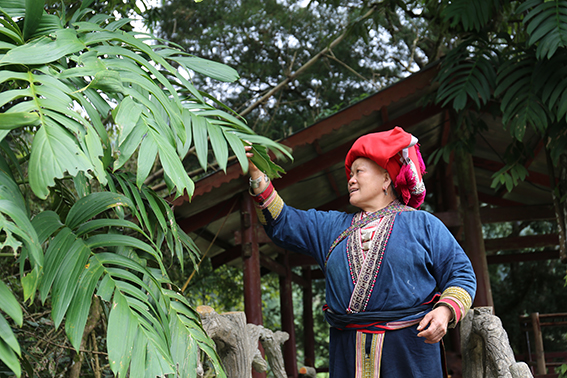
Bà Chảo Sử Mẩy, Tây nữ vương thuốc ở Tả Phìn, một trong ba người sáng lập Sapanapro. Ảnh: Thu Quỳnh.
Khắp Sa Pa giờ đây tràn ngập các khách sạn và spa mở dịch vụ tắm lá thuốc người Dao đỏ, nhưng dân du lịch có thâm niên và kể cả người dân địa phương thường mách nhau đến Sapanapro – cơ sở do chính người Dao đỏ sáng lập và điều hành. Giữa khuôn viên lộn xộn đủ loại phong cách thiết kế chẳng ăn nhập gì với nhau, người ta không thể không chú ý đến hai nhà tắm bằng gỗ pơ mu nằm mấp mé trên mỏm đất, với mái gỗ phủ đầy một lớp dương xỉ bù xù.
Mỗi nhà tắm có ba buồng và nội thất mỗi buồng có bốn chiếc bồn tắm lá thuốc. Mỗi bồn chỉ vừa đúng một người ngồi khoanh chân. Phải rất từ từ, tôi mới quen với nước trong thùng nóng hơn 400C, chìm dần vào thứ thuốc tắm không có xà phòng mà đầy bọt bồng bềnh như mây trắng, tỏa ra hương thơm ngào ngạt. Cửa sổ kính lớn trong phòng nhìn ra thấy bao la rừng núi và ruộng bậc thang vừa qua mùa gặt. Người lâng lâng, nhẹ bẫng.
Three years ago, Dinh Thi Huyen had a vision: her cooperative farm in Van Ho district, Son La Province, could improve living standards for her Muong ethnic minority community—if only their local specialty rice could reach more customers in Hanoi and tourist locations. Today, holding a beautifully packaged box of Seng Cu rice, she reports that there has been a doubling in the number of farmers working with the cooperative and a 20-percent-increase in their incomes.
“Our product has better quality, a recognized brand name, and a stronger position in the national market,” she says.
Ly-Et was enrolled in a school accommodating deaf children. The headmaster remembers her arrival.
STORY HIGHLIGHTS
The Quality Improvement of Primary Education for Deaf Children Project developed new sign language gestures and trained deaf teachers, mentors, and caregivers.
Expanded sign language facilitated the integration of deaf children in Vietnam into the mainstream and special education.
The success of the project makes it suitable for expansion around the country and to older students.
Lo Mu Du Ly-Et was born in 2010 to deaf parents belonging to the Cil (K’ho) ethnic group in the central highland province of Lam Dong in Vietnam. Ly-Et’s parents’ deafness was considered a burden to their families, but they overcame that stigma, raised a family together, and wanted their child to have opportunities that had been unavailable to them.
TP – Trong chiều dài một km nhưng sông Nậm Mộ đã phải gánh 3 nhà máy thủy điện. Hệ lụy nhãn tiền, người dân oằn mình chịu đựng. Lợi đâu chưa thấy nhưng khó khổ đã thấy nhiều.
Những hộ dân ở bến thượng lưu lòng hồ thủy điện Bản Vẽ
Ngược dòng Nậm Mộ
Giữa tháng 7, chúng tôi trở lại xã Tà Cạ, huyện Kỳ Sơn (Nghệ An). Con đường xưa cũ nay được mở rộng, thảm nhựa giúp chúng tôi đến với Tà Cạ nhanh hơn. Những bản làng nằm vắt vẻo bên sườn núi, bờ sông là nơi sinh tồn bao đời nay của cộng đồng dân tộc Thái, Khơ Mú…. Giao thông đã thuận lợi hơn những năm về trước nhưng Tà Cạ vẫn thế, như một đóa hoa rừng chưa đến thì bung nở. “Thủy điện lần lượt chắn dòng, sông Nậm Mộ bị chia cắt thành nhiều đoạn, chỉ 1km đã có 3 nhà máy, nếu tính mật độ và số lượng nhà máy thủy điện thì không địa phương nào nhiều hơn Tà Cạ. Thế nhưng, 3 bản của xã vẫn chưa có điện lưới. Ánh sáng từ điện còn chưa có, nói gì đến phát triển kinh tế”, ông Vi Văn Mằn – Chủ tịch xã Tà Cạ trầm buồn lí giải.
Planted in the 1970s as part of Vietnam’s post-war reforestation program, the Dak Doa forest has become both a burgeoning tourist attraction and a lifeline for ethnic minority farmers living in the district.
The forest is under threat due to a planned tourism, housing and golf complex slated to cover 517 of the forest’s 601 hectares (1,278 of 1,485 acres).
Work on the project is currently suspended due to the death of more than 4,500 trees in a botched relocation operation, as well as sanctions imposed on local leaders by central party leadership, which found local officials to have committed a series of violations related to land management.
While currently suspended, the project could still be revitalized if a new investor takes over.
DAK DOA, Vietnam — At the end of the rainy season, the hillsides in Dak Doa district, in central Vietnam’s Gia Lai province, turn pink as the Cỏ Hồng grass blushes in the basaltic soil of a 50-year-old pine forest.
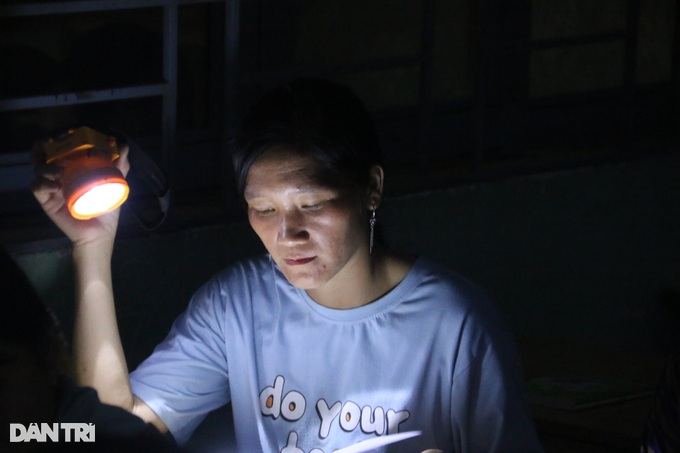
Giang Thi So slowly wrote down some new words in a small notebook under her classmate’s weak light torchlight. After travelling 20 kilometres and studying for over an hour, her own torch had already run out of battery.
Giang Thi So learns to write at the evening class in Dak Nong Province
“It has been raining for some days and there was no sunlight so I couldn’t charge it,” she said. “We don’t have access to the electricity grid so we depend on solar power.”
So is attending an illiteracy course organised by authorities for the Mong Ethnic Group in Dak R’mang Commune, Dak Glong District in the central highlands province of Dak Nong. The class is held every Friday evening at 7 pm in the classroom of a local primary school. The students are all adults who mostly farm.
Ethnic minority languages are an important component of national identity. In the Central Highlands region, young singer Balin has found a unique way to preserve and promote his Jarai language by introducing bilingual songs in the Jarai and Vietnamese languages to the public.
Nhan Dan (People) Newspaper held a talk with him to learn more about the project.
Question: You have covered popular songs in your native language, which have received tens of millions of views on YouTube. Can you tell us why you decided to turn to singing and composing songs in your mother language?
7 November 2022 at 9:10 (Updated on 7 November 2022 at 18:17)
Traditional slash and burn farming lands ethnic minorities in jail as authorities try to preserve country’s forests.
Many people in Dakrong district do not own any farmland. Instead, they are surrounded by a protected forest, hydropower plants and a special-use forest. PHOTO: Nguyen Dac Thanh
QUANG TRI, VIETNAM – One afternoon at the end of 2017, officials in Dakrong district in Central Vietnam’s Quang Tri province visited Ho Thi Nieng’s house. They claimed she and her husband had “burned the protected forest to do farming.”
“We had been cultivating that land for a long time and there had never been a problem,” 26-year-old Nieng, who belongs to the Van Kieu ethnic minority in Ta Leng village, said as she recalled her panic at the accusation.
The following year, in 2018, the young mother was sentenced to nine months in jail for burning the forest to farm it. Nieng’s husband, Ho Van Hai, 32, was also charged with the same crime, but received a suspended sentence – he was only “helping his wife” and had two young children.
VNE – By Phan Duong November 6, 2022 | 07:53 pm GMT+7
Two boys the northern Thanh Hoa Province in 2019. Photo by VnExpress/P.D
Bich Thao and her husband are still trying to get a son after seven years and five in vitro fertilization attempts despite knowing sex selection is illegal.
The couple, both 34 and from the northern Vinh Phuc Province, say they have been unlucky in that all five IVF attempts failed either to faulty embryos or a faulty Y (male) chromosome.
Thao married her husband in 2010 and their first child was a girl. With her husband being the oldest son, the expectation is that she, too, will produce a male heir.
Luật khám bệnh, chữa bệnh đang trong quá trình sửa đổi và trình lên Quốc Hội cho ý kiến và dự kiến xem xét thông qua tại Kỳ họp thứ 4, Quốc hội khóa XV vào tháng 10.
Luật khám bệnh, chữa bệnh có tác động rất lớn đến hệ thống ngành y tế cũng như vấn đề chăm sóc sức khỏe của người dân, trong đó có người Dân tộc thiểu số, Mạng lưới Tiên Phong Vì Tiếng Nói Người Dân Tộc Thiểu Số đã có một buổi trao đổi cùng chuyên gia trong lĩnh vực luật khám bệnh, chữa bệnh đồng thời thảo luận nội bộ để cùng đưa ra ý kiến đối với những vấn đề vẫn còn bỏ ngỏ trong luật.
Qua quá trình thảo luận, nhóm nhận ra rằng rào cản ngôn ngữ giữa bác sĩ và bệnh nhân là người dân tộc thiểu số ở tại địa phương và đặc biệt là cơ sở khám chữa bệnh tuyến Trung Ương là một vấn đề ảnh hưởng trực tiếp đến quyền và chất lượng sử dụng dịch vụ khám chữa bệnh của người dân tộc thiểu số. Dưới đây là những trải nghiệm cá nhân và quan sát của chính các thành viên Tiên Phong về vấn đề này:
Since 2015, the Cambodian government has been addressing the politically and diplomatically sensitive issue of illegal Vietnamese immigrants through methods such as documentation, deportation, eviction, relocation and registration. In this picture, Cambodia’s Prime minister Hun Sen (R) and his then Vietnamese counterpart Nguyen Xuan Phuc (L) inspect the guard of honour during a welcome ceremony at the Presidential Palace in Hanoi on 4 October 2019. Photo: Nhac NGUYEN/AFP.
EXECUTIVE SUMMARY
Since 2015, the Cambodian government has been addressing the politically and diplomatically sensitive issue of illegal Vietnamese immigrants through methods such as documentation, deportation, eviction, relocation and registration.
These actions are the ruling Cambodian People’s Party’s response to the opposition Cambodia National Rescue Party’s successful politicisation of anti-Vietnamese sentiments among Cambodian voters.
The Cambodian government’s Vietnamese immigrant policies also serve the ecological development goal of improving Cambodian water systems, as well as beautifying and developing its urban areas.
Given Cambodia’s asymmetrical power relationship with Vietnam and the sensitive issue of illegal Vietnamese immigrants, the closer bond between Cambodia and China serves as an enabling factor for the Cambodian government in adopting tougher policies.
The Cambodian government’s measures will however neither reduce the fear held by many Cambodians of Vietnamese domination nor will they alleviate the potential diplomatic fallout.
*Jing Jing Luo is Post-Doctoral Researcher at the School of Public Affairs, Xiamen University, China. Kheang Un is Professor of Political Science at Northern Illinois University, USA.
The lost tribe: The CIA’s secret army in Laos | REWIND
Al Jazeera English – 24-8-2019
We trace a forgotten Hmong community in the jungles of northern Laos who helped the US during the Vietnam War.
Half a century ago, as war raged in Vietnam, an isolated community in the jungles of northern Laos was recruited by the CIA to help fight the Pathet Lao – the Laotian equivalent of Vietnam’s Viet Cong.
Over 50,000 of the Hmong tribe became part of the United States’s secret army, helping disrupt Communist supply lines along the Ho Chi Minh trail.










 CVD
CVD 