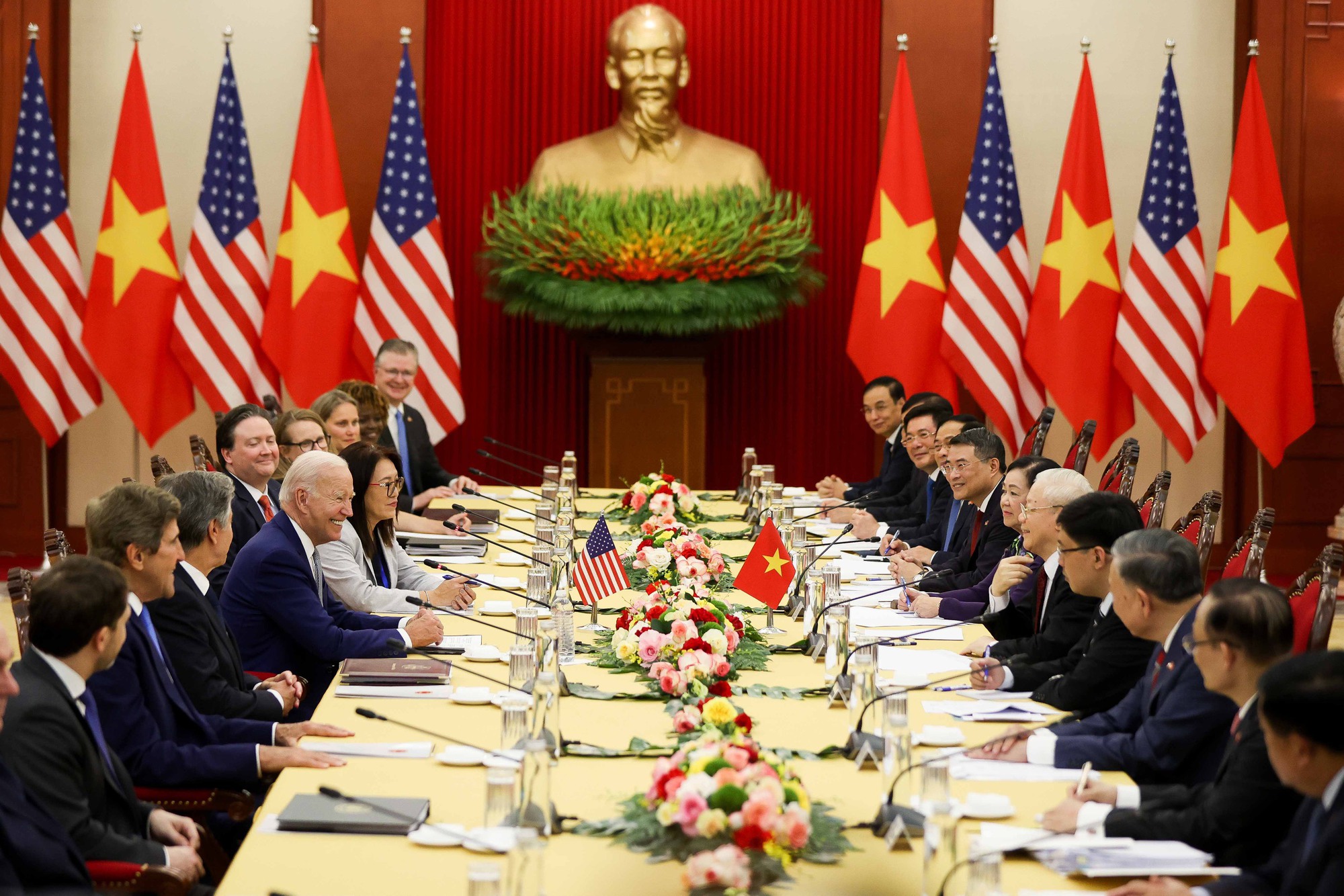
Tổng Bí thư Nguyễn Phú Trọng và Tổng thống Mỹ Joe Biden thông báo Việt Nam – Mỹ thống nhất nâng cấp quan hệ lên đối tác chiến lược toàn diện.
Chiều 10.9, tại trụ sở Văn phòng T.Ư Đảng, ngay sau khi kết thúc hội đàm, Tổng Bí thư Nguyễn Phú Trọng và Tổng thống Mỹ Joe Biden thông báo Việt Nam – Mỹ thống nhất nâng cấp quan hệ từ đối tác toàn diện lên đối tác chiến lược toàn diện – cấp cao nhất trong quan hệ ngoại giao nhà nước.
A vital regional river can be a route for U.S. diplomacy.
By Brian Eyler, the director of the Stimson Center’s Southeast Asia Program.
My FP: Follow topics and authors to get straight to what you like. Exclusively for FP subscribers. Subscribe Now | Log In
SEPTEMBER 8, 2023, 4:38 PM
On Sept. 10, Joe Biden pays his first visit to Vietnam as U.S. president, where he is expected to ink a deal to elevate the U.S.-Vietnam relationship from “comprehensive” to “comprehensive strategic”—the highest level of Vietnam’s diplomatic hierarchy. Biden is forgoing this week’s twin summits in Indonesia—the Association of Southeast Asian Nations summit and the East Asia Summit—to show the value Washington places on key bilateral partners, such as Vietnam, in the Indo-Pacific.
Some critics worry that China and Russia, two of Vietnam’s other comprehensive strategic partners, could punish Vietnam for its choice to upgrade relations with the United States. But Vietnam can come out of this complicated diplomatic competition a clear winner by centering the U.S.-Vietnam collaboration on the Mekong—the mighty river that keeps both Vietnam and much of the rest of the world fed.
The United States and Vietnam are poised to significantly enhance their economic and technological ties, bringing the former foes closer at a time of increased Chinese assertiveness in the region.
The deal, expected to be announced when President Biden makes a state visit to Vietnam next weekend, is the latest step by the Biden administration to deepen relations in Asia. For Hanoi, the closer relationship with Washington serves as a counterweight to Beijing’s influence.
If Hanoi agrees to a comprehensive strategic partnership with the U.S., it would represent a remarkable breakthrough in bilateral ties. Still, such a partnership would not represent a significant shift in Hanoi’s foreign policy.
United States President Joe Biden recently announced that he would be visiting Vietnam “shortly”, likely on his return trip from the G20 Summit in India on 9-10 September. While the specifics of the trip have not been confirmed, international media have speculated that the visit may result in an upgrade of bilateral relations. Unofficial reports suggest that the two countries, which are currently in a “comprehensive partnership”, may skip the “strategic partnership” level to move directly to the “comprehensive strategic partnership” (CSP) level.
If true, this will represent a remarkable breakthrough in bilateral ties, as the CSP is the highest level of partnership in Vietnam’s diplomatic hierarchy. The country only forms such partnerships with those that it views as of great importance for its security, prosperity, and international standing. So far, Vietnam has only established CSPs with four countries: China, India, Russia and South Korea.
KASI, Laos — Five decades have elapsed since the signing of the Paris Peace Accords on Jan. 27, 1973 that led to the end of the Vietnam War. The long conflict devastated all of Indochina, and its aftermath continues to stymie the region’s economic development.
Early this month, specialists of the Laotian military detected unexploded ordnance (UXO) in the northern town of Kasi. The team of about 10 found one cluster bomb the size of a tennis ball and used a loudspeaker to warn residents while cordoning off nearby roads before disposing of the device.
The new strategic partnership agreement opens the door to closer diplomatic, economic and technological cooperation with former foe — and China’s neighbor — Hanoi.
The deal adds to President Joe Biden’s string of successful diplomatic initiatives aimed to reassert U.S. influence in Asia in the face of China’s growing economic, diplomatic and military muscle in the region. | Alex Brandon/AP Photo
President Joe Biden will chalk up a fresh victory in his campaign to boost U.S. influence in the Indo-Pacific by sealing a deal with Vietnam next month aimed to draw Hanoi closer to Washington at a time of rising tensions with Beijing.
Biden will sign a strategic partnership agreement with Vietnam during a state visit to the Southeast Asian country in mid-September, according to three people with knowledge of the deal’s planning. They were granted anonymity because they weren’t authorized to speak on the record about the agreement.
The agreement will allow for new bilateral collaboration that will boost Vietnam’s efforts to develop its high technology sector in areas including semiconductor production and artificial intelligence.
Thỏa thuận an ninh ký với Papua New Guinea và Philippines giúp Mỹ hoàn thiện bố phòng quân sự, ngăn ảnh hưởng của Trung Quốc tại khu vực.
Thỏa thuận Hợp tác Quốc phòng (DCA) được Mỹ ký với Papua New Guinea hồi tháng 5 sẽ cho phép quân đội Mỹ toàn quyền tiếp cận mọi cảng biển cùng sân bay tại quốc gia có diện tích lớn nhất và đông dân nhất trong nhóm các đảo quốc Thái Bình Dương.
Vị trí chuỗi đảo thứ nhất và chuỗi đảo thứ hai. Đồ họa: Cofda
Giới quan sát đánh giá thỏa thuận này là một động thái lớn, giúp Mỹ cải thiện đáng kể khả năng hỗ trợ các căn cứ quân sự trên đảo Guam, đồng thời ngăn chặn ảnh hưởng ngày càng tăng của Trung Quốc ở khu vực nam Thái Bình Dương.
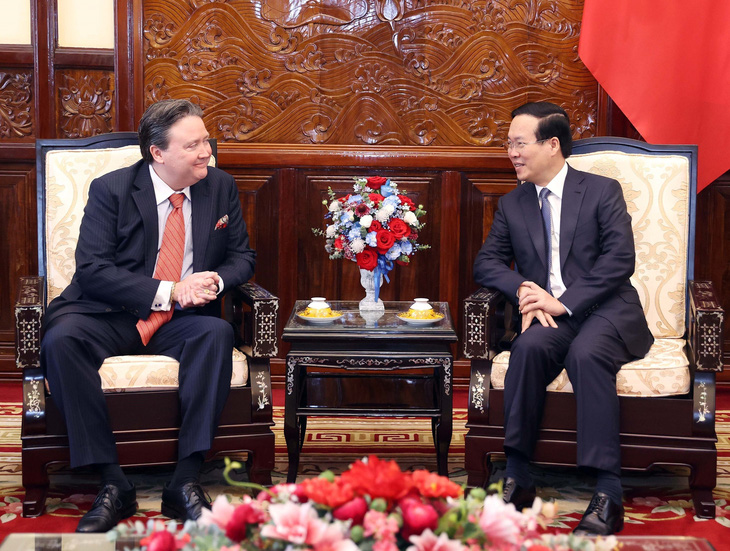
This image shows Vietnamese State President Vo Van Thuong (R) talking with U.S. Ambassador Marc Knapper (L) in Hanoi on June 5, 2023. Photo: Vietnam News Agency
Vietnam always attaches significance to developing its comprehensive cooperation with the U.S., one of its most important partners in the world, State President Vo Van Thuong told Ambassador Marc Knapper.
President Thuong was speaking at his meeting with the ambassador at the Presidential Palace in Hanoi on Monday, during which he also brought forward some suggestions for further promoting the Vietnam – U.S. comprehensive partnership that was set up in 2013, the Vietnam News Agency reported.
The coast guards of the Philippines, US and Japan are holding their first ever joint exercises.
They’re taking place as tensions are rising in the Indo-Pacific region.
Al Jazeera’s Barnaby Lo reports from the South China Sea.
During a ceremony held in Washington to commemorate the Lunar New Year in 2011, then–Vietnamese Ambassador to the United States Le Cong Phung surprised the audience by announcing that the two countries would raise their ties to the level of “strategic partnership.” Phrases describing partnerships can be nebulous, of course. But from what we know about Vietnamese diplomacy, Hanoi’s definition of strategic partnership is not just boilerplate, but signifies concrete, mutual, long-term strategic interests.
Vietnamese officials, however, never followed up on Phung’s newsworthy announcement. Instead, Washington and Hanoi announced a comprehensive partnership in 2013—a relationship that implies a less-serious geopolitical alignment for Vietnam. The United States has been left wondering why.
The United States stands with The Philippines in the face of the People’s Republic of China (PRC) Coast Guard’s continued infringement upon freedom of navigation in the South China Sea. Imagery and video recently published in the media is a stark reminder of PRC harassment and intimidation of Philippine vessels as they undertake routine patrols within their exclusive economic zone. We call upon Beijing to desist from its provocative and unsafe conduct. The United States continues to track and monitor these interactions closely.
Civilians are being killed by Russian weapons just like in Ukraine, says special rapporteur Tom Andrews in call for global action
A man sits in front of a house destroyed by a Myanmar junta air strike. The UN special rapporteur for human rights there has called for an arms embargo. Photograph: SOPA Images/LightRocket/Getty Images
Rebecca Ratcliffe South-east Asia correspondentWed 15 Mar 2023 19.00 GMT
Myanmar is a “failing state” and the crisis is getting exponentially worse, a UN special rapporteur for the country has warned, urging countries to adopt the same unified resolve that followed the invasion of Ukraine.
“The same types of weapons that are killing Ukrainians are killing people in Myanmar,” Tom Andrews, special rapporteur on the situation of human rights in Myanmar, told the Guardian in an interview, citing the supply of Russian weapons to the junta since the coup two years ago. The junta relies heavily on aircraft from China and Russia, and has increasingly resorted to airstrikes to attempt to quell determined resistance forces.
The international response to Myanmar has been inadequate and some countries are continuing to enable the junta’s atrocities, Andrews said, calling for an arms embargo.
Thủ tướng Hun Sen, kỹ năng chính trị và kiến thức của ông là vô song. CPP
Kavi Chongkittavorn
19 Tháng Tư, 2023
Biên dịch: GaD
Đối với Samdech Akka Moha Sena Padei Techo Hun Sen [Lãnh chúa chỉ huy quân sự tối cao Hun Sen], Thủ tướng Campuchia, thời gian là tất cả. Do đó, không có gì ngạc nhiên khi nhà lãnh đạo tại vị lâu nhất thế giới gần đây đã phát tín hiệu rằng ông sẽ từ chức chính trường. Không thể tin được, phải không? Ông từng nói rằng ông sẽ nắm quyền cho đến năm 90 tuổi. Nếu ông ta không nói trực tiếp điều đó, sẽ không ai tin. Quyết định được cân nhắc cẩn thận của ông được đưa ra vào thời điểm quan trọng nhất do các điều kiện bên trong và bên ngoài hiện tại và những hậu quả lâu dài có thể xảy ra.
Quan trọng hơn, nó cũng chứng tỏ khả năng của Hun Sen vượt qua mọi cơn gió chính trị đang ập đến mình. Sức mạnh bền bỉ ấy là đặc biệt nhờ bản năng chính trị của ông – điều mà người Campuchia sẽ mô tả là “Noyubuy..Ascha Nas!” Và, nó đang lan rộng ra bên ngoài đất nước.






 CVD
CVD 