Prime minister also says stronger Indo-Pacific alliance with like-minded nations is a ‘critical priority’ for Australia.
Australia’s Scott Morrison, standing, walks past China’s Xi Jinping during the G20 leaders’ meeting in Japan last year [File: Lukas Coch via EPA]
Australia’s Prime Minister Scott Morrison has said his government held a less dramatic view of US-China strategic tensions than a predecessor who warned of a potential “hot war” before US presidential elections in November, but added that a conflict is no longer inconceivable.
Republican senators line up in favor of Microsoft purchase
Mnuchin says Democratic leaders agree new approach needed
The Trump administration will announce measures shortly against “a broad array” of Chinese-owned software deemed to pose national-security risks, U.S. Secretary of State Michael Pompeo said.
The comments suggest a possible widening of U.S. measures beyond TikTok, the popular music-video app owned by ByteDance Ltd., one of China’s biggest tech companies. President Donald Trump told reporters Friday that he plans to ban TikTok from the U.S., but his decision hasn’t been announced. Pompeo signaled he expects a Trump announcement “shortly.” Chinese newspapers slammed a potential ban on TikTok.
While this dichotomy perhaps oversimplifies our attitude toward the founding generation, one would imagine that most Americans think that their country’s origin is fundamentally good.
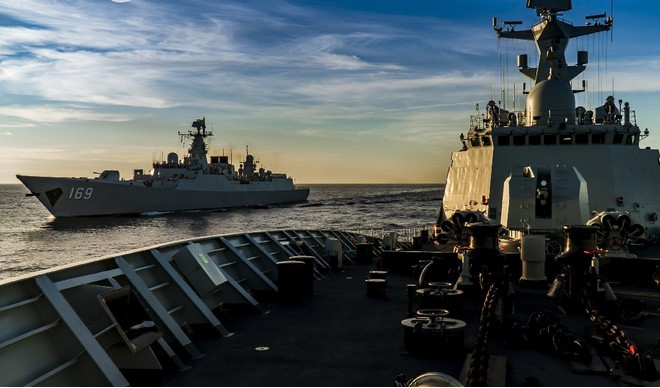
Fears are rising on both sides of the Pacific that the U.S. and China could be headed for a total breakdown of relations and even outright conflict within the next few months.
As the two powers ordered the closure of each other’s consulates in Houston and Chengdu last week amid allegations of espionage, Secretary of State Michael R. Pompeo called for the end of “engagement,” a policy that has defined U.S.-China relations for nearly five decades — and is considered one of the Republican establishment’s most important foreign-policy achievements in recent history.
“We, the freedom-loving nations of the world, must induce China to change,” Pompeo said in a speech delivered Thursday at a pointedly chosen site, the Richard Nixon Presidential Library and Museum in Yorba Linda. Nixon was the first president to reach out to China, in 1972.
The Chinese flag flies behind barbed wire at the Chinese Consulate General in San Francisco. Photo: AFP
A Singapore national on Friday pleaded guilty to using his political consultancy in the United States as a front to collect information for Chinese intelligence, the US Justice Department announced.
Yeo Jun Wei, also known as Dickson Yeo, entered his plea in federal court in Washington to one charge of operating illegally as a foreign agent.
Michael D. Swaine argued in 2019 that:The U.S.-China relationship is confronting its most daunting challenge in the forty years since the two countries established diplomatic ties. Current trends portend steadily worsening relations over the long term, with increasingly adverse consequences for all actors involved. Specifically, Beijing and Washington are transitioning from a sometimes contentious yet mutually beneficial relationship to an increasingly antagonistic, mutually destructive set of interactions. The often positive and optimistic forces, interests, and beliefs that sustained bilateral ties for decades are giving way to undue pessimism, hostility, and a zero-sum mindset in almost every area of engagement.[200]
Washington (CNN)Senior US government officials said Friday that a Chinese scientist who had been hiding in the country’s San Francisco consulate after accusations of visa fraud is now in US custody and also charged that Beijing has been using its diplomatic outposts to run an espionage network to steal intellectual property from US businesses, universities and research centers.Tang Juan, a researcher who said she was focusing on biology, “was a fugitive from justice until last night,” a senior Justice Department official said, but has now been charged in Sacramento.
The circumstances of Tang’s arrest were not clear, but she has not been charged with espionage.US officials made the announcement just hours before Washington’s deadline for Beijing to shutter its consulate in Houston, a move that triggered China to retaliate Friday by demanding the US close its consulate in Chengdu.Prosecutors earlier this week said that Tang concealed her connection to China’s military in order to enter the US, lied to federal investigators about those links and subsequently tried to avoid arrest by taking refuge in the San Francisco consulate.During an interview with FBI agents on June 20, “Tang denied serving in the Chinese military, claimed she did not know the meaning of the insignia on her uniform, and that wearing a military uniform was required for attendance at FMMU because it was a military school,” attorneys wrote in a July 20 court filing.
CHANGSHA, China — The United States has ordered China to close its consulate general in Houston “in order to protect American intellectual property and American’s private information,” State Department spokeswoman Morgan Ortagus said Wednesday.
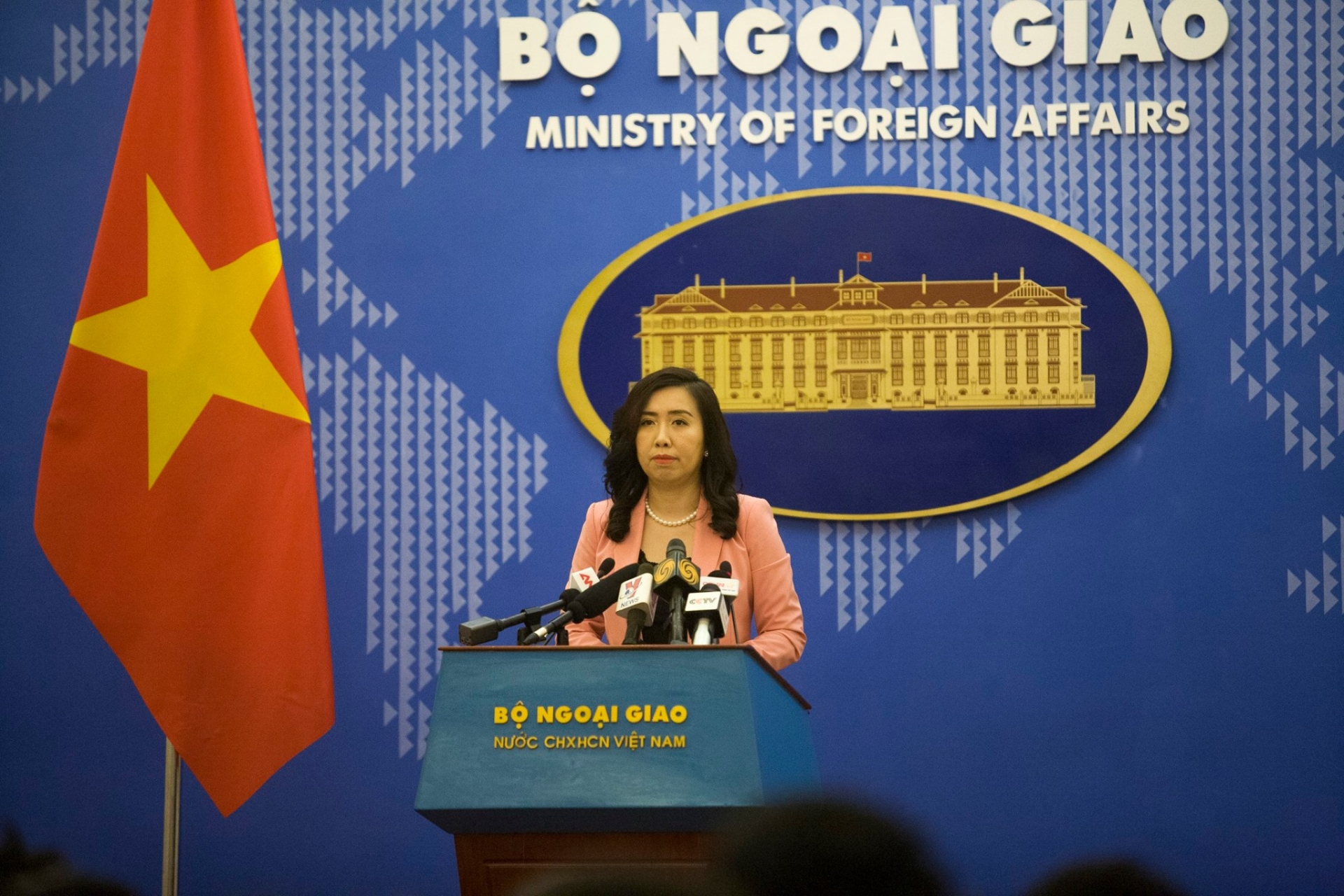
Foreign Ministry spokesperson Le Thi Thu Hang confirmed Vietnam’s stance, at a regular press briefing in Hanoi on July 15, concerning Secretary of State Mike Pompeo’s Declaration on the US Position on Maritime Claims in the South China Sea (known as East Sea in Vietnam).
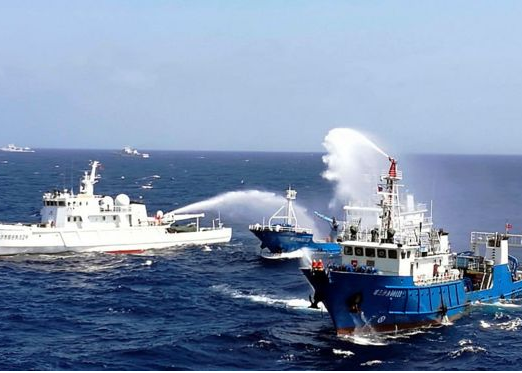
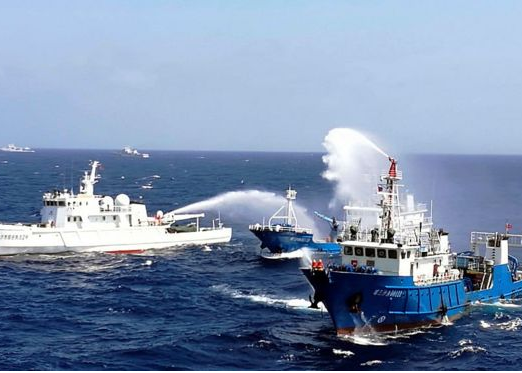
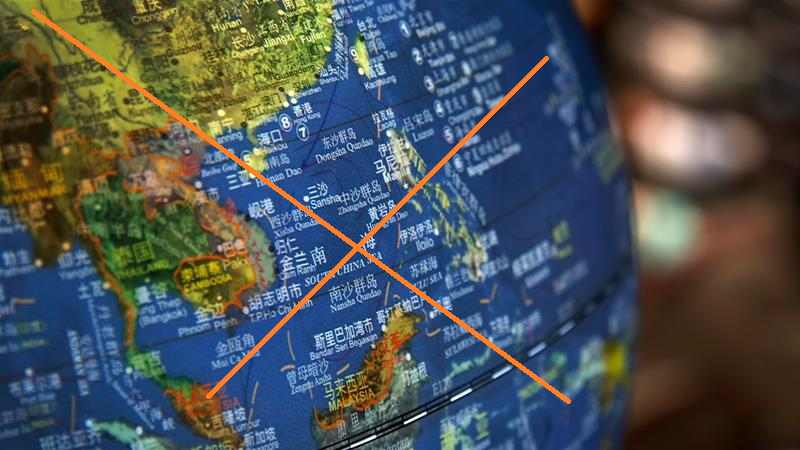
Secretary of United State Mike Pompeo on Monday announced a formal rejection of “most” of China’s maritime claims in the South China Sea, marking the turning point as Washington officially directs to Beijing’s ambition to assert control in the strategic waters.
Chinese maritime claims outside its internationally recognized waters are illegitimate. Photo: Andy Wong/AP
Accordingly, the administration presented the decision as an attempt to curb China’s increasing assertiveness in the region with a commitment to recognizing international law. But it will almost certainly have the more immediate effect of further infuriating the Chinese, who are already retaliating against numerous U.S. sanctions and other penalties on other matters.The Trump administration escalated its actions against China on Monday by stepping squarely into one of the most sensitive regional issues dividing them and rejecting outright nearly all of Beijing’s significant maritime claims in the South China Sea, reported Military Times. Tiếp tục đọc “US rejects nearly all Chinese claims to territory in South China Sea”→

![Australia's Scott Morrison, standing, walks past China's Xi Jinping during the G20 leaders' meeting in Japan last year [File: Lukas Coch via EPA]](https://www.aljazeera.com/mritems/imagecache/mbdxxlarge/mritems/Images/2020/8/5/abeee44e48264f8a84ffe7b27ef8499c_18.jpg "Australia's Morrison says US-China war no longer inconceivable")




![Wang Wenbin says 'malicious slander' is behind US order to close Chinese consulate in Houston, Texas [Ng Han Guan/ AP Photo]](https://www.aljazeera.com/mritems/imagecache/mbdxxlarge/mritems/Images/2020/7/24/a4e742b193d747f5b0ab15870a1ab14f_18.jpg "China orders closure of US consulate in Chengdu")

 CVD
CVD 